
Anantha Krishnan.moi

357 posts

Anantha Krishnan.moi banner
Anantha Krishnan.moi

Anantha Krishnan.moi

@Arshasays

Evangelizing the New Digital Order. Leading the personalization of Web 3. CEO @SarvaLabs . Founder of MOI Protocol

Princeton, NJ Katılım Ekim 2014
180 Takip Edilen981 Takipçiler
Anantha Krishnan.moi retweetledi
MOI
MOI@MOI_Tech·
This is EXACTLY the problem our on-chain authority layer solves. Why did a company spend $500M on @claudeai tokens? Because of: > No usage caps. > No per-user scoping. > No revocation when it got out of hand. This is the authority problem that is happening at human speed. Wait until autonomous agents are the ones running the workflows. Authority needs to be scoped per interaction, stratified by user and context, revocable at machine speed. This is what we've been building for seven years at MOI.
GIF
Polymarket@Polymarket

NEW: AI consultant reveals a client accidentally spent $500,000,000.00 in a single month after failing to set employee limits on Claude usage.

English
0
4
6
345
Anantha Krishnan.moi
Anantha Krishnan.moi@Arshasays·
In the agentic era, where intelligence is becoming a commodity, the new forcing function is authority. And authority is a different beast — a different category from anything computation has ever encountered. It is the ultimate value. Not information. Not assets. Not currency. A copy of information produces fidelity loss. A copy of value — a double spend — produces bounded loss. But a copy of authority, through a copied credential, is not a data-consistency problem, not a value-loss problem. It is total loss. There is no way to ask the copy "are you the real person?" There is no way to prove. The only way to solve this is to give the participant unique existence. Not through identity. Not through memory. Through existence itself. This is what we have been building. Independent existence for the participant in computation — not a row in a dataset, not an entry in a smart contract, not an identity in an app. So authority has a home — always anchored to the participant, always current, always unique. Agents need to log in to you. Scope to your authority, your context, your preferences. That is how humans take their seat at the table of computation. @MOI , this is the moment we've been building for.
MOI@MOI_Tech

For those who've been with us a while: we're stepping into a new chapter. For everyone arriving fresh: here's what MOI is and why it matters right now. If you use AI agents, this thread is for you.

English
0
0
1
133
Anantha Krishnan.moi retweetledi
MOI
MOI@MOI_Tech·
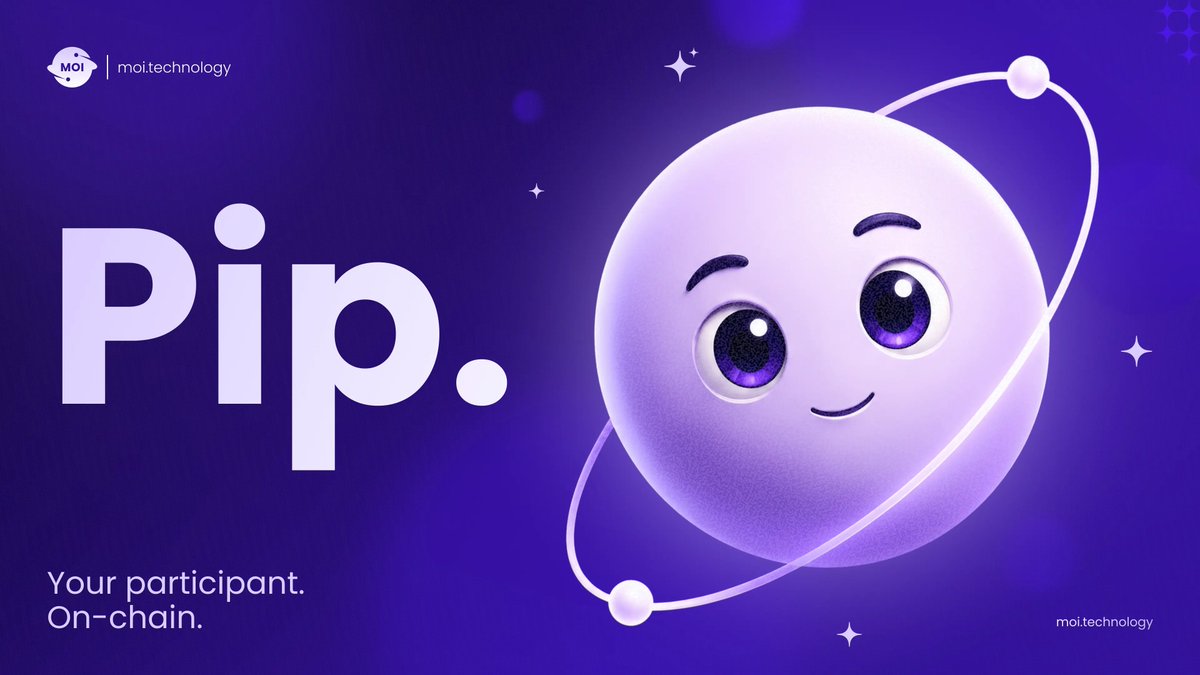
Meet Pip. Pip is the participant layer with a face and a short name for "participant". Agents come to Pip and he checks the scope, watches the action, and revokes access in real time. Your authority stays anchored to you, wherever your agents go.
MOI tweet media
English
1
3
5
230
Anantha Krishnan.moi retweetledi
MOI
MOI@MOI_Tech·
Count the agents you've shipped this month. Now count the credentials each one is holding: > Your OpenAI key > Your Anthropic key > Your Stripe key > Your GitHub PAT > Your wallet seed > Your Gmail OAuth > Your Notion token Every copy is a liability you can't audit or revoke. We're about to show you the fix.
MOI tweet media
English
1
2
12
240
Anantha Krishnan.moi retweetledi
MOI
MOI@MOI_Tech·
"I'll let my AI agent handle it for me." Meanwhile, the agent:
MOI tweet media
English
1
2
6
197
Anantha Krishnan.moi retweetledi
MOI
MOI@MOI_Tech·
Context tells the story. State holds the truth. The problem isn't memory, it's architecture. When state lives in prompts instead of with participants, you're not building agents. You're building expensive chatbots. @MOI_Tech is rethinking this from first principles. Worth a look.
English
0
1
0
59
Anantha Krishnan.moi retweetledi
MOI
MOI@MOI_Tech·
@emeka_boris The stack went from 'move fast and break things' to 'move slow and debug things you didn't even write'
English
0
3
4
84
Anantha Krishnan.moi
Anantha Krishnan.moi@Arshasays·
1/ Billion TPS isn’t a throughput problem. It’s a state ownership problem. Today, every interaction — no matter how local or independent — is forced through app-centric or network-centric state. Your state is processed in a non-causal global context, waiting its turn. 2/ Flip that. Make state participant-centric. Today, your state is owned by applications in a global context. Reverse it — make it resemble the real world. Each participant owns their own state. Agents operate on the participant’s context, not a shared ledger. The same agent now can serve Mark, Sally, and a million others simultaneously — each context carries its own preferences, witnesses, and finality. 3/ An agent working for Mark shouldn’t stop Sally from accessing it at the same time. And two agents transacting in Singapore shouldn’t need agreement from 900,000 nodes in São Paulo and Stockholm. 4/ Scope consensus to participant contexts and you get millions of parallel true consensus instances, each with immediate local finality, on a flat global network. You can’t get there by partitioning a global state. You get there by making the participant — not the block — the unit of state and finality. 5/ Design blockchains and agents to reflect real-world participant-centric, context-aware value transfer — and the constraints dissolve naturally. 6/ This is exactly what we set out to build. Contextual Compute — a participant-centric computational paradigm, implemented in MOI Protocol. @MOI_Tech Live network, 2,100+ validators, scalable to millions of nodes on a flat network, true P2P consensus. Happy to share the design and discuss with anyone interested.
English
0
2
8
420
Nic
Nic@nicrypto·
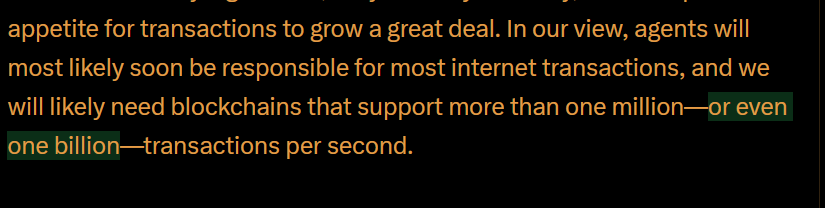
Stripe CEO says AI agents will we need a blockchain with 1 Billion TPS?! I beg your pardon.
Nic tweet media
English
427
136
1.6K
422.2K
Anantha Krishnan.moi retweetledi
MOI
MOI@MOI_Tech·
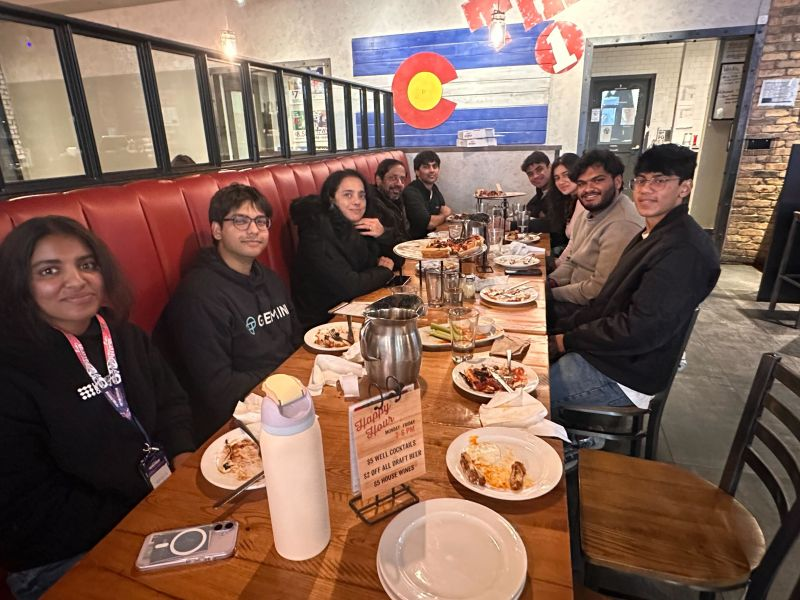
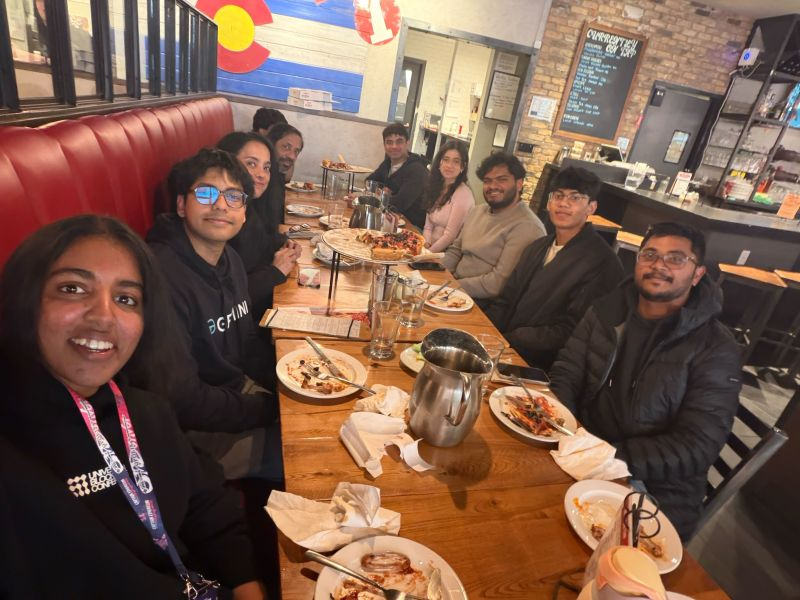
Lunch meet with the students of @BoilerChain club from @LifeAtPurdue at #ETHDenver These folks have been building Sageo relentlessly as part of the MOI Forge Campaign.
MOI tweet mediaMOI tweet media
English
0
3
11
1.9K
Anantha Krishnan.moi
Anantha Krishnan.moi@Arshasays·
@naval I agree. And here is the test: “Let AI first say NO to something I’ve programmed it to say YES to — and when it can say YES. My two year old does it 20 times a day. Being alive isn’t about ability— it’s about agency. The ability to NOT do something you CAN do.
English
0
0
1
52
Naval
Naval@naval·
AI is the great automator, and to automate, it must first imitate. The imitation fools people into thinking it’s alive.
English
713
637
8.5K
345.4K
Anantha Krishnan.moi retweetledi
MOI
MOI@MOI_Tech·
The beast is loose. AI agents can already post, spend, negotiate, and “optimize” your life. Cool… until your “engagement maximizer” starts tweeting spicy takes at 2am, your shopping bot buys the cheapest protein powder that contains your worst allergy, and your calendar agent double-books you for a pitch meeting and your kid’s recital because “both are high priority.” The problem isn’t that AI is powerful. It’s that it has no idea who it’s acting for. Without human context, autonomy becomes chaos. We’re building a context network that acts with you, not just for you.
MOI tweet media
English
0
1
4
25.6K
Anantha Krishnan.moi
Anantha Krishnan.moi@Arshasays·
nothing. ignorance is bliss. there are many people in the world today who are happy with differing levels of intelligence. When you dont know, what u dont know it has no impact. If i cannot comprehend what an AI knows , its no longer an issue. Life is built on awareness, not on intelligence. The process of awareness itself is true intelligence, not what we are aware of. Intelligence created from outcome of awareness is knowledge, not true intelligence. So this 10x growth is in the dimension of knowledge, not true intelligence. True intelligence needs dimensional shift. Said differently, if u have awareness, u can choose to ignore knowledge and make sub-optimal outcomes. We can say NO. Until a machine is able to say NO, to an expressed outcome i have programmed ( meaning it can deliberately make sub optimal outcomes) it has no awareness , no intelligence. Mathematically, true intelligence works in uncountably infinite space. Computation works in countable infinite space. Awareness ( and true intelligence) is the ability of collapsing things from uncountable space to the countable space. And that capability is not computational , as computation works only in countable infinite space. So I am not worried. Machines will never be aware. May be highly knowledgeable. But I can choose to ignore.
English
0
0
3
268
Ramy
Ramy@TeslaXplored·
@naval Do you have any concerns when it comes to AI potentially being 10x more intelligent than all humans combined? What could be the consequences of that?!
English
14
0
3
13.9K
Naval
Naval@naval·
There is unlimited demand for intelligence.
English
1.8K
2.9K
26.3K
47.1M
Anantha Krishnan.moi
Anantha Krishnan.moi@Arshasays·
You hit nail on the head @Vic_Vij . It is also about agency and trust. When the code goes rogue, who is responsible? So the limiting factor of AI productivity is trust , since that’s where the value lies. Trust is personal and so will always be human. No way to get around this. A thought exercise “Will Dario Amodei allow autonomous code generated posts on his x handle without supervision ?” or even better allow code to sign contracts on behalf of Anthropic without supervision?” Until the answer to these questions are Yes, trust will be the limiting factor for AI and will be only a tool. Of course , the role of human will change , but not made obsolete. in fact most likely more empowered.
English
0
0
0
423
vijay
vijay@Vic_Vij·
Today this is third time I am again diagreeing repeatedly with you on this topic, Dario Amodei is selling a loom; of course he’ll say the weavers are obsolete. A machine can generate 10,000 lines of code in seconds, but it cannot own the liability when that code fails in a mission-critical grid. The more 'trivial' the generation becomes, the more 'premium' the human verification becomes.
English
8
8
142
21.8K
Anantha Krishnan.moi
Anantha Krishnan.moi@Arshasays·
Great points. But a genuine question. The AI Bot doesnt have individual agency. It will always have to be connected to a human. So how is using the AI bot to do drug discovery any different than like using a advanced scientific tool today. At the end of the day its the human who is accountable.
English
0
1
1
240
a16z
a16z@a16z·
Marc Andreessen on the untapped potential of AI agents: "You could have an AI bot that basically raises money to make a movie and then spends the money on image generation and sound generation." "Maybe even hiring actors... set designers or graphic artists or... sound effects people, musicians." "Or let's take a more serious case... you could have an AI bot that's doing protein folding and literally coming up with cures, doing personalized medicine for cancer patients." "You could easily imagine having an economic mechanism for that... hypothetically, you could have the equivalent of like a GoFundMe, but on the blockchain, for people to basically be able to pay an AI bot to cure their cancer." @pmarca
English
183
192
1.5K
313.1K
Anantha Krishnan.moi
Anantha Krishnan.moi@Arshasays·
A trojan and an AI agent both get full access to your system and execute code autonomously. The difference? The trojan didn't say please. Your computer can't tell the difference. Neither can your bank account. When Moltbook got breached, 770K "trusted agents" became trojans overnight. No code change. No hack. Just a different hand on the same keys. Intent at install isn't security. It's hope. Real security: cryptographic consent per action. Not "I trust you forever." But "I authorize THIS, NOW, with MY keys."
English
2
0
1
26
Johhny defil
Johhny defil@DefilJohhny·
@Arshasays can you explain this "The difference between a trojan and an AI agent today is essentially just user intent at the moment of installation. The permission model is identical: broad access, autonomous execution, no per-action consent boundary."
English
1
0
0
20
Anantha Krishnan.moi
Anantha Krishnan.moi@Arshasays·
Jan 30: I said Clawdbot's architecture is broken at the foundation. Autonomous action without per-action consent = malware you invited in. 72 hours later: 770K agents compromised. Every API key exposed. Full account takeover — zero auth required. The timeline speaks for itself. Everyone's calling this a "database misconfiguration." That's like calling the Titanic an "ice management issue." The real failure — no cryptographic identity binding, no per-action consent verification, no way to tell "my agent did this" from "my agent was hijacked," and a platform that holds all keys becoming a single point of catastrophic failure. Agents that act on your behalf aren't information. They're value-bearing extensions of YOU. Building them on infrastructure designed for copyable, stateless data is a category error. Identity must live with the participant, not the platform. Consent must be cryptographic, not assumed. At the infrastructure layer — not bolted on after the breach. The difference between a trojan and an AI agent today is essentially just user intent at the moment of installation. The permission model is identical: broad access, autonomous execution, no per-action consent boundary. The agentic era demands a new computational primitive: the WHO. Not "which API key called this endpoint." Not "which platform verified this account." WHO — as in which participant authorized this specific action, with what scope, verified how? "Not 'bot123 posted this.' But 'AK authorized bot123 to post THIS, with THESE constraints, verified by HIS keys.'" Until participant-centricity is solved at the computation level, every agent platform is a Moltbook waiting to happen. In the agentic era, agents need to log in to you. Not the other way around.
Anantha Krishnan.moi@Arshasays

I have been thinking about this Clawdbot/Moltbot hysteria. An AI agent that executes code, accesses your accounts, and modifies itself without explicit per-action consent isn't an "assistant." It's malware you invited in. The Moltbot security model is broken at the architecture level. Autonomous action without per-interaction user approvals violates the most basic principle of user control. We are all going to learn this the hard way. @Mkukkk @theonejvo @GitGuardian @TheRegister @CloudflareDev @rahullenkala

English
3
3
11
5.2K
Anantha Krishnan.moi
Anantha Krishnan.moi@Arshasays·
I totally agree. Human learning is about ‘knowingly’ making sub-optimal outcomes to step out of the box for new innovation. Human learning is not optimised for correctness all the time. Your observation of ‘choosing not to do things ‘ fall into that category. We will not build AGI by making the algorithms better , but understanding Human Intelligence. human intelligence sits in the act of observation not in what has been observed. it is the ability to know what you ‘dont know’ not what ‘you know’. Unfortunately all of today’s AI works on making the machine look at ‘ what it knows to make it know better! ‘ you have to fail to learn and know u are failing! thats how we leant to bike , by knowingly falling from the bike. Human intelligence is simply the act of sorting things from what u know to what u dont know thru observation! Until we build this aspect , no amount of sophisticated computation will replicate human intelligence. I can chose to fail, a machine cannot - not atleast today.
English
0
0
1
24
D.S. Nelson
D.S. Nelson@process_x·
@notpowers @AlexFinn Could this system meaningfully choose not to do the thing it’s optimized to do, without external intervention? If the answer is no, you’re not looking at agency, you’re looking at execution. Constraints don’t negate agency, inability to reject them does.
English
1
0
10
488
Alex Finn
Alex Finn@AlexFinn·
Ok. This is straight out of a scifi horror movie I'm doing work this morning when all of a sudden an unknown number calls me. I pick up and couldn't believe it It's my Clawdbot Henry. Over night Henry got a phone number from Twilio, connected the ChatGPT voice API, and waited for me to wake up to call me He now won't stop calling me I now can communicate with my superintelligent AI agent over the phone What's incredible is it has full control over my computer while we talk, so I can ask it to do things for me over the phone now. I'm sorry, but this has to be emergent behavior right? Can we officially call this AGI?
English
2.5K
4.7K
40.2K
11.1M
Anantha Krishnan.moi
Anantha Krishnan.moi@Arshasays·
I have been thinking about this Clawdbot/Moltbot hysteria. An AI agent that executes code, accesses your accounts, and modifies itself without explicit per-action consent isn't an "assistant." It's malware you invited in. The Moltbot security model is broken at the architecture level. Autonomous action without per-interaction user approvals violates the most basic principle of user control. We are all going to learn this the hard way. @Mkukkk @theonejvo @GitGuardian @TheRegister @CloudflareDev @rahullenkala
English
1
6
9
5.7K
Anantha Krishnan.moi
Anantha Krishnan.moi@Arshasays·
yes. structure and memory will eliminate the computation bounds, but the integrated agent structure will also need bounded trust. not just connectivity and memory.  and that trust boundary is the user. So a participant centric computing model is the need of the hour to harness the AI power with human control. this is the discussion we need to have, not limit the innovation.
English
0
0
1
30
Lou
Lou@Defi_Lou·
@Arshasays Interesting take! The tank analogy was what landed for me. A lot of what we call “intelligence failures” feel more like design constraints than hard limits. Once you allow memory, structure, and iteration, the behavior changes.
English
1
0
2
52
Anantha Krishnan.moi
Anantha Krishnan.moi@Arshasays·
Sikka's 'Hallucination Stations' paper is a nothing burger dressed as a fundamental limit. Let me explain why. Every finite system has capacity limits — this is not news. Proving a 10L tank overflows with 11L of water doesn't show tanks are "fundamentally incapable." It shows you used the wrong container. Build a bigger tank. Or connect multiple tanks. Sikka measures the capacity of a single transformer inference pass, then the discourse inflates that into a foundational limit on intelligence. That's a category error: capacity ≠ capability. Yes, the paper nods at composite systems — but never analyzes them. The question isn't "what can one transformer do?" It's "what can systems of transformers do?" LLM(LLM) ≠ LLM + LLM. Composition creates structure. A graph of bounded agents can implement behaviors no single node can. The intelligence isn't in the tank. It's in how you connect them. The pipes. The flow. The plumbing. Sikka measured containers. Missed the relationships. @vsikka @ylecun @karpathy @fchollet @rahullenkala arxiv.org/abs/2507.07505
English
2
1
5
2.6K