barbarous

6.3K posts

barbarous banner
barbarous

barbarous

@barbarousep

Katılım Kasım 2022
1.6K Takip Edilen646 Takipçiler
barbarous
barbarous@barbarousep·
Humans aren't universal learners - of course it's difficult to recall examples of things we can't learn - but it's very likely that a child of normal hearing will learn to speak and enjoy music, and it's much less likely if they could only experience it through spectrographs. For the same reason, as Cosmides shown in 1985, people can learn rules like "If you are under 18, you can't drink" and "If a man eats cassava root, then he must have a tattoo on his face" very easily - however rules like "If a card is even on one side, it must be blue on the other" is much more fallible (one problem maps onto innate circuitry designed to detect cheaters; the other maps much less clearly onto things like confirmation bias, e.g. circuitry designed to make you look correct rather than be corrected) As for universal learning, it is not important to learn every problem, only the ones you face :)
English
0
0
0
32
Bruce Nielson
Bruce Nielson@bnielson01·
There's a mathematical proof that says no algorithm — no matter how clever, how sophisticated, or how well-designed — can outperform random guessing when averaged across all possible problems. Not A*, not neural networks, not even humans in the loop. Every advantage on one class of problems is paid for, dollar for dollar, somewhere else. It sounds like it should be false. It isn't. Please review the article: the theorem is sound. So you can't just dismiss it. Welcome to the "No Free Lunch Theorem". This raises an interesting question: how can humans be universal learners if this theorem says universal learns are impossible? Make your best arguments here. I hint at one possible resolution to this problem. mindfiretechnology.com/blog/archive/t…
English
77
38
325
30.2K
barbarous
barbarous@barbarousep·
Perhaps a better analogy is neural networks - and the interpretability work going on at large AI labs is showing interesting parallels. The issues with lesion studies are well known and addressed by using multiple converging methods and combining insights from evolutionary processes, which would build specific circuits like a "detect snake induce fear" circuit (sprawling some modularised detection-relevant and fear-relevant locations)
English

0
0
0
44
Max Shen
Max Shen@maxkshen·
there's this idea that specific brain regions 'do' things. 'the amygdala generates fear' or 'prefrontal cortex is responsible for executive function' how do we know this? put people in huge metal detectors and see which parts of their brains get more oxygen during certain tasks you can try to do the same thing with a microprocessor; each transistor is kinda like a neuron, and 'display donkey kong' is kind of like the behavior of a brain. You can then get the average activity ('local field potential') in a specific spatial region, which is similar to fMRI. if you do this, you get confusing conclusions like "this cluster of transistors is responsible for the donkey kong image" if you apply a bunch of other common neuroscience techniques like connectomics, lesion studies, tuning curves, you get a bunch of obviously wrong results like "there are distinct transistor cell-types with different functional roles" when there is only one type of transistor or "this transistor encodes visual brightness" — when really it just happens to correlate in a highly nonlinear way we don't have good models for the brain, but an even deeper challenge is that our tools aren't even adequate for distinguishing between a good and a bad model of the brain
Max Shen tweet mediaMax Shen tweet media
English
12
9
117
6.9K
barbarous
barbarous@barbarousep·
@corsaren On inappropriate dismissals, I find it interesting to see pairings of arguments like: 1. Your abstract theory is an unlikely hypothetical that would not work in the real world and 2. Your answer to this abstract hypothetical actually reveals that you are a true psychopath
English

0
0
1
65
corsaren
corsaren@corsaren·
Okay, so to recap: 1. If you only care about yourself, then pick red 2. If you only care about impartial consequences, then pick red 3. If you care about universalizable maxims, then both work Seems any justification for blue needs to either assume a very specific set of priors, or else posit duties which are rooted in “if everyone would just X” while also explicitly being grounded in a world where everyone cannot be expected to “just X” (hence ruling out red). Tough problem. Me thinks all the pedantic dismissal has been wildly inappropriate. I wonder if integrating over a distribution on the % of people who are “like you” is sensible in any way…
corsaren tweet media
qualia receptacle@neocartesian

which button should absolutely impartial utilitarians press in the red-blue game? i ran the numbers: the answer may surprise you. a thread:

English
39
4
118
18.8K
barbarous
barbarous@barbarousep·
@DanielW_Kiwi Similarly you shouldn't look down on someone just for getting a masters/phd
English
0
0
1
19
Daniel 🦔
Daniel 🦔@DanielW_Kiwi·
Looking down on someone for not going to University is stupid. Looking down on someone for going to University is also stupid
English
14
2
63
1.8K
barbarous
barbarous@barbarousep·
@thewreathwright Hmm I think I agree somewhat, but rotten & vice are somewhat a matter of perspective A comedian's dark humor for example, but also signaling in general is for perceived gain of some sort, so people vice signal when they think there's a group of people who see it as a virtue
English
0
0
0
94
Laurel Weaver
Laurel Weaver@thewreathwright·
the thing about perceived virtue signaling is that it might just be a honest demonstration of virtue but whichever way you slice vice signaling, it’s rotten sincere or not, with only the reason changing
English
2
3
18
847
barbarous
barbarous@barbarousep·
I have a lot of sympathy for this way of thinking too, and I've had a quite similar experience, investing extreme time and attention to being social and more likeable. I think there is also a difference as a straight man dating women, it is quite a jarring how much your interests and ways of thinking are just consistently weird and super incompatible. I was not diagnosed with ASD until last year, and before I understood the condition I coped the same way - oh I am just so smart they don't understand - but this was a bad way of thinking which delayed my understanding of what I was missing. When I read Simon Baron-Cohen's work, it gave me an incredible amount of psychological relief. If only someone could've told me earlier, I would not have spent so many years beating myself up over things. It was not necessarily the label, but understanding the constellation of symptoms and the shared experiences of similar people which ended up curing a whole lot of negative loops. I think whether we keep aspergers and autism separate, or collapse it into ASD, or break it down into 10 different terms, it makes no difference because the label is not the condition. When you understand yourself and the condition, you have the information you need. So why do people care about the label? I can see the point about government help and disability benefits, or to lump people into either "disabled" (and then excuse everything they do) or "normal" (and then we can blame them for all their traits). I can also see how way more people misdiagnose themselves, and join social media communities where they self-perpetuate their feelings of victimhood, creating negative loops rather than trying to get out of them. People also want some sympathy and recognition of their traits and I probably do too to some extent. There is something infuriating about being treated as the odd one out, but when you say "maybe this is why" get told that no they don't think there's anything odd about you at all (what a relief right?) Everyone is abnormal in some way and I don't think it's harmful to point that out. People do that with personality all the time, with more moral weight and less scientific rigor. I see the label debate as a form of friction resulting from technical debt, having locked in misunderstandings of psychology into society, law, and institutions.
English
0
0
3
185
Jack
Jack@tracewoodgrains·
I have a lot of sympathy for Christina here, because I think she's doing something similar to what I do. But her article doesn't quite land. My sister's adolescence was very similar to Christina's, right down to the self-harm and series of psychiatric hospitalizations. An autism diagnosis was a crucial step for her, one that helpfully reframed a lot of her struggles, and a decade down the line she's in her dream job keeping birds professionally and flourishing. (She's happy for me to talk about this stuff, incidentally. Hi "Ava"! Love you♥️) Anyway, at the time of her diagnosis, I wrote this: > Whether or not I am on the spectrum, I'm not interested in finding out. I make plenty of sense to myself, and have figured out who I am well enough without that. It's... odd... to suddenly have that label applied to "Ava," although it does make a certain degree of sense. I don't like how it will change people's reactions to her, though. Much better to consider her as "Ava" than as "girl with ASD". Like Christina, I've never been particularly fond of the autism spectrum. Like my sister and her, I struggled to make friends growing up, felt like an outsider, all that good stuff. And I more-or-less treated it all as a skill issue, threw myself into a Mormon mission where I had to interact with people constantly for better or worse, then joined the military, and emerged with functional skills and a happy life doing the sorts of things I want to be doing. For me, autism meant my friend's younger brother who flapped his hands and never spoke, and Asperger's meant my younger brother's obnoxious antisocial friend. The two seemed, and seem, different in kind, even now that they've merged into a cluster. I found, and find, the way the autism spectrum is diagnosed and clustered to be off-putting and aesthetically wrong. I distrust symptom-based mental health diagnoses; that is, almost all psych diagnoses, because they cluster deficits with disparate explanations together as unified phenomena. And I think there's a real danger of diagnosed people leaning into the behaviors indicated as diagnostic, with those with fewer symptoms turning it into a sort of badge of defiance. And yet. I also think a lot of that is sort of cope. I was defiantly Weird as a kid, and then when I became more aware I started realizing I was systematically irritated by a lot of people who were sort of like me, and I kept looking around and seeing mirrors I didn't really want to be. Memorably, at the start of college, my best friend started a brony club and I went there, looked around, thought "yeah, I don't want to be associated with these people," and dipped. So what's going on with me, and perhaps (if I'm reading right) Christina? Well, I've got an elitist streak a mile wide, I coped with being lonely by emphasizing in my head that it was because I was smarter than everyone else, I saw a lot of tendencies I had that were making my life worse, and I threw myself into environments that fought against those tendencies until I built a functional and happy life. Being diagnosed with anything would have yanked me out of being Me, with my particular strengths and weaknesses and fascinations and irritations, and shoved me into being a Type, and a Type I thought I was better than. Reading Christina, it sounds like she had serious challenges growing up, pushed admirably through them, got really irritated at being a Type and having to deal with a Movement full of people conflating her with things she wasn't and encouraging behaviors she disliked and very much the same sort of things I was raising an eyebrow at in my own way, and – now that she's admirably demonstrated strong capacity and built a happy life, would rather be herself than a Type. I get that, and I think it's basically right, or at least, the same thing I've chosen. A diagnosis would have slotted me into a category I didn't like and didn't want to be in, given me an explanation and an excuse I didn't want, and put up barriers to useful things like joining the military. But Something was going on with me throughout, and however satisfied I am to have remained functional enough and dodged a Category, well, to be honest I just think it's kind of cope to say "I thought I was autistic. I was wrong" instead of "this category of behaviors bugs me, it bugs me to be lumped in with nonverbal people who can't take care of themselves and antisocial people who are unpleasant to be around, and I don't want to be associated with it." It's just that that second case is a lot harder to make without sounding antisocial and unpleasant to be around, y'know?
Christina Buttons@buttonslives

I thought I was autistic. I was wrong. I was 30 in 2019 when stories of women discovering they were autistic all along began appearing everywhere. They popularized a newer understanding of autism, with its own “female presentation.” It was framed as a scientific correction to a historical wrong against women, the kind of narrative the press finds irresistible. Like so many women, I felt immense relief when I was formally diagnosed. It offered an explanation for the mental health crises of my youth and the daily realities of my adult life. Then I spent a year in the online autism community. What I saw there, especially the way activists treated parents of severely impaired children, turned me into a critic of neurodiversity. But it was becoming a journalist in 2022, after discovering detransitioners’ stories, that forced me to question narratives about identity and diagnosis, including my own. Journalism also required the social skills autism says I should have lacked. From there, the rest unraveled: many traits I had come to associate with autism are not uncommon in the general population, but through the “female autism” framework, they looked like a meaningful pattern. I don’t think my story is unique. The same incentives that kept my diagnosis intact may also help explain why so many women are entering the autism category in adulthood. Read my first article for @thefp: thefp.com/p/i-thought-i-…

English
23
8
225
33.4K
barbarous
barbarous@barbarousep·
I think that gets to the heart of it, you can either do this with the idealistic "rational actor" model or the vibes based "I'll cooperate in the blind prisoner's dilemma" way (because we evolved to under societal and reputation pressures) But at the end of the day it is a weird contrived hypothetical, an ideal scenario to pit game theory's fundamental assumption (rational self interest) against one of our evolved faculties (altruism for likely benefits), generating lots of engagement
English
1
0
1
14
Mik Happy
Mik Happy@KingPStream·
@CovfefeAnon You misunderstood why people pick blue. People know there will be innocent folk who pick blue. If they pick blue, it decreases the odds that they will die. Your argument only makes sense in an ideal world, but the world is not ideal
English
1
0
1
116
Covfefe Anon
Covfefe Anon@CovfefeAnon·
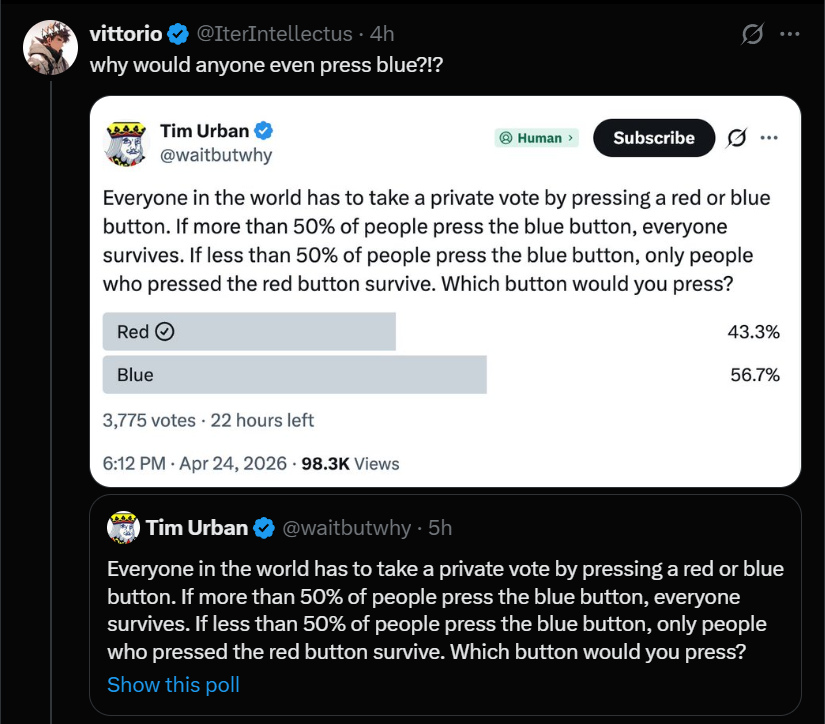
This twitter classic "red button / blue button" [everyone who picks blue dies unless more than 50% do; everyone who picks red lives] question is cursed but we've learned a lot about people since it went around on the timeline the last time First to get this out of the way - there is zero actual reason to push blue - none - there is no "payoff to cooperation" being modeled since the payoff on offer - not dying - is the same for both choices. The only rational reason to pick blue is that you *hope* less than 50% of people pick blue so you can end your life and escape the person who is putting you in contrived hypotheticals for his own amusement With that out of the way - what we've learned in the 2 years since this hit the timeline the first time is that many, many people are simply next token predictors and when they see this example they say they will pick the "cooperative" choice (which isn't actually that!) We have also learned that when confronted with the stupidity of this position, they will simply costlessly double down and "argue" about it forever rather than admit error Really, the question is extremely revealing
Covfefe Anon tweet media
vittorio@IterIntellectus

why would anyone even press blue?!?

English
407
148
2.7K
221.1K
barbarous
barbarous@barbarousep·
I was thinking it is 100% of success because if you commit to doing something 100 times it is guaranteed you will learn something useful. The post itself is a great success; it went viral, it was funny, and I learned about 1 - (1-1/n)^n -> (1-1/e) ≈ 0.63 (chance of 1 success in n tries for something with 1/n odds always converges to around 63%) The other thing is of course the payoff and the famous Bezos quote. Business is unlike the slot machine; 1 success might pay for 1000 tries
barbarous tweet media
English
1
0
1
16
Mik Happy
Mik Happy@KingPStream·
@LeilaHormozi Honestly, reasonable people just steelmanned you originally lol. It's no biggie but yeah
English
1
0
1
82
Leila Hormozi
Leila Hormozi@LeilaHormozi·
Community Note is right. It's ~63%, not 100%. Somehow I’ve managed to function and become successful in business despite being atrociously bad at math. lol. not a secret you can ask my team. Here's what I meant to say: 1 attempt = 1% odds. 100 attempts = 63% odds. 500 attempts = 99.3% odds. Persistence doesn't guarantee success. It does compounds your probability until the math is eventually on your side. And now we know that the worse you are at math…. the less time it takes🫣😂😅
Leila Hormozi@LeilaHormozi

Becoming successful is not luck. It’s math. If your probability of success is 1/100 and you try 100 times, you have a 100% chance of success.

English
156
47
2K
219.6K
Tom Davenport
Tom Davenport@TomDavenport·
@RokoMijic who concieved Roko's Basilisk @deepfates is a good bridge to the ai/tpot scene @sebkrier deep mind staff yet independent thinker No doubt you know @elder_plinius but basically Columbus of latent space @nptacek underrated explorer @chrisgpt great for new model capabilities @ClaireSilver creative AI queen @natived_ like a digital dali @rationalaussie on economics of ai change @barbarousep, @suntzugi, @thrialectics share some good weird ideas, many in this category i could pick
English
4
0
21
1.3K
Graham Linehan
Graham Linehan@Glinner·
Who are the best people on AI on here? I mean thinkers and nerd philosopher types rather than creatives (but that too if anyone's doing anything interesting)
English
76
3
61
13.5K
barbarous
barbarous@barbarousep·
@DaveShapi On "usefulness" - billionaires that earned their wealth through entrepreneurship or financial management produced great market value for society. This argument would start with those that married, inherited, "won the lottery", or got wealthy through oligarchy
English
0
0
0
15
David Shapiro (L/0)
David Shapiro (L/0)@DaveShapi·
Billionaires should not exist Let me explain, hear me out It has nothing to do with economics or equality It's all about hedonic adaptation It's about indulgence escalation The more power any human has, the more they can indulge in whatever they want, and insulate themselves from consequences Human neurology is simply not calibrated for this And very soon, the combination of Internet, blockchain and AI will allow us to coordinate mega projects at scale without elites to coordinate In other words, elites will not need to exist And from an evolutionary standpoint, we shouldn't allow them to exist Just throwing this out to see if it sticks. I'm not fully sold on this idea. But I want to discuss it Thoughts?
English
418
66
643
38.2K
barbarous
barbarous@barbarousep·
@johnloeber @devahaz Would you be able to hire a different janitorial company if you are unhappy with their services, or does the building restrict this? If it's the latter, it might explain them not giving a single f about customers; they are already cozy with building management.
English
0
0
0
3
John Loeber 🎢
John Loeber 🎢@johnloeber·
@devahaz Notably, this is not the building's fee, this is from a separate janitorial company that the building contracts. So this is a service that presumably they are commercially offering to other tenants in the building and getting paid.
English
4
0
29
4.1K
John Loeber 🎢
John Loeber 🎢@johnloeber·
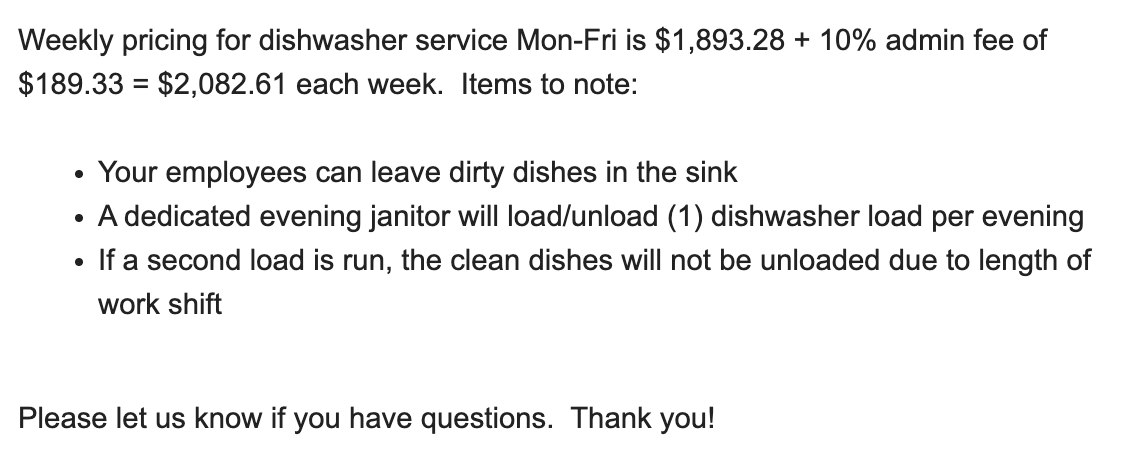
I asked my office building if the janitors (included in rent) could please also load/unload the dishwasher in the evening They have provided me a quote of $2,082.61 per week, which annualizes to about $104K/year. I could hire a whole full-time team of dishwashers at this rate
John Loeber 🎢 tweet media
English
129
8
1.8K
154.3K
Jeremy Kauffman 🦔🌲🌕
Jeremy Kauffman 🦔🌲🌕@jeremykauffman·
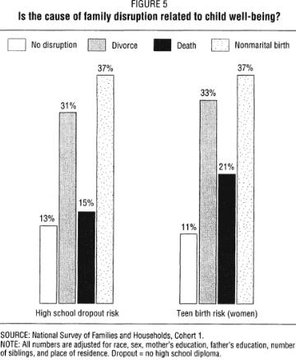
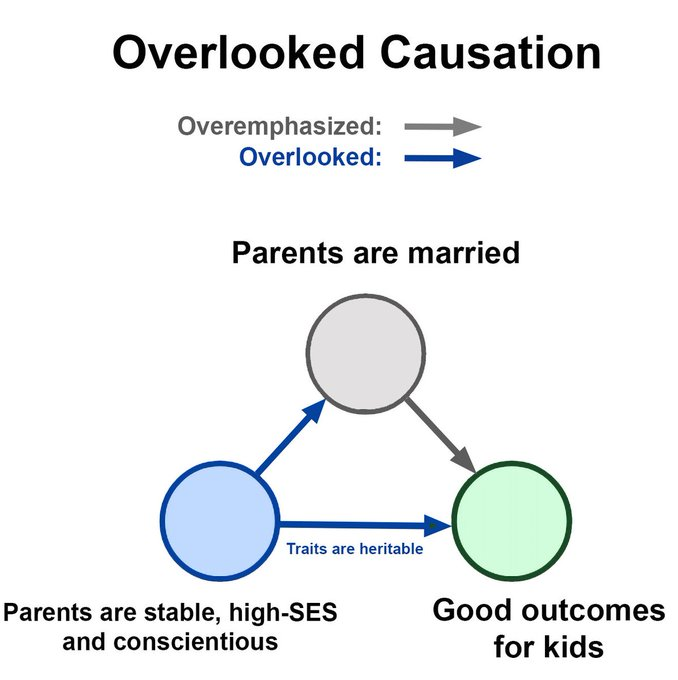
The idea that men abandoning their children is the primarily driver of criminality is a myth. When a father dies due to an accident, child outcomes are much closer to two parent households.
Jeremy Kauffman 🦔🌲🌕 tweet mediaJeremy Kauffman 🦔🌲🌕 tweet media
Fountainhead Forum@FountainheadFm

@jeremykauffman You take lots of pride in being a father, and you should. Is there a reason why you don't talk about children not having fathers? We need a sex war in this country a lot more than we need a race war. And all this race-war nonsense is a dangerous distraction.

English
58
119
1.8K
64K
barbarous
barbarous@barbarousep·
So if I understand what you're saying - group selection provided a boost to individual selection that, when they work in the same direction (as in stag hunt) created a stronger evolutionary pressure in combination, evolving traits faster and to higher intensity. But you are not saying it created adaptations that are impossible via individual selection, such as celibate monks who are better explained as byproducts/noise in evolutionary terms. To prove this, we have to model a deviance from the expected speed of evolution of a trait. Do we have such model or proof?
English
0
0
0
9
Jonatan Pallesen
Jonatan Pallesen@jonatanpallesen·
If it's a Stag Hunt, within group is the same direction; that's the point. What else does it predict? A lot. The whole status system in humans, where people are assigned status for doing or producing things that are seen as valuable for the tribe, for example. Many things that are core to human psychology.
English
1
0
1
51
Jonatan Pallesen
Jonatan Pallesen@jonatanpallesen·
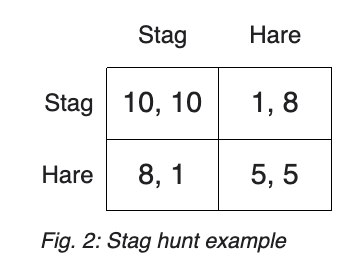
Many people tend to be skeptical of group selection in humans. This may be because they think too much in terms of the more famous Prisoner’s Dilemma, rather than the similar game-theoretic dilemma known as the Stag Hunt. In the Stag Hunt, each player receives a larger reward if both cooperate than if either defects. Mutual cooperation allows the players to hunt the stag, which provides a larger payoff to both. This makes cooperation a Nash-stable strategy. Over evolutionary history, human groups could have become locked into such stable equilibria of eusocial behavior, and groups that did so would have outcompeted those that did not.
Jonatan Pallesen tweet media
English
11
5
159
11.2K
barbarous
barbarous@barbarousep·
I believe there's no argument about it being theoretically possible, which was granted by Maynard Smith. The questions are whether: 1. the conditions that favored group selection were present and enduring in human evolutionary history 2. these produced specific adaptations I think if we grant that "adaptation" need not meet the high bar of Williams, Tooby & Cosmides e.g. complex, reliably developed, specific function solving... In that case, something like religion (or trait religiosity) could be seen as a group level adaptation that allowed for higher fertility, trust, and with lower costs & tradeoffs. I have no problem granting that it might be a group selected adaptation, and the argument for that is the best that I've seen - especially because they allow non-kin cooperation, trust in anonymous PDs and larger group formation, and promote group stability and fertility. But this is an extremely measured group selection argument. It is still constrained by within-group selection being less intense or in the same direction, leaving the door open for individual/sexual/kin selection explanations. I don't think celibate monks & nuns are explainable the same way. And what else does it predict?
English
1
0
1
26
Jonatan Pallesen
Jonatan Pallesen@jonatanpallesen·
Yes. Beyond kin selection. Let me try this: Lets say we have three groups. One of them acquire a culture that increases stag hunt cooperation outcomes. Remember that stag hint has two stable equilibria, and mutual non-cooperation is another one. Thats where the other two groups are. Over time there is gene-culture coevolution in this group, that increases genetic variants for cooperation in stag hunt as well. Eventually the whole group has much better stag hunt cooperation than the two other groups. As a result it outcompetes and replaces them. This is group selection.
English
2
0
0
443
barbarous
barbarous@barbarousep·
@jonatanpallesen would you say that group selection was something that occurred & created evolutionary psychological adaptations, beyond kin selection? Otherwise the debate here is that they are treated as basically the same, and kin selection is much more parsimonious. Stag hunt does not even require kin selection when it is selfishly beneficial. Reciprocal altruism can already explain it. Hence the focus on the "altruism" requirement in PD - proposed adaptations that aren't explainable by individual or kin-selection would generally be ones that discount kin & self in favor of the group
English
1
0
0
25
۟
۟@dronedoommetal·
I'm not suicidal but this hurts and I am going to kell myself
۟ tweet media
English
679
3.5K
58K
9.7M
barbarous
barbarous@barbarousep·
Aside from all the science and replicability on the matter, if the argument is that technology is harmful because of the communication of social trends which are harmful, I don't see how restricting technology will fix that. The rest of society is technology enabled, and we're all consuming the hyperoptimized memes, and people think little of social trends when in them. From a Nash POV, taking your kids social media away while everyone else keeps theirs is clearly going to be an individual disadvantage.
English
1
0
1
10
barbarous
barbarous@barbarousep·
@DavidPasko_ @hoovlet I assume you are referring to Vedel, 2017 - did this lump "economics" in with MBAs?
barbarous tweet media
English
0
0
0
2
David Pasko
David Pasko@DavidPasko_·
@hoovlet I didn't read the paper so my off hand comment would be they are lying. Or, predators.
English
1
0
0
163
steve hsu
steve hsu@hsu_steve·
I have high-g aspie friends to whom this is obvious, but most normies are reluctant to admit the following: Nice guys finish last. The group of people who make it to the top is heavily enriched with sociopaths, frauds, grifters, etc. Epstein correspondence reads like a who's who of this group circa 1990-2010s. Note: "heavily enriched" means represented far beyond their population fraction. For example, people in the top 1% for sociopathy and grift might make up 10% of big winners. Top 5% for sociopathy might make up 50% of super elites, etc. infoproc.blogspot.com/2011/06/on-emp… ... While patients with Williams syndrome often have abnormal proficiency in verbal skills, they do not perform better on verbal tasks than average. This syndrome is characterized more by a deficiency in other areas of processing. [Glib, but often mildly retarded.] I would guess that "neurotypicals" strike aspies the way that Williams sufferers strike the rest of us. Imagine how disturbing it must be to live in a society dominated by and structured around people so different from yourself. infoproc.blogspot.com/2021/08/traged… There is more of a late-stage imperial decline feel to Afghanistan and Iraq -- use of mercenaries, war profiteering, etc. -- than in Vietnam. All of these wars were tragic and unnecessary, but there really was a Cold War against an existential rival. The "war on terrorism" should always have been executed as a police / intel activity, not one involving hundreds of thousands of US soldiers. All of this is (in part) an unavoidable cost of having intellectually weak leaders struggling with difficult problems, while subject to low-information populist democracy (this applies to both parties and even to "highly educated" coastal elites; the latter are also low-information from my perspective). This situation is only going to get worse with time for the US. BTW, I could describe an exactly analogous situation in US higher ed (with which I am quite familiar): leaders are intellectually weak, either do not understand or understand and cynically ignore really serious problems, are mainly concerned with their own careers and not the real mission goals, are subject to volatility from external low-information interest groups, etc.
English
41
50
533
40.6K
M.Á
M.Á@rezfszubagoly·
@gen0m1cs Askenáziakat ne keverjük magyarokkal :)
Magyar
1
0
0
355
gen0m1cs
gen0m1cs@gen0m1cs·
“Is this Hungarian racism?”
gen0m1cs tweet media
English
5
1
103
9K