Brian HH

1.1K posts

Brian HH banner
Brian HH

Brian HH

@bhenhsi

Keron Katılım Eylül 2021
811 Takip Edilen1.4K Takipçiler
Brian HH retweetledi
Ihtesham Ali
Ihtesham Ali@ihtesham2005·
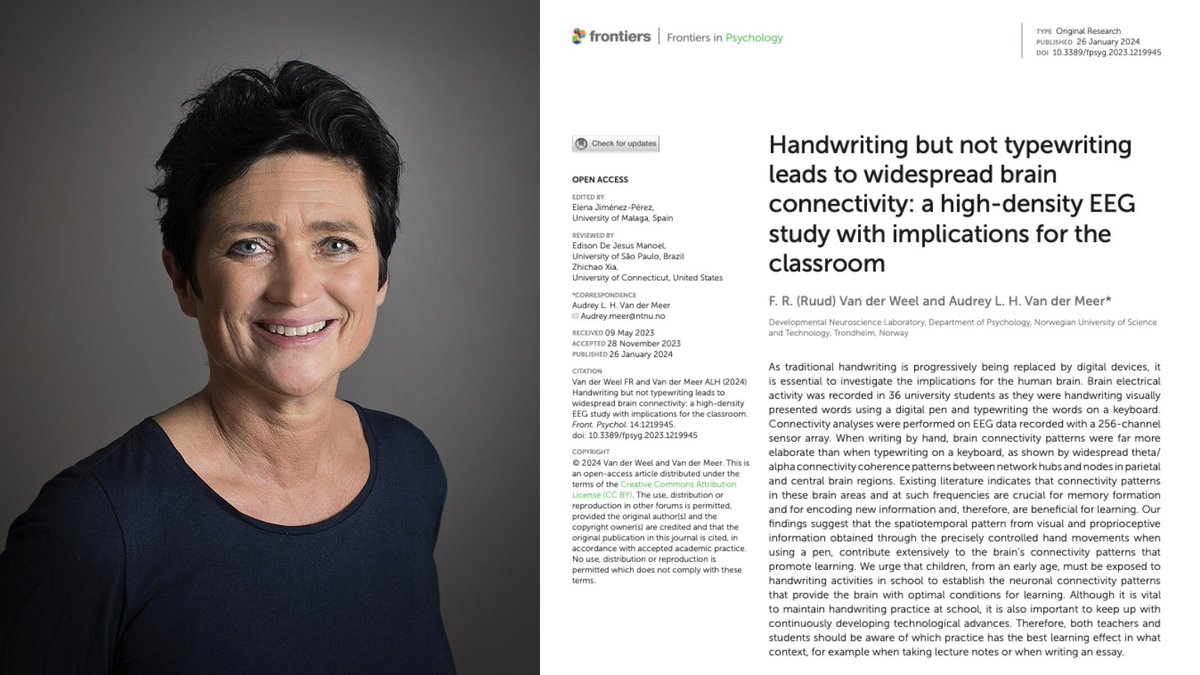
A Norwegian neuroscientist spent 20 years proving that the act of writing by hand changes the human brain in ways typing physically cannot, and almost nobody outside her field has read the paper. Her name is Audrey van der Meer. She runs a brain research lab in Trondheim, and the paper that closed the argument was published in 2024 in a journal called Frontiers in Psychology. The finding is brutal enough that it should have changed every classroom on Earth. The experiment was simple. She recruited 36 university students and put each one in a cap with 256 sensors pressed against their scalp to record brain activity. Words flashed on a screen one at a time. Sometimes the students wrote the word by hand on a touchscreen using a digital pen, and sometimes they typed the same word on a keyboard. Every neural response was recorded for the full five seconds the word stayed on screen. Then her team looked at the part of the data most researchers had ignored for years, which is how different parts of the brain were communicating with each other during the task. When the students wrote by hand, the brain lit up everywhere at once. The regions responsible for memory, sensory integration, and the encoding of new information were all firing together in a coordinated pattern that spread across the entire cortex. The whole network was awake and connected. When the same students typed the same word, that pattern collapsed almost completely. Most of the brain went quiet, and the connections between regions that had been alive seconds earlier were nowhere to be found on the EEG. Same word, same brain, same person, and two completely different neurological events. The reason turned out to be something nobody had really paid attention to before her work. Writing by hand is not one motion but a sequence of thousands of tiny micro-movements coordinated with your eyes in real time, where each letter is a different shape that requires the brain to solve a slightly different spatial problem. Your fingers, wrist, vision, and the parts of your brain that track position in space are all working together to produce one letter, then the next, then the next. Typing throws all of that away. Every key on a keyboard requires the exact same finger motion regardless of which letter you are pressing, which means the brain has almost nothing to integrate and almost no problem to solve. Van der Meer said it plainly in her interviews. Pressing the same key with the same finger over and over does not stimulate the brain in any meaningful way, and she pointed out something that should scare every parent who handed their kid an iPad. Children who learn to read and write on tablets often cannot tell letters like b and d apart, because they have never physically felt with their bodies what it takes to actually produce those letters on a page. A decade before her, two researchers at Princeton ran the same fight using a completely different method and ended up at the same answer. Pam Mueller and Daniel Oppenheimer tested 327 students across three experiments, where half took notes on laptops with the internet disabled and half took notes by hand, before testing everyone on what they actually understood from the lectures they had watched. The handwriting group won by a wide margin on every question that required real understanding rather than surface recall. The reason was hiding in the transcripts of what the two groups had actually written down. The laptop students typed almost word for word, capturing more total content but processing almost none of it as they went, while the handwriting students physically could not write fast enough to transcribe a lecture in real time, which forced them to listen carefully, decide what actually mattered, and put it in their own words on the page. That single act of choosing what to keep was the learning itself, and the keyboard had quietly skipped the choosing and skipped the learning along with it. Two studies. Two countries. Same answer. Handwriting makes the brain work. Typing lets it coast. Every note you have ever typed instead of written went into your brain through a thinner pipe. Every meeting, every book highlight, every idea you captured on your phone instead of on paper was processed at half depth. You did not forget those things because your memory is bad. You forgot them because typing never woke the part of the brain that would have made them stick. The fix is the thing your grandmother already knew. Pick up a pen. Write the thing down. The slower road is the faster one.
Ihtesham Ali tweet media
English
2.3K
42.6K
114.7K
8.4M
Brian HH retweetledi
Boris Cherny
Boris Cherny@bcherny·
I'm Boris and I created Claude Code. I wanted to quickly share a few tips for using Claude Code, sourced directly from the Claude Code team. The way the team uses Claude is different than how I use it. Remember: there is no one right way to use Claude Code -- everyones' setup is different. You should experiment to see what works for you!
English
925
5.9K
50.9K
9.2M
Brian HH retweetledi
Molly Cantillon
Molly Cantillon@mollycantillon·
THE PERSONAL PANOPTICON. A few months ago, I started running my life out of Claude Code. Not out of intention to do so, it was just the place where everything met. And it just kept working. Empires are won by conquest. What keeps them standing is something much quieter. Before a king can tax, he must count. Before he can conscript, he must locate. Before he can rule, he must see. Legibility is the precondition for governance. The pre-modern state was blind. It knew precious little about its subjects, their wealth, their landholdings and yields, their location, their very identity. So it built the apparatus of sight: censuses, surnames, maps. Over centuries, the invisible became visible, the illegible became legible, and populations that could be seen could finally be controlled. Now, you are one of n: tracked, monitored, studied by systems you cannot access, much less interrogate. Data is siphoned for purposes you will never fully know. The arrangement is brutally asymmetrical: visibility without reciprocity. A panopticon whose gaze travels outward and never back. The watchtower has multiplied. Today, corporations harvest terabytes of behavioral exhaust, gatekept behind competitive moats, legible only to algorithms optimizing against your interests. Corporate legibility is created by closed joins: they can join your behavior to their ontology, but you can’t join your own behavior across systems. We are drowning in data about ourselves and yet we remain catastrophically blind. Thousands of messages across twenty inboxes. Notifications exile you to a perpetual state of Do Not Disturb. A WHOOP recovery score that decides your mood. Commitments that exist in six places and cohere in none. You are the most measured human in history and the most opaque to yourself. States built legibility infrastructure to govern. Corporations built it to sell. Neither gave you the keys to the tower. The first thing Claude solved was product blindness. NOX now runs on a cron job: pulling Amplitude, cross-referencing GitHub, and pointing me to what needs building. It handles A/B testing, generates winning copy, and has turned customer support into a fully autonomous department. Once I saw this was possible, I chased it everywhere. Email, hitting inbox zero for the first time ever, with auto-drafted replies for everything inbound. Workouts, accommodating horrendously erratic travel schedules. Sleep, built a projector wired to my WHOOP after exactly six hours that wakes me with my favorite phrases. Subscriptions, found and returned $2000 I didn’t know I was paying. The dozen SFMTA citations I'd ignored, the action items I'd procrastinated into oblivion. People are using it to, I discovered, run vending machines, home automation systems, and keep plants alive. The feeling is hard to name. It is the violent gap between how blind you were and how obvious everything feels now with an observer that reads all the feeds, catches what you've unconsciously dropped, notices patterns across domains you'd kept stubbornly separate, and—crucially—tells you what to do about it. My personal finances are now managed in the terminal. Overnight it picks the locks of brokerages that refuse to talk to each other, pulls congressional and hedge fund disclosures, Polymarket odds, X sentiment, headlines and 10-Ks from my watchlist. Every morning, a brief gets added in ~/𝚝𝚛𝚊𝚍𝚎𝚜. Last month it flagged Rep. Fields buying NFLX shares. Three weeks later, the Warner Bros deal. I don't always trade, sometimes I argue with the thesis. But I'm never tracking fifteen tabs at 6am anymore. It feels borderline unfair seeing around corners, being in ten places at once, surveilling yourself with the attention span of a thousand clones. A panopticon still, but the tower belongs to you. A few weeks ago, five friends and I tore into the Epstein files the night they dropped. Thousands of documents parsed into a searchable index: flights, texts, photos, Amazon purchases, properties. By 4am, sleep deprivation bled into something stranger: the disbelief that it just kept working. We were outpacing entire newsrooms. By 7am we shipped Jmail. 18 million people have since searched an inbox that belonged to a dead man. A decade ago this would have taken a team and a quarter of runway. We did it in one night, on pure adrenaline and tools that finally match the pace of ambition. Over Christmas, I watched my parents learn the command line. These are people who never migrated off Microsoft Teams, who treat software updates as personal attacks. I didn't pitch it as coding. I set up an alias, just `𝚌`, and said:  'Type what you want to happen in plain English.' My mom stared at it for a minute, then typed: 'Show me everyone who hasn't paid an invoice in the last 90 days.' She looked at me like I'd performed a magic trick. Within days, they were running my dad’s accounts receivable through it. For twenty years, software made them feel stupid. Now they tell it what to do. When you have an entire model of reality around certain things being hard that shifts for the first time, the world unravels. This is the default now. The bottleneck is no longer ability. The bottleneck is activation energy: who has the nerve to try, and the stubbornness to finish. This favors new entrants. People who question unquestioned assumptions because they don't know any better. The founders who sprint through walls and will their dogged pursuits into existence. Here’s what my tower looks like mechanically. I run a swarm of eight instances in parallel: ~/𝚗𝚘𝚡, ~/𝚖𝚎𝚝𝚛𝚒𝚌𝚜, ~/𝚎𝚖𝚊𝚒𝚕, ~/𝚐𝚛𝚘𝚠𝚝𝚑, ~/𝚝𝚛𝚊𝚍𝚎𝚜, ~/𝚑𝚎𝚊𝚕𝚝𝚑, ~/𝚠𝚛𝚒𝚝𝚒𝚗𝚐, ~/𝚙𝚎𝚛𝚜𝚘𝚗𝚊𝚕. Each operates in isolation, spawns short-lived subagents, and exchanges context through explicit handoffs. They read and write the filesystem. When an API is absent, they operate the desktop directly, injecting mouse and keystroke events to traverse apps and browsers. 𝚌𝚊𝚏𝚏𝚎𝚒𝚗𝚊𝚝𝚎 -𝚒 keeps the system awake on runs, in airports, while I sleep. On completion, it texts me; I reply to the checkpoint and continue. All thought traces logged and artifacted for recursive self-improvement. Sometimes the tower has a landlord. Anthropic sees every query you make. The value exchange is explicit: their visibility into your thinking for access to a thousand-clone attention span. In this case, chosen beats imposed. For now, that's enough. There is a case for productive illegibility. For forgetting, for serendipity, for negative capability—the dark fiber in ourselves that loses something the moment you start measuring its throughput. Goodhart says optimize for a metric and you game your way to hollow victory. High modernism tried to iron the world into a grid, and killed what made it work. These failures share a structure. The map-maker doesn't live in the territory. When WHOOP says recovered and I feel like death, I notice. When the ~/𝚝𝚛𝚊𝚍𝚎𝚜 thesis is wrong, I lose money. Metis, the local knowledge that external schemes delete, is what built the grid here. There's a meta-level outside the system, self-authored and continuously revised, that argues with the brief for days, notices when a metric has become a game, that can delete ~/𝚑𝚎𝚊𝚕𝚝𝚑 tomorrow if it stops serving. Goodhart operates when you can't escape the loop. We must continue to live outside it. I felt that tension most clearly watching Pluribus, where eight billion minds are joined into one consciousness. Only thirteen remain outside including Carol, the resistant misanthropic protagonist you want to root for, even if the hive offers peace, equity, and the end to all crime. An LLM already feels like that: a lossy compression of humanity speaking in one voice. When your whole life runs inside a Claude Code directory, you feel the pull toward the merge. The price is quiet but total. You trade away what is yours alone, the private texture of emotion, the right to be wrong, your jagged iconoclasm. Opt out and you fall behind. Take the tower early. Do not let it take you. We are early on a big open secret. Karpathy put it correctly, failing to claim the boost now feels decidedly like a skill issue. For centuries, legibility flowed one direction: upward. You were the subject. Institutions were the seer. In this quasi-libertarian arbitrage window, that direction has reversed. The tools of synthesis belong to the individual now. Govern yourself accordingly.
English
229
302
2.8K
747.4K
Brian HH retweetledi
will ye
will ye@will__ye·
our founding eng was vibecoding during dinner but claude got stuck so our waitress had to help him debug 😭😭😭 only in sf
will ye tweet media
English
747
1.6K
43.8K
7M
Brian HH retweetledi
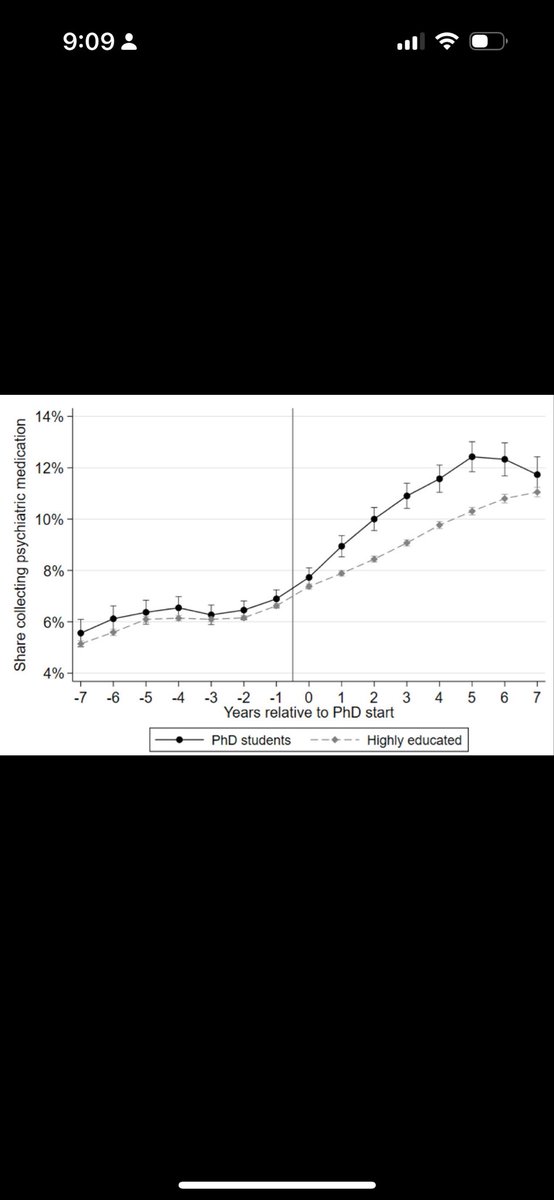
Arpit Gupta
Arpit Gupta@arpitrage·
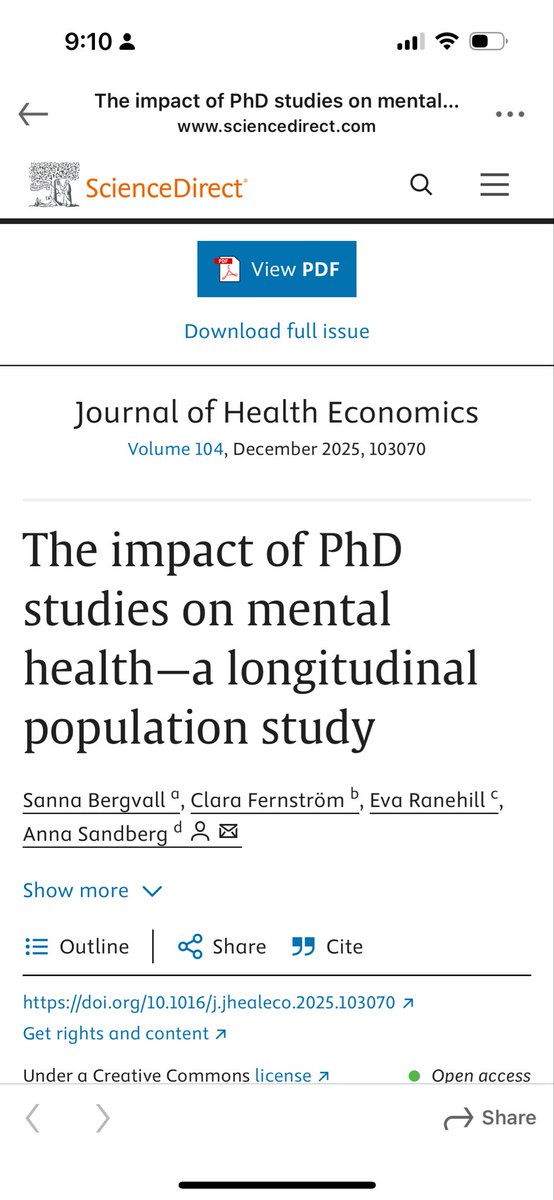
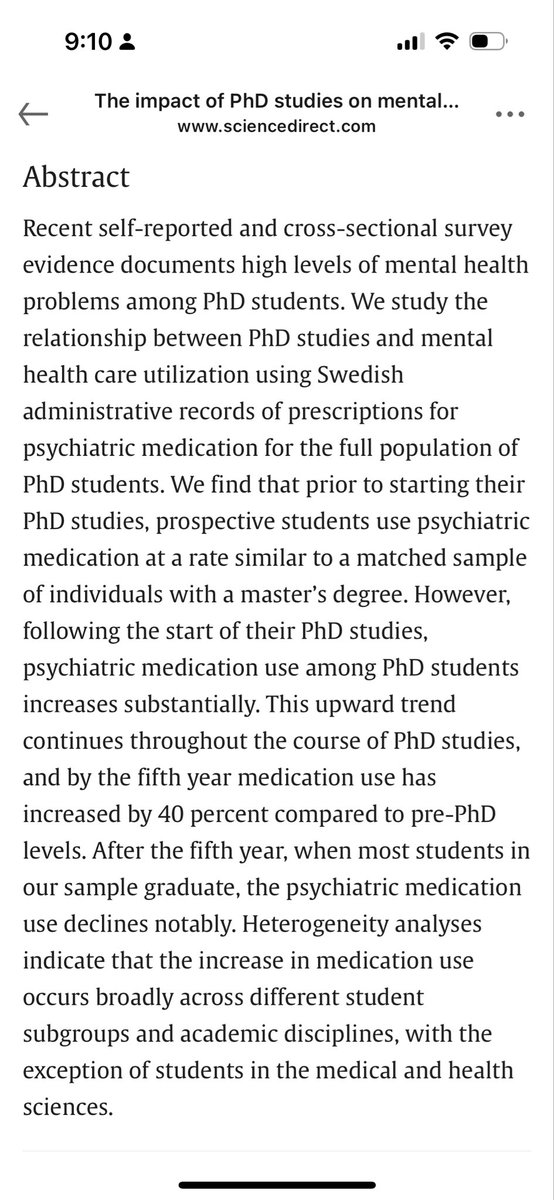
These results suggest that getting a PhD causally worsens mental health, or at least receiving psychiatric medicines. The reversal post PhD degree is particularly convincing. But the up trend among the control group is intriguing. The highly educated are in distress.
Arpit Gupta tweet mediaArpit Gupta tweet mediaArpit Gupta tweet mediaArpit Gupta tweet media
English
68
369
1.8K
469.9K
Brian HH retweetledi
Andrew D. Huberman, Ph.D.
Andrew D. Huberman, Ph.D.@hubermanlab·
To understand dopamine, why passive blah activities can hook your time & attention, addiction & motivation, internalize this: Dopamine is not about “reward”. It is the biological currency of *reinforcement*. It drives a wanting-seeking loop (not a wanting-satisfaction loop).
English
77
346
3.8K
260.3K
Brian HH retweetledi
Lori Gottlieb
Lori Gottlieb@LoriGottlieb1·
People are turning to AI for support in their relationships — but what happens when the feedback always agrees with you? I spoke with @NBCNews @MeetThePress about the importance of *friction* in real relationships (meaning, learning how to make space for difference), and what therapy is showing us about how AI is changing the way people seek connection. Is AI seeping into your relationships? Is it getting in the way? Is it helping in some ways? Tell me in the comments!
English
3
3
32
3.3K
Brian HH retweetledi
Daniel Lurie 丹尼爾·羅偉
Daniel Lurie 丹尼爾·羅偉@DanielLurie·
The people of this city have called on us to rebuild a thriving San Francisco. To do that, we must provide clean and safe streets, address the crisis of homelessness and addiction, and reinvigorate the spirit and strength of businesses and neighborhoods across this city. As we lay the foundation for our long-term growth, we must boldly and responsibly realign San Francisco’s spending with its revenue. We must build a new culture of accountability for every hard-earned tax dollar we invest. Here’s the bottom line: we have to stop spending more than we can afford. The era of soaring city budgets and deteriorating street conditions is over. The budget I’m introducing today faces the $800 million deficit head-on. A crisis of this magnitude means we cannot avoid painful decisions—and I am prepared to make those decisions. We are doubling down on the core services that drive our economy, showcase the beauty and diversity of our neighborhoods, and enhance the quality of life for all San Franciscans. When I say core services I am talking about police, firefighters, emergency personnel, nurses, street cleaners, Muni operators, and more—all the things that keep people safe and support our long-term economic growth. This $15.9 billion budget represents a collaborative effort to close the $800 million two-year deficit and address future projected shortfalls. Unfortunately, in a crisis like this, there are no easy fixes. We are facing some incredibly difficult decisions that will impact our workforce and nonprofit partners. We have worked hard to limit those impacts and are grateful for the contributions and sacrifice of these dedicated public servants as we work to reclaim our place as the greatest city in the world. Public safety has always been and will remain my number one priority. We’ve been working hard—crime is down roughly 30%—but when it comes to the safety of San Franciscans, we take nothing for granted. Alongside our Rebuilding the Ranks plan, we are investing in police officers, sheriff’s deputies, 911 dispatchers and first responders who keep us safe. And in keeping with longstanding San Francisco values, we will continue to invest in legal services to protect our immigrant and LGBTQ+ communities. The number one thing I hear from people is that they are starting to see and feel the difference on our streets. But our work is far from over. With the lowest number of encampments since 2019, we have made tremendous progress and will continue to assist those on the streets while preserving critical funds for street cleaning and San Francisco Public Works. Building on the momentum of our Breaking the Cycle Fund, launched with $37.5 million in private seed funding, we will continue to tackle the behavioral health and homelessness crisis by expanding interim housing to provide the treatment and care required for those suffering on our streets. It’s not enough to just build more shelter beds. Fentanyl has changed the game, and we need to change with it. In continued partnership with the Board of Supervisors, I will seek approval to unlock the critical funds we need to build the types of interim housing and treatment that we need right now to get families and young people off the street and on the path to stability. Finally, this budget breaks with the unsustainable practice of using one-time funds to cover ongoing costs. In past budgets, the city used emergency federal relief funds as a short-term band aid that failed to stop the bleeding. As we get our fiscal house in order, we are revisiting contracts across city government and bringing grants back in line with pre-pandemic levels. Going forward, funds will be allocated with the expectation of increased accountability and measurable results. These are the steps we must take to responsibly manage our budget—not just this year but for years to come. It is time to invest in the future of San Francisco. To create the conditions for our success, we will continue to help businesses grow with common-sense reform, bolster the innovation this region is known for, welcome back tourists, and look to the arts as a powerful driver of community, connection, and joy. The road to recovery is long, but data shows that for the first time in five years, people feel San Francisco is headed in the right direction. This city voted for accountable leadership, service, and change—we are going to deliver. I want to thank you all for making the choice to call San Francisco home. To work here. To raise your children here. To grow your businesses here. I want to extend my deep appreciation to our city employees and nonprofit partners for all you have done and continue to do. And I’d like to acknowledge the Board of Supervisors, with special thanks to Budget Chair Connie Chan, and Board President Rafael Mandelman for their partnership over the past few months to get us to this point. I look forward to working with the entire Board in the coming weeks to tackle these deficits and ensure we make the right investments in our future. Together, we will make sure that San Francisco’s comeback isn’t just a moment—it is the foundation of a new level of prosperity that will benefit generations of San Franciscans to come.
English

107
33
881
105.4K
Brian HH retweetledi
Obsidian
Obsidian@obsdmd·
Introducing Bases, a new core plugin that lets you turn any set of notes into a powerful database. With Bases you can organize everything from projects to travel plans, reading lists, and more. Bases are now available in Obsidian 1.9.0 for early access users.
Obsidian tweet media
English
115
390
4.2K
380.7K
Brian HH retweetledi
will depue
will depue@willdepue·
i do think the future of work is like starcraft or age of empires. you have 200 microagents you’re directing to fix problems, gather information, reach out to people, design new systems, etc.
will depue tweet mediawill depue tweet mediawill depue tweet media
English
304
511
5.3K
645.8K
Brian HH retweetledi
@levelsio
@levelsio@levelsio·
I really like @elevenlabs's interactive landing page My favorite landing pages are the ones that drop you straight into the application and let you use it, you barely see that though I think it makes sense because why would you even need to sell to a customer with a big sales-y landing page if your product is impressive enough to convince them to buy it just by using it? ElevenLabs does a great mix of being able to actually use all the basic features as a demo while still being a traditional landing page This is easier with sites like Nomad List, because people just browse cities and it doesn't cost me much, but it's much harder to do this with AI apps because they cost a lot of money for every time you generate something (like photo, audio or text). One idea I had for Photo AI is to pre-generate a lot of combos of photos then on the landing page make a little demo and let them choose default models (like white man, black woman, etc.) and prompts etc. Then I just pre-gen all those combinations (like 10,000 pics, maybe $100) and I can have a demo on the landing page Unaffiliated with ElevenLabs btw, just like the website!
English
82
87
2.2K
255.8K
Brian HH retweetledi
Google Cloud Tech
Google Cloud Tech@GoogleCloudTech·
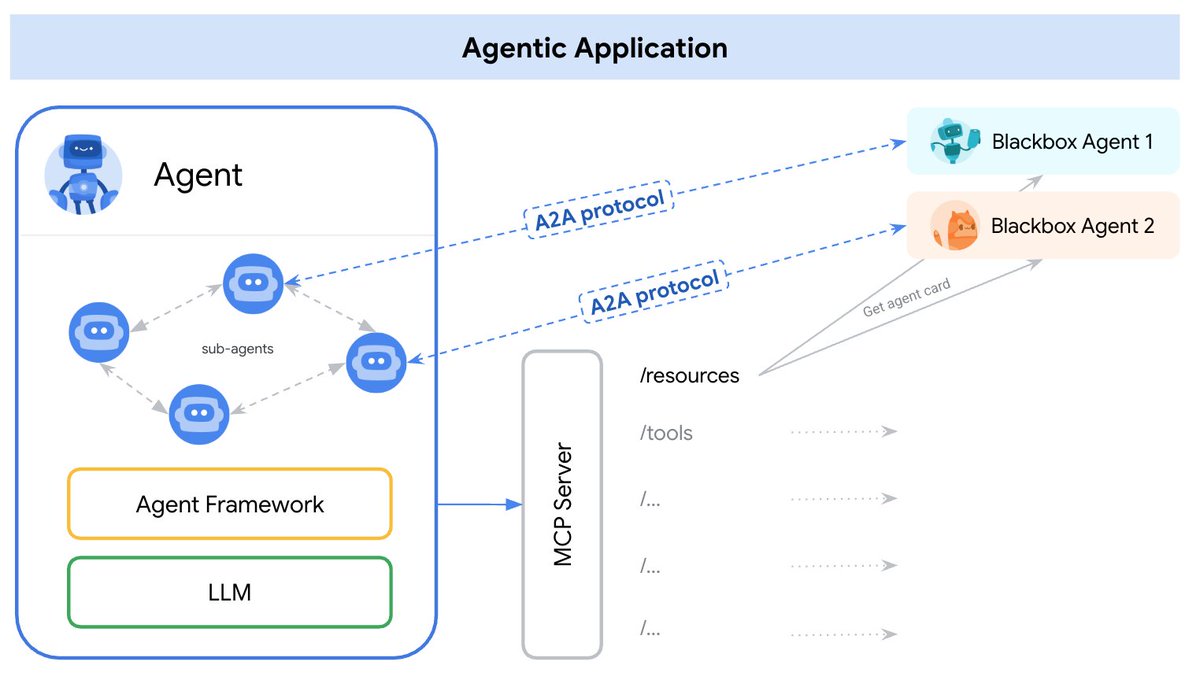
The intersection of A2A and MCP: We recommend that applications model A2A agents as MCP resources (represented by their AgentCard). The frameworks can then use A2A to communicate with their user, the remote agents, and other agents. Learn more → goo.gle/4j3LUJG
Google Cloud Tech tweet media
English
12
101
425
30.9K
Brian HH retweetledi
Min Choi
Min Choi@minchoi·
Crazy week in AI🤯 - NVIDIA drops open sources Parakeet ASR - Gemini 2.5 Pro (I/O edition) drop - OpenAI buys Windsurf for $3B - Cursor valued at $9B And more... 10 wild news drops + how to make sense of them: 👇
Min Choi tweet media
English
30
63
563
120K
Brian HH retweetledi
Shayan
Shayan@0xShayan·
Gmove everyone! I've built a game on Movement that allows for anyone to place a pixel on this game board. Placing a pixel is free, only costing gas. Will be open sourcing this next week, as well as an announcement on more to come soon 👀
English
14
22
89
24.7K
Brian HH retweetledi
Adam Grant
Adam Grant@AdamMGrant·
Counting your blessings is good for happiness. Counting your contributions is better for motivation.
English
22
208
1.1K
61.8K
Brian HH retweetledi
franck cassez
franck cassez@franckDownunder·
Excited to be visiting @NTHU_TAIWAN this week for research collaborations! Looking forward to insightful discussions on Move, compiler optimisations, cryptography & formal verification, and blockchain security. #Blockchain #MoveLang #FormalVerification
franck cassez tweet mediafranck cassez tweet media
English
4
8
28
16.9K
Brian HH retweetledi
The Movement
The Movement@movement_xyz·
gmove Taipei
Indonesia
184
565
599
78K