Murenzi Yves

1.7K posts

Murenzi Yves banner
Murenzi Yves

Murenzi Yves

@bivemorwose

Politician | Defender of Rwanda’s sovereignty 🇷🇼 | Peace, unit & development | Opinions are personal

Rwanda Katılım Mart 2022
265 Takip Edilen38 Takipçiler
Murenzi Yves retweetledi
Mugenzi Félix
Mugenzi Félix@FelixMugenzi·
The Pure Comedy of the #Tshisekedi Regime They once claimed that: ▶️ The #FDLR does not exist. ▶️The FDLR militias are old and no longer relevant. ▶️The FDLR is a pretext merely to cover for Kagame’s interest in minerals in the DRC. ▶️The FDLR operates in areas controlled by AFC/M23. Now, they are announcing plans to track them. These Genocidaires have been integrated into the FARDC. So FDLR is going to track themselves.
ACTUALITE.CD@actualitecd

Accord de Washington : les FARDC lancent la traque des FDLR actualite.cd/2026/03/29/acc…

English
15
25
51
6.2K
Murenzi Yves retweetledi
Munyakazi Sadate
Munyakazi Sadate@SadateMunyakazi·
QATAR yabaye igihugu cya mbere cyitandukanyije n'AMERIKA, QATAR yambuye AMERIKA uburenganzira bwo gukoresha Base mukugaba ibitero kuri IRAN. QATAR kandi yashyikirije IRAN miliyari 6 zama EURO zari zarafatiriwe kubera ibihano inongeraho miliyoni 300 zimpozamarira.
Rwanda 🇷🇼 Indonesia
39
21
297
23.2K
Murenzi Yves retweetledi
Presidency | Rwanda
Presidency | Rwanda@UrugwiroVillage·
President Kagame attended the #FIFASeries2026 Group A Finals, where Amavubi secured the championship title.
English
30
343
1.2K
18.3K
Murenzi Yves retweetledi
UWERA Jean Maurice
UWERA Jean Maurice@UweraJMaurice·
Ibikorwa byawe byambereye akabando 🎶🎵🎵🎤@demobrwanda 214 bari muri #FDLR bavuye mw’ishyamba biyemeje kubaka u Rwanda twifuza
Indonesia
12
51
268
16K
Murenzi Yves retweetledi
Mugenzi Félix
Mugenzi Félix@FelixMugenzi·
URGENT 🇨🇩🇨🇩 La famille #Tshisekedi envisagerait de relancer le MRND. Après la visite de Jean-Luc Habyarimana à Kinshasa. Ces derniers jours à Paris, une rencontre discrète attire l'attention : Marthe Kasulu, la mère de Tshisekedi a été vue aux côtés du Génocidaire Agathe Kanziga #Habyarimana . Selon plusieurs sources, ces contacts s’inscriraient dans une stratégie plus large, visant à relancer le #MRND, avec des levées de fonds envisagées en Europe et en Amérique du Nord.
Mugenzi Félix tweet mediaMugenzi Félix tweet media
Français
25
23
51
12K
Murenzi Yves retweetledi
Lawrence KANYUKA
Lawrence KANYUKA@LawrenceKanyuka·
Mise à jour du 30 mars 2026 Entre le 29 mars 2026 à 20h45 et le 30 mars 2026 à 07h00, la coalition de Kinshasa a mené des bombardements indiscriminés à l’aide de drones kamikazes, visant délibérément des zones densément peuplées de Mikenke et Gakenke, dans les hauts plateaux de Minembwe. Ces attaques constituent une grave violation du droit international humanitaire. Par ailleurs, le 29 mars 2026 à 18h30, cette même coalition a infiltré le centre densément peuplé de Shanji, dans le territoire de Kalehe, au Sud-Kivu, où elle a exécuté 7 civils innocents ( 1. SHADAI NDAGIJE 2. BISENGI MPENZE 3. ÉTIENNE GITINYWA 4. GASHIMYE HITIMANA 5. DANIEL HATEGEKA 6. NDAYAMBAJE MUHIRE 7. IRADUKUNDA NZANZUMUHIRE) et fait plus de 20 blessés. Ce nouveau massacre alourdit un bilan déjà tragique et témoigne d’une volonté manifeste de semer la terreur au sein des populations civiles. Le régime de Kinshasa persiste dans son refus délibéré de mettre en œuvre les engagements qu’il a lui-même souscrits. En violation flagrante de ses obligations, il continue de s’allier à des éléments des FDLR et de les déployer sur différents fronts, confirmant ainsi une stratégie cynique de déstabilisation et de terreur.
Français
9
72
183
23.4K
Murenzi Yves retweetledi
Me Moise Nyarugabo
Me Moise Nyarugabo@MoiseNyarugabo·
Ce matin du 30 mars 2026 , les drones des Fardc armée congolaise sous le commandement de Tshisekedi et des Fdnb, armée burundaise sous le commandement de Ndayishimiye ont tué un enfant dont l’âge se situe entre 10 et 12 ans. Cet enfant du nom de Patient Uwezo Ombeni dont les parents Rugimbana Alias Kadafi et Madame Espérance habitent le village Gakenke, spécialement Kwa Barabona, accompagnait les vaches de son père au pâturage en plein jour. Il a été frappé par une bombe et il est mort sur le champ. Certaines vaches ont été tuées aussi et une dizaine blessée. Ces dernières semaines plusieurs personnes ont été tuées dont un vieux papa de 95 ans et aujourd’hui, un enfant d’à peut près 10 ans. Il ne s’agit pas d’une erreur ni bavure. Ces assassinats sont intentionnels, voulus et décidés. Ceci pour dire qu’au sommet de ces États trônent des tueurs. Ils répondront de ces bombardements des civils par drones et ce, au quotidien. Le sang de ces faibles innocents éclaboussera, à coup sûr, ceux qui facilitent, couvrent et encouragent les auteurs de ce génocide contre les banyamulenge. Ceux qui leur donnent le blanc seing pour l’extermination d’un peuple. Ce crime est imprescriptible et ces écrits qui ne vont pas disparaître de la toile vous chargeront. @realTrump , @StateDept , @US_SrAdvisorAF, @_AfricanUnion, @ymahmoudali, @antonioguterres, @WilliamsRuto , @PaulKagame, @edmnangagwa, @KagutaMuseveni, @SuluhuSamia, @FelixTshis13, @GeneralNeva, @MofaQatar_EN, @jumuiya, @SADC_News, @JDVance @CyrilRamaphosa, @onduhungirehe, @marcorubio, @EmmanuelMacron, @MONUSCO,@PresidenceTg, @FEGnassingbe, @FelixTshis13 , @kajakallas, @eucopresident, @volker_turk, @HuangXia16, @prevotmaxime, @kikayabinkarubi.
Me Moise Nyarugabo tweet media
Français
84
55
87
7.2K
Murenzi Yves retweetledi
Bojana Coulibaly, Ph.D.
Bojana Coulibaly, Ph.D.@CoulibalyBojana·
Today March 30th, two separate Kinshasa-launched kamikaze drones killed respectively a boy of 12 years old and another of 10 years old in Minembwe. When will the @StateDept and @MONUSCO condemn these war crimes by the government of #DRC?
English
9
42
65
2.3K
Murenzi Yves retweetledi
Tom Close 𓋹
Tom Close 𓋹@tomcloseOG·
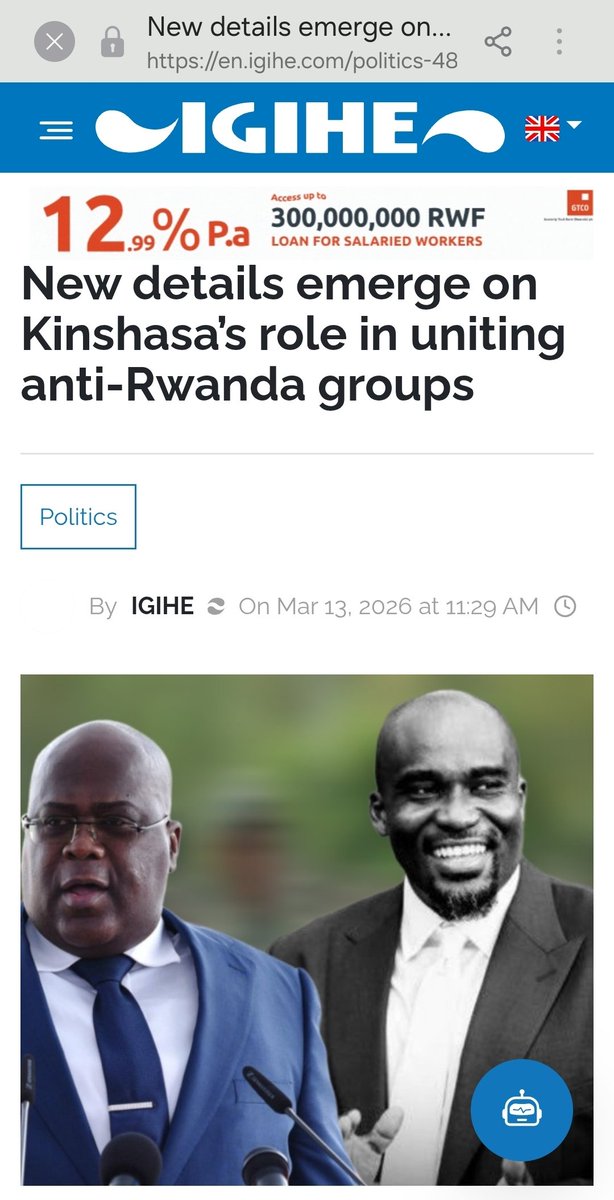
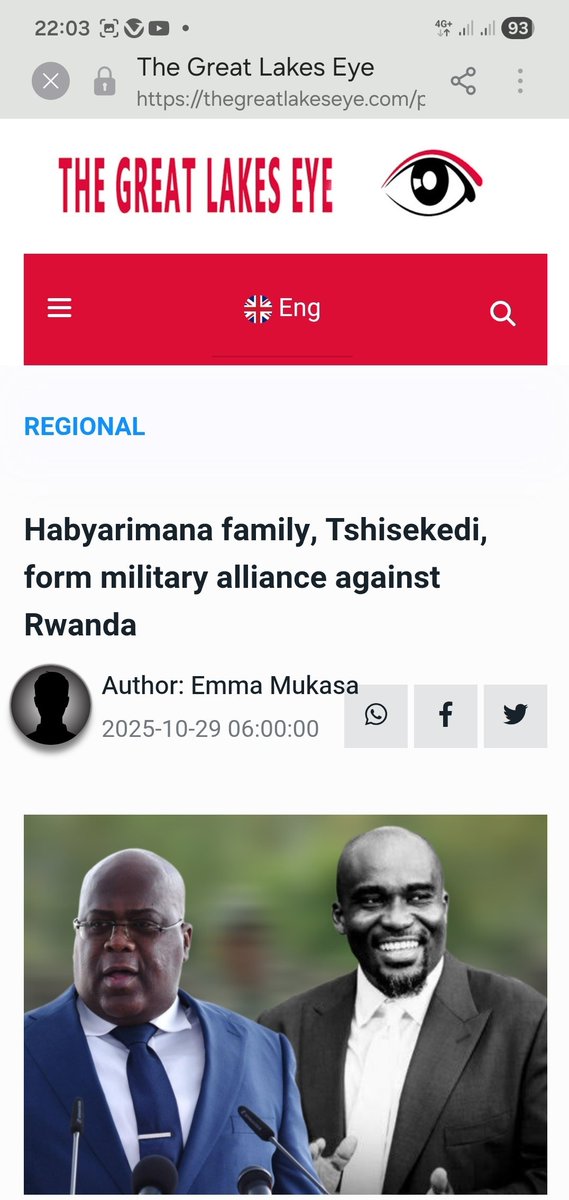
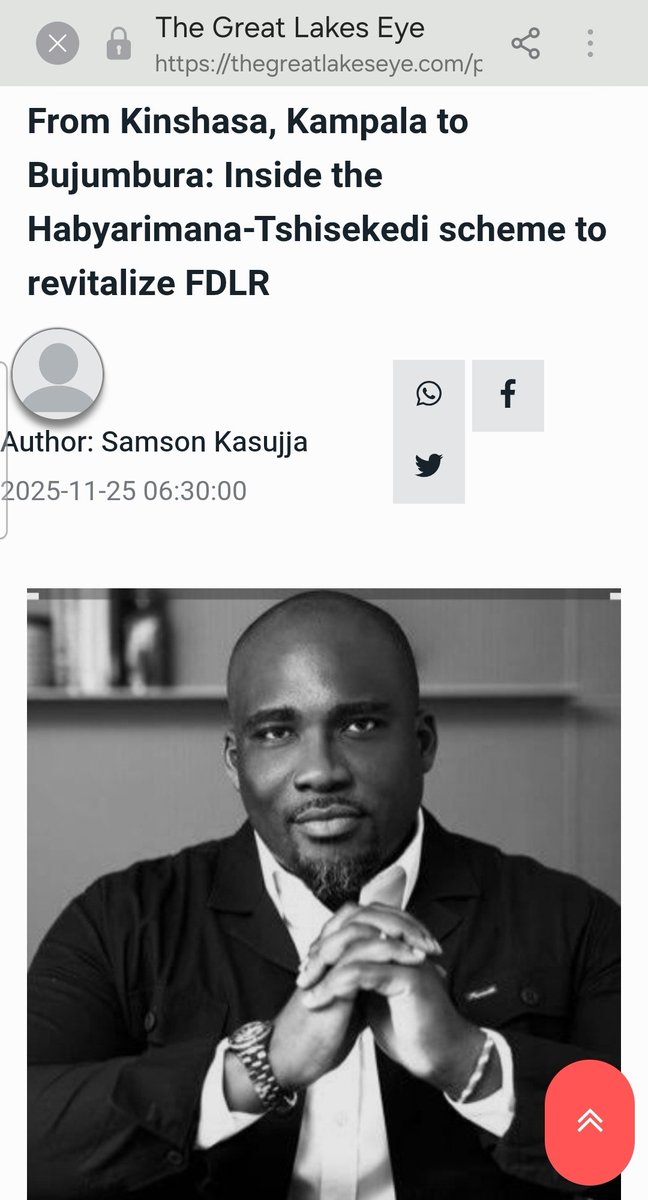
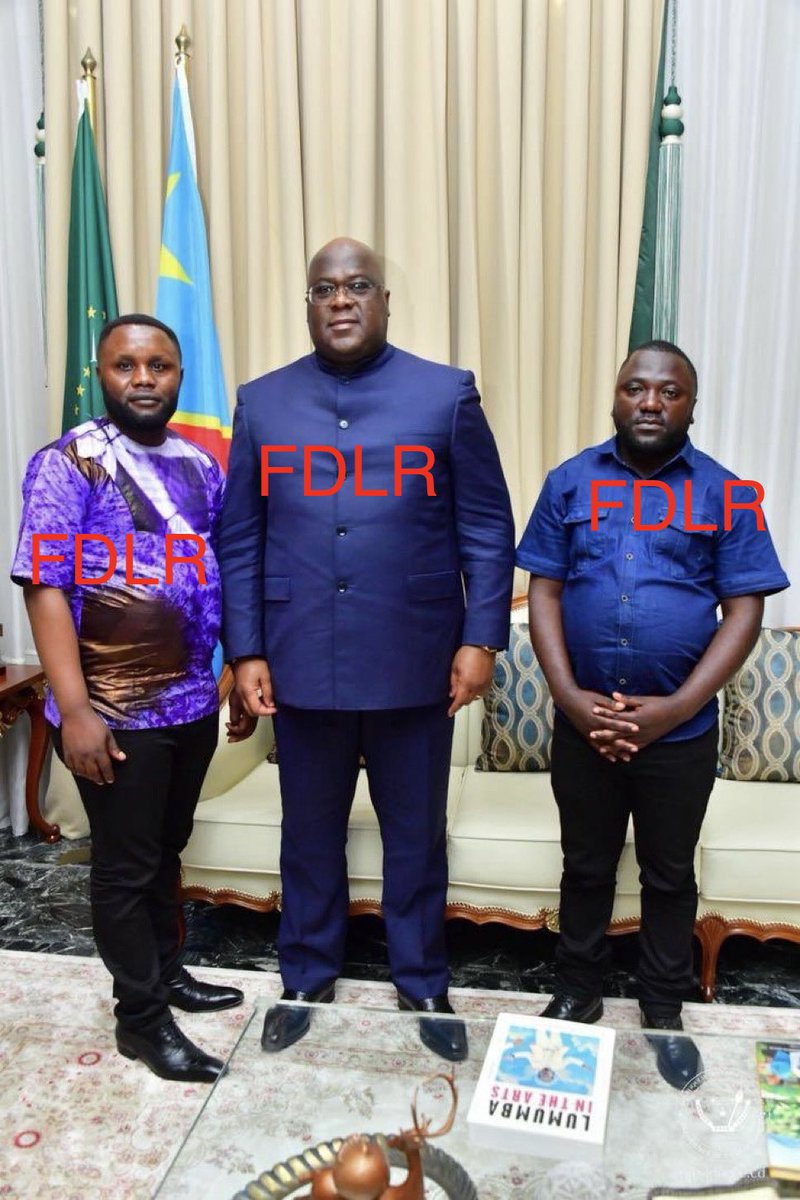
Without a transparent monitoring system to oversee the dismantling of FDLR, #Congo's claims will remain hollow. #FDLR is part & parcel of #FARDC & any claims of separation should be reviewed & confirmed by an independent party without conflict of interest. en.igihe.com/politics-48/ar…
Tom Close 𓋹 tweet mediaTom Close 𓋹 tweet mediaTom Close 𓋹 tweet mediaTom Close 𓋹 tweet media
English
8
16
30
2.7K
Murenzi Yves retweetledi
Alex Mvuka, Ph.D.
Alex Mvuka, Ph.D.@AlexMvuka·
Disarming the FDLR without simultaneously disarming the Wazalendo is nearly impossible, as the two are deeply interconnected. The FDLR is a key issue in the Washington peace agreement. However, there is no clear baseline or threshold to determine when mediators or parties in conflict will be satisfied that the FDLR has been neutralised. The DRC government suggests that it is already sensitising FDLR members to report to MONUSCO, as if their members were acting as Good Samaritans. I would like to show how disarming FDLR is an impossible mission. The symbiotic relationship between the FDLR, local communities, and other armed groups. Since 1994, when Rwandan refugees and combatants crossed into the DRC, Congolese Tutsi have come to be perceived not only as enemies of the state but also as “infiltrators.” The DRC effectively rejected its own citizens on the basis of their Tutsi ethnicity. At the same time, local and international humanitarian agencies created favourable conditions for welcoming Rwandan refugees, while excluding Tutsi individuals from their staff. An unofficial system of population exchange - or rather replacement - thus emerged: Hutu refugees from Rwanda were welcomed into Zaire, while Zairian Tutsi became persona non grata in their own country and were effectively destined for deportation to Rwanda. In this context, the FDLR can be seen as the most significant form of “infiltration” that the DRC has experienced. The normalisation of this situation presents a serious challenge to the disarmament of the FDLR. FDLR and Wazalendo cannot be separated. They have assimilated each other and share the same ideology. While the FDLR and Wazalendo groups operate in partnership with the government, they also function independently, generating revenue from a wide range of sources, including charcoal production, ransoms, poaching, kidnapping, and the taxation of various commodities and trade routes. Disarming the FDLR without simultaneously disarming the Wazalendo is nearly impossible, as the two are deeply interconnected. Inadequate intelligence on the FDLR The DRC security services lack the intelligence needed to determine how many Wazalendo and FDLR groups currently exist in the country or the size of their membership. The security services and the army do not have the power and authority to disarm them. For example, in Uvira, Wazalendo groups were able to defy a government decision to deploy an army general. FDLR and Wzalendo have military capabilities better than the national army. I am inclined to believe that the alliance of the FDLR and Wazalendo could potentially disarm the FARDC, rather than the other way around. In 2020, President Tshisekedi initiated a programme under the “État de siège” to enable the government to continue its military campaign against armed groups (Mayi-Mayi, FDLR, ADF, and CODECO), particularly in light of the gradual withdrawal of MONUSCO forces. However, these measures have failed in North Kivu and Ituri. This failure can be explained in three ways: the FARDC has collaborated with the very groups it was supposed to disarm; funds have been misappropriated and diverted to networks in Kinshasa; and the FARDC has lacked the logistical capacity to defeat these groups. This situation persists. How alliances shift – an illustration Given that the FDLR are considered allies, the FARDC is unlikely to eradicate them. It is important to highlight the complexities surrounding how the FDLR operates. The FDLR is, in theory, a political organisation, with the Forces Combattantes Abacunguzi (FOCA) serving as its armed wing. Since 2000, the FDLR has experienced numerous internal disputes and tensions, which have led to shifting alliances, including collaboration with the Congolese Hutu armed group Nyatura. Nyatura has generally received support from local communities, FARDC as well as political actors in Kinshasa and within the diaspora. Few years ago, a group known as CNDRD (an offshoot of the FDLR) split from the organisation following long-standing disagreements over political priorities. NDC-Renové later exploited the FDLR’s weakness after this split and formed an alliance with the FARDC (the national army) to fight against both the FDLR (FOCA) and Nyatura. FDLR and Nyatura resisted and NDC-Renové and FARDC were not capable to defeat FDLR and Nyatura. Armed groups including FDLR are frequently created and reconfigured, with alliances, objectives, and areas of deployment constantly shifting. For example, there have been clashes involving the FDLR, CNDRD, FARDC, Nyatura, and NDC-Renové. However, these groups may also act as allies in other contexts. In this sense, the FARDC can at times function similarly to an armed group. The main challenge Members of the FDLR have assimilated into local armed groups or civilian populations. They have changed names, adopted local identities, and spoken local languages. Some have also been integrated into the national army. The FDLR is supported not only by the DRC army but also by the Burundian army. With Burundi being involved in the DRC conflict, FARDC cannot reinforce disarmament of FDLR within the Burundian army. The FARDC has failed in its mandate to protect civilians and ensure security for several reasons: Its members are often mobilised along informal local, ethnic, and regional lines. The institution lacks the logistical capacity and discipline required for effective organisation. The vast size of the country, combined with multiple armed groups, significantly challenges efforts to maintain security or disarm non-state actors such as FDLR.
Alex Mvuka, Ph.D. tweet media
English
24
57
74
5.1K
Murenzi Yves retweetledi
Olivier J.P. Nduhungirehe
Olivier J.P. Nduhungirehe@onduhungirehe·
RULES GOVERNING AFRICAN CANDIDATURES WITHIN THE INTERNATIONAL SYSTEM In my posting of Friday, I recalled, in relation to the submission by the AU Chairperson of an African candidate to the position of UN Secretary General (UNSG), that the African Union is governed by the rule of law. This is also true for the AU endorsement of African candidatures within the international system. Here is the historical background and the regulatory framework of this matter: 1. On 18-20 July 1985, the 22nd Ordinary Session of the Assembly of Heads of State and Government of the Organization of African Unity (OAU) adopted, in Addis Ababa,“Resolution [AHG/Res. 144 (XXI)] on the Committee for Nominating an African Candidate for the Post of U.N. Secretary-General”. This Nominating Committee consisted of ten (10) countries, two per each of the five OAU regions; 2. Following the transformation of the OAU into the AU, the 8th Ordinary Session of the AU Executive Council (Council of Ministers), held in Khartoum on 21 January 2006, established, through Decision EX.CL/213 (VIII), a 15-member “AU Ministerial Committee on Candidatures within the International System”, and adopted its rules of procedures. Rule 3 of this new text broadens the mandate of the old OAU Nominating Committee to “candidatures for elective posts within the United Nations System as well as other International Intergovernmental Organisations”. 3. On the procedure, Rule 11 states that “All candidatures shall be submitted to the Committee, through the AU Commission, […] at least two (2) months prior to the Sessions of the Executive Council, which shall consider them”. In addition, Rule 14 provides that the Ministerial Committee adopts its recommendations on candidatures, for endorsement by the Executive Council. This Council shall then take its decisions “by consensus or, failing which, by a two-thirds majority of the Member States eligible to vote”, as per Rule 33 of its own rules of procedure. These aforementioned rules are clear and straightforward: FIRST, all African candidatures to the UN, including for the position of UNSG, must go through the AU Ministerial Committee on Candidatures within the International System. Therefore, any unilateral decision by the AU Chairperson to immediately submit, to the UN Secretariat in New York, an African candidature to the position of UNSG, without going through the Ministerial Committee, is irregular. SECOND, the Ministerial Committee adopts, after deliberation, its recommendations and submit them to the Executive Council (AU Ministers of Foreign Affairs). The latter shall take its decisions by consensus or by a 2/3 majority of the Member States eligible to vote. In other words, a direct rush to a 24-hour “silence procedure”, through which the AU Chairperson would wish to force a 2/3 “silent” majority endorsing his solo and irregular decision, without any attempt to seek an open discussion and a consensus on the African candidate for the position of UNSG, is also a gross breach of AU rules and regulations. Thank you.
Olivier J.P. Nduhungirehe@onduhungirehe

What happened today at the African Union is a stark reminder that leadership matters. It's unbelievable to note that a whole continental organisation can be tarnished or driven into a crisis by its own Chairperson, who is in office for not even two months. Unlike what I read here and there in the media, today's decision by the twenty (20) AU member States who broke the silence was not aimed at rejecting the candidature of anyone. It was aimed at opposing a flawed procedure initiated by President Evariste Ndayishimiye of Burundi, Chairperson of the African Union, in total violation of all rules and regulations governing African candidatures in the international system. In this matter, everything was wrong from day one: FIRST, on 2nd March 2026, the Permanent Representative of Burundi in New York sent a letter to the President of the UN General Assembly, informing her that: "my government, current Chair of the African Union, nominates His Excellency Macky Sall, former President of the Republic of Senegal, for the position of Secretary-General of the United Nations". This submission of an African candidature to the position of UN Secretary General came as a surprise to all African Heads of State and Government, as none of them was consulted by the AU Chairperson before taking this important decision. SECOND, after submitting the candidature of former President Macky Sall in New York, the President of Burundi attempted to force his African counterparts to endorse this gross breach of procedure. Indeed, he yesterday convened the bureau of the African Union (attended by only two other members) and decided to put such an important matter under an unusual 24-hour "silence procedure". In other words, President Ndayishimiye, instead of convening an AU Summit to advise him on the right procedure, chose to give his fellow AU Heads of State and Government only 24 hours to either endorse, by keeping silent, an AU decision that "EXPRESSES ITS FIRM SUPPORT to the President of the Republic of Burundi, H.E. Evariste Ndayishimiye, Chairperson of the AU for 2026, for having presented the candidacy of President Macky Sall [...] for the position of Secretary-General of the United Nations", or to reject it by breaking the silence. This was too much for many AU member States, which could not accept such a diktat and such disrespect from their Chairperson. They then decided to break the silence, block his decision and remind President Ndayishimiye that the African Union is governed by the rule of law. Unfortunately, the damage was already done in the outside world but I hope that this incident will nonetheless serve us as a lesson for future appointments of AU Chairpersons.

English
45
172
472
74.3K
African
African@ali_naka·
“The Americans will help us build an army to protect our country. They will come with their money, they will build the roads.The enemies wanted to keep us in war, in suffering, they wanted everything, but all that is now over,” Tshisekedi What an IRREDEEMABLE BASTARD!!
African tweet media
English
226
211
845
216.7K
Murenzi Yves
Murenzi Yves@bivemorwose·
@mathmixxer @ali_naka With proper governance, DRC’s own resources could generate more wealth than foreign aid. Natural resources aren’t the problem, management is. Look at Nigeria and Angola: resource-rich, yet most citizens remain poor due to weak governance and institutions.
English
0
0
0
7
Murenzi Yves
Murenzi Yves@bivemorwose·
@mathmixxer @ali_naka The real comparison between countries is not totals, but efficiency and outcomes: -Electricity access -Poverty reduction -Stability Big numbers don’t automatically mean development. What matters is how efficiently resources are turned into better living conditions for population.
English
2
0
0
16
Murenzi Yves
Murenzi Yves@bivemorwose·
@mathmixxer @ali_naka Need a serious discussion, bring data:Compare aid as % of GDP over time. Compare domestic revenue vs external financing.Look at how the national budget is financed today vs 30 years ago. Rwanda moved from very high aid dependency after 1994 to a more mixed financing model today.
English
1
0
5
53
Space_Mixxer
Space_Mixxer@mathmixxer·
@ali_naka Why is it only rwandan being concerned by the statement,, should we remind you that your country lives and breathe foreign aid ?
English
2
0
3
608
Murenzi Yves
Murenzi Yves@bivemorwose·
@KivuYouth_243 @ali_naka Haha, you people believe every rumor. You are quick to accuse others that they are controled by western countries, but putting Kagame in that group without proof just shows a lack of serious thinking. Bring evidence, not noise.
English
1
0
3
54
Murenzi Yves retweetledi
Rugamban'engwe
Rugamban'engwe@Rugusuki·
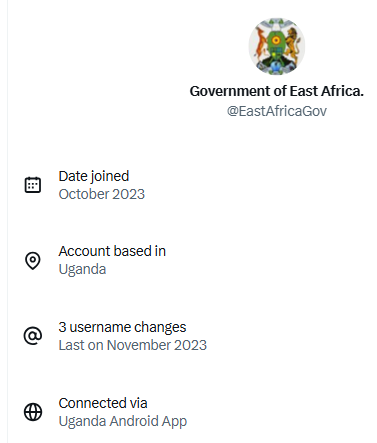
@albcontact hhhh...busted! The account is based in Uganda, but he claims he is in Tanzania!
Rugamban'engwe tweet media
English
3
2
15
3.5K
Murenzi Yves retweetledi
Prof. Awet  T.  Weldemichael
No, Your Excellency. The office of #AU Chair is powerful but not powerful enough to single-handedly nominate a person of it choosing to such a consequential role on behalf of remaining 53 heads of state. Had M. Sall been backed by all 54, vote by silence would’ve gone smoothly.
Amb. Willy Nyamitwe@willynyamitwe

The statement by the Minister of Foreign Affairs of #Rwanda (@onduhungirehe) is regrettable in both tone and substance, as it misrepresents established procedures of the @_AfricanUnion and unnecessarily personalizes what is, in essence, a routine institutional process. First, the use of the Silence Procedure is neither new nor irregular within the African Union. It is a well-established decision-making mechanism that has been applied on numerous occasions. The fact that some Member States chose to break the silence does not constitute a crisis; rather, it reflects normal institutional practice and demonstrates that consultation among Member States is both active and effective. Second, it is important to recall that H.E. President Evariste Ndayishimiye, in his capacity as Chairperson of the African Union, acted in line with his mandate and in respect of established procedures. His ruling was clear, in French: “Je voudrais vous remercier pour le soutien affiché en faveur de notre Frère Macky Sall et déclare que le Projet de Décision qui nous a été soumis est adopté. J’instruis la Commission de l’Union Africaine à l’envoyer à tous les États Membres, pour adoption par la procédure du silence, selon les règles et procédures de notre Union.” “I would like to thank you for the support expressed in favor of our brother Macky Sall and declare that the draft decision submitted to us is adopted. I instruct the African Union Commission to transmit it to all Member States for adoption through the silence procedure, in accordance with the rules and procedures of our Union.” This instruction explicitly entrusted the African Union Commission with implementing the process in accordance with the Union’s rules and procedures. Third, the 24-hour timeframe that has been criticized was not determined by the Chairperson of the Union. It resulted from internal handling at the level of the Permanent Representatives’ Committee (PRC) chairmanship, despite reservations expressed by the Legal Counsel and the Secretariat. It is therefore inaccurate to attribute this aspect to the Chairperson. Fourth, attempts to portray this procedural matter as a “violation of all rules” or as an action that “tarnishes” the African Union are exaggerated and risk undermining the credibility of our continental institutions. Differences in procedural appreciation should be addressed through established diplomatic channels, in a spirit of collegiality and mutual respect. Furthermore, no decision was imposed on Member States. On the contrary, the fact that silence was broken demonstrates that Member States fully exercised their sovereign right to express their positions, fully in line with the procedures of the African Union. Finally, it is important to emphasize that matters of such institutional importance call for responsibility, restraint, and respect for diplomatic decorum. Public commentary, particularly when expressed in a tone that is dismissive or inflammatory, does not contribute to constructive engagement and may give the unfortunate impression of a lack of discipline and experience in handling sensitive continental issues. Our Union is built on mutual respect and quiet diplomacy; it is in this spirit that we should continue to engage, especially on matters of such significance to #Africa’s collective voice on the global stage.

English
18
67
262
38.9K