@mesolude A friend of mine, @Christintweets, saw your tweet and sent it to me a while back and I ended up seeing it, falling in love with it, and eventually making an offer (closing soon)! Thank you for helping make this weird dream happen! 🥹
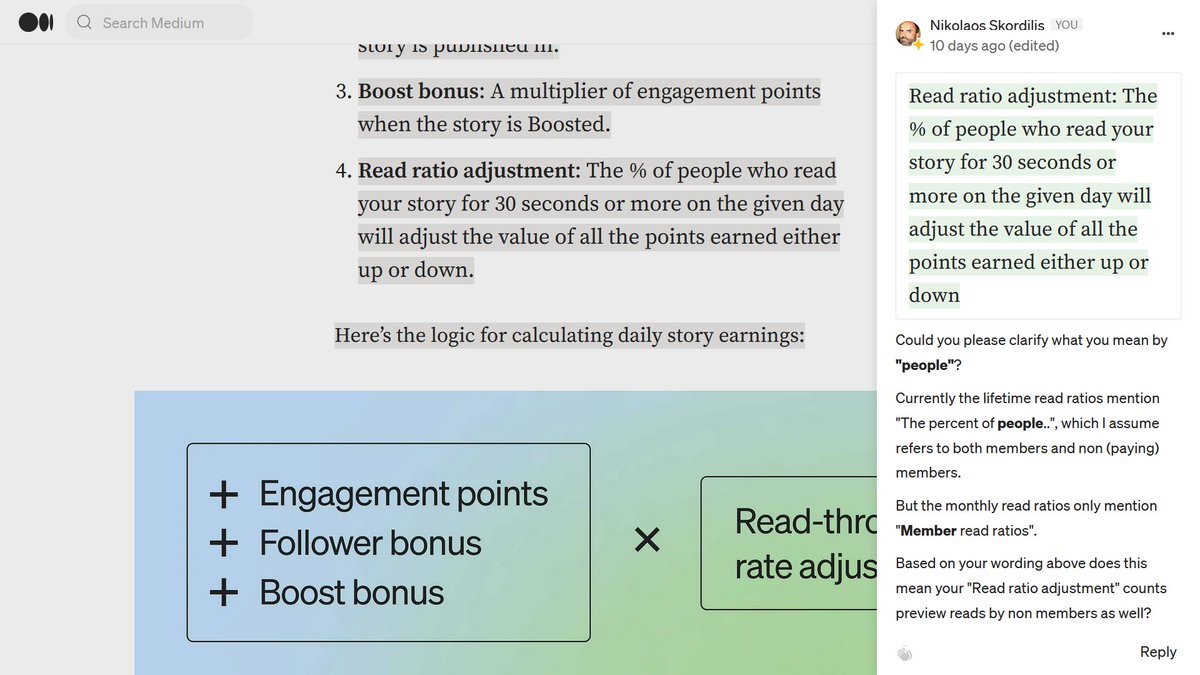
@nbarron@Medium@buster Which read ratio (RR) is that though?
The RR on top of each stat which includes non members ("percent of 𝐩𝐞𝐨𝐩𝐥𝐞") or the 𝐦𝐞𝐦𝐛𝐞𝐫 RR shown in the reads of monthly stats?
@buster's wording ("% of people") suggests the former, which would keep RR artificially low.
According to an Australian aboriginal tribe, we have three brains:
- one the stomach
- one in the heart
- And obviously the head one.
a few thoughts on why this is an interesting thought experiment to explore...
@buster Haha, I'm going to ask my ears where they want to go for lunch ;) that said it kinda feels like these three are core and distinct centres/filters for the intuition?
@jonnym1ller These map to standard modes of intuition, which seems helpful. Like the 6 thinking hats. AND, I suspect it‘a not just these 3 kinds of intuition. We can ask our toes where they want us to move, or our butts. We could ask the Sun, the Moon, our cat, etc. Intuition is everywhere!
In my experience, these two lower brains tend to get far less airtime — and perhaps our challenge (at least according to the Aborigines) is to create balance and greater felt (somatic) awareness between the three centers... such that deeper insights can emerge.
@buster Thanks Buster! I've been spending a lot of time reflecting recently, trying to figure out which parts of my experience were unique to Slack vs. generalizable. It's tricky!
You can be the smartest person in the room, and if you're a subpar listener you will be a terrible PM. Conversely, if you're amazing at listening – and *remembering* – you're likely to have a strong product career. Here's why, and what to do.
First, a story from Slack's early days:
I joined Slack when it was ~250 people. We were growing insanely quickly and struggling in all the ways hypergrowth companies struggle: feature requests, infrastructure scalability challenges, client performance, bugs, you name it – not to mention our own aggressive internal roadmap. We knew *what* we needed to achieve. It was the prospect of *doing* so much that was overwhelming. It all seemed critical.
Stewart knew this more than anyone, and was doing everything he could to motivate folks to work hard, tighten scope, and ship quickly without compromising quality. Somehow, though, projects still often got stuck near the finish line: details weren't right, an error state wasn't thought through, some bits didn't feel right in internal testing. Whatever the reason, too often work was getting turned around in launch reviews.
It was a vicious cycle: caught between pressure to ship and pressure to meet Slack's notoriously high quality bar, PMs came into review meetings fearful of rejection, and met with feedback they would often struggle to *listen* – grasping at rationale for design decisions and tradeoffs in order to survive.
Here's where problems multiply: when you defend a decision in an exec meeting, the main signal you send is, "I'm not listening."
Picture the job of the CEO. On either side of the product review meeting, they might be interviewing a leadership candidate, reviewing a deal for office space, doing a press interview, or talking to a prospective investor. There is a crazy amount of context switching (and stress!). When a PM shows up defensive in a review, it puts busy leaders into a panic. They can seem angry, but they're actually fearful: they worry you won't register and address their concerns. And they need to context switch and do something else, and a week (or more!) will pass before their next chance to talk to you.
Acknowledge and accept!
Here's the trick: when you're met with criticism or feedback, instead of explaining why, just say "got it." Then, ask questions.
This doesn't mean taking blame or accepting bad feedback. What you are doing is establishing a crucial baseline: "I hear what you are saying."
Clarify.
We all feel defensive when we receive feedback in high pressure situations. Channel your defensive energy toward questions that will clarify things for you and your team, and improve your alignment with the stakeholder. Things like:
* "Last time, you mentioned the importance of X. Does that still rank for you? Did we over-focus on it?"
* "When we did X, our concern was Y. Should we be worried about that?" (And if so, "Is there a better way to mitigate it?")
* "We've been really pushing to ship by X, we considered Y but the team thinks it is going to be expensive – is it worth slipping the date if necessary to get it in?" (This one can be a particular 💎, sometimes stakeholders just want to hear it's on your radar and you won't forget, and aren't going to block your launch if they know you are listening!)
Open a line of communication.
Great PMs flag projects when they experience the first of signs of these speedbumps, and do whatever they can to increase the communication cadence. When I was at Slack, if I got a signal that Stewart cared about specific details of a project, or if it started to feel like the scope he wanted wasn't going to fit into the timeline we'd promised, I would start sending him notes and questions directly. My goal was never to force him to make decisions, but just to keep him informed, give him a chance to weigh in, and send a clear signal: we are doing our best, we hear you, and if you want to weigh in, we're eager for your thoughts.
Bonus: ✏️ Write things down.
This one is so simple I almost left it out, but it's super, suuuper important. The best way to send an unambiguous message that you are listening is to write down feedback. Bring a notebook, do it on paper. No one expects you to hold 30 minutes of feedback in your head. In fact, when you try to do that, they think they are going to have to tell you again. Write it down! You'd be amazed how rarely people do this!
Final thought:
Yes, you need to be smart to be a PM. But I have seen more PMs struggle, burn out, and lose out on promotions and chances to work on exciting projects due to *lack of trust* than lack of intelligence. Software is a team sport. Show that you listen and care and you are way ahead of the pack.
@rrhoover The young adult sci-fi series The Arc of the Scythe (to be fair I read it with my son and enjoyed it as well) has a very knowledgeable/powerful AI that isn’t evil and is well done.
@bonnittaroy Seems more like a prediction than a "must". And all science is designed to be viewed with cautious suspicion even before and after any underlying unity of reality is identified.
what do you make of this statement
"Any science, pursued rigorously enough, must reveal the underlying unity of reality. Until this is achieved, all science must be viewed with cautious suspicion."
From the heart of the Amazon, reach out to the global community. Help us stop #PL2903#MarcoTemporal. @RodrigoPacheco, hear our call and the cry of the world. Take a stand against the destruction of our homes and our future. Sign and share the petition 👉 together.earth
After 20 years of interviewing candidates, I've found this to be the single most useful interview question:
"What is your greatest strength ... that you are most worried about not coming across in an interview setting?"
The more you heal, the less you see attention as affection, attachment as connection, codependency as support, disagreement as an attack, enmeshment as intimacy, lack of boundaries as empathy, external validation as internal self-love, and trauma bonding as healing.
@jonnym1ller@kevin2kelly What have you realized that technology wants based on the last 3-5 years that you might not have guessed when the book came out? Are its wants changing?