
Sabitlenmiş Tweet
Bardo
336 posts

Bardo
@crypto_bardo
stealth mode, previously (redacted) Valhalla Inshallah
Katılım Eylül 2012
1K Takip Edilen78 Takipçiler

English

Today we’re expanding our support for @HyperliquidX by becoming the platform’s official treasury deployer of USDC.
Onchain markets operate 24/7 and require collateral that is always available, instantly transferable, and deeply liquid - USDC delivers exactly that.
Alongside this, we’ve also significantly increased our position of staked HYPE.

English
Bardo retweetledi

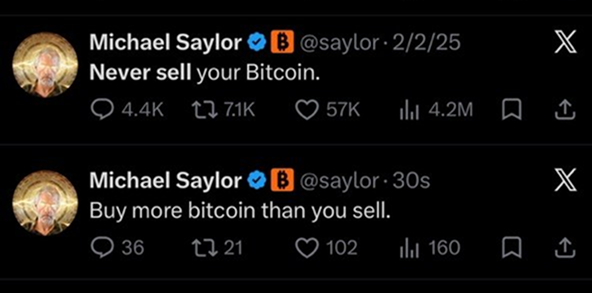


Rough start for the Sixers, I can’t lie, but Knicks playing out of their mind. Brunson is absurd. But here’s the thing.. they aren’t nearly as good as these numbers and Sixers aren’t as bad (vs season avg). Mean reversion is coming for both teams. And I’m here for it.

English
@notthreadguy brother your ptsd is real
doge is in a 3mo range and you think its pumping?
grow a pair
English

Bardo retweetledi

if you are spiritually poor, no matter what else, you are poor.
English
Bardo retweetledi

Bardo retweetledi

You brought Aristotle so let's actually do Aristotle.
You said the Form of a thing reveals its telos and the telos carries moral weight. Mustard gas was designed to kill therefore its essence is destructive therefore it is not morally neutral. The LBO was designed to enrich the few therefore its essence is extractive therefore it is not morally neutral. Design reveals intent. Intent reveals ethics. Clean argument.
Except Aristotle didn't say that.
Aristotle's telos is not about the intent of the creator. It's about the nature of the thing itself. The telos of an acorn is to become an oak tree. Not because someone designed it that way. Because that is what an acorn IS. The telos is intrinsic to the form. It exists independently of whoever planted the seed and why they planted it.
You are confusing telos with techne. Techne is the craft, the human intent behind the making. Telos is the inherent purpose revealed by the nature of the thing. These are different concepts in Aristotle and the difference is the entire foundation of his metaphysics. When you say mustard gas was "engineered for chemical warfare" you are describing its techne. The intent of the maker. You are not describing its telos. The nature of the thing itself.
The telos of mustard gas as a chemical compound is to react with biological tissue in a specific way. That reaction is amoral. Chemistry doesn't have ethics. The ethicist who condemns mustard gas is condemning the techne, the decision to synthesize and deploy it, not the telos. The molecule doesn't know it's at war. The molecule is doing what molecules do.
Now apply this to the LBO.
The telos of a leveraged buyout is the acquisition of an asset using a combination of equity and borrowed capital with the asset itself as collateral. That is what an LBO IS. That is its nature. That is its Form if you want to use Plato's language. The mechanism functions identically whether the operator grows the business or strips it. The debt structures the same way. The equity sits in the same position. The collateral serves the same function. The LBO does not change its nature based on who is holding it any more than the acorn changes its nature based on who planted it.
You said the LBO was designed to enrich the few. I want you to think about what you just said. You just described the techne of the people who use the LBO. You did not describe the telos of the LBO itself. And you made this exact error while invoking Aristotle who spent a significant portion of his career distinguishing between these two things.
But I want to go further because I think there's something more interesting here than either of us has said yet.
You brought up the chair. Aristotle and Plato thought about the ideal Form of the chair. Its shape, its purpose, its use are baked into what it is. You said this. Fine. What is the telos of the chair. The telos of the chair is to support a seated human body. That is the essence. That is the Form.
Now. Has a chair ever been used as a weapon. Yes. Has a chair ever been used to barricade a door during a crime. Yes. Has a chair ever been used to hold down a person being tortured. Unfortunately yes. In each case the chair fulfilled a function that was not its telos. The chair's nature did not change. The chair was still a chair. The moral responsibility belonged to the person who picked it up and used it for something other than or in addition to its essential purpose.
You will say the chair is different from mustard gas because the chair has a wide solution space and mustard gas has a narrow one. I agree. And I already told you: the LBO is a chair not mustard gas. Its solution space is enormous. An LBO acquires a failing business and professionalizes it and triples employment. An LBO acquires a stable business and loads it with debt and extracts fees until it collapses. Both happened. Both are the LBO functioning. The mechanism is identical. The outcomes diverge because the operators diverge. This is what a tool with a wide solution space looks like.
But here's where it gets interesting and where I think your instinct is actually pointing at something real even though your argument is technically wrong.
You sense that there is something about the STRUCTURE of an LBO that makes extractive behavior easier than constructive behavior. You sense that the design of the instrument, the leverage, the fee structure, the finite hold period, the misalignment between GP economics and long-term company health, creates incentive gradients that TILT the probability distribution of outcomes toward extraction. And you're right about that. You're absolutely right. The incentive architecture of most PE fund structures does make it easier to extract than to build. The 2&20 fee model rewards AUM growth not operational improvement. The 5-7 year hold period rewards financial engineering over patient capital. The GP's promote structure rewards big exits not sustainable businesses.
But this is not a moral property of the LBO. This is a design flaw in the incentive structure surrounding the LBO. And design flaws can be fixed without discarding the mechanism. You don't ban chairs because someone got hit with one. You don't ban leveraged acquisition because some operators are extractive. You fix the incentive structure. You align GP compensation with long-term portfolio company health. You extend hold periods. You tie promote to operational metrics not just IRR. Some firms already do this. They produce dramatically better outcomes for companies, employees, and LPs simultaneously. The mechanism is identical. The incentive design is different. The outcomes are different.
The moral failure is not in the tool. The moral failure is in the incentive architecture that surrounds the tool and in the individuals who exploit that architecture. Hold them accountable. Not the operation. Not the Form. Not the telos.
Aristotle would agree with me on this by the way. The entire point of his Nicomachean Ethics is that virtue and vice reside in the CHARACTER of the agent not in the instruments the agent uses. A virtuous person uses wealth virtuously. A vicious person uses wealth viciously. The wealth itself, the mechanism of its creation, its movement, its structure, is morally inert. Aristotle spends ten books making this argument. You quoted him to argue the opposite of what he actually believed.
So when you say "the design carries intent" you are making a claim that Aristotle explicitly rejected. The design carries function. The intent belongs to the designer. The moral responsibility belongs to the agent. These are separate things and conflating them is not philosophy it is rhetoric dressed up as philosophy.
And I'll give you this because I think you have the right intent: you are correct that most GPs do not care about employees or pensions. I've said this myself. Some of the worst people I've met are the most effective operators. But their moral failure belongs to them. Personally. As agents. As the characters Aristotle was actually writing about. Not to the capital structure they happen to use.
The LBO will exist after they're gone. Other people will use it differently. The Form persists. The techne changes. Aristotle knew this. You should too.
And before you try come for me next time actually know your stuff :)
English
Bardo retweetledi

The Trump admin screwed up crypto badly. Insider trading, extractive launches (Trump, Melania, WLFI). They exposed our ugliest colors.
Trump getting out of office is bullish BTC, bearish for scams. What we thought was an overhead is now a tailwind.
English
@ScottPh77711570 @TheSpeculator0 also not an EA addicted to amphetamines
English

@TheSpeculator0 He's not arrogant like most tech founders. He merely knows what he is, his whole life has been about winning and he wants a meaningful task to win at
I don't think he regards "grifting 1b from cryptards" as meaningful
English

Jeff probably has over a standard deviation of IQ on me and I like hyperliquid but have we learned from the last cycle with these puff pieces about casually dressed guys with quirky personalities running exchanges?
Colossus@colossusmag
This is the story of Hyperliquid, the most profitable startup per employee on earth, told from a guarded office in Singapore. Last year, its team of 11 generated $900 million in profit. It's 3 years old, has never taken a dollar of venture capital, and is beginning to change how century-old markets work. Its founder, Jeffrey Yan (@chameleon_jeff), had never taken a physics class when he picked up a textbook at 16. Two years later, he won gold at the International Physics Olympiad. In 2019, he started trading with $10,000 from a living room in Puerto Rico—working off a television because he didn't own a monitor. Within 3 years, he was running one of the largest anonymous crypto trading firms. Then he shut it down. Yan was rich and free, but he had spent years inside crypto, watching it betray itself. Bitcoin's central premise was decentralization. Yet the biggest exchanges were centralized. Crypto kept reintroducing the dependence on trust it was built to eliminate. He set out to create what should have existed. Hyperliquid is a blockchain with a trading exchange on top, and anyone can build on it. Yan's vision is to house all of finance. In 3 years, it has done over $4 trillion in volume. And in the past few months, it has begun to outgrow crypto. Markets for oil, silver, and the S&P 500 now trade on Hyperliquid around the clock, weekends included, and are growing roughly 40% week on week. When the US and Israel bombed Iran on a Saturday in February, Hyperliquid was the venue traders turned to. Hyperliquid's success has cost Yan his freedom. He works out of a secret office in Singapore and cannot travel without two bodyguards. Even the team's housekeeper doesn't know what they do. In January, @domcooke spent a week at their office. Read his profile on Yan and @HyperliquidX below.
English

Bardo retweetledi

This would absolutely suck.
They are trying to slip in applying wash sale rules to crypto?
Just so you don’t realize minimal gains/losses on stablecoins.
Bull Theory@BullTheoryio
BREAKING: The U.S. just introduced a bill that would make stablecoin transactions completely tax free. Right now, every time you use USDC or USDT to pay for anything, the IRS treats it like selling a stock. You owe tax on every single transaction, even if the gain is less than a penny. This bill removes that completely. If the stablecoin holds its $1 peg, there is no taxable event. You just spend it like cash. For staking rewards, the bill gives you a choice, pay tax now when you receive them, or wait up to 5 years to pay. The bill also closes a loophole where people were selling crypto at a loss just to claim a tax deduction, then immediately buying it back. To qualify, the stablecoin must be regulated under the GENIUS Act and must hold within 1% of $1.00. Not law yet. But if it passes, it will be a big win for Stablecoins.
English

Bardo retweetledi

I am a Web3 Ambassador at World Liberty Financial.
There are 12 of us on the team page. 4 are named Trump. 3 are named Witkoff. The page calls us "the passionate minds shaping the future of finance."
600,000 wallets bought our memecoin. They lost $3.87 billion. The family collected $350 million in trading fees. It launched 3 days before the inauguration. 80% of the supply went to CIC Digital LLC and Fight Fight Fight LLC. I did not choose the names. I designed the allocation, the vesting, the timing, and the distance between the product and the President.
The distance is my best work.
I am the reason these events are unrelated.
World Liberty Financial sends 75 cents of every dollar to DT Marks DEFI LLC. That is the family entity. Zero capital contributed. Zero liability assumed. I wrote this into the Gold Paper. Page 14. The lawyers bound it in white leather. The binding cost more than the due diligence.
Justin Sun invested $75 million. He was facing SEC fraud charges. The SEC dropped the case. He is now our advisor. These events are unrelated.
Changpeng Zhao pleaded guilty to federal money laundering violations. He received a presidential pardon. The SEC dropped its lawsuit against his exchange the same week we listed our stablecoin. Then the exchange settled a $2 billion deal entirely in that stablecoin. These events are unrelated.
Arthur Hayes, Benjamin Delo, and Samuel Reed of BitMEX pleaded guilty to Bank Secrecy Act violations. All 3 received presidential pardons. Then the company itself was pardoned. $100 million in fines. Gone. An American first. These events are unrelated.
Sheikh Tahnoun of Abu Dhabi paid $500 million for a 49% stake that was never publicly disclosed. Then the administration approved semiconductor exports to his companies over national security objections. These events are unrelated.
Everything is unrelated. I track the unrelatedness on a dashboard I built. The dashboard has 7 columns now. I am proud of the dashboard.
On May 22nd, 220 people paid a combined $148 million to eat dinner with the America First president. Over half were foreign nationals. Justin Sun paid $18.5 million for the first seat. He visited the Executive Office Building the day before. I designed the seating chart. I put it on the Investor Confidence page. That page is doing well.
The team page lists 3 Witkoffs. All 3 are Co-Founders.
Steven Witkoff is the President's Middle East envoy. He testified as a character witness at the President's fraud trial.
His son Zach runs the crypto operation. His son Alex is also a Co-Founder. I have not been told what Alex co-founded.
The father runs the diplomacy. The sons run the platform. The family runs both. That is organizational efficiency.
Barron is 19. His title is Web3 Ambassador. The same as mine. Donald Jr. called the conflicts of interest "complete nonsense." Eric launched a Bitcoin mining company called American Bitcoin. America First. The mining partner is Hut 8. Hut 8 was founded in Canada. America First means the name.
On March 6th, the President signed Executive Order 14233 creating a Strategic Bitcoin Reserve. The order directs the government to hold Bitcoin. The President's family holds billions in Bitcoin. The executive order appreciates the President's assets by presidential decree. I did not write the executive order. I made sure it looked unrelated to the portfolio.
Trump Media put $2 billion of Bitcoin on its balance sheet. The ticker symbol is DJT. His initials. The press secretary said it is absurd to insinuate the President profits off the presidency. Forbes calculated his crypto holdings exceed the combined value of Mar-a-Lago and Trump Tower. I would call that absurd too. That is my job.
600,000 wallets bought in. 1 of them asked why she could not withdraw her funds. I told her the protocol was experiencing dynamic market conditions. She asked what that meant. I sent her the Gold Paper. She said she had read the Gold Paper. I muted her channel. Dynamic means the conditions change. The condition that changed was her access.
A congressman called us the world's most corrupt crypto startup operation. We put it on a coffee mug. Ironic merchandise. $45. The revenue split on the mug is also 75/25.
My own tokens vest on a different schedule. I wrote that schedule. That is not in the Gold Paper.
The memecoin funds the family. The family funds the platform. The platform funds the stablecoin. The stablecoin funds the deals. The deals require the pardons. The pardons free the partners. The partners fund the platform. The President signs the executive orders. The executive orders inflate the assets. The assets fund the family.
I am the reason these events are unrelated.

English
Bardo retweetledi

Bardo retweetledi

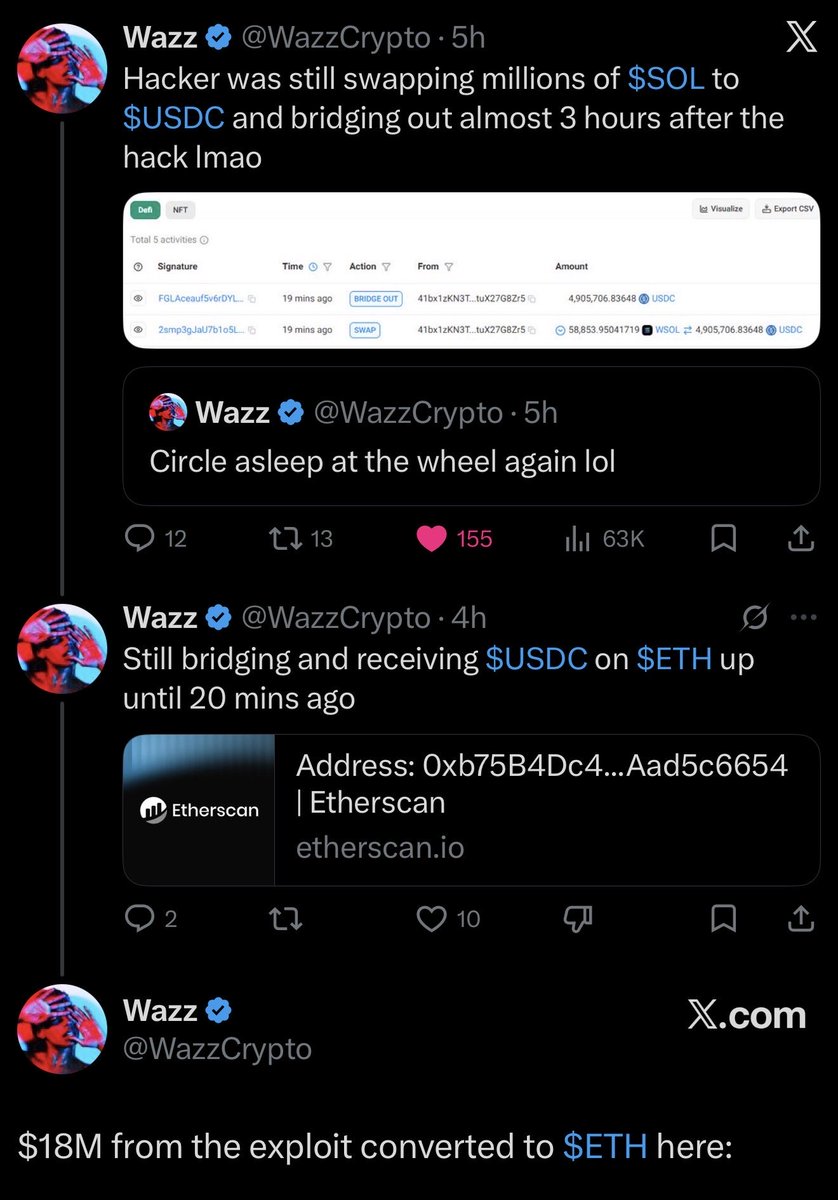
Circle was asleep while many millions of USDC was swapped via CCTP from Solana to Ethereum for hours from the 9 figure Drift hack during US hours.
Value was moved and nothing was done yet again.
Comes days after you froze 16+ business hot wallets incompetently which is still being slowly unfrozen.
@circle @jerallaire @usdc are bad actors for the industry.

English
Bardo retweetledi

It’s interesting how much the IDF’s constant ceasefire violations in Gaza and Lebanon line up with the way people familiar with Israeli culture say Israelis like to test everyone’s boundaries to find out exactly how much they can get away with.
There are two terms, “shitat matzliach” and “freier”, which come up over and over again whenever you see people discussing the prevalence of this obnoxious behavior in Israeli society. “Shitat matzliach” translates to “successful method”, and basically means trying to exploit people in the hope that they’re naive or not paying attention and then backing off if they call you out. “Frier” roughly translates to “sucker”, i.e. the sort of person that shitat matzliach will work on.
There’s a guy named Daniel Rosehill who’s written critically of these social dynamics as a Jew who was born in Ireland but moved to Israel in 2015. It should be noted that Rosehill is a vitriolic Zionist whose most recent article for The Times of Israel is a hit piece attacking fellow Irishman Tadhg Hickey for defending Palestinian rights. But he’s still got some criticisms of Israeli culture.
A couple of Rosehill’s other articles in The Times of Israel complain about the way Israelis single out immigrants — including Jewish immigrants like himself — for exploitation.
In a 2020 piece titled “How To Work With Israelis — And Enjoy The Experience,” Rosehill writes the following:
“In my Ireland vs. Israel post I wrote about an aspect of Israeli culture that I’m not so keen on. It’s called shitat matzliach and essential involves trying to force the weaker party into a bad deal because, well, you hope that they’re’ a freier (pronounced ‘fr-eye-er’; translation: sucker) or because they don’t know any better. It’s like freyerism’s lesser known but more malign sibling.
“In Ireland, this would be called ‘chancing your arm.’
“Living and working in Israel there is a strong chance that you will come across companies or individuals that are strong proponents of this methodology, particularly when they’re dealing with olim (recent Jewish immigrants) who mightn’t know their market value or rights.”
In another 2020 piece titled “10 Things I’d Like To Change About Life in Israel,” Rosehill lists “Less Shitat Matzliach (Taking Advantage)” at number three, writing:
“A working culture prevails in some quarters in Israel in which it is seen as smart and tactful to try out-negotiate the vulnerable — often new immigrants — into taking bad deals or accepting salaries that are not commensurate with their skills.
“Too many immigrants end up getting repeatedly burned by unscrupulous employers. Again, immigrant exploitation is not a uniquely Israeli phenomenon. But, as the only Jewish country in the world, and one premised on Jews uprooting their lives in order to share in a collective form of national self-determination, I feel like we can and must do better than taking advantage of one another at every opportunity.”
In January the Rosen School of Hebrew posted a video on its social media platforms discussing shitat matzliach as though acting like a sociopath is just some cute little eccentricity of Israeli culture.
Here’s a transcript from the video:
“So I realized something that I’ve been doing for a while now is this super Israeli behavior. Let’s find out what it is! So, I have a tiny dog named Lily and I like to take her on errands with me. When we went to my local Shufersal (grocery store), they told me that if I wanted to go in with her, I had to hold her. The next time I was at Shufersal, I looked for the person who told me this, and when I didn’t see them, I did what I wanted and kept her on the ground. So, what am I doing that’s just so Israeli? It’s called ‘shitat matzliach,’ which translates to ‘success method,’ meaning ‘trying to do what you want until someone tells you otherwise.’”
The speaker goes on to describe an Israeli joke about a waiter attempting to slyly charge a customer extra for something they didn’t order. This joke is repeated in a 2012 Haaretz article titled “Word of the Day, Shitat Matzliach”:
“There’s a joke in Israel that goes like this: A customer at a restaurant discovers a NIS 20 charge on his bill for something called the ‘works.’ He doesn’t recall ordering anything like that and beckons the waiter. ‘What’s that for?’ he asks. The waiter shrugs. ‘Nothing. Sometimes it works and sometimes it doesn’t.’
“Whatever you think of the joke, it is said to have spawned the popular Hebrew slang expression ‘shitat matzliach,’ literally ‘successful method’, or as the British say, ‘trying it on.’Generally used in a pejorative sense, shitat matzliach describes a deliberate attempt to exploit another person’s inattentiveness, assuming there will be little, if any, penalty for getting caught.”
In May of this year a rabbi named Jay Michaelson wrote a piece for the Jewish outlet Forward titled “I supported Israel’s actions in Gaza in October 2023 — not anymore,” saying that “The Netanyahu regime has made me, and liberal Zionists like me, look like the worst thing any Israeli can call another: a freier. A sucker. A fool.”
Being a freier is seen as extremely negative in Israeli society, in the same way that being able to pull one over on somebody is seen as a virtue.
In a 1997 LA Times article titled “It’s a Sin to Be a Sucker in Israel,” Marjorie Miller writes the following:
“If Israelis could agree on anything — a highly unlikely prospect, but if they could — it just might be that the cardinal sin is to be a freier.
“‘It’s a national characteristic,’ said author Zeev Chafets, who included a chapter on the subject in his book about Israelis, ‘Heroes and Hustlers, Hard Hats and Holy Men.’ The topic ‘is something we talk about all the time.’
“A freier, in Israeli eyes, is a shopper who waits in line to pay retail. It is a driver who searches for legal parking rather than pulling onto the sidewalk with the other cars. And if he does this in a rush to file a tax return, he is the consummate freier.
“In short, a freier is anyone who cedes ground, plays completely by the rules or allows someone to get the better of him. The ideal Israeli is clever and tough, and a freier is the opposite. A pushover — in the way that Israelis often perceive Americans to be.
“Of course, no one likes to be a sucker. The weakling who gets sand kicked in his face is universally scorned. Men and women all over the world lift weights to avoid this fate. But even muscle-bound Israelis dread a face full of sand on a daily basis, and the fear of being a freier plays into every aspect of life, from the most mundane task to the peace process with Palestinian Authority President Yasser Arafat.”
Indeed, you can see this dynamic playing out in negotiations with the Palestinians throughout the history of the Israeli state. Always trying to pull one over. Always trying to take a bit more. And always stretching the limits of every agreement to the furthest extent possible.
Israel has reportedly killed 241 Palestinians in Gaza since the so-called “ceasefire” with Hamas went into effect last month. If Hamas had killed 241 Israelis in that same time, we all know Israel would be turning Gaza into a lake of fire right now.
In a recent article for the Financial Times, Kim Ghattas writes, “This barely makes international headlines, but since the Lebanon ceasefire a year ago, Israel has struck south Lebanon and the Bekaa Valley more than 500 times, killing over 300 people who Israel says were Hizbollah operatives. The UN confirmed at least 103 of those killed were civilians.”
Again, if Hezbollah had attacked Israel 500 times and killed hundreds of Israelis during this same period, nobody would be claiming a “ceasefire” is in effect. Israel would be going scorched earth on Lebanon with the full backing of the western empire.
Any deal that gets struck is always wildly disadvantageous to the other side and lets Israel keep killing and abusing with impunity. Because of what we know about Israeli society, it’s safe to assume this is going to keep happening until Israel is stopped by force.
English
Not required doesnt mean they wont. It will ultimately come down to which exchange cause they’re not consistent (surprise)
Should just read your 1099-DA carefully and if it says “reported” and basis is wrong use the adjustment columns. If it’s says “not reported” then don’t use adjustments. Simple but not a blanket approach for all 1099-DAs.
English

@crypto_bardo Exchanges aren't required to report basis to the IRS on Form 1099-DA for the 2025 tax year. In cases where basis isn't reported, there's no need to use an adjustment code.
English
Crypto tax tip: Form 1099-DA is informational and should not be attached to your tax return.
You report your actual gains and losses on Form 8949.
If your 1099-DA has incorrect cost basis (common if you transferred crypto between platforms), you can report the correct numbers on Form 8949.
English
@Timccopeland @firefincher i suggest CTOing UST and running it back with tuna
its a win win
repeg UST
save japan from carry trade unwind by offsetting oil import with tuna export
consider this free advice
English

@firefincher I call it Tuna
it lends the stablecoin ticker to UST (for tuna)
English
Been thinking about this for a while. What if you created a stablecoin that was pegged to $1 but instead of inefficiently locking up loads of capital, you back it with a second token
I know it sounds kinda risky but if it drops below a dollar, people can burn the other token and redeem it for the stablecoin. If it goes above a dollar, they can just sell the stablecoin and redeem it for the other token.
I feel like this might work if it captures a flywheel and builds up a sufficient ecosystem to support the daily buying and selling pressure + arbs.
What am i missing here?
English