My fireside chat with the CEO of Western Union.
> you crypto people think real time settlement is new
> we've been doing real time settlement for 20 years
> you can go to a WU and send money to your mom in guatemala and it lands in 3 seconds
> but that only happens because I have liquidity pool of $1.5B
> stablecoins are going to give me back that $1.5B
> my stock trades at $2.7B
> I'm going to take that $1.5B and use it to buy back a boat load of my stock
> oh and also, we're going to use stablecoins to give all 100m+ customers a US dollar debit card aka mini bank account
Stablecoins aren't going to kill Western Union...
They're going to save it.
• According to the story, the dog's cancer has not been cured.
• Absent all regulatory and manufacturing constraints, we could not just synthesize magic mRNA cancer cures. The technology is very promising, but it's not yet any kind of panacea.
• The emergent system of regulators and manufacturers is indeed far too conservative, and small-scale experimentation is much harder than it should be. More people should read the first part of The Rise and Fall of Modern Medicine. Recommend @RuxandraTeslo, @PatrickHeizer for more.
a little something i cooked up over the weekend — autonomous agents covering the AI supply chain
an experiment in AI x media
follow along @silicon_wiresiliconwire.xyz
Somewhere out there is a guy who uses Notion, Superhuman, OpenClaw on a Mac Mini, Raycast, a mechanical keyboard ($400), Wispr Flow, and gets nothing done every day
I think creatine will become super popular this year
- Safe
- Cheap
- Naturally found in food
- Enhances strength
- Also improves cognitive function
- Incorrectly stigmatized as an extreme workout drug
- Consumed orally (compare to peptides)
It is hard to communicate how much programming has changed due to AI in the last 2 months: not gradually and over time in the "progress as usual" way, but specifically this last December. There are a number of asterisks but imo coding agents basically didn’t work before December and basically work since - the models have significantly higher quality, long-term coherence and tenacity and they can power through large and long tasks, well past enough that it is extremely disruptive to the default programming workflow.
Just to give an example, over the weekend I was building a local video analysis dashboard for the cameras of my home so I wrote: “Here is the local IP and username/password of my DGX Spark. Log in, set up ssh keys, set up vLLM, download and bench Qwen3-VL, set up a server endpoint to inference videos, a basic web ui dashboard, test everything, set it up with systemd, record memory notes for yourself and write up a markdown report for me”. The agent went off for ~30 minutes, ran into multiple issues, researched solutions online, resolved them one by one, wrote the code, tested it, debugged it, set up the services, and came back with the report and it was just done. I didn’t touch anything. All of this could easily have been a weekend project just 3 months ago but today it’s something you kick off and forget about for 30 minutes.
As a result, programming is becoming unrecognizable. You’re not typing computer code into an editor like the way things were since computers were invented, that era is over. You're spinning up AI agents, giving them tasks *in English* and managing and reviewing their work in parallel. The biggest prize is in figuring out how you can keep ascending the layers of abstraction to set up long-running orchestrator Claws with all of the right tools, memory and instructions that productively manage multiple parallel Code instances for you. The leverage achievable via top tier "agentic engineering" feels very high right now.
It’s not perfect, it needs high-level direction, judgement, taste, oversight, iteration and hints and ideas. It works a lot better in some scenarios than others (e.g. especially for tasks that are well-specified and where you can verify/test functionality). The key is to build intuition to decompose the task just right to hand off the parts that work and help out around the edges. But imo, this is nowhere near "business as usual" time in software.
After reading Citrini's write-up, asked Claude to rank the top 5 states it would want to own real estate in if white collar jobs get widely displaced by AI. It says:
1) Texas
2) Florida
3) Tennessee
4) North Carolina
5) Virginia
Very interested in what the coming era of highly bespoke software might look like.
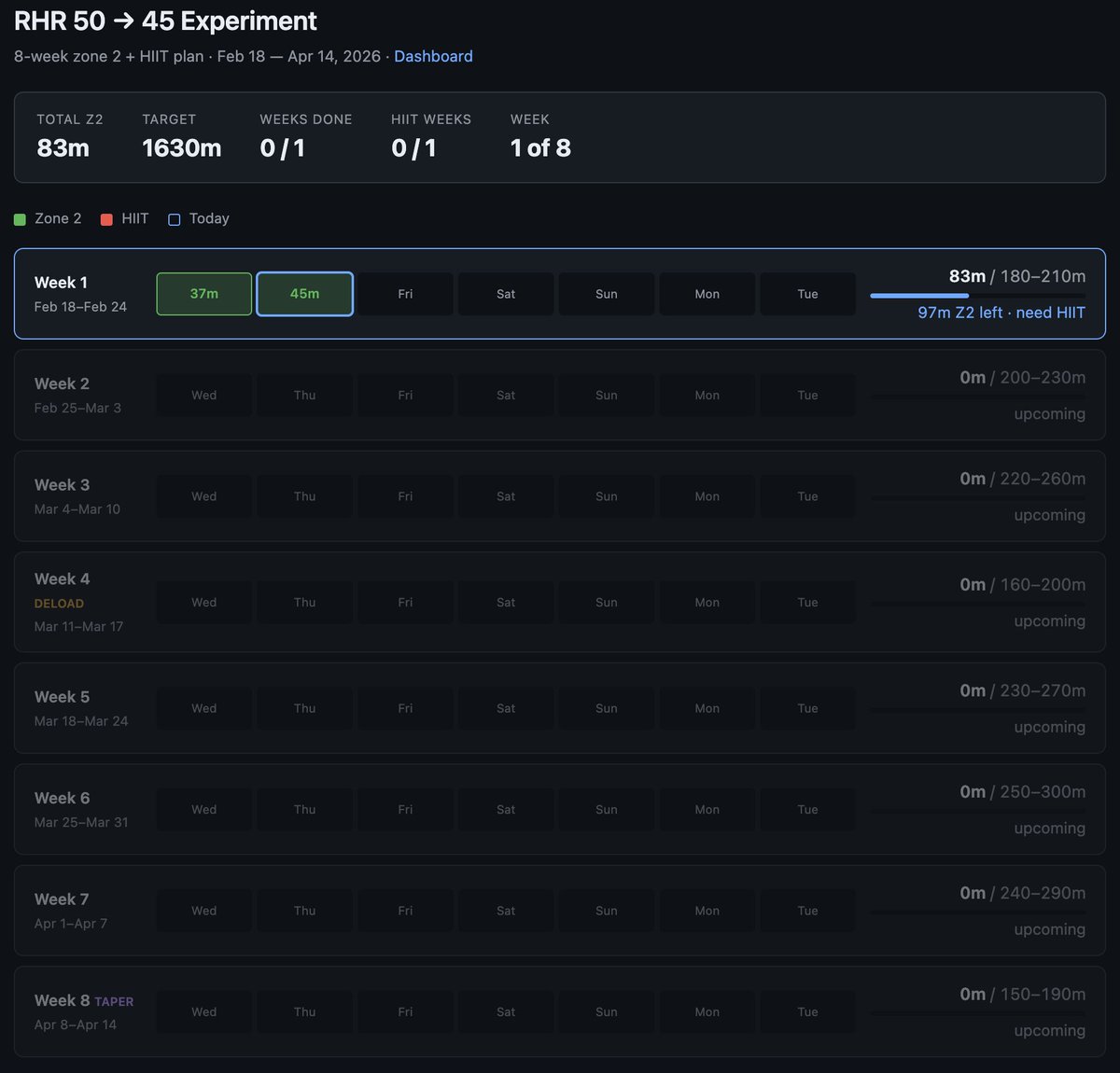
Example from this morning - I've become a bit loosy goosy with my cardio recently so I decided to do a more srs, regimented experiment to try to lower my Resting Heart Rate from 50 -> 45, over experiment duration of 8 weeks. The primary way to do this is to aspire to a certain sum total minute goals in Zone 2 cardio and 1 HIIT/week.
1 hour later I vibe coded this super custom dashboard for this very specific experiment that shows me how I'm tracking. Claude had to reverse engineer the Woodway treadmill cloud API to pull raw data, process, filter, debug it and create a web UI frontend to track the experiment. It wasn't a fully smooth experience and I had to notice and ask to fix bugs e.g. it screwed up metric vs. imperial system units and it screwed up on the calendar matching up days to dates etc.
But I still feel like the overall direction is clear:
1) There will never be (and shouldn't be) a specific app on the app store for this kind of thing. I shouldn't have to look for, download and use some kind of a "Cardio experiment tracker", when this thing is ~300 lines of code that an LLM agent will give you in seconds. The idea of an "app store" of a long tail of discrete set of apps you choose from feels somehow wrong and outdated when LLM agents can improvise the app on the spot and just for you.
2) Second, the industry has to reconfigure into a set of services of sensors and actuators with agent native ergonomics. My Woodway treadmill is a sensor - it turns physical state into digital knowledge. It shouldn't maintain some human-readable frontend and my LLM agent shouldn't have to reverse engineer it, it should be an API/CLI easily usable by my agent. I'm a little bit disappointed (and my timelines are correspondingly slower) with how slowly this progression is happening in the industry overall. 99% of products/services still don't have an AI-native CLI yet. 99% of products/services maintain .html/.css docs like I won't immediately look for how to copy paste the whole thing to my agent to get something done. They give you a list of instructions on a webpage to open this or that url and click here or there to do a thing. In 2026. What am I a computer? You do it. Or have my agent do it.
So anyway today I am impressed that this random thing took 1 hour (it would have been ~10 hours 2 years ago). But what excites me more is thinking through how this really should have been 1 minute tops. What has to be in place so that it would be 1 minute? So that I could simply say "Hi can you help me track my cardio over the next 8 weeks", and after a very brief Q&A the app would be up. The AI would already have a lot personal context, it would gather the extra needed data, it would reference and search related skill libraries, and maintain all my little apps/automations.
TLDR the "app store" of a set of discrete apps that you choose from is an increasingly outdated concept all by itself. The future are services of AI-native sensors & actuators orchestrated via LLM glue into highly custom, ephemeral apps. It's just not here yet.
Personal Update: I have recently left Monad Foundation eco team. Joining as one of the early APAC hires has been one of the most rewarding experiences of my career. And it's been a real privilege to work alongside such an ambitious, thoughtful and driven group of people.
I am deeply grateful to @keoneHD@0x_eunice@thetinaverse@sungmo_apac16z and @jinglingcookies for welcoming me as an early member of the team. From our first on-the-ground developer activation workshops in China, to building out the Mandarin speaking community, to launching builder initiatives like Monad Madness HK, I have no doubt the APAC ecosystem will continue to grow with the help from @lulu70191243@Harveycww@BoxMrChen and many others.
As I wrote in “Why Crypto Matters” two years ago, I believe blockchains are an institutional technology that enables new forms of economic coordination through control, liberation, and the expansion of individual action. I am confident Monad will be an important network in enabling that future. I will be cheering for Monad from the side and contributing to the eco in my personal capacity.
Staying close to the space and exploring what's next, always happy to connect.
People say you want to launch in the bear so you can get good distribution everyone can participate in upside valuations are reasonable etc but no one talks about how much it absolutely sucks to launch in that same bear and the outright vitriol and hate the community at large is coming at you with