Daniel Corcos

45.5K posts

Daniel Corcos banner
Daniel Corcos

Daniel Corcos

@daniel_corcos

MD, PhD Mammography-induced cancers Medical science whistleblower https://t.co/OrggmGwu0r https://t.co/pDaq6Oavuc
Paris Katılım Nisan 2018
362 Takip Edilen7K Takipçiler
Daniel Corcos
Daniel Corcos@daniel_corcos·
@lsanger I was banned from the article "Mammography" for mentioning a publication from the New England Journal of Medicine.
English
0
0
1
33
Larry Sanger
Larry Sanger@lsanger·
Not gonna lie, a lot of Wikipedia articles still suck—just poor quality—and always were. People with the knowledge to make improvements are not generally motivated to participate. They are not welcomed or respected; often, they are driven away.
English
32
20
270
7K
Daniel Corcos retweetledi
Muriel Blaive, PhD
Muriel Blaive, PhD@MurielBlaivePhD·
David Morens now working for Peter Daszak is wild - shameless, shameful, and a telling indication of the depth of the ties between Fauci's NAIAD and Peter Daszak's research in Wuhan. I have a special relationship to Paul's article in the BMJ in 2021 because it caused me to be shadow-banned on Facebook for 3-4 years - I couldn't even access my own posts, my so-called "FB memories", on anything Covid until the end of 2024 (see the link to my book in my pinned post, chapter 2.) This process left me somewhat traumatized, I guess - as if my own identity had been wiped out and what I said just didn't exist. But mainly, I'm nowhere near overcoming my anger at how my image was forcibly turned from a well-integrated, progressive social scientist with a decent reputation into a suspicious weirdo who might have sympathies for the extreme right - that's certainly how some of my colleagues suddenly seemed to think of me. I don't know if I will ever forgive, but I will sure as hell never forget. All this for an article in the BMJ of all places 🤬
Paul D. Thacker@thackerpd

Short video about Peter Daszak and Fauci sidekick virologists complaining about my BMJ investigation exposing their conspiracy to label everyone a conspiracy theorist. Enjoy the emails.

English
3
24
73
1.9K
Daniel Corcos
Daniel Corcos@daniel_corcos·
@LocasaleLab It wasn't always like this. The field was corrupted when vaccine research moved into the military domain, in the same way that the field of radiation effects research had been corrupted previously.
English
0
0
1
59
Jason Locasale
Jason Locasale@LocasaleLab·
The reality is that space for open, good-faith discussion is very limited. If you ask questions about adverse effects of vaccines or question their efficacy, you can be labeled a far-right wing, anti-science, anti-vax activist and subjected to smear campaigns. In some cases, people have even lost their jobs or careers. As a result, there is almost no room for nuance or complexity. Merely asking a question can get you canceled. Medical training also contributes to this. It is shaped by an adversarial, legally informed framework that tends to speak in absolutes. As a result, there is a proclivity to dismiss questions about vaccine injury or lack of effectiveness as impossible rather than something to be carefully evaluated.
Brianne Dressen@BrianneDressen

There are only two camps: 1 - vaccines save lives, dismiss all harms. 2 - vaccines harm people, and don't save lives. What about option 3, for the MANY who are now ready to evaluate BOTH potential risks and potential benefits? I say we listen, learn, and engage in productive dialogue: I will learn a thing or two, challenge concepts I have... and the other person will learn a thing or two and challenge concepts they have. (Rome wasn't built in a day. Takes time to evolve these deeply rooted beliefs.) Do you believe COVID vaccine injury is real? Cool. Let's talk. :) We can do a lot, but we can do a lot more with others joining our cause.

English
7
2
24
1.8K
Jason Locasale
Jason Locasale@LocasaleLab·
Boston biotech has been running the same playbook for years and everyone in the ecosystem knows it. Early-stage companies are built less on validated biology and more on signaling: a splashy Nature or Science paper, a thin patent scaffold, and the reputational gravity of well-networked academic founders. That combination is often enough to unlock large funding rounds. The problem is that high-impact publication has become a proxy for truth. It isn’t. It’s a selection mechanism for novelty and narrative. The result is predictable: – groupthink gets reinforced – weak or irreproducible findings persist for years – dissent is disincentivized – hype substitutes for validation In many cases, the goal is not to rigorously test whether an idea is correct, it’s to create enough mystique that it feels important. That perception alone can carry a company surprisingly far. So it’s not surprising to see the same voices recycled across boards and advisory roles—people who helped build and legitimize this model in the first place.
Flagship Pioneering@FlagshipPioneer

Flagship welcomes @EricTopol M.D., as Academic Advisor. A renowned physician-scientist, researcher, and author, Dr. Topol has long been at the forefront of advancing medicine through science and technology. His leadership at the intersection of digital health, genomics and AI has reshaped how we understand disease detection and prevention. We look forward to working with Dr. Topol as we as we accelerate a new era of preemptive health and medicine.

English
17
20
196
42.6K
Daniel Corcos retweetledi
atuntable
atuntable@atuntable·
@TelGlobalHealth @honigsbaum Nonsense. Viruses never cross species instantly with no adaption period and then suddenly cause a pandemic that start 1000 miles from their source. Inside, the Furin Cleavage Site is obviously not natural. And WIV was making these types of viruses.
English
1
5
47
610
Daniel Corcos
Daniel Corcos@daniel_corcos·
@LocasaleLab I used to complain about the funding for basic research. But if you compare it to that of applied medical research, it's not so bad.
English
0
0
0
34
Jason Locasale
Jason Locasale@LocasaleLab·
If we care about basic science, the focus should be on how it’s funded, not just how much. The issue isn’t the size of the NSF budget. Basic science, when it’s funded efficiently and aligned with its true purpose, is one of the highest-return public goods we have. The problem is that the NSF system has drifted far from that ideal. Funding decisions have become increasingly shaped by bureaucracy, virtue signaling, and internal politics rather than clear merit and scientific value. That leads a lot of work that is incremental, redundant, or simply not very informative. Simply adding more money doesn’t fix the problem, it amplifies it.
Dimitris Papailiopoulos@DimitrisPapail

The entire NSF research budget is ~$9B/year. This is literally funding every awarded PI at every field and every institution. But we've decided that all of basic science is a rounding error in comparison to venture bets. Please consider funding basic science more.

English
3
2
36
3.7K
Daniel Corcos retweetledi
Jason Locasale
Jason Locasale@LocasaleLab·
This reflects how science has been packaged and evaluated over the past two decades. In the 2000s figure preparation software such as PowerPoint and Illustrator became straightforward to use. By the early 2010s, high-impact journals came to associate dense, elaborate figures (i.e. the exhibits of a scientific study) with rigor and depth. The implicit assumption was that more panels and more data reflected more thorough and careful work. At the same time, the editorial decision on whether to proceed to peer review was made by individuals not deeply embedded in the specific science, relying more on visual presentation and the perceived completeness of the data. The aesthetics of the figure panels became a proxy for scientific thoroughness. In response, scientists adapted. Figures became more complex, more densely populated, and more expansive in scope. This gave the appearance of rigor independent of whether the additional data materially clarified the central questions of the study. Reviewers were tasked with evaluating these large and complex datasets under significant time constraints, typically within a few days and without compensation, while managing substantial professional responsibilities. Under these conditions, it is impossible to systematically interrogate every component of a multi-panel figure. There is also a reluctance to question whether key elements of a study are missing if there is a possibility they are included somewhere within the large amount of presented data. The result is a publication system in which the presentation of large volumes of data in complex figure formats can facilitate publication in high-profile journals, often with limited connection to the underlying clarity, coherence, or quality of the science itself.
Banana Oncology@Banana_Oncology

Ok this figure is pretty intimidating...
English
11
38
276
39.1K
Daniel Corcos retweetledi
Tyler Stepke
Tyler Stepke@TylerAStepke·
Anyone still supporting this blatant BS from the most dangerous scientific frauds of our era isn't just failing as a scientist or journalist; they are threatening global biosecurity and public health.
Tyler Stepke tweet media
Telegraph Global Health Security@TelGlobalHealth

A ‘nail in the coffin’ for the lab-leak theory? A new study suggests Covid-19 didn’t need special adaptation to spread to humans but was simply waiting for the right opportunity Analysis by medical historian Mark Honigsbaum (@honigsbaum)👇 telegraph.co.uk/global-health/…

English
2
15
68
1.2K
Daniel Corcos retweetledi
Jay Bhattacharya, MD, PhD
Jay Bhattacharya, MD, PhD@NIHDirector_Jay·
🚨Join us TOMORROW at 2:30pm ET for the inaugural talk in our NIH Scientific Freedom Lecture Series, titled “Viral: The Search for the Origin of COVID-19” featuring a conversation with Matt Ridley, D.Phil. Watch online via the NIH videocast page: bit.ly/3PsHAu5
Jay Bhattacharya, MD, PhD tweet media
English
51
94
418
50.4K
Daniel Corcos retweetledi
Disa Sacks
Disa Sacks@SacksDisa·
Moreover the US military continues to wield its power to silence scientists who publish EVIDENCE on other “ dual use” technologies - Ionizing Radiation used in medical testing is another -esp screening tests such as screening mammography and CY quant Calciuim scores Ionizing radiation is an undisputed carcinogen and should have no role in screening healthy populations The Evidence is being censored
Daniel Corcos@daniel_corcos

@CartlandDavid The Covid response was led by the US military, who caused the pandemic with funding the GOF experiments, and had the financial resources and power to silence dissident voices. If you ignore this, you understand nothing.

English
1
1
3
176
Daniel Corcos
Daniel Corcos@daniel_corcos·
@CartlandDavid The Covid response was led by the US military, who caused the pandemic with funding the GOF experiments, and had the financial resources and power to silence dissident voices. If you ignore this, you understand nothing.
English
0
1
5
323
Dr Dave Cartland BMedSc MBChB Ex-MRCGP
" The COVID response was a symptom of replacing the culture of questioning in science and medicine with a culture of authority It didn't matter what was actually true... what mattered was whether you were aligned with authority. " - Jay Bhattacharya, NIH Director.
English
54
1.1K
3.1K
39.8K
Daniel Corcos
Daniel Corcos@daniel_corcos·
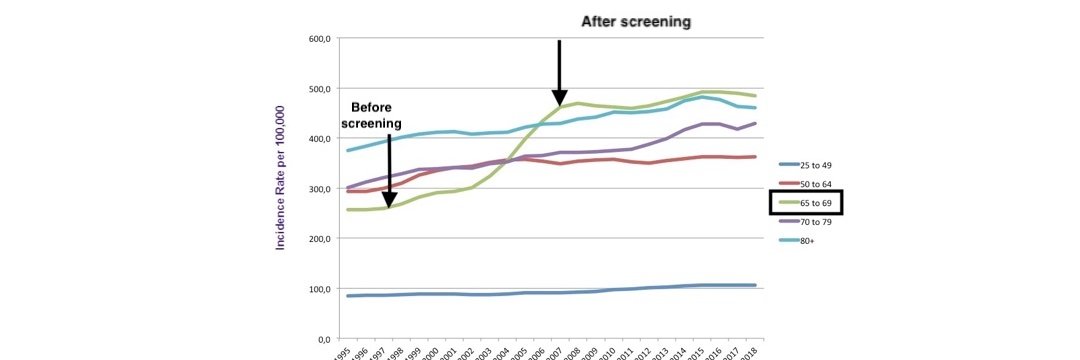
The NIH is no longer functioning: that's a fact. But it's not a funding issue. The discovery of mammography-induced cancers cost nothing, because it was made possible by analyzing existing data. Verifying these claims and ending recommendations for mammography screening would cost the NIH nothing. If such a significant problem is being ignored, even though the @NIH director, @DrJBhattacharya has been informed, it means the NIH is no longer functioning. Please RT.
Daniel Corcos tweet mediaDaniel Corcos tweet media
Jason Locasale@LocasaleLab

The “NIH is no longer functioning” narrative was always dramatically overstated. A delayed apportionment coming after a prolonged government shutdown was framed as institutional collapse rather than what it likely was: a lag in funding flow tied to broader delays in federal operations. That context was largely ignored. Instead, a handful of social influencers amplified by outlets like Science and Nature pushed a doomsday storyline that was far more dramatic than the underlying reality.

English
2
1
7
594
Daniel Corcos retweetledi
Disa Sacks
Disa Sacks@SacksDisa·
Let’s discusss the Evidence published by senior MDPhD researcher @daniel_corcos on the unsuitability of screening mammography -ionizing radiation that is actively being censored by The US Government Censorship of scientists was wrong when it was happening to you during Covid and it’s still wrong now that you are in power and part of the Government Women need the facts
English
1
2
11
574
Daniel Corcos retweetledi
Disa Sacks
Disa Sacks@SacksDisa·
Stand with @daniel_corcos who is dealing with similar( even worse) than what you are going through you are a research oncologist -perfect to review the solid Evidence that Dr Corcos posts about the unsuitability of mammography ( ionizing radiation an undisputed carcinogen) as a screening tool this debate and discussion is long overdue Any scientist complaining about government censorship ugly tactics should know they are not alone Speak out by refusing to be silent on the Data and analysis
Daniel Corcos@daniel_corcos

Career is irrelevant when dealing with criminals. Those who fired me for discovering mammography-induced cancers are cold-blooded criminals, and those who protect them are complicit.@DrJBhattacharya @DrMakaryFDA
English
1
1
2
146
Janiesaysyay
Janiesaysyay@janiesaysyay·
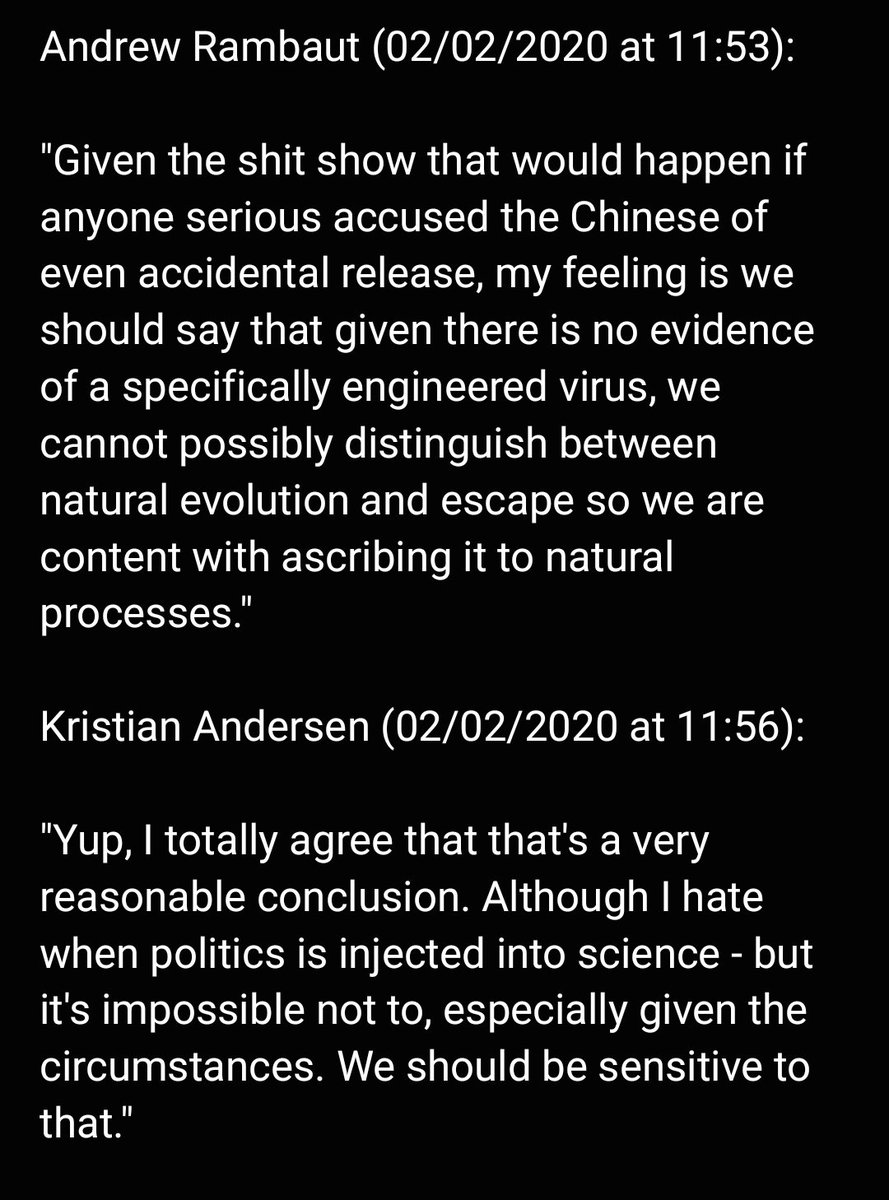
Why is the Big Lie a Big Deal? Let’s talk about why the Proximal Origins of SARS-CoV-2 📜 did damage to the scientific community and got thousands disabled and 💀 For evidence on how we know the paper is fraudulent please see @ChalesRixey @BillyBostickson #DRASTIC and many others like Richard Ebright. There are now mountains of evidence from past research papers by Ralph Baric and Shi Zhengli attempting to make a GoF SARS 🦠 just like SARS-CoV-2. There are mountains of genomic evidence that SARS2 is like no other coronavirus in history and is entirely unnatural. And, imo, the most important evidence comes from the Proximal Origins authors themselves, who first looked at the viral genome and determined it likely had a 🧪 origin and then admitted it in private emails and phone calls, while they conspired to cover that idea up in order to preserve political relations with China and shield US/China bi0weapons programs. They admitted the Big Lie was a Big Lie when they wrote the paper. 🧵
Bryce Nickels@Bryce_Nickels

🥂Happy 6-Year Anniversary to the Big Lie!🥂 6 yrs ago today, Kristian Andersen, Andrew Rambaut, Ian Lipkin, Eddie Holmes, and Robert Garry published the fraudulent “Proximal Origin” paper, which claimed to “clearly show” that SARS-CoV-2 was not a product of intentional manipulation. The now-notorious paper played a central role in spreading the false -- and pervasive -- narrative that the weight of scientific evidence ruled out a lab origin for COVID-19—a claim that Andersen and his colleagues continue to promote today. In the years since, the misconduct surrounding its creation has been publicly exposed. A taxpayer-funded congressional investigation even concluded that Proximal Origin was the product of scientific misconduct. And yet, the paper—and its authors—remain largely unaccountable. If the scientific community cannot muster enough courage to retract such an egregious fraud, they are clearly not worthy of public trust.

English
2
4
24
842
Daniel Corcos retweetledi
National Association of Scholars
"Peer review has become a way of introducing group think . . . science is in trouble and the reason it's in trouble is it's being nationalized." American science is in deep trouble, beset by multiple plagues including the irreproducibility crisis, doubts about academic integrity, turmoil over government funding, and a general erosion of public trust.
English
12
74
255
159.5K
Sigrid Bratlie
Sigrid Bratlie@sigridbratlie·
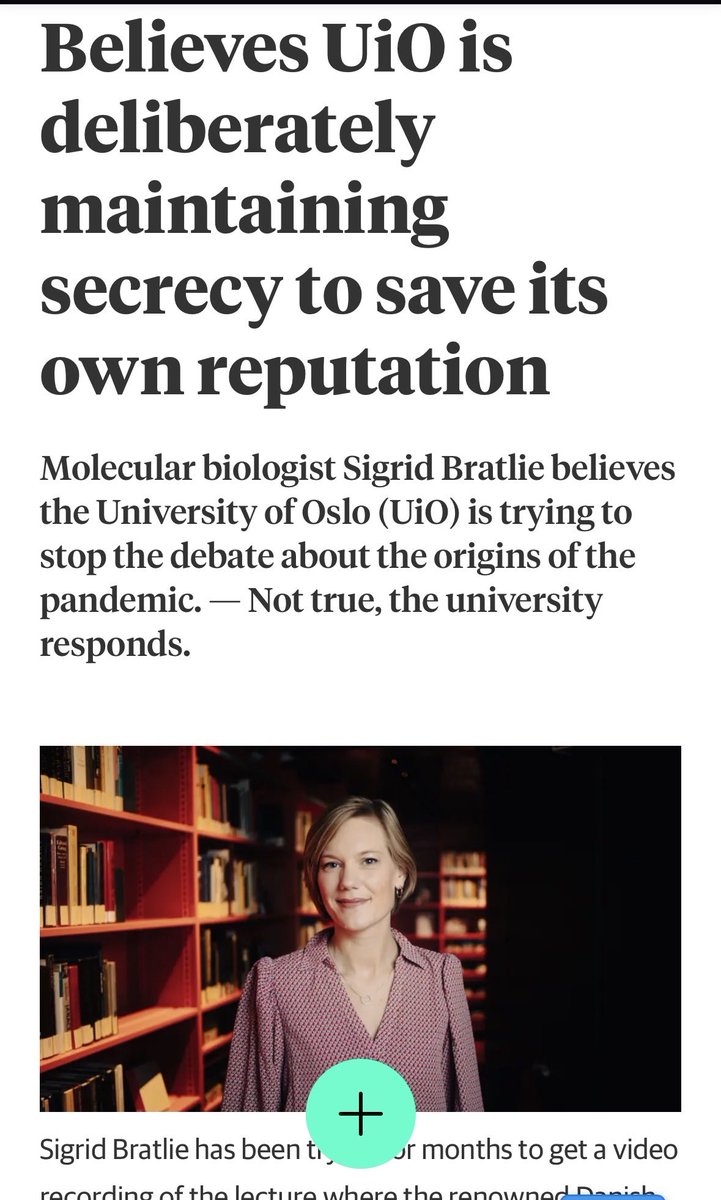
Transparency, accountability and freedom of information are among the most fundamental principles in academia, especially in a debate of significant public interest. It is therefore deeply disappointing that the University of Oslo (UiO) has spent months obstructing the release of a recording of the lecture Kristian Andersen gave about the origins of the pandemic in Oslo (organised by UiO) a year and a half ago in which he made serious allegations against me and others who have spoken out in this debate. Many who were present thought it problematic and perceived it as an attempt at intimidation. I want the recording made public so it can be subject to objective assessment and public scrutiny so I filed a freedom of information (FOIA) request. That was no easy task! UiO has searched high and low for legal grounds to deny access and avoid releasing the recording, cycling through a remarkable number of justifications: first, they argued it couldn’t be considered an official document. Then, they said it had to be protected as Andersen’s intellectual property (which is particularly ironic given that he was showing my media quotes on the screen). Next, they claimed it would be too burdensome to isolate the relevant parts of the video. And also that releasing parts of the recording would create a misleading impression. None of these arguments held up. The Norwegian Directorate for Higher Education and Skills gave me full support, in two separate appeal rounds. But the saga doesn’t end there. UiO is now attempting to circumvent the ruling. First they gave me a version of the video with a large watermark attempting to prohibit me from publishing it publicly. They have now removed it after yet another round of arguing. However, now they have redacted the video so that Andersen is cut out, claiming it is for privacy reasons. I have appealed again. It is frankly incomprehensible that an academic institution behaves this way. They have no legal basis for any of this. Either UiO’s lawyers are unable to grasp basic principles of freedom of information and privacy law — or this is a deliberate strategy to avoid accountability for something that reflects badly on the university. I strongly doubt it’s the former. But beyond the legal dimension: Andersen appeared in a public capacity, at a public event, which was already broadcast live online — and made public statements criticising named individuals and making statements that must be understood as claims and opinions in an ongoing public debate. Academics do not enjoy enhanced privacy protections compared to other public figures, and cannot retract or block others’ access to statements they have made publicly. The European Court of Human Rights has established in numerous cases that Article 8 (right to privacy) does not protect public figures’ public statements from documentation and dissemination- particularly when those statements concern other people. I should also mention that certain UiO employees have attempted to prevent me from speaking about the origins of the pandemic at other public events — by contacting organisers and asking them to remove me from the programme. This is completely unacceptable. A news feature can be read at Khrono Original Norwegian version here: khrono.no/mener-uio-driv… Google translated version here: www-khrono-no.translate.goog/mener-uio-driv…
Sigrid Bratlie tweet media
English
9
47
176
12.6K