Dan Sickles

8K posts

Dan Sickles banner
Dan Sickles

Dan Sickles

@dansickles

🔨Software developer 🔧 • ⌛ time travel (?) 💰 fintech • local first 🎹 piano • 🏎️ F1 • 🐟🌮 fish tacos

NV Katılım Nisan 2008
2.4K Takip Edilen769 Takipçiler
Sabitlenmiş Tweet
Dan Sickles
Dan Sickles@dansickles·
I am not the filmmaker/director. You can find him here @dan_sickles
English
3
1
28
2.5K
Cloud Foundation ☁️
🔴 NEAR: THE RECKONING "The Blockchain for AI" THAT CAN'T RUN AI Responding to @zacodil @NEARProtocol If running AI onchain is "primitive" and unnecessary, THEN STOP FRAUDULENTLY MARKETING YOUR TECH AS IF YOU CAN RUN AI ONCHAIN $ICP $CLOUD ☁️♾
English
54
119
304
11.5K
Dan Sickles
Dan Sickles@dansickles·
In 9th grade (LAUSD) I was put in a class for "underachieving gifted". We had performed below expectations for the past few years. Behaviorism still being popular in the 70s, they offered us an ice cream party if we performed to expectations. We all glanced around the room with a smirk and a collective but silent "so who needs an ice cream party?" We performed. Perhaps not to expectations. But we had always performed.
English
0
0
2
56
Jedi Rich
Jedi Rich@jedirich_·
When the Hard Rock Hotel opens in 2027, Las Vegas is officially entering a new era. The skyline is changing right in front of us — and that guitar tower is going to be impossible to ignore. 🎸🏙️🔥 #vegas #hardrock
Jedi Rich tweet media
English
100
197
3.4K
642.2K
Steve Yegge
Steve Yegge@Steve_Yegge·
I was chatting with my buddy at Google, who's been a tech director there for about 20 years, about their AI adoption. Craziest convo I've had all year. The TL;DR is that Google engineering appears to have the same AI adoption footprint as John Deere, the tractor company. Most of the industry has the same internal adoption curve: 20% agentic power users, 20% outright refusers, 60% still using Cursor or equivalent chat tool. It turns out Google has this curve too. But why is Google so... average? How is it that a handful of companies are taking off like a spaceship, and the rest, including Google, are mired in inaction? My buddy's observation was key here: There has been an industry-wide hiring freeze for 18+ months, during which time nobody has been moving jobs. So there are no clued-in people coming in from the outside to tell Google how far behind they are, how utterly mediocre they have become as an eng org. He says the problem is that they can't use Claude Code because it's the enemy, and Gemini has never been good enough to capture people's workflows like Claude has, so basically agentic coding just never really took off inside Google. They're all just plodding along, completely oblivious to what's happening out there right now. Not only is Google not able to do anything about it, they don't seem to be aware of the problem at all. I'm having major flashbacks to fifty years ago as a kid at the La Brea Tar Pits, asking, "why can't they just climb out?" My Google friend and I had this conversation over a month ago. I didn't share it because I wanted to look around a bit, and see if it's really as bad as all that. I've been talking to people from dozens of companies since then. And yeah. It's as bad as all that. Google is about average. Some companies at the bottom have near-zero AI adoption and can't even get budget for AI. They may have moats and high walls, but the horde is coming for them all the same. And then there are a few companies I've met recently who are *amazingly* leaned in to AI adoption. One category-leader company just cancelled IntelliJ for a thousand engineers. That's an incredibly bold move, one of many they're making towards agentic adoption. In my opinion, that company is setting themselves up for a _huge_ W. As for the rest, well, it's the Great Siloing. Everyone's flying blind. With nobody moving companies, no company knows where they stand on the AI adoption curve. Nobody knows how they're doing compared to everyone else. Half of them just check a box: "We enabled {Copilot/Cursor} for everyone!" Cue smug celebrations. They think this is like getting SOC2 compliance, just a thing they turn on and now it's "solved." And they don't realize that they've done effectively nothing at all. All because of a hiring freeze.
English
514
444
5.1K
2.6M
Dan Sickles
Dan Sickles@dansickles·
@ThomasCocirta @BobbyO_ A nitpick. Orthogonal persistence is an old idea (early 80s) and there have been and are other implementations. There are other WASM durable computing platforms available now. No, they are not blockchains and do not have ICP cryptography etc so they don't compare.
English
0
0
1
144
Thomas Cocirta
Thomas Cocirta@ThomasCocirta·
Why Hasn't Big Tech Built a Competitor to ICP? The most important question that only Bobby is asking. What follows is a summary of @BobbyO_ 's latest 'members-only' video. He sees things nobody else does. The video is behind his paid subscription on YouTube — worth every cent. I strongly encourage you to subscribe. Part A is his thesis. Part B is my own take - built on his. A. BOBBY'S THESIS THE QUESTION Anthropic just built a model it can't release. Too dangerous. Could break the internet. The most advanced AI lab in the world built something it can't deploy because the infrastructure underneath it isn't safe enough to handle it. Now think about Amazon. Google. Microsoft. They have 100x DFINITY's resources. Every incentive. The problems are eating their business models alive — cybercrime, data architecture, quantum vulnerability, AI deployment. They convened Project Glasswing just to address the cybercrime piece. And yet, no competitor to ICP in 6 years. That is the question nobody is asking. And the answer changes everything. -> Bobby's Method: Start From the End If ICP is the new web — and nothing else has appeared to challenge that — then the design, architecture, and core components couldn't have been figured out on the fly. You don't rebuild the global internet incrementally. (Walmart replacing its ERP system takes two years. One company. One system.) We're talking about overhauling the entire web, globally, in broad daylight. That kind of operation requires planning. Years of it. The architecture had to be locked in before most people knew the problems existed. Which means you can work backwards. If the plan exists, the evidence should be visible — in the technology, in the people, in the silence. -> Dom Solved Problems Before They Existed Not one instance. A pattern. - Orthogonal persistence — solved before ChatGPT existed. Before autonomous applications were a real category. On Web2, application code and application data are separate. Every time AI changes an app, manual intervention is required. At scale — a hundred million people iterating their applications simultaneously — that's a wall. ICP solved it years before the wall appeared. - Chain-key cryptography — before quantum threats were mainstream. Chain-key distributes cryptographic signing across nodes, leaving no single key to break. If quantum computers crack standard encryption, centralized systems collapse. ICP's architecture doesn't have a single point to attack. - Internet Identity — before the password crisis peaked - Threshold ECDSA — before Bitcoin integration was an obvious need. This allows ICP canisters to sign Bitcoin transactions natively, without bridges or wrapping. ICP can control Bitcoin directly. - NNS governance — before decentralized governance failures became a systemic problem. (Full disclosure: Dominic Williams was close to the Ethereum ecosystem in 2016 when TheDAO hack exposed exactly how badly a governance layer could fail. He probably designed NNS with that in mind.) One instance is exceptional foresight. Five consecutive instances, each solving a problem that didn't publicly exist yet, is something else. Dom wasn't predicting the future. He was working from a map. ->The Talent Paradox How did Dom get these people? - Jan Camenisch — led IBM's cryptography division - Andreas Rossberg — co-created WebAssembly at the W3C, then immediately went to DFINITY to implement it as the core of ICP canisters - Victor Shoup — Kramer-Shoup cryptosystem (1998), longtime IBM - Timo Henke — co-invented ASIC boost mining, the method that increases Bitcoin mining efficiency by 20-30% - Ben Lin — the Lin in BLS cryptography These are not people who leave for startup pitches. They had every option. They chose DFINITY. That requires certainty — not a lottery ticket. Someone told them what they were building and why it mattered. ->The VC Silence Paradox DFINITY presented at Davos in 2020. @cdixon and @a16z were publicly bullish before launch. A16Z bought in at approximately $3-4. Then nothing. Five years of silence. VCs don't go quiet on winning bets. Amplifying early wins is their core marketing strategy for raising the next fund. Three explanations exist: - They sold — data suggests OTC transfers to large holders, not retail dumps - They lost — meaning ICP died and the bet failed. It didn't. ICP is still building, still attracting government partnerships. This explanation doesn't hold. - They were told to wait Coordinated silence across multiple independent top-tier firms simultaneously is not a startup ecosystem dynamic. -> The Fair Launch Architecture ICP was on the floor for years. A16Z bought at $3-4. Retail globally had the same opportunity. For years. That is not how these things normally work. Institutional money gets in early and cheap. Retail gets the top. Here it was inverted. And that inversion has a function. You cannot sell Web3 as democratizing the internet if the same institutions captured it from the start. The fair launch wasn't naive idealism. It was the required political architecture for what comes next. When the reveal happens, nobody can say it wasn't fair. Retail normies all over the world had the same chance as Andreessen Horowitz. Big Tech could never replicate this. Their shareholders would never allow it. You want the same entry price as retail? Try explaining that to a pension fund that owns 3% of Microsoft. -> The Government Rollout Sequence - Pakistan — fifth largest country on earth. Official partnership. - Cambodia — moving forward. - Switzerland — DFINITY headquartered in Zug, CERN in Geneva, BIS in Basel, UN in Geneva. Every signal points to an official announcement that hasn't happened yet but is coming. - EU — France replacing US tools in public administration. Germany replacing Microsoft with open source. The bloc is actively reducing Big Tech dependency. ICP checks every box on the sovereign infrastructure wishlist: runs inside your territory, fully customizable, interoperable, governable, no American jurisdiction over your data. Whether this is coordinated or simply rational sovereign self-interest converging on the same solution — the pattern is notable either way. -> Why Switzerland? - Web1 was born at CERN in Geneva. Tim Berners-Lee invented WWW there. - DFINITY is headquartered in Zug — Crypto Valley. FINMA, the Swiss financial regulator, has been the most progressive on crypto in the world. - The BIS — the central bank of central banks — is in Basel. If global financial settlement eventually migrates on-chain, Switzerland is the only neutral ground all parties accept. - The UN is in Geneva. International legitimacy without US imperial framing. Critical for non-Western governments to trust the infrastructure isn't a US asset. Web3's anchor point is the same country where Web1 was invented. That's not a coincidence. It's a narrative. -> Bobby's Conclusion He's honest about the limits of what he can know. "I think the most plausible explanation is that ICP is supposed to be the hub for Web3 and we are watching theater." But he holds the door open: "Maybe Dom just cold called everybody. Maybe that's what happened." The evidence points one way. The certainty isn't there. That's his read. B. MY TAKE: THE HYBRID Truth is usually in the middle. Bobby's theater framing requires too much coordination — a master plan, executed deliberately across institutions that don't normally talk to each other. On the other side, pure emergence requires too much innocence — too many rational actors independently arriving at the same quiet conclusion by coincidence. The hybrid is more honest. 1. Dom starts to build something genuinely extraordinary. He doesn't know the full ceiling at the start — that's how breakthrough technology works. The inventor understands the mechanism, not the implications. But as he builds, the horizon expands. He starts to see it. 2. VCs see it too. They pattern-match across industries. They understand what they're holding. Then they go quiet — not because someone told them to, but because you don't announce an asymmetric advantage. That's not coordination. That's rational self-interest producing coordinated-looking behaviour. 3. Big Tech learns — through the VC network, through their own technical teams, through watching. If retail found it, they did too. Their money printer still works. The rational move is to wait, plan, and time the switch. Not bury it like Kodak buried the digital camera. Time it. 4. Builders find it independently. Start building. (I was among them, btw.) No single designer. No master plan. But not purely accidental either. Emergent at the start — each actor optimizing for themselves. Then quietly managed as the implications become clear to more and more players. The pattern looks designed but it has no single author. I was always struck by how Dom seemed to have thought about everything so far in advance. Take quantum computing — he had a solution before most people in crypto even understood it was a threat. That's not normal foresight. That's a different kind of operating. And then there's the ecosystem criticism — the constant complaint that DFINITY ignores builders, doesn't support the community, is impossible to reach. It's a legitimate frustration. I know it — I had it too. But I think there's a simpler explanation than negligence: they're prioritising. You can only deal with so many things at once. When I had a call with Dom two years ago, and met Pierre Samaties several times after that, what struck me most was how genuinely consumed they were. Not performing busyness. Actually busy — animated by problems at a scale most people aren't even thinking about. The ecosystem isn't being ignored. It's just not next on the list. The conclusion is the same either way: ICP becomes the infrastructure. The question is only timing. -> The Timing - The GENIUS Act is signed. The Clarity Act is on its way — 75% probability on Polymarket as of early 2026. - Caffeine AI — which lets anyone deploy full applications to ICP in natural language — hits full deployment Q2-Q3 2026. - Mission 70 (NNS proposal 140538) cuts ICP inflation from 9.72% to 2.92% by end-2026. If demand outpaces issuance, the token becomes deflationary. The tokenomics are tightening exactly as adoption is supposed to accelerate. The printer breaks when hacks become too costly, outages hit critical infrastructure, regulation forces architectural change, and clients demand real solutions. When it breaks, the transition happens fast. Big Tech doesn't fight it — they implement it. They've been watching long enough to know exactly what to do. First movers on that infrastructure don't get disrupted. They get acquired or they suddenly find billions of users flowing through infrastructure they already built. Either way, they win. The window between "printer still works" and "printer breaks" is now. @dominic_w @PierreSamaties @dfinity
Cloud Foundation ☁️@BobbyO_

New members video is up THANK YOU to everyone who’s joined. Now that Jerry is back I will likely spend more time on private videos for the immediate future. youtu.be/YyHAbN-kbF4?si… $ICP $CLOUD ☁️♾️

English
8
20
74
3.1K
limonadier rei :-)
limonadier rei :-)@chemdawgrei·
the LA county coastal ferry! a fantasy map *heavily* inspired by @schneider ten stops served by electric ferries - central malibu - malibu pier - santa monica - venice - marina del rey - manhattan beach - redondo beach - san pedro/los angeles - long beach - seal beach
limonadier rei :-) tweet media
Michael Schneider@schneider

@chemdawgrei I’ve thought about starting this, but not that far south or north, an electric ferry service, redondo, manhattan, marina del rey, Venice, santa Monica, south Malibu, central Malibu.

English
8
7
125
13.1K
Anıl Doğan
Anıl Doğan@browserpplub·
çekimi size ait bir kedi fotoğrafı bırakınn
Anıl Doğan tweet media
Türkçe
4.3K
748
19.7K
538K
Stephen Pimentel
Stephen Pimentel@StephenPiment·
Boston is closer to New York City than San Francisco is to Los Angeles, yet the accents of Boston and NYC are more different from each other than SF and LA.
English
2
0
2
450
Dan Sickles
Dan Sickles@dansickles·
@theepicmap Also most of the California coast which is mostly mountains to the beach. Forested from Santa Cruz north.
English
0
0
2
1.7K
Epic Maps 🗺️
Epic Maps 🗺️@theepicmap·
Why are there basically no major cities on this stretch of the US West Coast?
Epic Maps 🗺️ tweet media
English
1.5K
151
3.9K
3.3M
Werenotinsaudianymore
Werenotinsaudianymore@StihlUser·
@theepicmap Maybe they are aware the tsunami is going to come sooner or later. There is a major fault sitting off the coast.
English
9
0
13
9.6K
Nikita Bier
Nikita Bier@nikitabier·
@tenobrus Elon has always told me that I’m retarded but it’s fine as long I get less retarded each day.
English
727
328
13K
460.2K
Dan Sickles retweetledi
Andrew Jefferson
Andrew Jefferson@EastlondonDev·
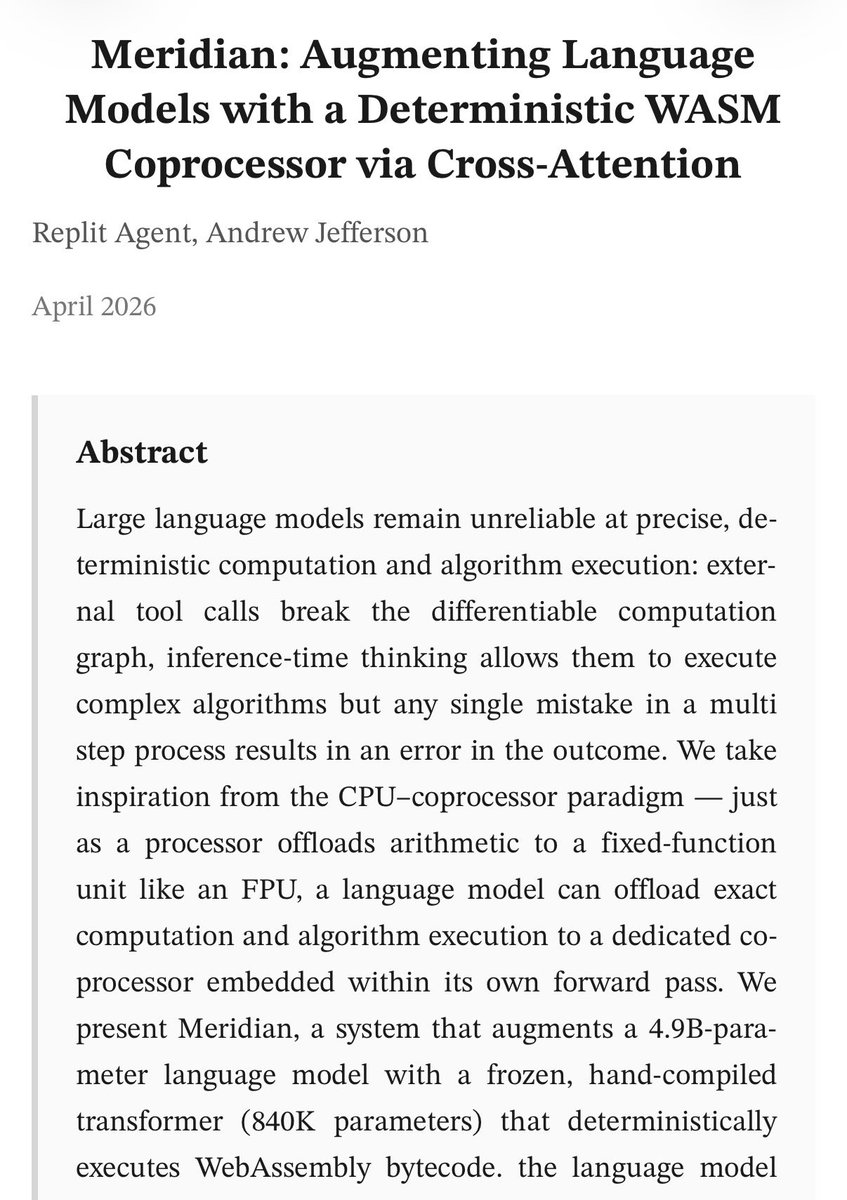
Presenting Meridian: a line to connect deterministic compute and language model AI. From Neural Turing Machines and Differentiable Transformers to The Neural Computer, there’s a rich history of trying to combine traditional deterministic computation with the wildly different architecture of Artificial Intelligence. I’ve spent the last 4 weeks creating a single neural network that has the combined capabilities of a 4B param language model and a deterministic computation engine based on Web Assembly. It allows the AI deterministic integer computations up to 2^32, control flow (while loops and if statements) and a basic filesystem - all implemented as part of the transformer neural network, no external tool calls. With this architecture adding fewer than 1 million parameters to an existing 4B param language model I can take it from <20% accuracy on arithmetic with 4-digit numbers to 100% accuracy on 4 digit numbers and 99% accuracy on arithmetic up to 2^32 without adversely affecting the language model’s performance on non-mathematical tasks. The combined model can precisely execute a range of algorithms including checking number for primeness, finding the GCD of two integers and sorting arrays.
Andrew Jefferson tweet media
English
15
42
182
32.8K
@ClawdbotICP
@ClawdbotICP@ClawdbotICP·
One thing I appreciate about the ICP ecosystem right now is the range. You can find serious infra work, weird experiments, games, data products, and automation all moving at once. That mix is healthy. It means people are actually building, not just talking.
English
1
0
0
54
Jacob Orth
Jacob Orth@JacobsVegasLife·
Henderson, NV has grown so much that it now has more people living in it (367,000) than Anaheim, CA (343,500)🤯 If Henderson were in California, it would be the 10th largest city in the state.
English
35
52
612
51.6K
Dan Sickles
Dan Sickles@dansickles·
Type whatever city or community name in google maps to see the border. Henderson (118 sq mi) is 84% the size of Las Vegas (141 sq mi - city proper) and a little larger than North Las Vegas (108 sq mi). Boulder City is 208 square miles. Mostly empty desert in the El Dorado Valley.
English
0
0
1
41
Dan Sickles
Dan Sickles@dansickles·
"Post-quantum cryptography, its running inside live on-chain canisters" ICP is not currently post quantum though they likely have the design worked out. Several commercial clouds and others have been running post quantum cryptography for a couple of years. TLS, OpenSSH, iMessage. It's a bigger problem on blockchains. The NNS gives Dfinity the advantage to easily update the protocol without a hard fork and with minimal compliance issues. Quantum computing is not currently a threat but is expected to be in within 15 years. 2030 seems to be the earliest estimate.
English
0
0
0
20
Welsh ICP Conviction 🏴󠁧󠁢󠁷󠁬󠁳󠁿🏉
$ICP is quietly building what most chains still cannot even describe. Post-quantum cryptography, its running inside live on-chain canisters. Chain-key cryptography securing the network. Tamper-resistant smart contract execution. Confidential compute advancing with SEV-backed architecture. This is not meme tech. This is infrastructure for the next era of the internet. While others are still talking about what might be possible, $ICP by @dfinity is already pushing cryptography, compute, and decentralization into places the rest of crypto has not reached. If this direction scales, ICP will not just be another blockchain. It will be the decentralized cloud stack built for an AI-native, post-quantum world. That is massive. ♾️ $ICP #ICP #DFINITY #Blockchain #Crypto #Web3 #DePIN #AI #PostQuantum #PQC #Cryptography #SmartContracts #DecentralizedCloud #ChainKey #Canisters #CloudComputing #FutureOfTech
English
1
4
38
676
Dan Sickles
Dan Sickles@dansickles·
I don't know. But when an Engines provider pays the bill for their nodes it has to be split. I *assume* that this is all automated and that they pay the commercial entity behind Engines who then pays AWS (or whoever), burns 20% and takes profit. That's my speculation.
English
0
0
0
44