David Dufty

316 posts

David Dufty banner
David Dufty

David Dufty

@daviddufty

Author, living in Canberra. coffee enjoyer.

Canberra Katılım Mayıs 2011
911 Takip Edilen222 Takipçiler
Sabitlenmiş Tweet
David Dufty
David Dufty@daviddufty·
Here's an interview with me on ABC Radio National about my new book, "Charles Todd's Magnificent Obsession: the epic race to connect Australia to the world". Thanks @AllenAndUnwin abc.net.au/listen/program…
English
1
2
6
853
David Dufty
David Dufty@daviddufty·
@BillTheKid1603 This book has not 'aged poorly' nearly as much as people claim. Even if you don't agree with his central thesis, it's a solid work with tons of interesting stuff and is worth reading.
English
0
0
6
1K
🇮🇴WilliamTheBonqueror
🇮🇴WilliamTheBonqueror@BillTheKid1603·
Jared Diamond was the first person to attempt to give a comprehensive multi disciplinary explanation for how the west became dominant that wasn't just aryan mysticism. He got things wrong and people have done better since but he undoubtedly elevated our historical understanding
isaac Samuel@rhaplord

Guns, Germs, and Steel

English
82
101
2.8K
273.2K
David Dufty
David Dufty@daviddufty·
@Danny_Lynch82 @TheCinesthetic A misunderstood and underrated movie. “But the main characters die horribly, and anyway, I didn’t like them.” That’s because it’s from the pov of the bad guys! Those two guys were the villains, whereas the hero, who triumphs against them, spends most of the movie off-screen.
English
1
0
1
18
cinesthetic.
cinesthetic.@TheCinesthetic·
A movie that's in your top 25 list but unlikely to be in anyone else's?
English
2.6K
45
766
1.7M
Joshua D Phillips
Joshua D Phillips@JoshPhillipsPhD·
Midway upon the journey of our life I found myself within a forest dark, For the straightforward pathway had been lost. Dante The Inferno Canto I
Joshua D Phillips tweet media
English
6
5
62
908
David Dufty
David Dufty@daviddufty·
@brdmu_ @Delicious_Tacos Unfortunately , the chance of any given book I’m interested in being available for loan in my local library is pretty small.
English
1
0
0
30
brdmu
brdmu@brdmu_·
@Delicious_Tacos Very well said, but to add to your point, buying a book is also paying not to read it, considering that you can borrow it from a library
English
1
0
0
67
David Dufty
David Dufty@daviddufty·
@nosilverv read the most famous Borges stories and work back from there. Garden of Forking Paths & Lottery in Babylon are his best imo. I personally found both of those quite mindblowing.
English
1
0
1
186
Ideas Guy
Ideas Guy@nosilverv·
Can someone Borges-pill me? Started reading the guy bc of all the aura that’s ascribed to him but so far seems like the laziest writer imaginable
English
37
1
89
16.3K
David Dufty
David Dufty@daviddufty·
@ESYudkowsky @Plinz The Chinese Room, at its heart, is just ‘argument from incredulity.’ It says “Look at this mindless process made up of simple transactions; who could believe it could produce anything complex or mysterious?” It fails to take emergence into account.
English
0
0
0
106
Eliezer Yudkowsky ⏹️
Eliezer Yudkowsky ⏹️@ESYudkowsky·
The Chinese Room thought experiment runs like this, updated for modern times. A man who speaks no Chinese is locked in a room. He receives a card bearing a Chinese character. The man looks up the character in a table, and retrieves 16,384 numbers, each recorded to 3 significant digits of precision. Following instructions in a rulebook, the man now multiplies those 16,384 numbers by a matrix with 16,384 rows and 16,384 columns, so 268 million entries. If he can multiply two three-digit numbers in 10 seconds, this will take him 85 years. This represents one sub-operation inside on layer of a modern LLM. Each of 100 layers might have 3-6 sub-operations like this. The man receives a series of 20 cards, with a total of 20 Chinese characters. So he repeats all of the huge sub-operations 2000 times. Some sub-operations take longer than 85 years, especially the 'attention' operations where each token collects data from all the previous tokens. The man is immortal. He cannot be bored. Many millions of years pass. The man finishes processing the original 20 cards. He now starts carrying out further operations on the numbers, that will produce hundreds of new vectors of 16384 floats, whose closest neighbors the man can look up to produce hundreds of Chinese characters. Billions of years pass. The planet and sun containing the room are as immortal as the man himself. Eventually a slip of paper slides out of the room, bearing a sequence of a few hundred Chinese characters. === Originally a woman had written "我在王府井和长安街的交叉口,需要到达颐和园": I am at the corner of Wangfujing and Chang'an and need to reach the Summer Palace. The slip of paper that emerges contains the correct directions in Chinese: subway lines, transfers, the right exit to the east gate. The woman follows them and arrives successfully. Or maybe a Chinese mathematician, working on a forthcoming math paper, had requested help on a blocked step of a math proof. She gets back a valid mathematical argument, also in Chinese, and completes her paper, which will later pass peer review and publish. === But the human male inside the Chinese room knows nothing of this, for he does not know Chinese. He only multiplied numbers according to a rulebook. He's never seen a map of Beijing. He couldn't state a single one of the axioms used by the mathematician's proof. That indeed is a valid fact, in the context of this thought experiment. But what follows from it about real life? === If you are wise, the moral of this story is that a large structure can contain knowledge that isn't in any single piece of the structure. Pick up an accurate street map of part of Beijing. Even if the map's whole structure has a good pointwise correspondence to the actual streets of Beijing, that correspondence won't be visible in a single point of ink, or the molecules making up the ink. It is formally "the fallacy of composition" to reason as if what is true of a part must be true of a whole. The man in the Chinese Room isn't particularly necessary. We could replace the pen-and-paper multiplications with bits in transistors, and then the operation of AND gates and OR gates would be simple enough to replace the man with a trained immortal dog. Or we could replace the dog with mechanical wheels and gears: stateless machinery with no internal memory at all. So the moral, if you are wise, is that a machine operating on the vast arrays of numbers that encode Chinese, does not itself need to encode Chinese inscribed on its wheels or gears. And similarly the man in the room doesn't need to understand Chinese, in order for the vast matrices to (somehow, nobody knows the details) encode a Beijing street map; or in order for giant dancing vectors of numbers to somehow understand math well enough to prove a new lemma in a new theorem. === But when Searle invented the Chinese Room thought experiment in the 1980s, the sort of AI that would *back then* pretend to talk to you, involved a handful of human-written rules for rewriting sentences. It was the sort of tiny computation that a human could do by hand in a couple of minutes, if not less. So Searle thought he had proven that, since the man in the room didn't understand Chinese -- by dint of doing that handful of rewrites, that you easily *could* contain all in your own mind and look over -- then perforce no mere computer shuffling bits should EVER be said to understand Chinese, just in virtue of it manipulating mere bits. Because there could be a person inside the room, manipulating those bits, and HE wouldn't understand Chinese. In fact this validly proves a different point, if you look at it sideways. Searle validly proved that the underlying circuit board of a GPU, that shuffles around the giant vectors and matrices, should not be said to understand Chinese. And this conclusion is true in our own world; if you look at the GPU's underlying circuit patterns, nothing about them will encode Chinese, any more than the man in the room has learned any Chinese. The map that accurately matches the territory is not in the man, and it's not in the transistor diagram for the GPU. It's the pattern of dancing numbers that can plot accurate directions through Beijing or prove a new theorem. But if you say that something about this experiment has proven that True Understanding cannot be in the vast arrays of numbers either -- by what right and law does that follow? Why wouldn't that Prove Too Much, if we're now allowed to throw around the Fallacy of Composition as if it were an inference rule rather than a fallacy? The man doesn't encode a map of Beijing in his own brain -- he will at no point remember enough numbers at once for that. So if it's a rule that "whatever is not in the man's brain, cannot be in the larger system either", then we have proven that no system of mere bits can plot new, non-memorized paths between two points in a city that it's never been asked about before; and that contradicts our own observed reality. So we cannot in general reason by the Fallacy of Composition from the man to the billions of numbers; because that would prove false things about numbers being unable to navigate streets -- or prove theorems, or drive cars, or play chess, etctera etcetera. Then there is no reason to look at this whole thought experiment, and say that it proves the billions and trillions of dancing numbers, manipulated over the eons, do not Truly Understand Chinese. === So that is what the Chinese Room thought experiment actually describes and implies, as updated for the modern era. And that contrariwise is what Searle and some other people used to think it proved, back when they thought AI meant one man applying rewrite rules from a rulebook for a couple of minutes.
English
107
89
1.2K
182.7K
David Dufty
David Dufty@daviddufty·
@_jamesmck @GENIC0N It’s brilliant. Great scifi, but also disturbing, intriguing, and with a powerful, tragic drama underpinning the story. One of his best. Maybe his best.
English
1
0
3
22
James McKinney
James McKinney@_jamesmck·
@GENIC0N Just checked out A Scanner Darkly from the library. I’ve seen the movie but never read the book.
English
2
0
3
246
Earth Is A Sales Funnel For SATAN
if you read every Philip K. Dick book and short story, you will discover they contain the genesis of half the popular ideas in science fiction
English
116
127
2.1K
59.4K
Rory McCarthy
Rory McCarthy@roryisconfused·
Cormac McCarthy Don Delillo Elizabeth Strout Tessa Hadley George Elliot Toni Morrison Frank McCourt Proust Annie Proulx Tolkein etc.
English
18
32
1.1K
80.3K
David Dufty
David Dufty@daviddufty·
@SketchesbyBoze It’s a great book but there are several expository chapters about whales, which I found a slog. When I got to the two chapters on whale heads, I thought “are you kidding me?” But no, he wasn’t. I enjoyed it overall, but Melville might have benefited from a tougher editor perhaps.
English
0
0
5
109
Boze Herrington, Library Owl 😴🧙‍♀️
Forget what you’ve heard about Moby-Dick being a slog. There are cannibal harpooners & cooks who deliver sermons to sharks. Chapters are devoted to the joys of squeezing sperm in buckets & the horror of the color white. The whole book is gloriously silly. And deranged.
Carlos That Notices Things@QuetzalPhoenix

There is a scene in Moby Dick where the whalers are just chilling in a room with dozens of lamps lit up all around them, and Melville makes the point that until this moment (the early 1800s) only kings & religious figures were able to have as much artficial light shone upon them.

English
25
31
447
17.8K
✨💜 King 💜✨
✨💜 King 💜✨@king_reinhardt·
I'm really not a fan of the whole "cut every word that isn't absolutely necessary" school of thought. Like, you're cutting out the flavor! You're gonna end up with a "chicken boiled with just the tiniest bit of salt and no other seasonings" kinda book that way!
English
46
10
202
5.2K
David Dufty
David Dufty@daviddufty·
@eigenrobot When calculators came along, educators said 'Yay! kids don't need to learn times tables any more!' That's how we discovered that, in fact, times tables are a critical step in mastering mathematics. Literacy has a bigger load-bearing role than that. The experiment is being run.
English
0
0
0
16
eigenrobot
eigenrobot@eigenrobot·
i worry about this or rather: i anticipate we're going to become a postliterate culture fairly quickly, beyond what we already are. people may still be able to read but i doubt many will in volume, or with a relationship to literature like once existed should i WORRY? idk
Kendric Tonn@kendrictonn

My go-to topic at dinner parties lately is to claim that we're standing just past the terminus of a distinct culture of reading that lasted from the early nineteen century until the release of the last Harry Potter book.

English
71
0
444
14.8K
David Dufty
David Dufty@daviddufty·
@danfaggella It’s one of my favourite science fiction novels, but it has completely dropped off the cultural radar.
English
0
1
2
26
Daniel Faggella
Daniel Faggella@danfaggella·
I have give up on science fiction almost entirely It is brute anthropocentrism through and through The limits of the medium (ie a story that hominids have to be willing to pay to read/watch) are profound It simply doesn’t explore the SUPER vast expanse of nature/mind enough
English
66
3
106
6.7K
barry pierce
barry pierce@BarryPierce·
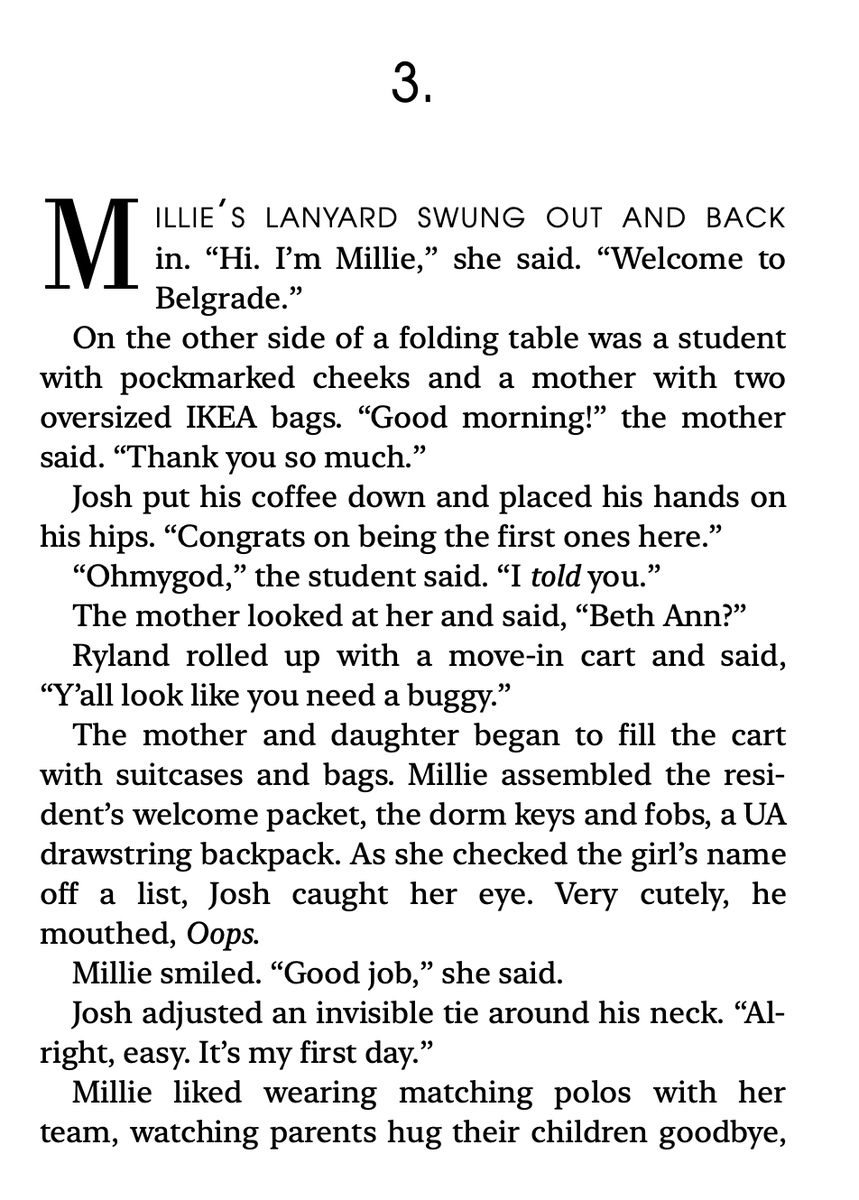
take the beginning of this chapter: this is entirely just description, as if someone were recollecting a scene from a film in an overly detailed way. this type of writing used to relegated to the fringes of genre, now it's all over literary fiction. this is not creative writing.
barry pierce tweet media
barry pierce@BarryPierce

why are so many contemporary novels just characters performing actions? followed by pithy sentences about the act of the action? there's no narrative or insight. it's this character went there and did this, this character reacts to that action, over and over.

English
151
248
4.5K
1.1M
David Dufty
David Dufty@daviddufty·
@MuseZack Raymond Chandler did this; his books were supposed to be trashy hardboiled crime novels; literally ‘pulp fiction’ (mass produced & printed on cheap paper). They are exactly that, yet somehow they are also much more. The Big Sleep; The Long Goodbye; Farewell my Lovely.
English
0
0
1
44
Zack Stentz
Zack Stentz@MuseZack·
What if someone wrote the Great American Novel, but it was like...a Star Trek novelization? Has that ever happened? A cynical corporate cash in that ended up being a beautiful and startlingly original work of art?
English
307
89
3.7K
1.3M