Dean Crash

146 posts

Dean Crash banner
Dean Crash

Dean Crash

@dcrash9

nachos !!!

moon Katılım Eylül 2012
1K Takip Edilen43 Takipçiler
Jason Fried
Jason Fried@jasonfried·
The problem with software estimates is that they're both entirely right and entirely wrong. Yes there's a 3 week version of something. And a 6 week version. And a 4 month version. And a 12 month version. That's correct. Yet, you'll almost always be wrong whichever you pick. Because estimates aren't walls — they're windows. Too easy to open and climb through to the next one. The 3 week version will turn into the 6 week version will turn into the 12 week version. You can see right through. Software that encourages you to estimate how long something will take makes it even worse. That software is part of there problem. You know which products I'm talking about. So what to do instead? Set an appetite. A appetite is like a budget. Not "we think it'll take 4 weeks" but "we're only giving it 4 weeks." That's all we've got side aside for it. Then the team tasked with the work has to get creative and figure out the 4 week version of that feature. There is no 6, 8, 10, or 12 week version when the appetite is 4 weeks. Just like there's no $7,000 vacation when you only can afford a $2500 one. And you know how that ends up if you overspend. Are there times when you need to give something another week? Maybe even two? Yes. There's some margin for that because it can only happen once per project, and it's commensurate with the time spent. You don't double the time, maybe you give it 10% more time if you need to. A little margin for error and reality is built in there. This isn't absolutist, this isn't fundamentalism. And yes, there are times when things aren't completed within the time allotted, and there's no obvious, honest path to finishing it with a touch more time. In those cases the project dies, we internalize, and hope that doesn't happen again. It rarely does here at 37signals, but it has. It's part of the cost of doing things this way. The payoff is huge, the downside is limited — that's a tradeoff we can live with.
English
47
170
1.3K
138.7K
Dean Crash retweetledi
HangukQuant
HangukQuant@HangukQuant·
🚨🚨🚨alright it's hangukquant's birthday, so I am going to do a GIVEAWAY. super long since i done one - about 20k worth of quant content to give out. here are the prizes with (# winners) I will allocate. last time I did this I got 500 signups, good luck! forms.gle/EUSUAcrbyvW8wR… all you gotta do is rt and like this, maybe comment and tell me happy birthday or that you hate me or whatever lol🤣. cheers! love you guys (some, at least) the form is here
HangukQuant tweet media
English
99
142
252
36.1K
Ed Finley–Richardson
Ed Finley–Richardson@ed_fin·
Shots fired! Finansavisen: “Øystein Stray Spetalen and Kjell Inge Røkke are charlatans, according to @XtraInvestorcom Lars Brandeggen, who believes they are acting "unfairly" towards the shareholder community.”
Ed Finley–Richardson tweet media
English
6
2
25
7.3K
Dean Crash
Dean Crash@dcrash9·
@__paleologo still capturing the factor while accounting for a premium/reversal? ps: this might be a stupid answer. pss: yes, it is. psss: sorry
English
0
0
0
477
Gappy (Giuseppe Paleologo)
Gappy (Giuseppe Paleologo)@__paleologo·
What is the *best* argument you can make to build factor portfolios from sorted characteristics (eg. Long top 1/3 cheapest stocks, short 1/3 most expensive stocks)?
English
30
5
111
70.5K
Chris Sanders 🔎 🧠
Chris Sanders 🔎 🧠@chrissanders88·
Investigation Scenario 🔎 You've discovered that a Windows file server on your network has RDP enabled. It should not have RDP enabled. What do you look for to determine if a compromise has occurred? #InvestigationPath #DFIR #SOC
English
14
15
74
18.8K
Rich Falk-Wallace
Rich Falk-Wallace@richfalkwallace·
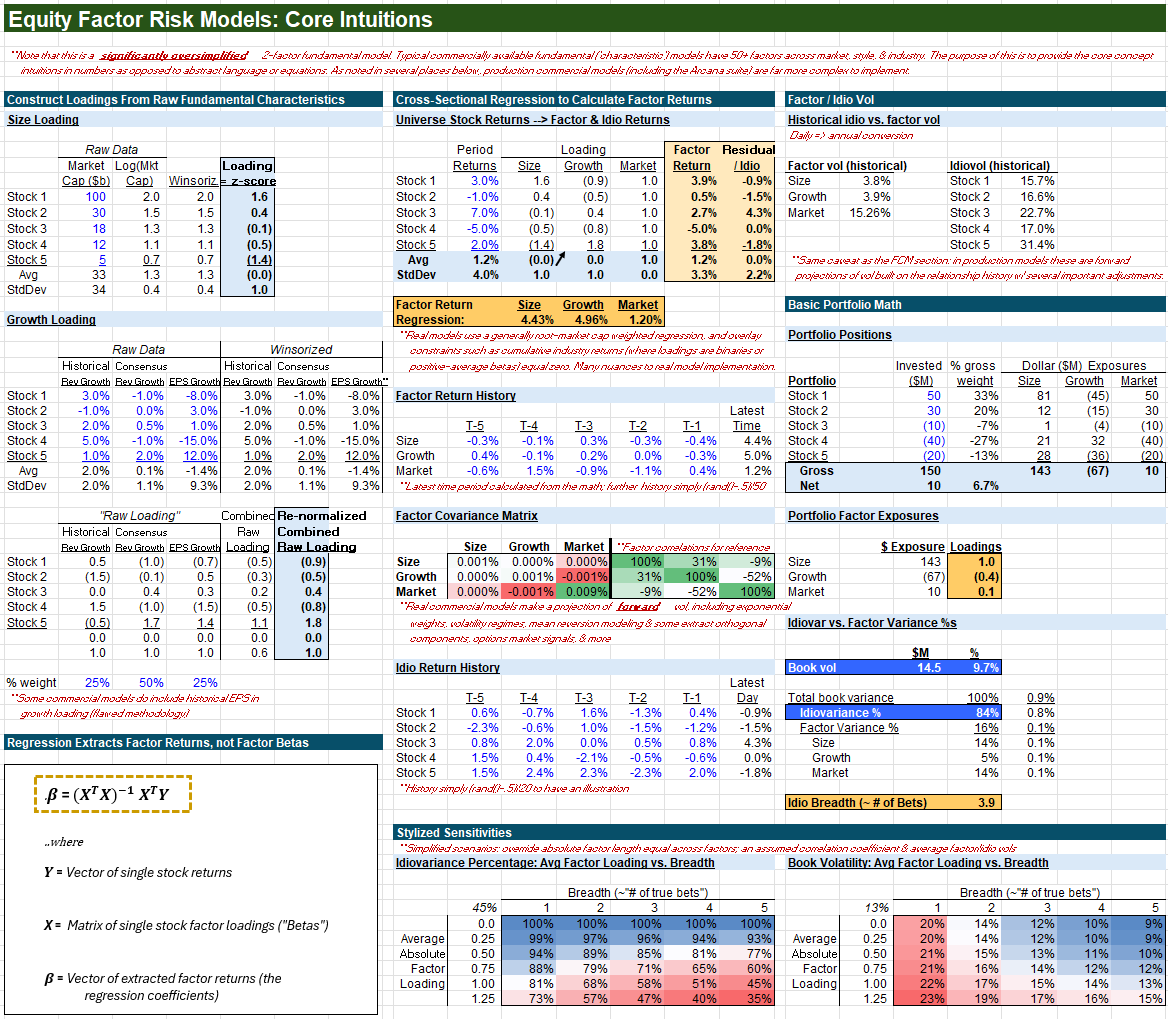
Risk models increasingly drive the behavior of fundamental long short equity investors. @__paleologo's 'Advanced Portfolio Management' is the most efficient primer to understand the internals of what is happening. Chapter 1-4 bullets, with math & comments. Let know if you'd like the excel. *1) Risk, alpha, factors, & performance (Ch 1-3)* "Any argument in favor of conflating beta and alpha is weaker than the simple argument in favor of decomposing them." In the simple version, stocks contain components of both: 1) Systematic (factor) returns driven by common attributes across names, and 2) Idiosyncratic (residual) returns driven by specific attributes of each. Most investors accept this distinction at a high level. But the nuance is: How sophisticated should your modeling of this "systematic" component be? The first intellectual step beyond simple benchmarking is to look at historical beta: running a univariate regression between stock & market. But simple betas are imprecise for several reasons, among them that they conflate one-time idio moves with recurring systematic relationships; and they also gloss over other often large systematic drivers (industry, growth, value, momentum). Factor models in principle address those limitations: If a simple benchmark "gives us a way to describe performance and variation of stock returns," the solution is "factor models[, which] capture these two intuitive facts, make it rigorous, and extend them in many directions." *2) How to build a factor model (Ch 4)* There are many flavors of plausible factor models, and Gappy outlines 3 (fundamental/characteristic, statistical, time-series). As Gappy points out: "Each of these approaches has its merits and drawbacks" and he covers several of the core tradeoffs at the outset of the chapter. But "the characteristic model has the benefit of being interpretable by the managers" and "can be extended with new characteristics and perform quite well in practical applications." The result is that "because of these two decisive advantages, the fundamental (or characteristic) method is by far the most used model by fundamental managers." To build a fundamental factor model, the starting point are company attributes which are transformed into "loadings" (betas) of a stock to that attribute's returns. For example: The "size" loading is the simplest factor, and starts with the log of the stock's market cap compared to other market caps in the universe you care about. The size loading is then its z-score (# of standard deviations away from avg) in that universe. (In the weeds, data is winzorized, may use EWMAs, and more). But armed with those loadings, the model then pulls factor returns by running cross-sectional regressions of stock returns against their loadings. Restated in math: The Y vector is each stock in the universe's return over the period, The X matrix is all of their loadings. The time series of those extracted factor returns then drives factor covariances (the FCM), residual returns, mimicking portfolios, idiovar%s, breadth, vol, and more. There is much more worth spending time on here, but particularly to arm the fundamental investor with the basic mathematical intuitions, I've attached a very simplified fundamental factor model. Will cover many other topics Gappy touches on another time: attribution, sizing skill, factor detail, PCAs & non-linearity, Sharpes & ICs, optimization, vol, & leverage. But stepping back, the reason this all matters is simple: "empirically, most PMs have no skill in style factors whatsoever, and a few have very moderate skills in having exposures to industries or sectors." The book's meta theme is intellectual honesty: "The simplest and deepest challenge is to understand the limits of your knowledge." Factor models rigorously separate what analysts can predict about single stocks, from what they cannot. As Gappy points out, "you are entering an industry in transition." Let know if you'd like the excel.
Rich Falk-Wallace tweet media
English
275
92
763
298.1K
Dean Crash
Dean Crash@dcrash9·
@__paleologo loved APM style with intro, produres, insights and takeaways for each chapter
English
0
0
2
458
Stuart Reid
Stuart Reid@StuartReid1929·
I see a lot of this on X, so I thought I would share my 2c. I think we should all be wary of "experts" who - 1) Claim to have predicted the full range of capabilities of LLMs. 2) Claim that we fully "understand" LLMs because we built them. 3) Claim with extreme confidence that they are incapable of X. Many of the current capabilities of LLMs are > emergent traits <. Emergent traits are ones that arise from the interactions of smaller, simpler elements within a larger complex system. Crucially, these traits are not predictable by analyzing the behaviour of smaller elements. They emerge through complexity. Many complex systems demonstrate emergent traits - superconductivity in materials, the organization of large ant colonies, the loss or collapse of biodiversity, the origin of multicellular organisms, financial market crashes, and even your own consciousness. Scientists study these traits in depth because they are interesting ... ... but also because they have a very hard time predicting them 🧐. If LLMs are in the same category then it is reasonable to assume that we will have a hard time predicting their emergent capabilities as we scale. This argument cuts both ways. We don't know if they will develop a kind of consciousness or sentience. We also don't know that they won't. My 2c is to be wary of experts who speak with irrevocable confidence. I, for one, am pro acceleration. I want to see what happens next. But I'm willing to acknowledge that there are limits to knowledge and foresight.
English
1
0
7
1.1K
Dean Crash
Dean Crash@dcrash9·
@Grady_Booch i think you’re wrong. it’s another perfect example of POOMA, the main and most used McKinsey consulting process. (pooma stands for Pulled Out Of My A$$).
English
0
0
2
263
Joel Rubano
Joel Rubano@TCK_JRubano·
Commodity trader goes to the beach: Sand Mine
Joel Rubano tweet media
English
3
2
34
5K
Dean Crash
Dean Crash@dcrash9·
@StuartReid1929 @senyeezus it looks like the investment is in the people (just glanced at cofounder’s past job titles)… and their future expected results
English
0
0
0
16
senyo
senyo@senyeezus·
A one year old AI startup raised $1.3 billion? Ha, let’s see how this goes
English
2
0
2
444
Dean Crash
Dean Crash@dcrash9·
@StuartReid1929 good timing… was starting to feel a bit bad, mildly, that i wasn’t listening to podcasts or missing some due to research/reading :) … so much to read…
English
1
0
1
25
Stuart Reid
Stuart Reid@StuartReid1929·
I love podcasts, but, I see them for what they are. A form of entertainment while doing dishes. Listening to people talk about {thing} is different to actually doing {thing}. There are no shortcuts on the path to mastery. You have to do the work to understand authentically.
English
3
0
8
320
Stuart Reid
Stuart Reid@StuartReid1929·
Unpopular opinion - the people with enough talent and clout to be invited onto big podcasts to talk about their work don't spend their days listening to podcasts. It's not a path to mastery. It is casual entertainment that only feels more productive than, say, Netflix. It isn't.
English
4
0
7
777
MATLAB
MATLAB@MATLAB·
Reply with 🫴 and we’ll give you a ⚙️
English
180
10
143
46K
Brad Kaellner
Brad Kaellner@bkaellner·
Doing a personal weight loss challenge Currently 218# in dad-bod form, ideal around 195# Give me your best long-term weight management practices 🔥 And feel free to join the challenge in the comments/DMs 🙌
North Carolina, USA 🇺🇸 English
82
1
41
27.7K
Stuart Reid
Stuart Reid@StuartReid1929·
Been enjoying British rap lately. What is going on 😅
English
3
0
4
692
GURGAVIN
GURGAVIN@gurgavin·
IF I GAVE YOU A MILLION RIGHT NOW AND YOU COULD ONLY BUY AND HOLD 1 STOCK FOR THE NEXT YEAR WHAT WOULD IT BE ?
English
2K
39
963
687.3K
Stuart Reid
Stuart Reid@StuartReid1929·
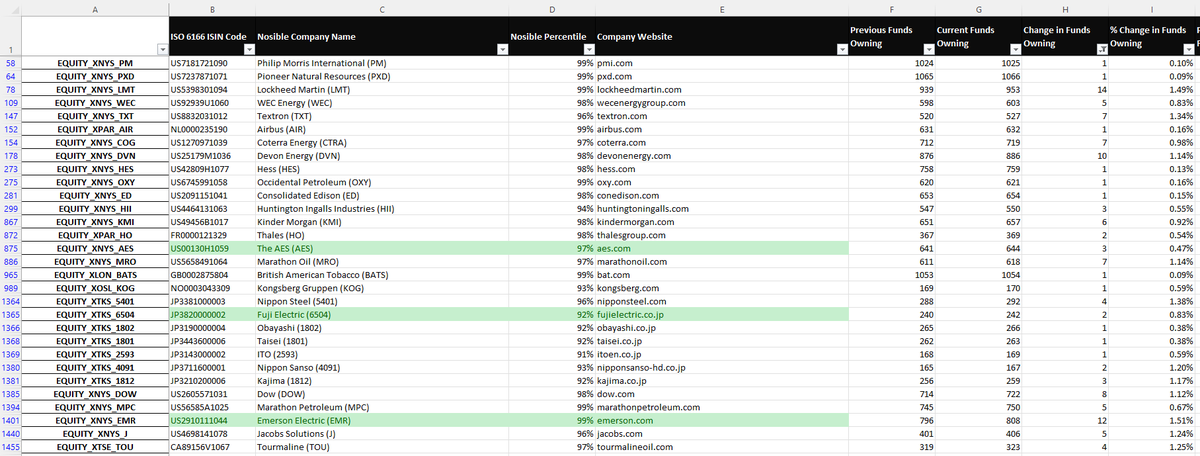
New @NosibleAI dataset. Which stocks are being bought by funds overall but sold by ESG? ESG funds are about-facing on defense and selling energy stocks they ought never to have owned! But they're also selling out of AES, Fuji Electric, & Emerson Electric. I wonder why that is?
Stuart Reid tweet media
English
3
0
4
0