

deepakalur
2.2K posts

deepakalur
@deepakalur
love building great teams & delightful products - VPE @OneMedical/Amazon - previously @OpenGov @Anaplan @Chartcube @JackBe @Sun @eBay @CMC
Oakland, CA Katılım Ekim 2008
751 Takip Edilen676 Takipçiler
we don’t talk about this much right now. but we need to understand the true economics of AI beyond the subsidized token world we are living in.
DavidLinthicum@DavidLinthicum
Agentic AI promises efficiency but beware the hidden costs. Beyond token consumption, maintaining these systems requires expensive human oversight. You might not save on resources, and initial prototypes are already being rejected due to price. #AICosts #TechTrends
English
deepakalur retweetledi

The fastest-growing companies in AI are either selling inference or reselling it. But reselling inference at cost is a zero-margin business : a payment rail, not a software company.
How do you keep 30 points of gross margin? 🧵
English
deepakalur retweetledi
Nature Magazine shows that generalized models (eg: Gemini / GPT / Opus) beat best-in-class specialist models (eg: OpenEvidence) on medical benchmarks.
This is nothing new, and can be explained in three words: The bitter lesson.

English
worth reading this and reflecting on how you’re sorting this out in your org and with your leadership
Gokul Rajaram@gokulr
THE TOKEN HANGOVER @matanSF (Matan Grinberg), CEO and co-founder of @FactoryAI , interviewed by @HarryStebbings (@20vcFund ) This is a special for me since I've been an investor in @FactoryAI since their seed round, and think Matan is a very very special founder. Summary: Grinberg argues the next 24 months in enterprise AI are a resource-allocation problem: tokens, dollars, and people. Most CIOs are now waking up to bills they cannot justify. The fix is to spend frontier tokens only on the 10-20% of work that requires planning intelligence, run the other 80-90% on open models, and rebuild teams around load-bearing polymaths who own business outcomes. The single-frontier-monopoly fear is fading: four roughly-equivalent labs is the emerging reality, which puts pricing power back in the application layer. 1. The Token Hangover. Enterprise AI adoption ran through three phases this year: boards yelling at CEOs about AI strategy, "token maxing" with AI usage written into perf reviews, and now the morning-after bill. One CIO Grinberg spoke to was spending hundreds of thousands of dollars a month on engineers asking Opus 4.8 things like "how's it going" and "what are my macros from lunch." The frontier model became the default surface for every question, no matter how trivial. Phase 3 is the moment routing matters: every call to a frontier model needs to earn its price. 2. Resource Allocation Is the Job. For the next 24 months every C-suite is solving the same problem: how to allocate dollars, tokens, and headcount against business outcomes. Engineering teams used to be judged by features shipped per quarter, a metric with no link to revenue, market share, or retention. A logistics company adding more engineers to ship more features was always solving the wrong problem; AI made the misallocation visible. Tie every person's work to the metric that actually moves the business, then re-allocate. 3. Load-Bearing Individuals. The "10x engineer" frame measures lines of code, the wrong unit. Grinberg's unit is the load-bearing individual: the person whose absence breaks something. With AI the load-bearing few compound roughly 10,000%; the others get close to nothing, so any org enforcing one token-spend-per-engineer number is painting with too wide a brush. Average token spend per engineer will land on the same order of magnitude as their salary within three years, with a wildly bimodal distribution. 4. Frontier for Decisions Only. 80-90% of software development tasks can run on open models; the remaining 10-20% is planning, where the frontier still wins. This mirrors how human orgs work: leadership is a tiny share of total hours but decides the company's fate. The ego trap is engineers assuming their work is too important for an open model. The router decides better than the engineer, and the cost curve falls only if you wire the routing. 5. The Kirkland Mistake. Kirkland & Ellis announced a $500M, five-year internal AI build, which Grinberg reads as validation for Harvey rather than a threat. Building AI is not a law firm's core competency, and Kirkland's spend will teach them how hard it is. The general rule: just because you can build it does not mean you should, and the discipline is naming the few things you and your team own end-to-end. Outsource everything else, even when you technically know how to do it yourself. 6. Model-App Separation. When the model provider also sells the app, the incentives split: an API business wants you to spend more tokens. A healthy market keeps the application layer independent, so model providers compete on price, speed, and quality every week. Enterprises do not want to vendor-lock again; every CIO carries scars from the cloud era's three-year discount-then-jack-the-price trap. The application layer survives precisely because it forces that competition. 7. Sales as Product. Name a legendary company with a weak sales or marketing team. You can't. The Silicon Valley fallacy that research sits at the top and sales is "dirty work" produces companies that win the gold rush and then collapse when gravity returns. At Factory, engineers and salespeople sit intermixed; when sales closes, engineering says "we closed"; when engineering ships, sales says "we shipped." Atrophied sales muscles will not regrow once enterprise buyers stop saying yes to everything. 8. Polymath Era. Da Vinci, Newton, Euler could be polymaths because their fields were shallow. By the 2010s a theoretical physicist needed 50 years to reach the frontier before contributing anything new. AI collapses that catch-up time, so one person can push forward developer marketing, token-caching infrastructure, and solution engineering at once. The engineer of the future is a GM who owns marketing copy, product metrics, and sales enablement. 9. Build the Factory. Factory's name is literal: engineers in the next era design the assembly line that produces software. The DevX investments that used to scale linearly with headcount (good docs, CI/CD, linters, pre-commit hooks) now scale with the number of agents you run, which is 10x or 100x larger. Every dollar spent making agents production-ready compounds against thousands of PRs a week. Humans move up the stack, from writing code to designing the system that writes code. 10. Seal Team Six. Mandating beds in the office is a hiring failure dressed up as commitment. Grinberg's image: a basketball game judged by who sweat the most, when the scoreboard is what counts. Factory bought eight sleeps for all 30 team members at the time, because recovery is where the gains come from when work requires every ounce of brain power. If your load-bearing engineer can do their best work on two hours of sleep, they were not doing load-bearing work in the first place. 11. Four Frontier Labs. Grinberg's biggest mind-change this year: a single dominant model is unlikely, and four roughly-equivalent frontier providers is the more probable steady state. That outcome is the win for humanity. A one-lab monopoly was the dangerous scenario, and four equivalent labs is also the structural bull case for the application layer because it forces real ongoing price competition. Every CIO Grinberg meets has already decided not to throw their lot in with a single provider. 12. Dario's Self-Serving Doom. "AI will take your jobs" was the pitch that helped raise hundreds of billions, and Grinberg thinks it damaged public psychology and fed the slow-AI lobby. Watch the rhetoric flip at IPO: humans will suddenly become important again, because humans are the ones buying the stock. Founders who never needed to raise that money, like Zuckerberg and Hassabis, never made that argument. Incentives drive the labor-displacement rhetoric more than philosophy does.
English
this is amazing
Tim Thimmaiah@thingsinmotion
It's time for California's housing boom. Many recent laws have made building homes easier across the state, but only a few know how to use them. We're launching @infillworks to make it simple for anyone to figure out how to add new housing to existing lots in the neighborhoods we love.
English
deepakalur retweetledi

This is the most sober and sobering analysis of AI investing that I have seen. The cannibalizing the passive flows in idices has been buzzing in my head for weeks now...
x.com/DarioCpx/statu…
JustDario@DarioCpx
To go out publicly and say what he is saying, @edzitron has balls the size of the Las Vegas sphere
English
deepakalur retweetledi

CEOs are uniquely prone to AI psychosis because they’re sufficiently distant from the last mile of work that still has to happen to generate most value with AI.
So when they play with AI, they see the happy path results, often not considering the next 10 or 20 things that have to happen to get sustainable results from agents.
“Look I made this awesome product prototype”. Yes but you didn’t have to review the code before it went into production and fix a bunch of issues.
“Look I generated a contract”. Yes but you didn’t verify all the terms before it goes out to the counterparty and didn’t have to wire up all the past contracts to work with.
The best thing you can do as a CEO is to use AI a *ton* to figure out the real implications of agents in the enterprise, and come out the other side with an appreciation for both the upside and the real work that goes into them.
Michal Malewicz@michalmalewicz
CEOs are the most delusional about AI. Detached from reality.
English
deepakalur retweetledi

The SpaceX $SPCX IPO is specifically targeting retail traders.
Is this one of the greatest retail traps of all time?
Financelot@FinanceLancelot
Well... this is a shocking chart of the SPACEX IPO They've flipped voting rights to confuse everyone: 1. Class A shares of $SPCX bought by retail with only 1 vote 2. Class B shares with 10 votes are entirely owned by Elon Musk giving him complete 81% control over the entire company
English
deepakalur retweetledi

I read all 277 pages of SpaceX's IPO filing so you don't have to.
Losses up 700%. Revenue decelerating. 107x price-to-sales multiple.
It's a trainwreck. Full breakdown below 👇
Ed Elson@edels0n
English
deepakalur retweetledi

Andrej Karpathy admits he’s struggling with AI
Stephanie Zhan@stephzhan
@karpathy and I are back! At @sequoia AI Ascent 2026. And a lot has changed. Last year, he coined “vibe coding”. This year, he’s never felt more behind as a programmer. The big shift: vibe coding raised the floor. Agentic engineering raises the ceiling. We talk about what it means to build seriously in the agent era. Not just moving faster. Building new things, with new tools, while preserving the parts that still require human taste, judgment, and understanding.
English
This is interesting. Weak defense against the great questions. Anthropic is on to something that seems to threaten the dominance. Saying it is a one off case doesn’t answer the question. A first sign of a change is always a one off case until it sets off a trend.
Dwarkesh Patel@dwarkesh_sp
The Jensen Huang episode. 0:00:00 – Is Nvidia’s biggest moat its grip on scarce supply chains? 0:16:25 – Will TPUs break Nvidia’s hold on AI compute? 0:41:06 – Why doesn’t Nvidia become a hyperscaler? 0:57:36 – Should we be selling AI chips to China? 1:35:06 – Why doesn’t Nvidia make multiple different chip architectures? Look up Dwarkesh Podcast on YouTube, Apple Podcasts, Spotify, etc. Enjoy!
English
deepakalur retweetledi

27% of employees say AI is replacing parts of their job. 21% say it’s enabling entirely new tasks.
AI is both compressing and expanding the surface area of work. But so far, most of that impact has been at the individual level.
That’s not how enterprises actually operate.
Enterprise workflows are not a collection of isolated tasks. They span multiple teams and approval flows, with context scattered across mutliple systems of record and software tools.
Leveraging AI without rethinking the org chart gives you pockets of efficiency, but not systems that improve over time.
Faster individuals don’t automatically add up to a more productive organization. The org chart itself needs to be rebuilt around AI.
In their latest p.o.v., my partners @joannezchen and @realleolu explore what that reorg actually looks like: foundationcapital.com/ideas/the-grea…

English
Great way to make the case publicly. I like Bevel’s vision of making data accessible from different wearables in a unified way. I didn’t know about Bevel until now and I’m downloading it. I don’t like the tyranny of wearable device companies on our health and wellness data.
Grey@greynguyen
@WHOOP just filed a lawsuit against us. A $10B company with 800+ employees is scared of us, a 20-person team making health tracking accessible to all. Rather than focusing on product and innovation, Whoop has decided to use its newly raised capital on lawfare. In this video, I share our side of the story, explain why their claims are baseless, and why we believe fighting back is the right thing to do.
English
deepakalur retweetledi

one of the coolest parts of this is the intelligence layer we built to figure out the best regulatory approach that makes building your home financially feasible in California
access to the information on where, how, and what can be built is important to unlock more housing where people actually want to live

Tim Thimmaiah@thingsinmotion
living near your friends is one of the best life upgrades you can make excited to launch our partnership with @livenearfriends that paves a way for anyone to create a friend compound using new missing-middle laws and our new infill design system @typefive
English
deepakalur retweetledi
living near your friends is one of the best life upgrades you can make
excited to launch our partnership with @livenearfriends that paves a way for anyone to create a friend compound using new missing-middle laws and our new infill design system @typefive
English
deepakalur retweetledi
deepakalur retweetledi

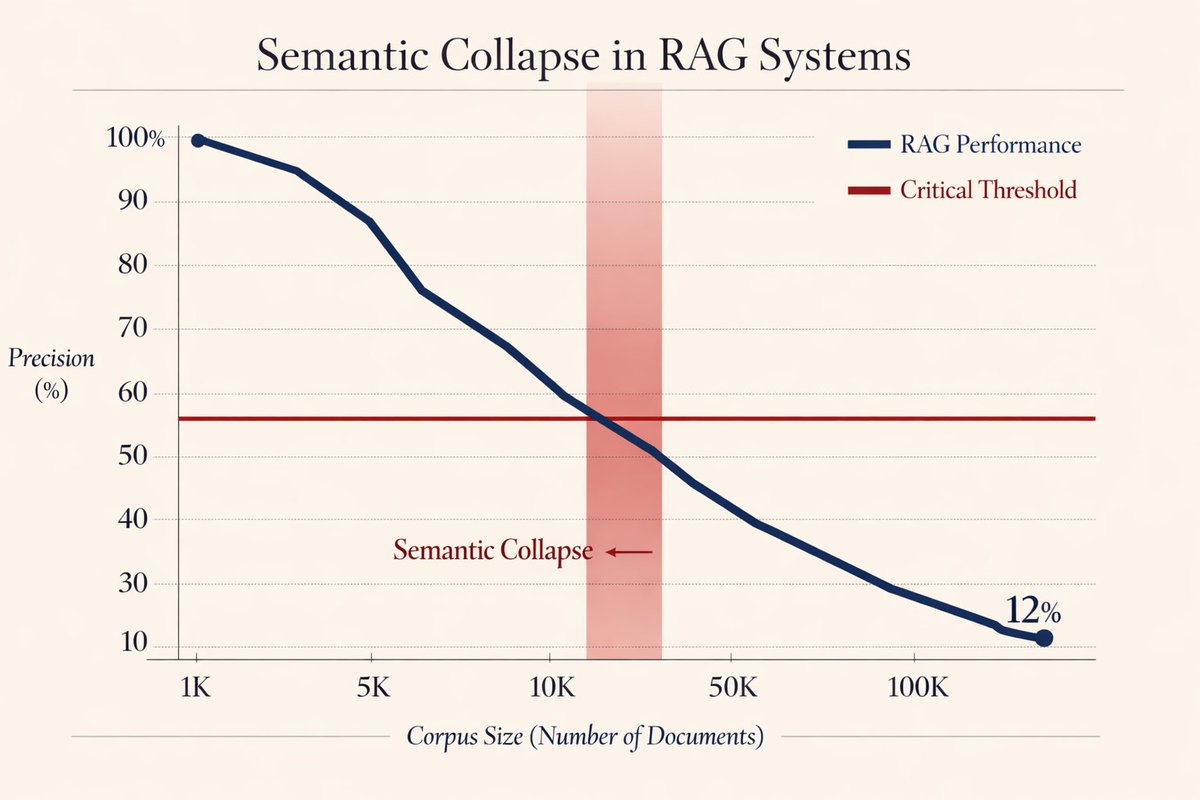
🚨 RAG is broken and nobody's talking about it.
Stanford just exposed the fatal flaw killing every "AI that reads your docs" product.
It's called "Semantic Collapse", and it happens the moment your knowledge base hits critical mass.
Here's the brutal math (and why your RAG system is already dying):
English