Derek Alia retweetledi
Derek Alia
819 posts


@derekalia
Wizarding on @muni_bio






NSF announces $1.5B NSF X-Labs initiative to pursue generational breakthrough science efforts. NSF X-Labs will scale a new generation of transformative independent research organizations to advance breakthrough science outside of traditional institutions. nsf.gov/news/nsf-annou…
NSF announces $1.5B NSF X-Labs initiative to pursue generational breakthrough science efforts. NSF X-Labs will scale a new generation of transformative independent research organizations to advance breakthrough science outside of traditional institutions. nsf.gov/news/nsf-annou…
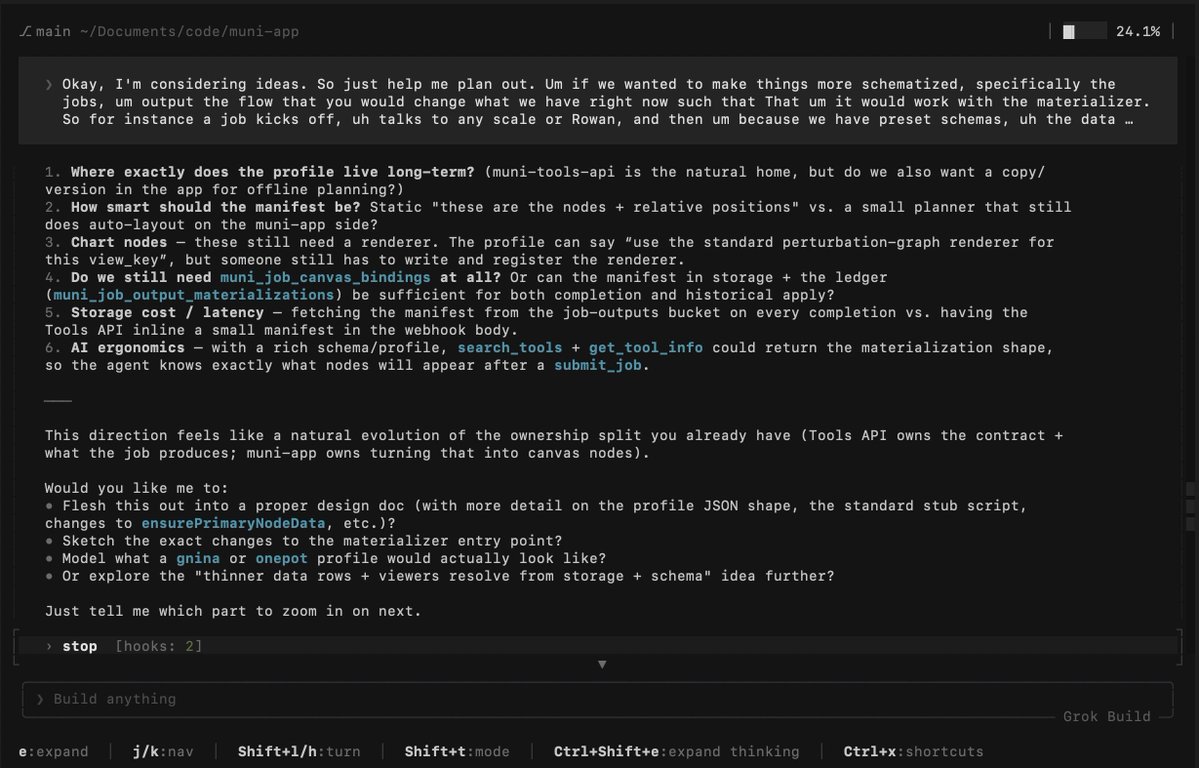
An early beta of Grok Build, an agentic CLI for coding, building apps, and automating workflows is now available for SuperGrok Heavy subscribers. Through this early beta, we will improve the model and product based on your feedback. Try it at x.ai/cli


Cluster testing is currently in progress

Underrated Ideas in Biotech (Part I) My list of writing ideas is growing far faster than I can possibly publish. So here are some "half-baked" ideas in biology that I hope others will pick up and run with. In this first blog, I share three ideas: 1. Hyperspectral Biology — It is possible to see microbes from outer space. (That sentence sounds ridiculous, but it's true.) We can now build planetary-scale networks that would enable us to engineer microbes that sense pathogens, or act as early warning systems for other threats, and monitor using satellites. 2. Biology for Beauty — Nature is often described as the most beautiful thing on Earth, far exceeding artistic works from Monet and Picasso. Yosemite and the Grand Canyon feel as if they were sculpted by the hands of God; all other art is unmistakably the work of humans. Why aren't there entire companies that (like Tiffany or Cartier) aim to make eternal art using biology? 3. Mapping the Air — Microbes can travel thousands of miles, traversing continents by riding on dust motes carried by atmospheric winds. Sand from the Sahara desert travels all the way to New York City, carrying pathogens with it. We have barely begun to study the microbes hitching rides on these atmospheric winds. On a related note: There is a growing field of AirDNA. Every time you breathe, saliva droplets are released into the air. These droplets contain DNA, which can be captured and sequenced. After the DNA settles onto the ground after about 24 hours, it gets wrapped into dust, and sits there for years. It is feasible to take the dust from a room and build a genomic record of everyone who has ever entered it. In 2023, researchers at MIT also engineered living cells to take up and permanently record DNA from their surroundings. The bacteria were sensitive enough to distinguish between two sequences differing by a single nucleotide at exceptionally low concentrations — about 4.6 femtomolar. These “sentinel” cells can be used to figure out what a person looks like, solely by storing the trace amounts of DNA they leave behind in a room. Many facial features are influenced by single-nucleotide polymorphisms (SNPs), or single-letter variants in the genome that correlate with things like nose width and eye spacing. The MIT team engineered cells to detect five facial SNPs and showed each could be detected independently. Sprayed onto a surface, these cells would capture SNPs and, once sequenced later, reveal who passed through. This is not science fiction. The authors say it directly in the paper: “we demonstrated sentinel cells on a set of five human SNPs associated with human facial features. One could record this information in a single cell or consortium, recover the DNA, and use artificial intelligence to rebuild the predicted face.” Much more: nikomc.com/essays/underra…