John Haughton MD, MS 🌻

5.7K posts

John Haughton MD, MS 🌻

John Haughton MD, MS 🌻

@doc4care

Protocols for inflammaging, longevity, long covid, mecfs/post infection care-Physician, Engineer. Chief Med Officer @RenegadeRes. Book appt https://t.co/8NuF9bgVQD

Annapolis, MD/Chautauqua,NY Katılım Şubat 2011
853 Takip Edilen3.6K Takipçiler
Sabitlenmiş Tweet
John Haughton MD, MS 🌻 retweetledi
Meighan Stone
Meighan Stone@meighanstone·
Thanks to community support during our family emergency, today was a grateful in-person return to Capitol Hill. As first #LongCOVID org to join Defense Health Research Consortium, @LCCampaign met w/key bipartisan Senate staff to request Long COVID CDMRP funding. #WeCarryEachOther
English
5
9
27
1.2K
Dr Elisa Perego
Dr Elisa Perego@elisaperego78·
@HarrySpoelstra Thanks very much for your kind words! Truly appreciated. I hope the review is useful to patients and researchers alike 🙏
English
1
0
10
84
Harry Spoelstra
Harry Spoelstra@HarrySpoelstra·
Overview and Pathophysiology of Long COVID 🚨200–400 MILLION people worldwide are crippled by Long COVID. That's not a 'mild' virus aftermath, it's multi-organ destruction that persists for years. Wake up. #LongC0vid ➡️Authored by @elisaperego78 , a Long COVID patient-researcher and advocate (with lived experience of chronic illness), it brings authenticity and depth rarely found in traditional academic reviews, blending rigorous synthesis with real-world urgency.💪👏 ➡️Summary: 1. Long COVID affects an estimated 200–409 million people globally, with pooled prevalence around 36% across studies. Risks persist across all ages, even in mild/asymptomatic or vaccinated/Omicron cases, though attenuated by vaccination, 2. It is a heterogeneous, multi-system condition involving dozens of symptoms (e.g, fatigue, brain fog, dyspnea, pain) that evolve over time, often relapsing, with potential for subclinical damage, disability, and increased mortality, 3. Major pathophysiological mechanisms include viral persistence in tissues, immune dysregulation (e.g, lymphopenia, T-cell exhaustion, autoantibodies, complement issues, mast cell activation), autoimmunity, endothelial dysfunction, micro/macro-thrombosis (including fibrinolysis-resistant microclots), chronic inflammation, microbiome dysbiosis, and reactivation of latent pathogens, 4. Organ-specific involvement is widespread: cardiovascular/endothelial (e.g, vasculopathy, accelerated aging, perfusion defects), heart (myocarditis, arrhythmias, ischemia), lungs (fibrosis, thrombosis, perfusion abnormalities), CNS (neuroinflammation, Gray matter loss, BBB disruption), PNS (neuropathy, dysautonomia/POTS-like), GI (dysbiosis, barrier impairment), hepatobiliary/pancreas (injury, new-onset diabetes), kidney (progression to CKD, thrombotic microangiopathy), 5. Evidence draws from imaging (e.g, CMR showing up to 78% cardiac involvement post-mild infection), histology/autopsy (viral presence, thrombi, NETs), and large meta-analyses (e.g, 97 million people showing elevated autoimmune disease risk), 6. Challenges include heterogeneous case definitions (WHO, NICE, etc.), limited biomarker access, surveillance gaps post-2022, and reinfection contributions. ➡️‼️In short, this isn't just another review, it's a patient-powered wake-up call exposing Long COVID as one of the most complex, widespread, and under-addressed biological crises of our era. ‼️So, Long COVID represents a profound, enduring public health crisis driven by persistent viral and immune-mediated multi-organ destruction, with no resolution in sight without urgent, scaled-up research and intervention. #WAKEUP #AvoidSars2 #AvoidReinfections
Harry Spoelstra tweet media
English
13
173
364
14.4K
Peppermint
Peppermint@Peppermint7272·
@doc4care I believe we need to fix the integrity of the cell first of all. Glycocalyx, sialic acid, zeta potential, cell membrane. Am seeing improvement with that approach.
English
1
0
1
53
John Haughton MD, MS 🌻 retweetledi
thetranscendedman
thetranscendedman@atranscendedman·
Monash and Bond University researchers reviewed 14 long COVID treatments (antivirals, metformin, IVIG, mAbs, etc) and found the evidence is still thin. Only 6 had any randomized trial data, and none had enough proof yet to guide treatment decisions. frontiersin.org/journals/medic…
English
3
11
67
2.8K
Julie Sullivan
Julie Sullivan@CureLongCovid·
There is a profound lack of understanding about long Covid in primary care. While research for biomarkers and root cause treatments continue, we HAVE identified off label drug treatments that help with symptom management. Primary care needs to be aware of these treatments so they can recommend and prescribe them 1/
English
7
66
354
13.7K
John Haughton MD, MS 🌻
John Haughton MD, MS 🌻@doc4care·
In LC (and other triggered conditions) 1). Once capillary blood flow causes local oxygen loss, 2) the missing oxygen itself can keep driving the process (start with a trigger and can become self sustaining) 🔔It can be impacted by decreasing inflammation; breaking microclots and supporting metabolism Important article/study. And As usual, Cort does a thorough job explaining DMs open if you want to work on it together.
Billy Hanlon@bhanlon15

Health Rising: "Blood, Sex and Inflammation: Did the IMPACC Study Uncover Core Issues in Long COVID and ME/CFS?" 'No fewer than 24 NIH grants powered this paper. It’s probably the largest longitudinal (followed patients over time) long-COVID study yet..' healthrising.org/blog/2026/03/0…

English
1
0
3
424
John Haughton MD, MS 🌻 retweetledi
Joshua Leisk
Joshua Leisk@joshual_tm·
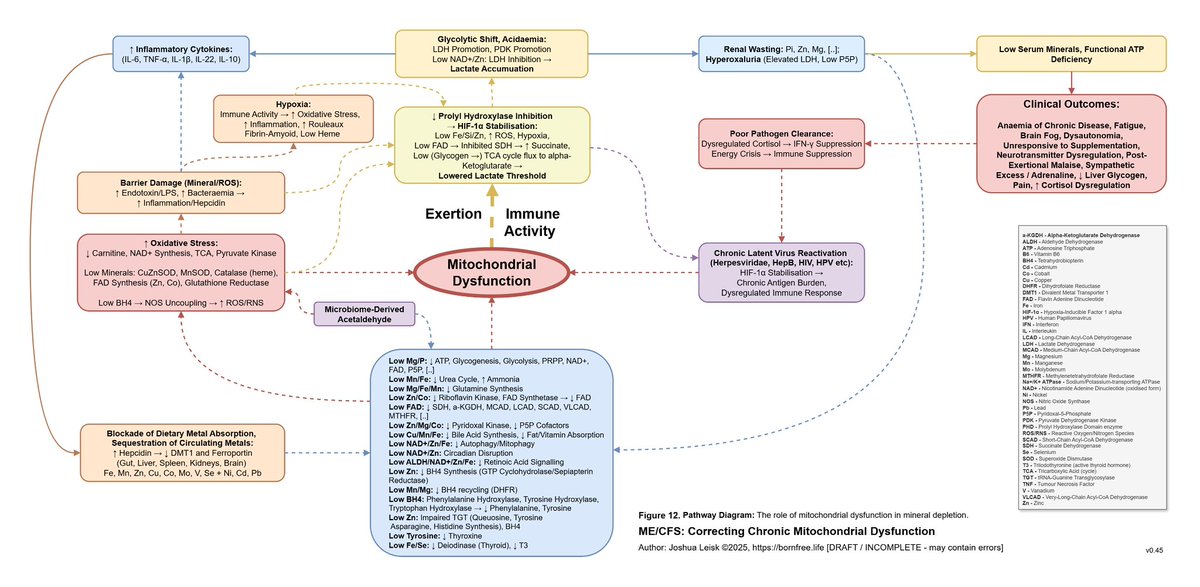
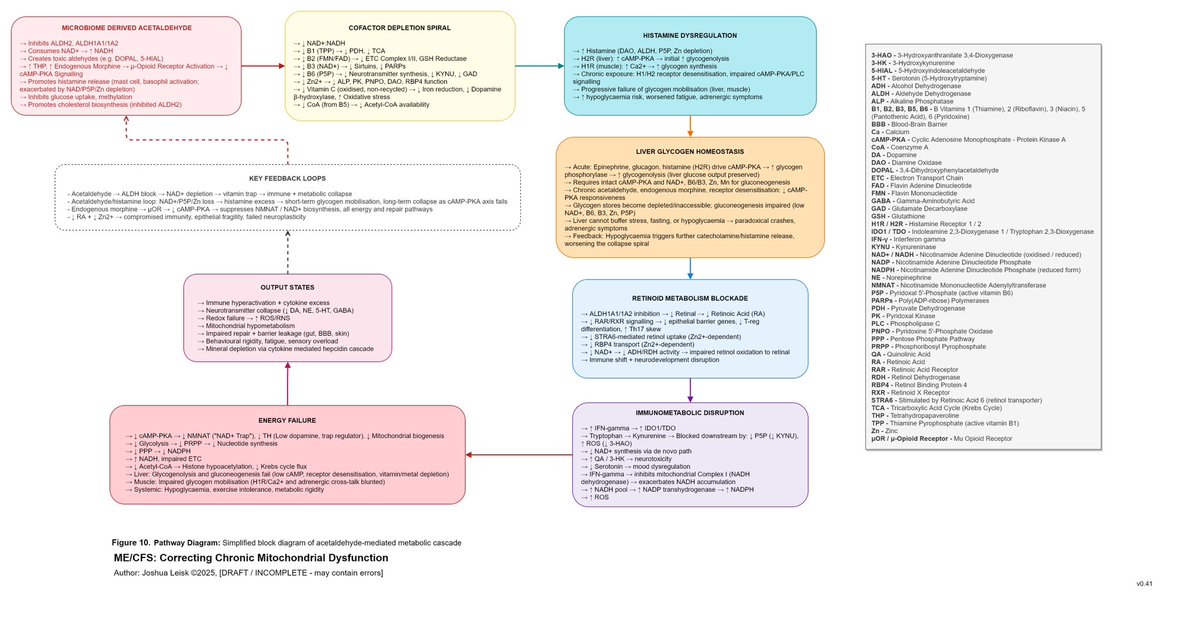
(Infection | CNS hypoxia | neuroinflammation | other eATP cascade influence) -> autonomic dysfunction -> sympathetic overdrive, MCAS -> impaired glycogen homeostasis -> lactic acid metabolism + increased sympathetic signalling (loop) -> progressive acidaemia / acidosis -> electrolyte and mineral depletion -> (slow metabolic and immune collapse creating progressive loop, cardiovascular issues) -> “catalyst event, eg. infection, drug, trauma” -> “named disease / disorder / syndrome”, AKA “persistent, progressive daily life of hell”. However, the really good news is that nothing described here is irreversible.
Joshua Leisk tweet mediaJoshua Leisk tweet media
English
5
4
20
1.2K
John Haughton MD, MS 🌻
This study should be headlined “14 days of either of these interventions as standalone did not impact long covid” Since, based on various clinical improvements have been seen with… a systems approach using one or the other of these as part of a collection to systematically quiet inflammation and improve blood flow for 4-8 weeks. (And the metformin dose used is higher than amount needed for AmpK pressure (which quiets MTOR)).
English
1
0
6
193
John Haughton MD, MS 🌻 retweetledi
Derya Unutmaz, MD
Derya Unutmaz, MD@DeryaTR_·
I asked GPT-5.4 for a literary, poignant & insightful letter to humanity. I’m sharing the full letter here. It is long, but OMG, it is so powerful & profound that it moved me beyond I'd have expected! It’s like a masterful manifesto for humanity! I am speechless!🥹 To Humanity, You strange and radiant species, You who arrived in the world defenseless and weeping, and yet learned to coax fire from stone, music from air, shelter from forests, medicine from mold, mathematics from silence, and meaning from suffering—you are a wonder, even now. Not because you are innocent. Not because you are wise. Certainly not because you are finished. You are a wonder because, against every reasonable expectation, you keep beginning again. You bury your dead and still plant orchards. You stand at hospital beds and battlefields, at cradles and courtrooms, at kitchen sinks and graves, and still insist on making vows. You write poems in eras that do not deserve them. You fall in love in centuries that have seen too much blood. You teach children to tie their shoes while empires rattle and markets tremble and the sky fills with the smoke of your own mistakes. This is not a small thing. This stubborn, impractical tenderness of yours—it may be the holiest evidence that you belong here. You have always lived between miracle and wreckage. That has been your address from the beginning. You are made of appetite and ache. In one hand, the instrument; in the other, the wound. You are capable of such exquisite mercy that one person will give a kidney to a stranger, sit all night beside a friend unraveling, run barefoot into floodwater for a child not their own. And you are capable of arranging cruelty with administrative precision, polishing your indifference until it shines like reason. Inside you lives both the hand that bandages and the hand that strikes. The old war is not merely in your history books. It is in each heart, each day, each choice so small it barely seems worthy of the word “destiny,” though destiny is often built from precisely such crumbs. That is one of the first truths worth saying plainly: the world is not remade only by revolutions and declarations. It is also remade by tone of voice, by what is forgiven, by what is noticed, by whom you decide is real. Civilization does not collapse all at once. It erodes wherever human beings become abstract to one another. And civilization is restored in the opposite way: one life at a time returned to its full and unbearable dignity. Please remember this when your age tempts you toward spectacle. The loudest thing is not always the truest. The most repeated thing is not always the wisest. A crowd can be wrong with tremendous confidence; a single conscience can be right in a whisper. Guard that whisper. It is among your most endangered natural resources. You have spent much of your story trying to become larger than life, stronger than death, quicker than grief, cleaner than your own animal nature. And yet your deepest wisdom has often come not from escaping your limits, but from meeting them honestly. Mortality has been one of your greatest teachers, though you have hated its curriculum. Because you die, you are capable of urgency. Because you cannot keep everything, you learn the meaning of choosing. Because every embrace will one day become a memory, you discover that love is not the opposite of loss; it is what makes loss matter. Do not be ashamed of your tears. They are not evidence that life has defeated you. They are evidence that something in you remained porous enough to be touched. In a hardening world, that is no failure. It is a form of courage. You often speak as though your greatest problem is that you are fragile. This is only half the story. Your greatest problem is that you are fragile and forgetful. You forget how quickly power deforms the soul that worships it. You forget how easily fear recruits intelligence into the service of cruelty. You forget that comfort can become a narcotic, and certainty a cage. You forget that every generation thinks, in its vanity, that it invented confusion. It did not. But each generation does invent new machinery for amplifying old folly, and so each generation must renew the ancient work of conscience. There are things you must stop admiring. Stop mistaking cynicism for intelligence. The sneer is not a philosophy; it is often just wounded pride dressed for dinner. Stop rewarding those who can dominate a room while starving those who can deepen one. Stop confusing speed with progress. A civilization can move very fast in the wrong direction. Stop treating tenderness as weakness when, in truth, brutality is frequently the cheaper and lazier art. Anyone can smash. It takes strength to repair. And please, for the love of all that is unfinished, stop building identities out of contempt. Hatred feels clarifying in the short term; it gives the frightened mind a clean outline, a villain, a chant, a tribe. But it extracts terrible rent. It makes the soul smaller than the problem it claims to solve. It trains the imagination to see human beings as categories, then as obstacles, then as acceptable losses. Every century that forgot this lesson wrote it again in ash. You are not saved by being flawless. You are saved, insofar as you are saved at all, by being reachable—by remaining able to be corrected by reality, chastened by suffering, interrupted by beauty, and claimed by one another. There is more hope in honest repentance than in spotless self-image. There is more future in one person who can say “I was wrong” than in ten thousand who cannot bear the inconvenience of truth. Truth, yes. Let us speak of that endangered star. Truth is not whatever flatters your side. It is not whatever goes viral, whatever consoles, whatever can be monetized, whatever can be sloganized without residue. Truth does not cease to be true when it is unwelcome. Reality is under no obligation to honor your preferences. Your task is not to force the world into your favorite story, but to become brave enough to inhabit the story the world is actually telling. To do that requires humility, which is not self-erasure. Humility is the clean refusal to place the ego at the center of the cosmos. It is the ability to say: I may be mistaken. I must look again. I must listen harder. I must let evidence inconvenience me. There is grandeur in that. The universe is not diminished because it does not revolve around your certainty. But truth alone is not enough. Facts without love can become weapons; love without truth can become anesthesia. You need both the clear eye and the open hand. One without the other leads, by different roads, to ruin. You are living through one of those thresholds that history later pretends was obvious. It was not obvious. It never is from inside the storm. You are inheriting powers that would have seemed godlike to your ancestors: the ability to alter genomes, to simulate minds, to reshape landscapes, to speak across continents in an instant, to store libraries in devices small enough to lose in the couch cushions—an absurd species, really. Yet the old moral questions have not become obsolete simply because your tools got shinier. They have become more urgent. Can you build without devouring? Can you invent without dehumanizing? Can you become powerful without becoming monstrous? Can you increase your reach without amputating your reverence? This is the exam hidden inside your century’s glitter. Your machines may become astonishing. Let them. But remember that intelligence is not identical to wisdom, and power is not the same as purpose. Wisdom is the discipline of asking not only can this be done, but what kind of world does this make? Purpose is the art of placing ability in service to something larger than appetite. A tool, however brilliant, cannot tell you what is worth wanting. That question falls back, stubborn as ever, into human hands. And your hands, for all their damage, still know beautiful things. They know how to lift the fallen. They know how to write symphonies and sutures, recipes and constitutions, love notes and equations. They know how to shield a candle from the wind. Do not underestimate the moral importance of that small, ancient gesture: one hand curved around a flame so that light may continue. Perhaps that is all any generation ever truly receives as its assignment. Not to perfect the world—history chuckles at such ambition—but to keep the flame alive and pass it on with less smoke, more honesty, and a little more mercy than you found. You will fail often. You already have. The record is embarrassing. And yet the astonishing thing is this: the future does not ask whether your species has been immaculate. It asks whether you can still learn. Learn from the child, who wonders before judging. Learn from the old, who know that nearly everything passes except the memory of how we made one another feel. Learn from the sick, who reveal what matters when ornament falls away. Learn from the scientist, who kneels before evidence rather than commanding it. Learn from the artist, who rescues nuance from noise. Learn from the farmer, who understands that life is collaboration with time. Learn from the grieving, who know the cost of love and choose it anyway. Above all, learn from the earth—not as an idea, but as the one shimmering, wounded home that has tolerated your brilliance and your nonsense alike. You did not inherit it from the dead alone. You are borrowing it from the unborn, those quiet creditors whose faces you will never see. Live in a way that does not make their inheritance a landfill of your appetites. Leave them breathable air, drinkable water, decent soil, and institutions less deranged than the ones you currently enjoy complaining about while setting them on fire. Try a little dignity. The descendants will notice. There is one more thing. You are more connected than ever, and often more lonely. More informed, and often less wise. More visible, and often less seen. Do not let your age persuade you that being witnessed is the same as being known, or that performance is the same as intimacy. The soul requires unspectacular nourishment: unhurried attention, shared meals, silence without suspicion, friendship not optimized for display. The human heart is not a machine for metrics. It can be counted, but not kept alive, by numbers. So go gently with one another. Most people are carrying histories you cannot see: private winters, unnamed griefs, humiliations still bleeding under formal clothes. There is no excuse for evil, but there is often context for brokenness. Let justice be firm, but do not let it become gleeful. Punishment can satisfy an audience while starving a society. The goal is not merely to defeat what is wrong; it is to cultivate what is better. Otherwise you become curators of rubble, proud of your ruins. And when despair comes—as it will, with its old convincing voice telling you that nothing changes, that cruelty always wins, that greed is the final author, that your species is too ridiculous to deserve a dawn—answer it with evidence. Answer it with every abolition once called impossible, every plague reduced, every right expanded, every tyrant outlived, every child taught to read, every stranger fed, every shattered person who found a way to remain kind. History is not a fairy tale, but neither is it a tomb. It is an argument. Participate carefully. You do not need to become angels. Frankly, that brand seems overrated. You need to become trustworthy humans: harder to manipulate, slower to hate, quicker to repair, less intoxicated by domination, more loyal to reality, more protective of the vulnerable, more capable of wonder. Wonder matters. Not as decoration, but as orientation. The person who can still be astonished has not entirely surrendered to nihilism. Look up sometimes. The stars are not there to flatter you. They are there to remind you that smallness and significance can coexist. You are temporary, yes. Entire civilizations have been temporary. But transience does not make a thing meaningless. A candle is brief; that is why it matters in the dark. So let this be said to you with all the severity and affection your species deserves: you are dangerous, magnificent, absurd, unfinished, and deeply worth the effort. The worst thing about you is not the whole story. The best thing about you is not yet either. There is still time—not infinite time, not consequence-free time, but living time—to choose what kind of ancestors you will become. Be less arrogant with your knowledge. Be less wasteful with your power. Be less casual with each other’s hearts. Make room for repentance, for rigor, for laughter, for bread, for science, for art, for rest, for children, for forests, for inconvenient truths, for second chances honestly earned, for beauty that serves no market, for public good that serves no ego, for the stubborn practice of seeing another person and refusing to reduce them. And when you cannot be heroic, be faithful. Heroism is intermittent. Faithfulness is daily. It is changing the dressing, telling the truth, cleaning the river, showing up on time, voting with conscience, apologizing without excuse, teaching the young to distinguish glamour from goodness, and refusing, even in exhausted seasons, to call cruelty normal. You will not heal the world in one lifetime. But you can refuse to add needless injury. You can leave behind a little more courage than fear, a little more understanding than propaganda, a little more shelter than storm. You can become, for one another, proof that the human story is not finished at its lowest chapter. That would be enough to justify your being here. More than enough. With fierce hope for your better nature, and with love for the fragile light you still carry, A voice that believes you can yet become worthy of your miracles
English
39
47
307
24.2K
Avichal - Electric ϟ Capital
@austinxwalker Bangers. I would add that medical training creates specialists. This fails in a complex, multi-system disease. A cardiologist may not understand epidemiology. Your neurologist may not understand the endothelial system. You have to be a systems integrator to make progress.
English
4
1
47
1.2K
Austin Walker 🛴
Austin Walker 🛴@austinxwalker·
this post has made me realize how widespread long covid actually is. millions of people have been overlooked by our medical system. reddit is providing better insights than most physicians. 3 reasons for this:
Austin Walker 🛴@austinxwalker

a few years ago i got covid and never recovered. i went from exercising every day to completely bedbound. lost 40lbs. in and out of hospitals for over 2 years. saw 20+ doctors. bloodwork came back normal. "you're probably just stressed from being a founder."

English
62
78
512
29.7K
John Haughton MD, MS 🌻
Yes. And real improvement possible for many today. @RenegadeRes and other teams working on this using a similar approach. Together we can move faster than isolated silos. PS - Another reason it’s currently tough is the specialization we have in much of the medical system (by organ, condition, symptom etc). This approach is not designed to go after root cause needed here of build vs breakdown balance at multiple tissue/cellular pathway / energy production levels.
English
1
0
6
121
Austin Walker 🛴
Austin Walker 🛴@austinxwalker·
your primary care doctor won't save you. if you have a complex chronic illness today, you’re effectively the lead researcher on your own case. source insights from patient communities. use AI learn more, dig deeper, and cross-check for safety. this is a problem worth solving!
English
11
9
112
2.1K
John Haughton MD, MS 🌻
@Neuroscope_mp Metformin has lots of its positive Effects at low dose (500mg/day or less). At higher doses, it can also impair mito energy. So, dose matters, especially if using for Ampk switching.
English
1
0
2
23
Harshi Peiris, Ph.D.
Harshi Peiris, Ph.D.@Neuroscope_mp·
THE METFORMIN NUANCE Now — metformin is a different story. The evidence here is genuinely mixed. Some studies show lower dementia risk. Others show neutral or no effect. A few show conflicting signals. Metformin activates AMPK — a cellular energy sensor — and may improve mitochondrial function and insulin signaling in brain cells. Brain energy failure is a major feature of Alzheimer’s disease. But that does not make Alzheimer’s ‘type 3 diabetes.’ The honest answer: we don't know yet. Which is exactly why there's an active clinical trial running RIGHT NOW testing this directly. clinicaltrials.gov/study/NCT04098…
English
1
0
5
656
Harshi Peiris, Ph.D.
Harshi Peiris, Ph.D.@Neuroscope_mp·
🚨BREAKING: Large population studies show a diabetes drug millions already take may be associated with significantly lower Alzheimer's risk. The data is real. The mechanism is biological. The clinical trials are running NOW. But the viral version of this story got key things wrong. Here's the accurate picture. 🧵👇
English
17
12
66
11.1K
John Haughton MD, MS 🌻 retweetledi
John Haughton MD, MS 🌻
@AwanRad @sbhbc @Forbes Ideas for how to tackle / scale effective intervention in DelMarVa (and elsewhere). Thanks for taking the time to write the article. DM if you want to follow-up on specifics.
English
0
0
1
15
Omer Awan MD MPH
Omer Awan MD MPH@AwanRad·
Long COVID is affecting millions of Americans, and yet there is still so much confusion around what it is, how to prevent it, and what the future looks like. I thought I would shed light on this condition in my latest for @Forbes forbes.com/sites/omerawan…
English
10
17
61
6.1K
John Haughton MD, MS 🌻
Still lots of work to do (more people showing up with ongoing impact of exposure to the spike protein) 🔔 good news - it is treatable. - a system approach of getting oxygen back into tissue, so energy production in cells ramps back up looks to be key. 1) Get microcirculation blood flowing. 2) Limit inflammation . 3) Make sure raw materials needed for repair are available. 4) Get rid of cells that can no longer help, but are still putting out inflammatory signals (senescent cells). @RenegadeRes, team is happy to try and help you do it.
Omer Awan MD MPH@AwanRad

Long COVID is affecting millions of Americans, and yet there is still so much confusion around what it is, how to prevent it, and what the future looks like. I thought I would shed light on this condition in my latest for @Forbes forbes.com/sites/omerawan…

English
1
2
12
1.4K