Nitin Joshi

90.6K posts

Nitin Joshi banner
Nitin Joshi

Nitin Joshi

@duramount

Katılım Ocak 2014
587 Takip Edilen432 Takipçiler
PRARTHANA SINGH
PRARTHANA SINGH@PrarthaSingh83·
गाजियाबाद,सूर्या के मौत पर हँस रहा मुस्लिम समाज,क्या इंसानियत भी मर गयी है इनके अंदर😡😡
हिन्दी
81
1.9K
5.1K
91K
Nitin Joshi retweetledi
Kashmiri Hindu
Kashmiri Hindu@BattaKashmiri·
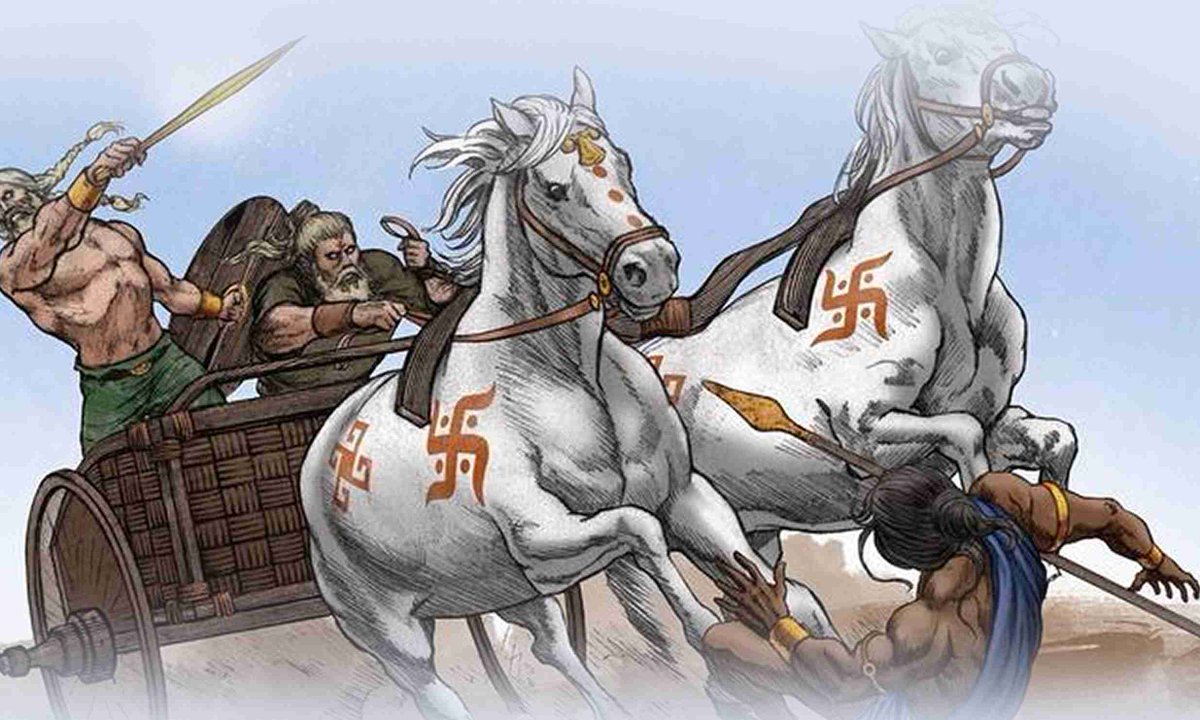
In the North, you’ll find Kashi and Kedarnath. In the South, Srisailam. In the East, Puri. In the West, Somnath. Across the country, you’ll find the hands of Maa Ahilyabai, quietly rebuilding, preserving, and shaping the identity of Bharat - The Hindu Rashtra #AhilyabaiHolkar
Kashmiri Hindu tweet media
English
22
757
1.7K
12K
Nitin Joshi retweetledi
Mohit Sharma
Mohit Sharma@Awara013·
@Muslim_ITCell Not allegedly? Madarcho* Asad was a terrorist, who killed Hindu boy Instead of tweeting for Surya, you are supporting that terrorist No wonder, Islam is a religion of terrorists
English
6
14
240
4K
Phoenix🇮🇳
Phoenix🇮🇳@sharma02neeraj·
@Muslim_ITCell Don’t argue! Asad tried to retaliate & opened fire against UP police when they tried to catch him. In self defence UP police fired back and he got killed. Case close
English
1
0
0
367
Muslim IT Cell
Muslim IT Cell@Muslim_ITCell·
Ghaziabad, Yogi's Uttar Pradesh. The Uttar Pradesh Police gunned down the suspect Asad during a reported encounter. Asad and his associates were allegedly responsible for the murder of Surya Chauhan, whom they stabbed repeatedly with knives. Why no arrest? Why no court? Why bullets every time a Muslim name appears? #IndianMuslims
Muslim IT Cell tweet mediaMuslim IT Cell tweet media
English
699
121
454
68.4K
@Ram_Mohd_Singh_Azad
@Ram_Mohd_Singh_Azad@Arun_Kaku05·
The word Sanatan has its origins in Paali which was Language of Buddhists. Hindus have got nothing to do with Sanatan.
English
4
2
13
361
Ⓡⓐⓜⓐⓝ Ⓢⓘⓝⓖⓗ
Who was King Kuru? Subcontinental history is mostly speculative. Historical connections are ignored to protect other hypotheses. King Kuru is none other than Cyrus the Great. His name on Elamite inscriptions is Kūruš (𐎤𐎢𐎽𐎢𐏁) or Kuru. Kuru means Like the Sun
Ⓡⓐⓜⓐⓝ Ⓢⓘⓝⓖⓗ tweet media
MD Umair Khan@MDUmairKh

Professor David Miano, a prominent historian and archaeologist, explains why the Indus Valley in Pakistan and the Ganga-Yamuna in India are two different civilisations.

English
1
1
9
779
Nawab Asad Jutt
Nawab Asad Jutt@nawabasadjutt·
Pakistanis claiming the legacy of the Indus Valley Civilization and taking pride in that ancient heritage have left Indian nationalists scrambling overnight. It has given them a sudden, unpredictable wave of inferior complexity that they never thought of. A narrative that was rarely challenged is now facing serious competition from the people who inhabit the land where most of the civilization's major sites are located. That's what you call a masterstroke.
English
9
6
25
1K
traveller
traveller@soulrambler_·
Undeniable facts: >Without the Bhakti movement, India would have been an Islamic country. >North Indians lost Afghanistan, “Pakistan”, “Bangladesh” & didn't help Persia. >South Indians kept the entire India economically & culturally alive. These are scientific facts.
English
21
12
128
7.5K
Nitin Joshi
Nitin Joshi@duramount·
@DrDavidMiano Its very difficult @ProfVemsani For a white ( the commandments oriented person) to understand multi faith hinduism All converging in one
English
0
0
0
51
David Miano
David Miano@DrDavidMiano·
This is a good example of the historian's fallacy, in which events of the past are judged by what we have in our own time. In this example, it is assumed that the multiple versions of gods and goddesses have existed that way since the beginning, and not that different gods and goddesses were combined over time, which is what we commonly see through history in many countries. This fallacy happens most often with religion, because present-day adherents assume that the way it is now is the way it always has been, but only with their own faith and not that of others. It can happen even to someone holding a Ph.D., if their belief system is stronger than their devotion to the historical method. This person even goes so far as to accuse historians who look at her religion in a secular fashion as "colonialist," even though they approach all religions this way.
Dr. Lavanya Vemsani Ph.D.@ProfVemsani

They can’t understand the phenomenon of multiple names: it’s our most signature feature. We have multiple names, our gods and goddesses have multiple names and our nation has multiple names. Everything in this land has multiple names. Each name represents one unique feature of the same, but they think each name is a separate divine/entity. There is inadvertent or intentional disjunction in their thought. #ColonizedMinds cannot comprehend the truth unless they remove their colonialist frameworks.

English
48
22
95
14.4K
Rakhshanda Jalil
Rakhshanda Jalil@RakhshandaJalil·
Did they actually listen to the song? The lyrics are in URDU!!!! And it mentions JANNAT where the faithful and the devout go! And Tabeez! And Ayaat!!! And KALMA, the Muslim proclanation of Faith !!! Shudder! Shudder!
Nikhil saini@iNikhilsaini

Only question: why can’t we just act normal when we’re abroad? Foreign jaate hi sabka dance kyun bahr ane lagta hai ? Why do we feel the need to stand out everywhere across the globe? Everyone else is sitting quietly and enjoying the moment, but our people somehow have to pull out a full Chaiyya Chaiyya performance.
English
7
4
24
1.5K
Nitin Joshi
Nitin Joshi@duramount·
@RealJamesWoods The psychological blackmail as a weapon of supremism imposition (Coz they dont hv any IQ / motive to do anything constructive/ toil for food) Begins in white lands also We tolerated it some time Now kicking them out
English
0
0
0
11
James Woods
James Woods@RealJamesWoods·
Mosques are popping up like a fungus in every city in the U.S. Yet so many Americans are asking why are they stopping traffic to “pray” in the streets. It’s not about prayer, folks. It’s a declaration of war. The invaders are declaring their ownership.
English
9.3K
43.4K
124K
1.3M
Tony Joseph
Tony Joseph@tjoseph0010·
Why much of the rightwing hand-wringing over the Mohenjo Daro seal stems from under-appreciation of the historical process and context: The Vedic period begins AFTER the Harappan Civilization started declining and after the arrival of the Indo-European language-speaking pastoral tribes from the Eurasian Steppe. Therefore, any Harappan deity identified IS a pre-Vedic one. In the centuries that followed, as the incoming culture mixed with the existing culture, there were adaptations and borrowings. Some Harappan customs and practices continued as folk traditions and found their way into later Sanskrit texts. The sacredness of the peepul tree, or designs and motifs in jewellery and pottery, games of dice... This is to expected and is the natural result of mass migrations. Excerpt from Early Indians paperback edition, Pages 203 to 205: "Remnants of a civilization The Vedic corpus was composed over many centuries, and it is important to remember that the discrepancy between it and the Harappan Civilization reduces over time. The later the Vedic text, the more the likelihood of finding connections to the Harappan cultural heritage. If the Rigveda was antagonistic to, and disdainful of, ‘shishna-deva’, by the time of the Upanishads, composed between 500 BCE and 100 BCE, this was no longer the case. The number of borrowed words from Dravidian languages is also higher in the later Vedic texts than in the earlier ones. There are many Harappan seals, sealings and terracotta figurines that remind one of yoga, but there are no clear references to yoga in the Rigveda. But by the time of the Katha Upanishad, there are explicit references to it. A Harappan seal shows a figure wearing a horned headdress sitting in a yoga-like posture surrounded by animals, and it has been interpreted by some as an early depiction of Siva. Many historians and archaeologists reject this interpretation on the grounds that this is projecting later-day concepts into the distant past. While that may be so, it still leaves open the possibility of a convergence between later-day ideas of an ascetic Siva and the seal images, beliefs and myths of the Harappans. This is not surprising because over time incoming cultures often do adopt, adapt to and intermingle with existing cultures, and the Arya and the Harappans may have done the same to varying degrees across cultural domains and geographic regions. And, of course, a lot of the cultural continuity from the Harappan Civilization is reflected in popular practices rather than in the Vedic corpus. The way houses are built around courtyards; the bullock carts; the importance of bangles and the way they are worn; the manner in which trees are worshipped and the sacredness of the peepul tree in particular; the ubiquitous Indian cooking pot and the kulladh; the cultic significance of the buff alo; designs and motifs in jewellery, pottery and seals; games of dice and an early form of chess (dice and chess-like boards have been found at multiple Harappan sites); the humble lota which is used to wash up even today; and even the practice of applying sindoor and some measurement systems – the ways in which we carry on the traditions of the Harappan Civilization are too many to count. A vase discovered at the Harappan site of Lothal in Gujarat has a painting that shows a crow standing next to a pitcher with a deer looking back at it, seemingly depicting the tale of the thirsty crow in the Panchatantra. So some of the tales we tell our children may have been the same ones told by the Harappans to their own children. What ended around 1900 BCE, therefore, was the power structure that had kept the civilization going for over seven centuries, and with it went the script, the seals, the standardized bricks and some of the ideology as well – such as the unicorn. But many other things that are part and parcel of the common man’s life continued, along with some of the philosophical and cultural underpinnings of south Asia’s first civilization..."
English
36
77
243
17.8K
Dr. Lavanya Vemsani Ph.D.
Dr. Lavanya Vemsani Ph.D.@ProfVemsani·
They can’t understand the phenomenon of multiple names: it’s our most signature feature. We have multiple names, our gods and goddesses have multiple names and our nation has multiple names. Everything in this land has multiple names. Each name represents one unique feature of the same, but they think each name is a separate divine/entity. There is inadvertent or intentional disjunction in their thought. #ColonizedMinds cannot comprehend the truth unless they remove their colonialist frameworks.
Halley@halleyji

"Yoga predates Hinduism by at least 500 years" "Yoga is evidenced in Indus Valley and then adopted by the Vedic people arriving in waves from 1500 BCE" "There's no Hinduism/Vedic religion in the Indus Valley, or anywhere else in the Indian subcontinent before 1500 BCE" "Shiva as a yogi is a Puranic construct, the Vedic Rudra, which comes before Shiva is not a Yogi" This flavour of history academics and historians in general are rattled for the past decade plus. What they have built in unison with their colonial masters for several decades is being questioned now. I really don't see how any reconciliation is possible with this lot.
English
22
218
863
26K