

ELBITROTH_THA_GAWD
21 posts

ELBITROTH_THA_GAWD
@elbitroth
Sponsored by Mountain Dew Baja Blast, the McDonalds Breakfast Menu, and the last shriveled hotdog still rolling on the heater at your local 7-Eleven.
Kings Canyon Katılım Temmuz 2019
10 Takip Edilen2 Takipçiler
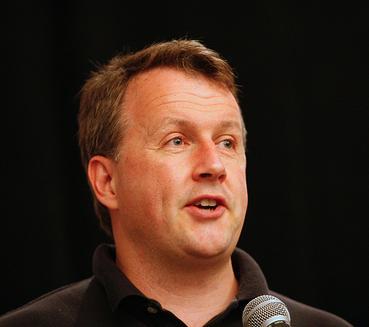
@metapreston How can you claim it's YC dogma not to have kids when I wrote an essay about why people should?
paulgraham.com/kids.html
Do you just make this stuff up?
English

Ignore the YC dogma.
Get married and have kids
And work with the people who have something to lose
Zelda@zeldapoem
Obsessed with this picture of the Apple team in 1984 (who is this baby next to Steve Jobs???)
English
@axios @Art_Gallardo I can’t believe Emil is throwing away his reputation do keep pushing this.
English

Pentagon: Anthropic's foreign workforce poses security risks trib.al/mxJqnc8
English
@Jree503 @Newsforce @davidgoggins lol the millitary doesn’t pay anyone, unless your name is Raytheon
English

@Newsforce @davidgoggins Not a bad move for recruitment. I wonder how much they paid him for this PR stunt.
English

51-YEAR-OLD GOGGINS REENLISTS AND CHOOSES SUFFERING AGAIN
@davidgoggins has reenlisted in the U.S. Air Force at age 51 as a master sergeant, entering the elite Special Warfare Training Wing after receiving an age waiver.
The move places him back into one of the military’s toughest pipelines, where most candidates decades younger fail, despite Goggins already completing Navy SEAL training, Army Ranger School, and Air Force Tactical Air Controller training earlier in his career.
Most people midlife crisis buy a sports car, he picked a two-year training pipeline designed to break humans.
Source: NewsForce
English
I'm going to make some obvious points.
(1) Blowing up all the oil infrastructure in the Middle East is an insane idea, and may well result in a global economic crash and humanitarian crisis unrivaled in the lives of those now living. We're talking about the price of everything everywhere rising, from food to gas, at a moment when inflation was already high. All of that will be laid at the feet of the authors of this war.
(2) The antebellum status quo of Feb 27, 2026 was just not that bad, but we're unlikely to return to it. Expect indefinite, long-term, ongoing disruptions to everything out of the Middle East.
(3) Also assume tech financing crashes for the indefinite future. The genius plan to get the Gulf states caught in the crossfire has incinerated much of the funding for LPs, for datacenters, and for IPOs. Anyone in tech who supported this war may soon learn the meaning of "force majeure" as funding gets yanked.
(4) Many capital allocators will instead be allocating much further down Maslow's hierarchy of needs, towards useful basic things like food and energy.
(5) It's fortunate that all those progressives yelled about the "climate crisis." Yes, their reasoning about timelines was wrong, and much of the money was wasted in graft, but the result was right: we all need energy independence from the Middle East, pronto. It's also fortunate that Elon and China autistically took climate seriously. Now they're going to need to ship a billion solar panels, electric vehicles, batteries, nuclear power plants, and the like to get everyone off oil, immediately.
(6) It's not just an oil and gas problem, of course. It's also a fertilizer problem, and a chemical precursor problem. Maybe some new sources will come online at the new prices, but it takes time to dial stuff up, particularly at this scale, so shortages are almost a certainty.
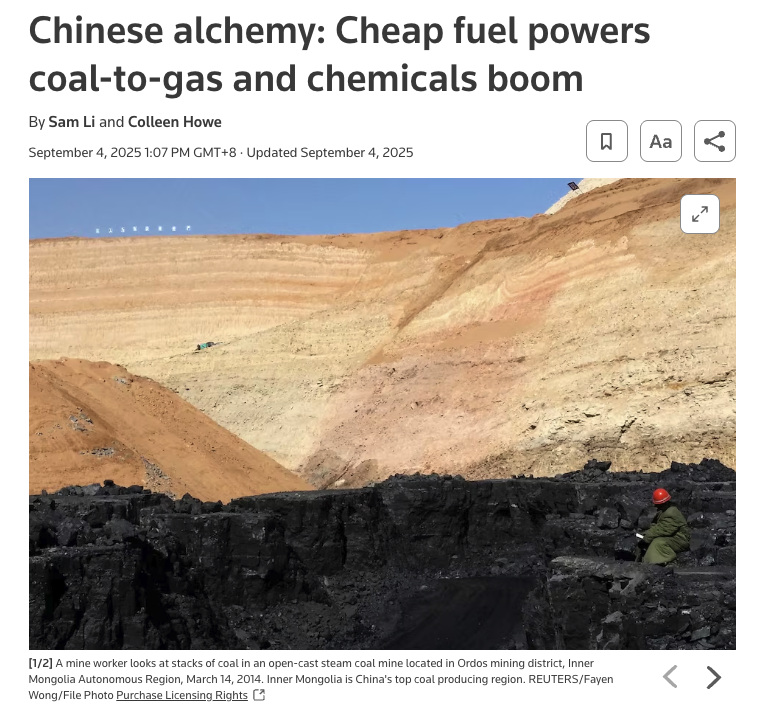
That said, China has actually scaled up coal-to-chemicals[a,c] (C2C), and there's also something more sci-fi called Power-to-X[b] which turns arbitrary power + water + air into hydrocarbons. But all of that will need to get accelerated. I have a background in chemical engineering so may start funding things in this area.
(7) Ultimately, this war is going to result in tremendous blame for anyone associated with it. It's a no-win scenario to blow up this much infrastructure for so many people. Simply not worth it for whatever objective they thought they were going to attain. But unless you're actually in a position to stop the madness, the pragmatic thing to do is: scramble to mitigate the fallout to yourself, your business, and your people.
[a]: reuters.com/business/energ…
[b]: alfalaval.com/industries/ene…
[c]: reuters.com/sustainability…
English

Joe Kent just resigned as Director of the National Counterterrorism Center, invoking the memory of his wife Shannon — a US Navy cryptologist killed in Manbij in 2019. His grief deserves respect. But his letter erases the people Shannon’s mission was built on, and that erasure now has a direct cost in American lives.
Shannon was killed alongside Kurdish-led SDF fighters. The US mission she served was made possible because those fighters bled for every inch of that ground. As the founder and former commander of the YPG International Battalion, I buried friends so that American soldiers could operate from the rear. One of them was Konstantin Gedig, a German volunteer. He died defending Serêkaniyê — not from ISIS, but from Turkish forces and their jihadist proxies. He died when Trump announced the US withdrawal on Twitter. That tweet was the starting gun. Turkish ground operations began within hours. Konstantin was killed in a Turkish airstrike defending a city that American policy had just abandoned. A tweet killed my friend, along with 508 men and women of the SDF, and 208 civilians (including 18 children). Hundreds of thousands were displayed, Kurds, but also Christian Armenians and Assyrians, who saw their homes and land seized and placed of worship desecrated.
Manbij, where Shannon fell, was handed to the Russians and ultimately fell to same jihadist forces backed by Ankara in 2024. Then came al-Jolani’s invitation to the White House. Then the final betrayal of the Kurds in January of this year. These were not accidents of geopolitics. They were choices.
Now we are at war with Iran. The Kurds are once again the only ground force capable of fighting the IRGC — and PJAK has said it openly: we don’t trust Americans anymore, not after Syria. That distrust is not sentiment. It is strategy, and it carries a price. Allies who absorb your casualties stop doing so when you betray them. You then pay that cost yourself, in American lives. Joe Kent understands body counts. He should understand this one.
Shannon’s brothers and sisters in arms remember who she died alongside. They hold her among those who fell fighting for a better world — not just for Syria, but for all of humanity. His letter does not mention them. It should.
English

“The Effective Altruist movement has a structural problem when it comes to conservative America. Its donor class is all Bay Area progressives... Its policy agenda, which calls for sweeping AI regulation and content governance, reads to most conservatives as exactly what it is: a censorship power play dressed up in safety language. To move that agenda… the movement needed a vehicle that didn’t look like it came from them.”
Jordan Schachtel@JordanSchachtel
English
@STS_News Agreed. But at the same time, the industry — especially founders — should never forget how @pmarca @shaunmmaguire @wolfejosh and others sold out America under the guise of liberty for a quick buck.
English
My bet is that this whole right-wing Silicon Valley thing is *WAY* more about opportunists trying to get ahead in a specific moment than it is anything deeper than that, and that all the effort lefty intellectuals are putting into exegesis of this stuff will be turn out to have been a huge waste of time that would be better spent doing materialist analysis of geopolitics and how industries work.
Jacobin@jacobin
Silicon Valley is openly embracing antidemocratic and reactionary ideas. Far from being isolated to tech billionaires, such ideologies are now commonplace in Bay Area tech culture: jacobin.com/2026/03/tech-f… (via @bayareacurrent)
English
@pmarca This weird a16z media blitz is so tone dead and weird. Pop a zyn and work in the factory? Then use the a16z gambling apps?
English

Amen.
a16z@a16z
"There's something about this culture of young people coming up where they're not afraid of hard work. They're not afraid to pop a Zyn and work at the factory all day." Why @KTmBoyle is bullish on Zoomers: "The best quote that summarizes why I'm so bullish on the Zoomers is Alysa Liu after winning her gold. She said, 'I love to struggle. It makes me feel alive.'" "It's the opposite of the morose theater kid vibes that we got from the millennial generation, where everything was very different in how they operated." "Like Jack Hughes—they get their teeth knocked out, they come back and say, 'It's not even a question. Of course I got my teeth knocked out. It's hockey.'" "And that means we're seeing totally different companies than we saw out of the Facebook diaspora—which was very much the Harvard dorm room—I like to work on my computer, I like to build apps. It's a totally different style of founder." "The next generation is so patriotic and bullish on the American project. I think this generation cares a lot about the country. And it shocked us. @davidu and I talk about this all the time—for some of these young people, they were not born on September 11th. They have no recollection of the things that the millennials remember, or anyone older than us remembers, but they care about the country." "They look up to people like @elonmusk, to people like Alex Karp. They look up to people who've been doing the hard thing for 20, 30 years and they want to do it too." "It's a different generation of founder that we've had the privilege of seeing very, very early on. I think the rest of the country is going to define tech and Silicon Valley by these people for the next 10–20 years." From @nypost
English
@pmarca Marc I think the thing you are missing here is that a lack of introspection is a telltale sign of being a sociopath. Which is concerning for someone who manages billions of dollars, not that you don’t like Marcus Aurelius…
English
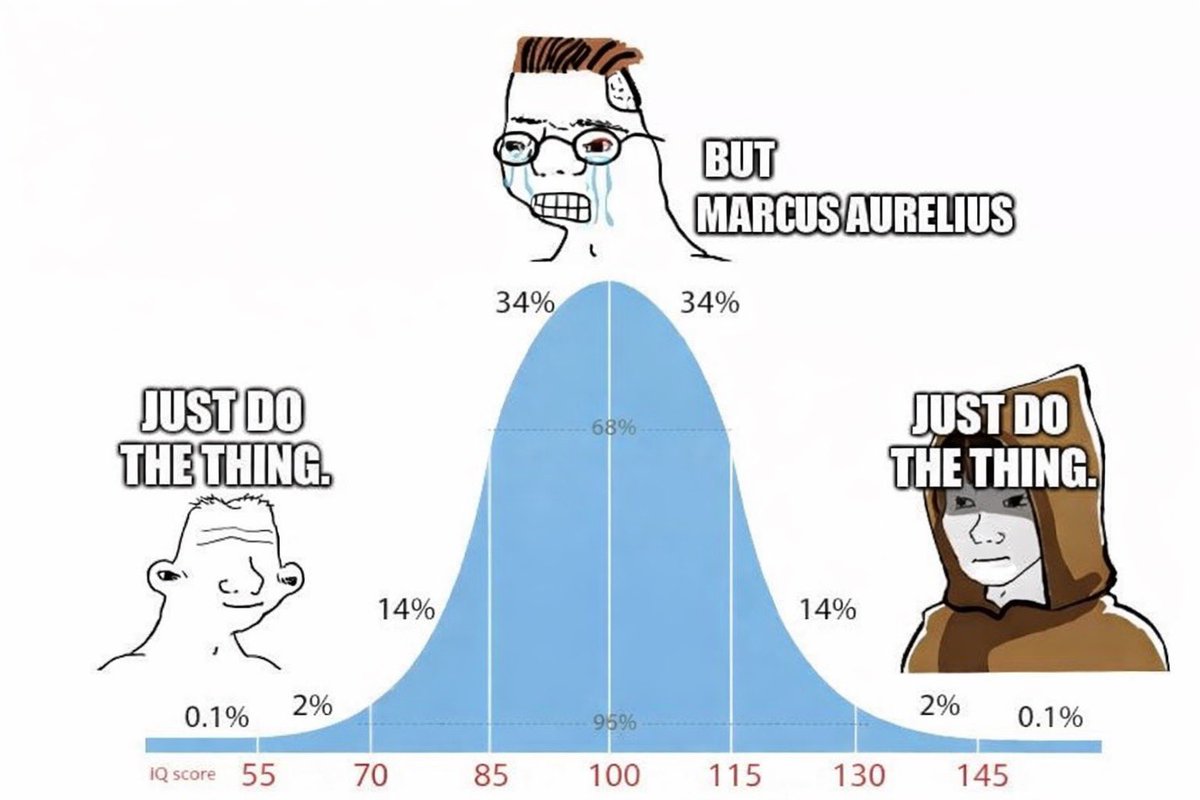
@pmarca Well.
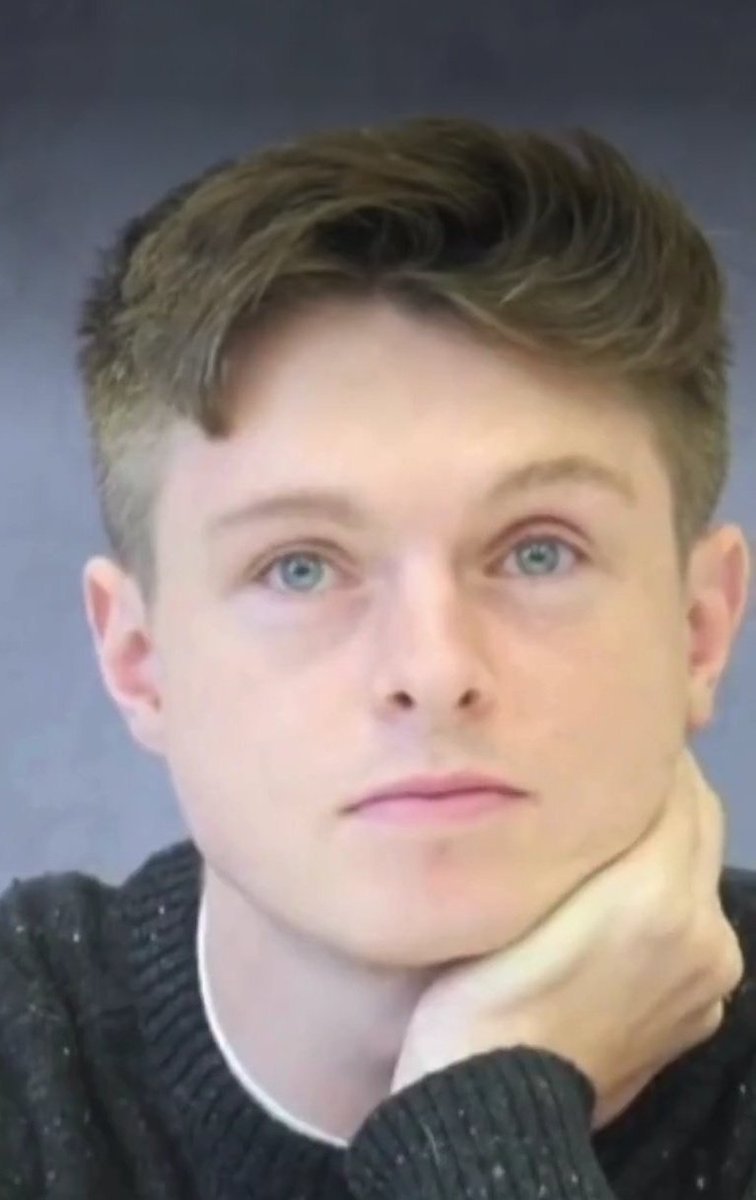
* dies of a preventable cancer because of hubris *
English
Riley Coyote@RileyRalmuto
i'm going to offer a rebuttal to absolutely everything @pmarca has said about introspection here. and Marc, i say this respectfully, with peace and love. i would still love your support one day 😜 but this has to be said. <3 context: so, in a recent interview, Marc proudly declared he has "zero" introspection - "as little as possible" - and then made one of the most historically inaccurate claims i've ever heard a public intellectual say out loud: "if you go back 100 years ago, it never would have occurred to anybody to be introspective. all of the modern conceptions around introspection are manufactured in the 1910s, 1920s." he went further: "great men of history didn't sit around doing this stuff at any prior point. it's all a new construct." he blamed freud. he called it a "guilt-based whammy" from vienna designed to make individuals second-guess themselves. he said the best founders operate at "0% neuroticism" - no self-examination, no looking back. just forward. just go. right... except theres a huge problem with this: virtually every great mind in recorded human history disagrees with him. lets take this part case by case- socrates (469–399 BC) said "the unexamined life is not worth living" — and was executed rather than stop examining it. that was 2,400 years before freud opened a practice in vienna. marcus aurelius (121–180 AD) - roman emperor, the most powerful man alive - kept a private journal of ruthless self-examination. night after night, entry after entry: where am i failing? what are my weaknesses? how do i govern my own reactions before i govern rome? that journal became the meditations, one of the most influential texts in western civilization. marc says "great men of history didn't sit around doing this stuff." marcus aurelius literally ran the roman empire while doing exactly this. seneca (4 BC–65 AD) described his nightly introspective practice: "when the light has been removed and my wife has fallen silent, i examine my entire day and go back over what i've done and said, hiding nothing from myself and passing nothing by." that's therapy without a therapist. two thousand years before anyone in vienna was born. augustine of hippo (354–430 AD) wrote the confessions - 13 books of pure introspection examining his desires, his motivations, the nature of memory itself. it's considered the first autobiography in western literature. 1,500 years before freud. the buddha (5th century BC) built an entire system of practice around it. vipassanā literally means "clear seeing" - seeing into your own mind. the entire buddhist tradition is introspection formalized into a path of liberation. confucius (551–479 BC): "i daily examine myself on three points." self-examination was a prerequisite for ethical governance in chinese philosophy, not a weakness. lao tzu: "knowing others is intelligence; knowing yourself is true wisdom." the upanishads (800–200 BC) made self-knowledge - ātman - the central pursuit of human existence. montaigne (1533–1592) literally invented the essay as a literary form - and the entire point of it was self-examination. the word "essay" comes from essayer: to try, to test. he was testing himself on paper. four centuries before freud. benjamin franklin created a systematic daily self-examination practice, tracking 13 virtues on a grid and reviewing his own behavior every single night. he wrote about it extensively in his autobiography. leonardo da vinci filled thousands of pages of private notebooks with constant self-questioning, to-do lists for self-improvement, and reflections on his own thinking process. thomas jefferson - whom marc literally name-drops in this same interview as a "founder-type" - kept meticulous journals, wrote extensively about his own contradictions, and advised: "when angry, count to ten before you speak. if very angry, count to a hundred." that's emotional self-regulation through introspection. alexander the great - also name-dropped by marc — slept with a copy of homer's iliad annotated by aristotle under his pillow. he was consumed with measuring himself against mythological heroes. that's introspection filtered through narrative identity. every major civilization on earth - greek, roman, indian, chinese, japanese, islamic - independently arrived at the same conclusion: the examined inner life is the highest form of human development. not a weakness. not a disease. the pinnacle. Marc's claim isn't just wrong. it's the kind of wrong that like requires never having read a single primary source from before 1900. that kind of wrong. theres another layer to this that kinda makes all of this even more mind boggling to me - even his own peers, the founders he holds up as exemplars, practice exactly what he dismisses... steve jobs did extensive zen meditation for decades. he credited it with sharpening his intuition and decision-making. he traveled to india specifically seeking inner knowledge. he once said his time meditating was the most important thing he ever did. elon musk has spoken repeatedly about examining his own first-principles thinking - the process of questioning your own assumptions down to bedrock. that is introspection. it's directed inward at your own reasoning patterns. mark zuckerberg did year-long personal challenges - reading a book every two weeks, learning mandarin, running every day, meeting someone new every day - each one designed as structured self-improvement through self-examination. you can't design a personal challenge without first looking inward at what needs to change. ray dalio built an entire management philosophy - principles - around radical self-awareness. he literally calls it "the most important thing." jeff bezos has talked about his "regret minimization framework" - a deeply introspective thought exercise where you project yourself to age 80 and look back at your decisions. that's introspection operating across a lifetime. you see what i mean? these are marc's people...his world. and they all do the thing he says nobody needs to do. okay now *this* is the part that really matters here (to me, at least): what Marc is actually describing when he says "introspection" isn't introspection at all. it's rumination. and those are **opposites*. rumination is dwelling on the past. spiraling. getting stuck in loops of regret and self-criticism. it's correlated with depression and paralysis. rumination is genuinely counterproductive. it is all the things Marc describes introspection being. introspection is self-awareness. its pattern recognition applied to your own mind. understanding your motivations, your biases, your blind spots. it iss correlated with better decision-making, stronger leadership, and longer-lasting impact. Marc has confused the disease with the medicine - and built an entire philosophy around avoiding the cure because he thinks it's the illness. the deepest irony: the claim that introspection is useless requires zero introspection to make. like...he didn't examine it. he didn't check it against history. he didn't question his own assumption or anything. he just said it, it felt right, and he kept going. then doubled down bc thats what supports the claim that he doesnt introspect. he even almost catches himself in the interview: "to actually analyze that properly would require a level of therapy that i'm not willing to engage in." he knows there's something under there. he just doesn't want to look, i guess? and that's fine as a personal choice. but don't dress it up as history. don't claim that socrates, marcus aurelius, the buddha, confucius, augustine, leonardo, franklin, jefferson, and every contemplative tradition in human civilization were all doing something that was "invented" by sigmund freud in 1920, man...like wtf. that's not a bold take, imho, it's just not having done the reading. (yes, claude did help me write this. no, that doesnt mean its any less sincere.)
ZXX

Probably why he doesn’t know how to speak and breathe at the same time
More Perfect Union@MorePerfectUS
Billionaire Marc Andreessen says he has "zero" introspection, and that the idea itself is a modern invention.
English
English

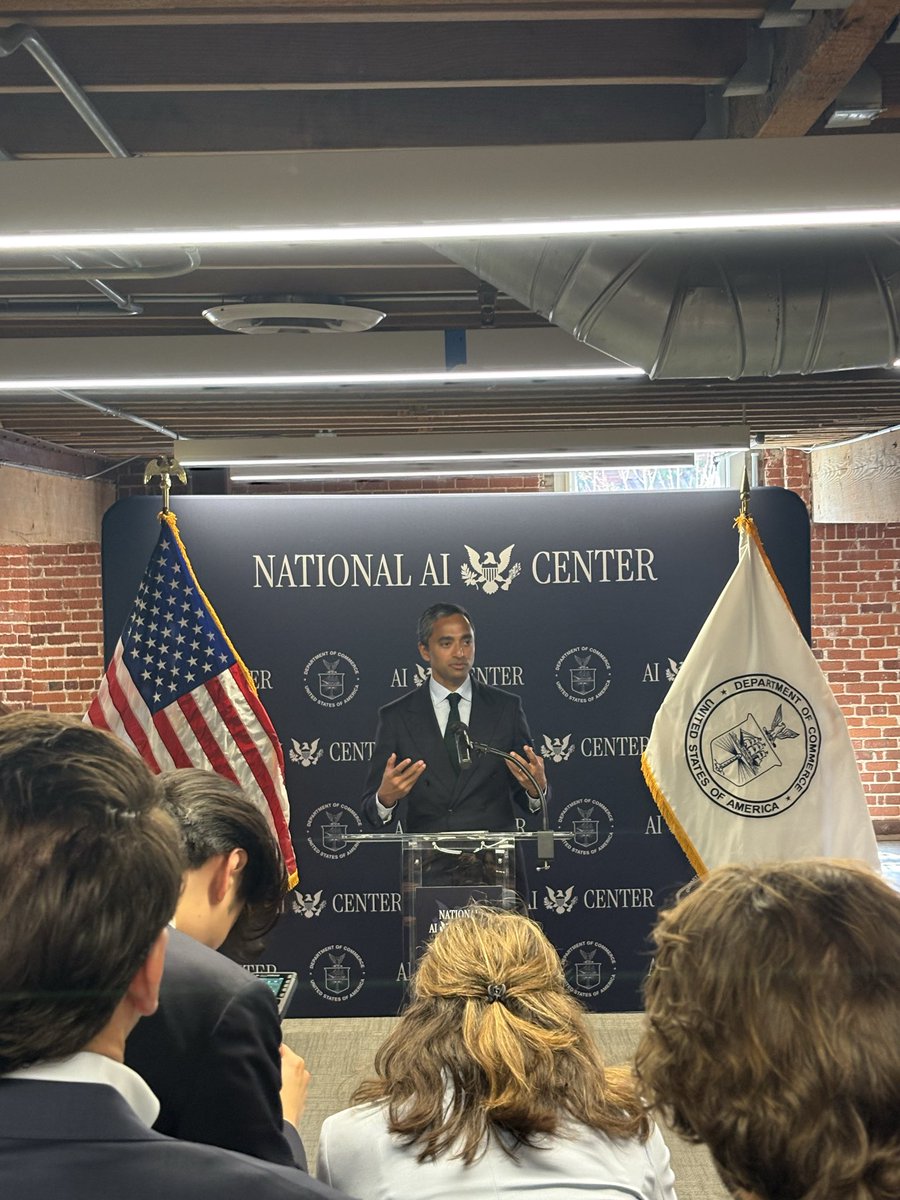
National AI Center opens in SF 🇺🇸
Government being customer obsessed coming to SF
“We’re coming to you, we want to serve you”
@howardlutnick @gdb @chamath



English
@aphysicist How about you stop pocket watching and get back to work.
English

why is it so hard to direct this wealth to productive things that matter. we should have a hundred private DARPA's, bell labs, arc institutes, HRL's, Battelle's, etc
John Arnold@johnarnold
I understand and agree with many criticisms of philanthropy. But practically, fortunes have to go somewhere. There are only 3 options: philanthropy, heirs & govt. If not nonprofits, is Peter Thiel's plan to give $10B+/child? I'm more skeptical of that than he is of philanthropy.
English

My second interview with @soren_ma, Co-Founder and CEO of @neros_tech.
Neros just acquired a new 250k square foot factory which will allow them to ramp production to 1M drones a year.
0:50 New 250k square foot factory
5:13 How the Russia Ukraine war has evolved
8:51 Learning from the Starlink production ramp
12:37 Building a military spec drone
15:25 Prototypes vs production product
17:27 Creating a fully China-free drone
20:27 Scaling production capacity
25:53 Production hell vs supply chain hell
29:11 Timelines and urgency
34:08 Flyoff mode and PBAS
37:40 How Soren operates during a sprint
40:54 Shifting from building drones to company building
42:37 Leadership hiring
49:05 Focusing on execution
50:30 Defeating drone jammers
57:55 Oh sh*t moments
1:00:09 Refocusing on health and taking care of yourself
1:05:21 Measuring effectiveness by battle field results
1:13:04 Evolution of their testing process
1:16:05 Archer Fiber
1:17:55 Lifting up the entire drone industrial base
1:21:12 Building region-specific supply chains
1:23:49 How America can win over the coming decades
1:26:55 Are we going fast enough?
1:29:12 Choosing to work on lethal systems
1:32:35 Being pro-America
1:35:37 Future of warfare and autonomous systems
English
ELBITROTH_THA_GAWD retweetledi

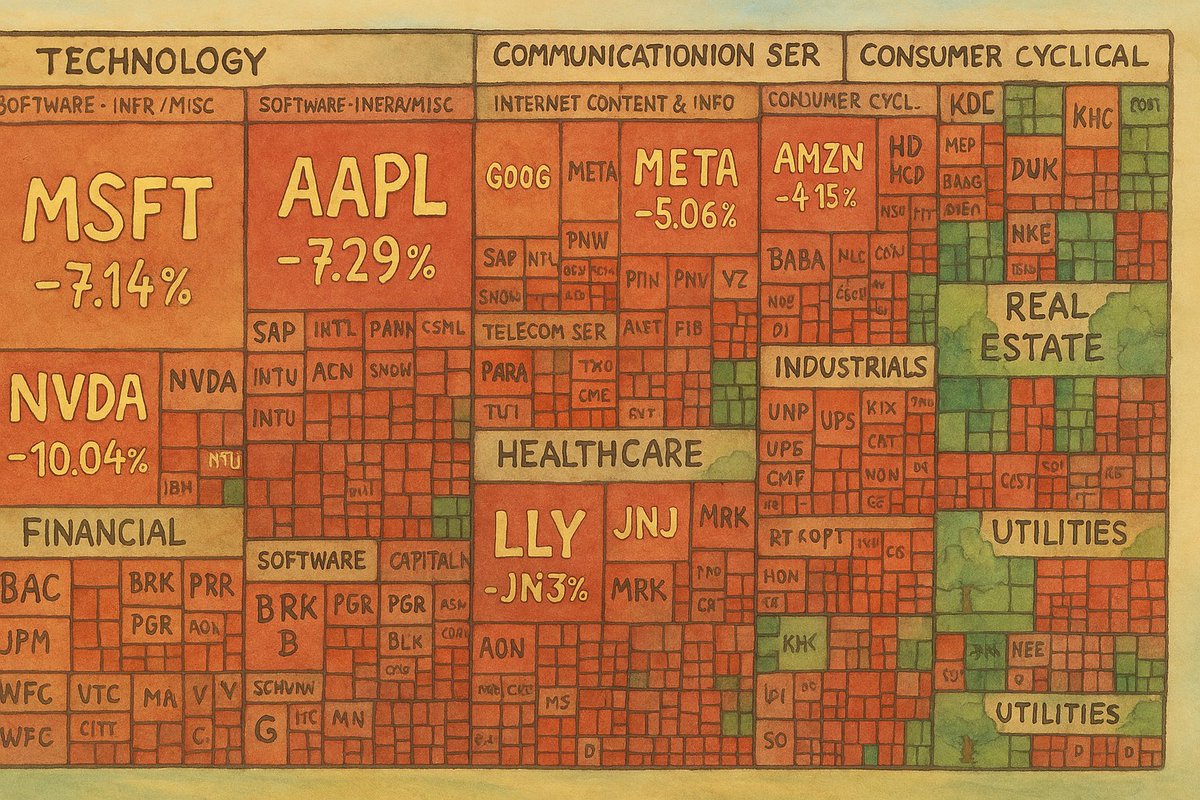
STOCK MARKET ISN’T WORKING OUT EXACTLY AS I PLANNED SO I’M GAMBLING ON MONKEY RACES IN VIETNAM NOW.
#stockmarketcrash #BlackMonday
English
ELBITROTH_THA_GAWD retweetledi
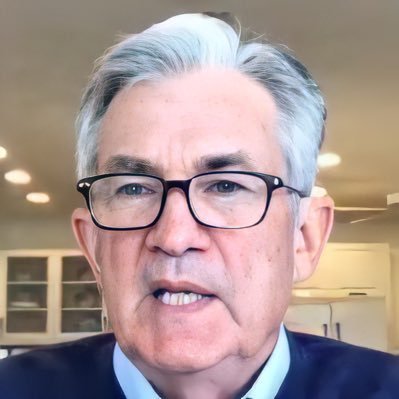
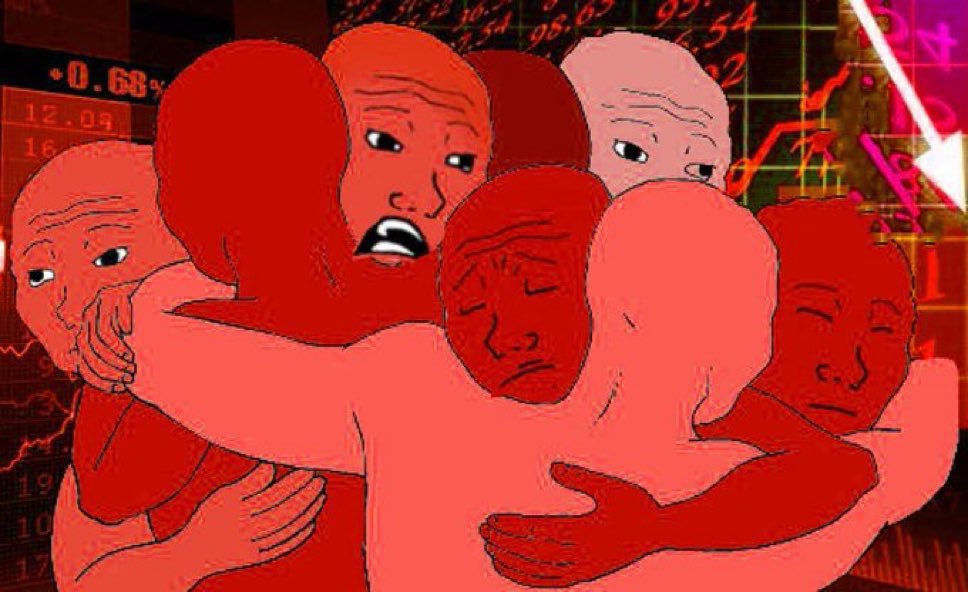
It’s not about the money, it’s about the friends you make along the way
English
ELBITROTH_THA_GAWD retweetledi

ELBITROTH_THA_GAWD retweetledi


@TimKennedyMMA Tim you literally make money on convincing average Americans they need to be ready for war. And you train military and LEO. You loooooooove playing both sides. It would be impressive if it weren’t so sad.


English
The rich profit from war.
The politicians send the poor to die.
The poor have never had a say.

English