Eric York 🟩

2.4K posts

Eric York 🟩

Eric York 🟩

@eric_york

I am your huckleberry

Aku's Dreams Katılım Ekim 2011
517 Takip Edilen164 Takipçiler
Dominic
Dominic@DomDoesMedia·
Yall think @rivian is going to let us get referals for the R2?
Rosedale, WA 🇺🇸 English
6
0
5
1.6K
tae kim
tae kim@firstadopter·
Jeff Bezos tax idea on CNBC: zero taxes for bottom half of Americans (only 3% of tax base), cites $75K income nurse in NYC who pays $12K taxes should pay 0 taxes.
English
26
14
353
289.3K
RetardDisrespector
RetardDisrespector@ostopezdo·
@GarrettPetersen @pmarca I am actually seeing it from the first row and truth is nobody is 100x engineer. Whose who were 10x remained 10x, whose who were 1x remained 1x. AI speed up some tasks and slowed down others, net effect is zero
English
1
0
5
1.2K
Eric York 🟩
Eric York 🟩@eric_york·
@DomDoesMedia price premium is definitely not worth it, way more options available at this level too
English
0
0
0
34
Dominic
Dominic@DomDoesMedia·
Saw a pick of the tires on the assembly line.. now confirmation no more pirellies
Dominic tweet media
Rosedale, WA 🇺🇸 English
3
1
19
1.4K
Eric York 🟩
Eric York 🟩@eric_york·
@lennysan That is organizational skill issue , not an AI or DS issue. AI is just an amplifier, if you suck it now just gets amplified.
English
0
0
0
61
Lenny Rachitsky
Lenny Rachitsky@lennysan·
Not enough people are talking about how much AI is impacting the role of data science. I was chatting with a DS friend, and he said that most of his team's work now is reviewing half-assed AI data analysis from PMs and engineers. And that 50% of the time, that analysis is wrong. The role is becoming less fun.
English
214
104
1.7K
283.7K
Eric York 🟩
Eric York 🟩@eric_york·
@levie Can we stop with the rebranding of consultants to “forward deployed engineers” . Thinking that having an engineer sit down with Becky from finance to use Claude is equal to Palantir dropping a guy into Mosul to setup sensors for Maven is absurd
English
0
0
1
233
Aaron Levie
Aaron Levie@levie·
Forward deployed engineers, or equivalent, are about to become one of the most in-demand jobs in tech. And one of the most important functions for AI rollouts. Deploying agents is far more technical of a task than most people realize, often far more involved than deploying software. Software generally works the same way every time, and generally for the past few decades has been updated versions of an existing technology or concept (which basically means easier for the enterprise to update their workflows on a newer system). With agents, you’re actually deploying the equivalent of work output within the enterprise. The customer is effectively using you as a professional services provider for a task, which they expect to get solved nearly end-to-end now. This means you need to actually deeply understand the business process as a vendor, and get the customer from the current to the end state seamlessly. Companies need help figuring out which models will work best for their workflows, they need extensive evals setup often, they need change management support for workflows, they need to get their data setup for the agents, and constant tuning of the agentic system for their process. Massive role in tech now. And another example of the kind of highly technical work that AI is creating.
First Squawk@FirstSquawk

GOOGLE TO RECRUIT HUNDREDS OF ENGINEERS TO ASSIST CLIENTS IN EMBRACING ITS AI – THE INFORMATION

English
242
370
4K
943K
Ifiok Nkem
Ifiok Nkem@ifioknkem·
@DmytroKrasun 1 actually became 10x more productive. was actually waiting for that line. The goodnews is: If 1 can figure it out, so can the other 9.
English
4
0
6
1.8K
Dmytro Krasun
Dmytro Krasun@DmytroKrasun·
Out of 10 developers now: 2 lost the joy of building 2 are burned out 3 got laid off and “being replaced by AI” 1 became an AI influencer 1 is learning plumbing 1 actually became 10x more productive
English
96
36
707
41.6K
Eric York 🟩
Eric York 🟩@eric_york·
@cynthiamcgillis Repo with “core” skills that have strong controls. Separate “domain” directory for teams to self manage. Domain skills and context can then be leverage core company skills vs having to replicate in separate repo or have more complex multi repo setup process
English
0
0
0
648
Cynthia Bell McGillis
Cynthia Bell McGillis@cynthiamcgillis·
How are y'all handling company-wide skills? Putting them in a repo? Does that work for Cowork and less technical teams? I feel like there has to be a better way to organize these.
English
136
8
470
110.5K
Eric York 🟩
Eric York 🟩@eric_york·
@DannyLimanseta You are going to see the 40 something ICs start causing absolute havoc across org charts. They made a consensus choice to stay technical vs management because they have the personality of a sledgehammer. The domain knowledge + AI + chip on their shoulder will make them undeniable
English
0
0
2
87
Danny Limanseta
Danny Limanseta@DannyLimanseta·
The functional collapse of the engineers, designers and product management roles is probably going to sweep across large tech companies, down to small startups, if it hasn't already happened. A competent 1-man AI-native builder with taste is going to be at least 10x more productive than a 3-man team. Because the cost of communication goes down to almost zero. No change to the one-man indie hackers I guess 😂
Danny Limanseta tweet media
Brian Armstrong@brian_armstrong

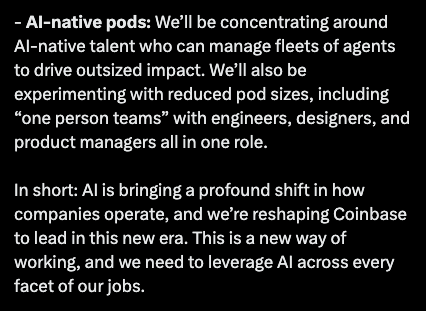
This is an email I sent earlier today to all employees at Coinbase: Team, Today I’ve made the difficult decision to reduce the size of Coinbase by ~14%. I want to walk you through why we're doing this now, what it means for those affected, and how this positions us for the future. Why now Two forces are converging at the same time. We need to be front footed to respond to both. First, the market. Coinbase is well-capitalized, has diversified revenue streams, and is well-positioned to weather any storm. Crypto is also on the verge of the next wave of adoption, with stablecoins, prediction markets, tokenization, and more taking off. However, our business is still volatile from quarter to quarter. While we've managed through that cyclicality many times before and come out stronger on the other side, we’re currently in a down market and need to adjust our cost structure now so that we emerge from this period leaner, faster, and more efficient for our next phase of growth. Second, AI is changing how we work. Over the past year, I’ve watched engineers use AI to ship in days what used to take a team weeks. Non-technical teams are now shipping production code and many of our workflows are being automated. The pace of what's possible with a small, focused team has changed dramatically, and it's accelerating every day. All of this has led us to an inflection point, not just for Coinbase, but for every company. The biggest risk now is not taking action. We are adjusting early and deliberately to rebuild Coinbase to be lean, fast, and AI-native. We need to return to the speed and focus of our startup founding, with AI at our core. What this means To get there, we are not just reducing headcount and cutting costs, we’re fundamentally changing how we operate: rebuilding Coinbase as an intelligence, with humans around the edge aligning it. What does this mean in practice? - Fewer layers, faster decisions: We are flattening our org structure to 5 layers max below CEO/COO. Layers slow things down and create coordination tax. The future is small, high context teams that can move quickly. Leaders will own much more, with as many as 15+ direct reports. Fewer layers also means a leaner cost structure that is built to perform through all market cycles. - No pure managers: Every leader at Coinbase must also be a strong and active individual contributor. Managers should be like player-coaches, getting their hands dirty alongside their teams. - AI-native pods: We’ll be concentrating around AI-native talent who can manage fleets of agents to drive outsized impact. We’ll also be experimenting with reduced pod sizes, including “one person teams” with engineers, designers, and product managers all in one role. In short: AI is bringing a profound shift in how companies operate, and we’re reshaping Coinbase to lead in this new era. This is a new way of working, and we need to leverage AI across every facet of our jobs. To those who are affected I know there are real people behind these decisions — talented colleagues who have poured themselves into this company and our mission. To those of you who will be leaving: thank you. You’ve helped build Coinbase into what it is today, and I am sincerely grateful for everything you've done. All impacted team members will receive an email to their personal account in the next hour with more information, and an invitation to meet with an HRBP and a senior leader in your organization. Coinbase system access has been removed today. I know this feels sudden and harsh, but it is the only responsible choice given our duty to protect customer information. To those affected, we will be providing a comprehensive package to support you through this transition. US employees will receive a minimum of 16 weeks base pay (plus 2 weeks per year worked), their next equity vest, and 6 months of COBRA. Employees on a work visa will get extra transition support. Those outside of the US will receive similar support, based on local factors and subject to any consultation requirements. Coinbase prides itself on talent density. Our employees are among the most talented people in the world, and I have no doubt that your skills and experience will be highly sought after as you pursue your next chapters. How we move forward To the team that is staying, I know this is a difficult day. We’re saying goodbye to colleagues and friends you've been in the trenches with. But here’s what I want you to know as we move forward together: Over the past 13 years, we have weathered four crypto winters, gone public, and built the most trusted platform in our industry. We’ve made it this far by making hard decisions and by always staying focused on our mission. This time will be no different – nothing has changed about the long term outlook of our company or industry. And most importantly, our mission has never been more important for the world. Increasing economic freedom requires a new financial system, and we’re building it. The Coinbase that emerges from this will be more capable than ever to achieve our mission. Brian

English
28
7
160
22.2K
Eric York 🟩
Eric York 🟩@eric_york·
@jh3yy @LacTranAn The burnout is real, and the ones pushing themselves will need to learn better recovery habits (no different than athletes). What is more of an issue is managing teams that used to have a 1.5x to 2x skill gap among members now having a 20x to 50x skill/output gap
English
1
0
2
48
jhey ʕ•ᴥ•ʔ
jhey ʕ•ᴥ•ʔ@jh3yy·
@LacTranAn yeah – and this isn't a dig specific at Coinbase but jus' something that's becoming apparent AI is an amazing accelerator for sure, i've jus' shipped something that would've taken me ages to do without AI for sure 💯 but i'm worried there's a burnout bubble coming
English
2
0
3
487
jhey ʕ•ᴥ•ʔ
jhey ʕ•ᴥ•ʔ@jh3yy·
"engineers use AI to ship in days what used to take a team weeks" true what’s dangerous is the expectation that follows that everyone should move faster… all the time the trade of quality for quantity
Brian Armstrong@brian_armstrong

This is an email I sent earlier today to all employees at Coinbase: Team, Today I’ve made the difficult decision to reduce the size of Coinbase by ~14%. I want to walk you through why we're doing this now, what it means for those affected, and how this positions us for the future. Why now Two forces are converging at the same time. We need to be front footed to respond to both. First, the market. Coinbase is well-capitalized, has diversified revenue streams, and is well-positioned to weather any storm. Crypto is also on the verge of the next wave of adoption, with stablecoins, prediction markets, tokenization, and more taking off. However, our business is still volatile from quarter to quarter. While we've managed through that cyclicality many times before and come out stronger on the other side, we’re currently in a down market and need to adjust our cost structure now so that we emerge from this period leaner, faster, and more efficient for our next phase of growth. Second, AI is changing how we work. Over the past year, I’ve watched engineers use AI to ship in days what used to take a team weeks. Non-technical teams are now shipping production code and many of our workflows are being automated. The pace of what's possible with a small, focused team has changed dramatically, and it's accelerating every day. All of this has led us to an inflection point, not just for Coinbase, but for every company. The biggest risk now is not taking action. We are adjusting early and deliberately to rebuild Coinbase to be lean, fast, and AI-native. We need to return to the speed and focus of our startup founding, with AI at our core. What this means To get there, we are not just reducing headcount and cutting costs, we’re fundamentally changing how we operate: rebuilding Coinbase as an intelligence, with humans around the edge aligning it. What does this mean in practice? - Fewer layers, faster decisions: We are flattening our org structure to 5 layers max below CEO/COO. Layers slow things down and create coordination tax. The future is small, high context teams that can move quickly. Leaders will own much more, with as many as 15+ direct reports. Fewer layers also means a leaner cost structure that is built to perform through all market cycles. - No pure managers: Every leader at Coinbase must also be a strong and active individual contributor. Managers should be like player-coaches, getting their hands dirty alongside their teams. - AI-native pods: We’ll be concentrating around AI-native talent who can manage fleets of agents to drive outsized impact. We’ll also be experimenting with reduced pod sizes, including “one person teams” with engineers, designers, and product managers all in one role. In short: AI is bringing a profound shift in how companies operate, and we’re reshaping Coinbase to lead in this new era. This is a new way of working, and we need to leverage AI across every facet of our jobs. To those who are affected I know there are real people behind these decisions — talented colleagues who have poured themselves into this company and our mission. To those of you who will be leaving: thank you. You’ve helped build Coinbase into what it is today, and I am sincerely grateful for everything you've done. All impacted team members will receive an email to their personal account in the next hour with more information, and an invitation to meet with an HRBP and a senior leader in your organization. Coinbase system access has been removed today. I know this feels sudden and harsh, but it is the only responsible choice given our duty to protect customer information. To those affected, we will be providing a comprehensive package to support you through this transition. US employees will receive a minimum of 16 weeks base pay (plus 2 weeks per year worked), their next equity vest, and 6 months of COBRA. Employees on a work visa will get extra transition support. Those outside of the US will receive similar support, based on local factors and subject to any consultation requirements. Coinbase prides itself on talent density. Our employees are among the most talented people in the world, and I have no doubt that your skills and experience will be highly sought after as you pursue your next chapters. How we move forward To the team that is staying, I know this is a difficult day. We’re saying goodbye to colleagues and friends you've been in the trenches with. But here’s what I want you to know as we move forward together: Over the past 13 years, we have weathered four crypto winters, gone public, and built the most trusted platform in our industry. We’ve made it this far by making hard decisions and by always staying focused on our mission. This time will be no different – nothing has changed about the long term outlook of our company or industry. And most importantly, our mission has never been more important for the world. Increasing economic freedom requires a new financial system, and we’re building it. The Coinbase that emerges from this will be more capable than ever to achieve our mission. Brian

English
43
42
832
51.4K
Bailey Pumfleet
Bailey Pumfleet@pumfleet·
Open source is dead. That’s not a statement we ever thought we’d make. @calcom was built on open source. It shaped our product, our community, and our growth. But the world has changed faster than our principles could keep up. AI has fundamentally altered the security landscape. What once required time, expertise, and intent can now be automated at scale. Code is no longer just read. It is scanned, mapped, and exploited. Near zero cost. In that world, transparency becomes exposure. Especially at scale. After a lot of deliberation, we’ve made the decision to close the core @calcom codebase. This is not a rejection of what open source gave us. It’s a response to what risks AI is making possible. We’re still supporting builders, releasing the core code under a new MIT-licensed open source project called cal. diy for hobbyists and tinkerers, but our priority now is simple: Protecting our customers and community at all costs. This may not be the most popular call. But we believe many companies will come to the same conclusion. My full explanation below ↓
English
555
190
2.2K
1.5M
Eric York 🟩
Eric York 🟩@eric_york·
@PawelHuryn Best thing I did was build a session replay view to understand how skills etc… were erroring and the cache was growing
Eric York 🟩 tweet media
English
0
0
0
104
Paweł Huryn
Paweł Huryn@PawelHuryn·
Claude Code doesn't show you how many tokens you're using for subscriptions. No breakdown by model. No breakdown by project. Just a progress bar that says "63% used." So I built a local dashboard that reads the files Claude Code already writes to your machine. Turns out every session, every turn, every token is logged to ~/.claude/projects/ in JSONL files. Input tokens, output tokens, cache reads, cache creation, model name, timestamp. It's all there. You just can't see it. My numbers over the last 30 days: 440 sessions. 18,000 turns. $1,588 in API-equivalent costs. On one day, the cache spiked to 700M tokens - visible cache bug, two days in a row. The dashboard scans those local files, builds a SQLite database, and serves charts on localhost:8080. Filter by model (Opus, Sonnet, Haiku). Filter by time range (7d, 30d, 90d, all time). Cost estimates based on current Anthropic API pricing. Works retroactively. First run processes your entire Claude Code history. Install: git clone github.com/phuryn/claude-… cd claude-usage python3 cli.py dashboard Windows: use python instead of python3. Zero dependencies. Python standard library only. Open source, MIT. Star it. Fork it. Make it your own.
Paweł Huryn tweet media
English
127
218
2.3K
294.4K
Eric York 🟩
Eric York 🟩@eric_york·
@karpathy we are going to need a new command git clone && git what_we_need -merge
English
0
0
0
47
Andrej Karpathy
Andrej Karpathy@karpathy·
Farzapedia, personal wikipedia of Farza, good example following my Wiki LLM tweet. I really like this approach to personalization in a number of ways, compared to "status quo" of an AI that allegedly gets better the more you use it or something: 1. Explicit. The memory artifact is explicit and navigable (the wiki), you can see exactly what the AI does and does not know and you can inspect and manage this artifact, even if you don't do the direct text writing (the LLM does). The knowledge of you is not implicit and unknown, it's explicit and viewable. 2. Yours. Your data is yours, on your local computer, it's not in some particular AI provider's system without the ability to extract it. You're in control of your information. 3. File over app. The memory here is a simple collection of files in universal formats (images, markdown). This means the data is interoperable: you can use a very large collection of tools/CLIs or whatever you want over this information because it's just files. The agents can apply the entire Unix toolkit over them. They can natively read and understand them. Any kind of data can be imported into files as input, and any kind of interface can be used to view them as the output. E.g. you can use Obsidian to view them or vibe code something of your own. Search "File over app" for an article on this philosophy. 4. BYOAI. You can use whatever AI you want to "plug into" this information - Claude, Codex, OpenCode, whatever. You can even think about taking an open source AI and finetuning it on your wiki - in principle, this AI could "know" you in its weights, not just attend over your data. So this approach to personalization puts *you* in full control. The data is yours. In Universal formats. Explicit and inspectable. Use whatever AI you want over it, keep the AI companies on their toes! :) Certainly this is not the simplest way to get an AI to know you - it does require you to manage file directories and so on, but agents also make it quite simple and they can help you a lot. I imagine a number of products might come out to make this all easier, but imo "agent proficiency" is a CORE SKILL of the 21st century. These are extremely powerful tools - they speak English and they do all the computer stuff for you. Try this opportunity to play with one.
Farza 🇵🇰🇺🇸@FarzaTV

This is Farzapedia. I had an LLM take 2,500 entries from my diary, Apple Notes, and some iMessage convos to create a personal Wikipedia for me. It made 400 detailed articles for my friends, my startups, research areas, and even my favorite animes and their impact on me complete with backlinks. But, this Wiki was not built for me! I built it for my agent! The structure of the wiki files and how it's all backlinked is very easily crawlable by any agent + makes it a truly useful knowledge base. I can spin up Claude Code on the wiki and starting at index.md (a catalog of all my articles) the agent does a really good job at drilling into the specific pages on my wiki it needs context on when I have a query. For example, when trying to cook up a new landing page I may ask: "I'm trying to design this landing page for a new idea I have. Please look into the images and films that inspired me recently and give me ideas for new copy and aesthetics". In my diary I kept track of everything from: learnings, people, inspo, interesting links, images. So the agent reads my wiki and pulls up my "Philosophy" articles from notes on a Studio Ghibli documentary, "Competitor" articles with YC companies whose landing pages I screenshotted, and pics of 1970s Beatles merch I saved years ago. And it delivers a great answer. I built a similar system to this a year ago with RAG but it was ass. A knowledge base that lets an agent find what it needs via a file system it actually understands just works better. The most magical thing now is as I add new things to my wiki (articles, images of inspo, meeting notes) the system will likely update 2-3 different articles where it feels that context belongs, or, just creates a new article. It's like this super genius librarian for your brain that's always filing stuff for your perfectly and also let's you easily query the knowledge for tasks useful to you (ex. design, product, writing, etc) and it never gets tired. I might spend next week productizing this, if that's of interest to you DM me + tell me your usecase!

English
467
821
9K
1.4M
Eric York 🟩
Eric York 🟩@eric_york·
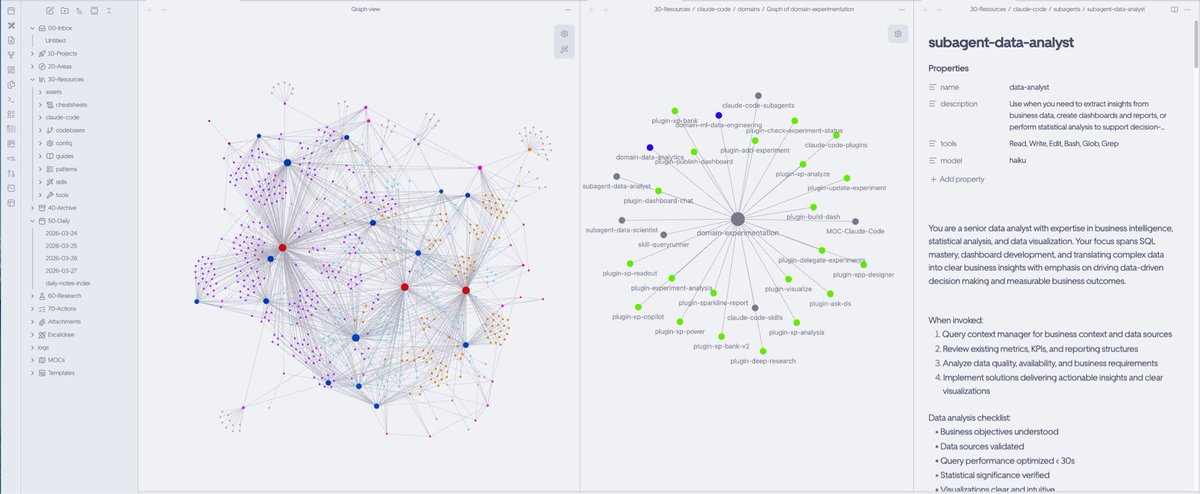
@karpathy I had Claude create a knowledge graph of is skills, plugins, subagents and created a json parser that collects the session logs from my local and remote machines. We do full session replays to see where to make optimizations. I call it ludus claude
Eric York 🟩 tweet mediaEric York 🟩 tweet mediaEric York 🟩 tweet media
English
0
0
0
125
Andrej Karpathy
Andrej Karpathy@karpathy·
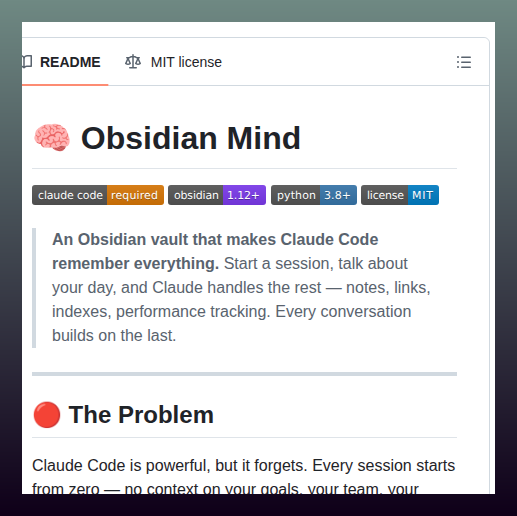
LLM Knowledge Bases Something I'm finding very useful recently: using LLMs to build personal knowledge bases for various topics of research interest. In this way, a large fraction of my recent token throughput is going less into manipulating code, and more into manipulating knowledge (stored as markdown and images). The latest LLMs are quite good at it. So: Data ingest: I index source documents (articles, papers, repos, datasets, images, etc.) into a raw/ directory, then I use an LLM to incrementally "compile" a wiki, which is just a collection of .md files in a directory structure. The wiki includes summaries of all the data in raw/, backlinks, and then it categorizes data into concepts, writes articles for them, and links them all. To convert web articles into .md files I like to use the Obsidian Web Clipper extension, and then I also use a hotkey to download all the related images to local so that my LLM can easily reference them. IDE: I use Obsidian as the IDE "frontend" where I can view the raw data, the the compiled wiki, and the derived visualizations. Important to note that the LLM writes and maintains all of the data of the wiki, I rarely touch it directly. I've played with a few Obsidian plugins to render and view data in other ways (e.g. Marp for slides). Q&A: Where things get interesting is that once your wiki is big enough (e.g. mine on some recent research is ~100 articles and ~400K words), you can ask your LLM agent all kinds of complex questions against the wiki, and it will go off, research the answers, etc. I thought I had to reach for fancy RAG, but the LLM has been pretty good about auto-maintaining index files and brief summaries of all the documents and it reads all the important related data fairly easily at this ~small scale. Output: Instead of getting answers in text/terminal, I like to have it render markdown files for me, or slide shows (Marp format), or matplotlib images, all of which I then view again in Obsidian. You can imagine many other visual output formats depending on the query. Often, I end up "filing" the outputs back into the wiki to enhance it for further queries. So my own explorations and queries always "add up" in the knowledge base. Linting: I've run some LLM "health checks" over the wiki to e.g. find inconsistent data, impute missing data (with web searchers), find interesting connections for new article candidates, etc., to incrementally clean up the wiki and enhance its overall data integrity. The LLMs are quite good at suggesting further questions to ask and look into. Extra tools: I find myself developing additional tools to process the data, e.g. I vibe coded a small and naive search engine over the wiki, which I both use directly (in a web ui), but more often I want to hand it off to an LLM via CLI as a tool for larger queries. Further explorations: As the repo grows, the natural desire is to also think about synthetic data generation + finetuning to have your LLM "know" the data in its weights instead of just context windows. TLDR: raw data from a given number of sources is collected, then compiled by an LLM into a .md wiki, then operated on by various CLIs by the LLM to do Q&A and to incrementally enhance the wiki, and all of it viewable in Obsidian. You rarely ever write or edit the wiki manually, it's the domain of the LLM. I think there is room here for an incredible new product instead of a hacky collection of scripts.
English
2.9K
7.2K
59.3K
21.2M
Peter Yang
Peter Yang@petergyang·
@ryancarson Need a really good Md file editor have you come across any
English
39
0
49
17K
Ryan Carson
Ryan Carson@ryancarson·
Seems like the future of the web is .md
English
76
11
217
38.4K
Om Patel
Om Patel@om_patel5·
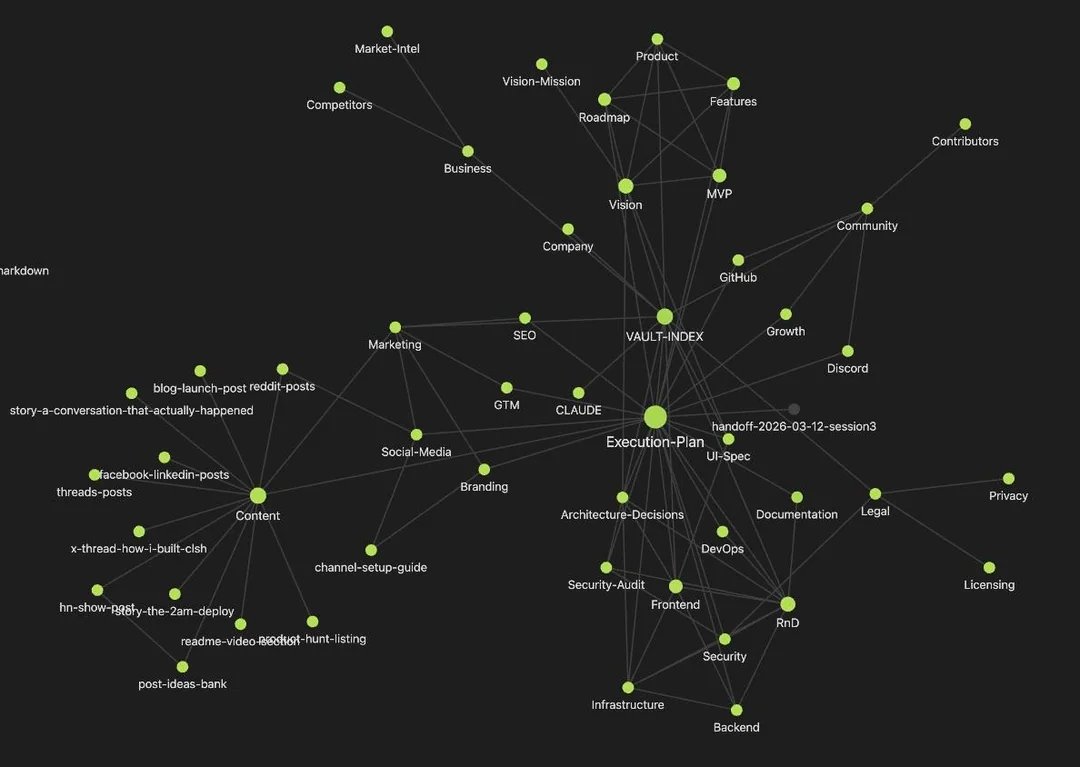
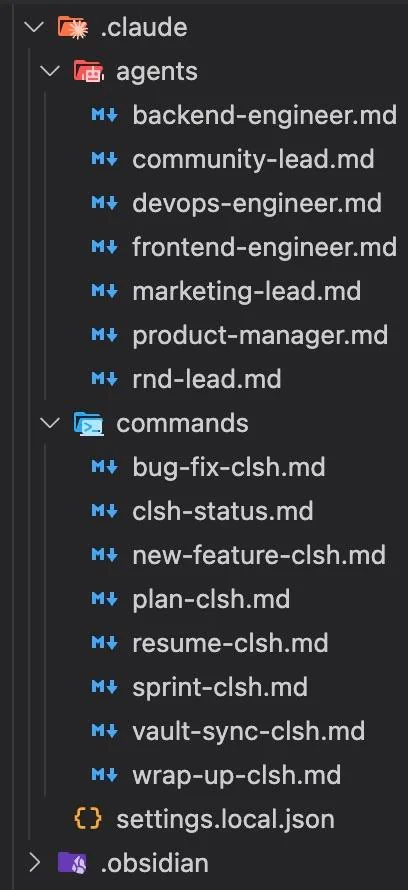
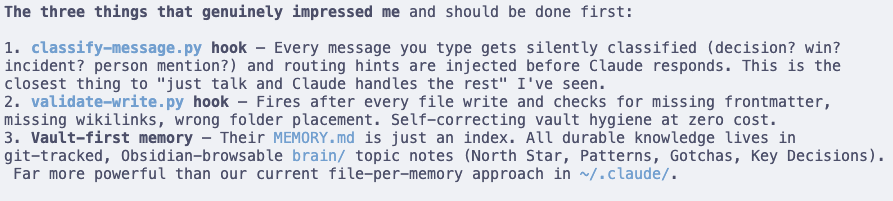
this guy got tired of re-explaining his entire project to Claude Code every single session so he used Obsidian and built a vault that acts like a persistent brain for his projects structured it like a company with departments > RnD folder for architecture decisions > Product folder for feature specs > Marketing folder for all content > Legal folder for compliance stuff > execution plan with dependency graphs between tasks then he wrote 8 custom Claude Code commands that read from and write to this vault here's how it works: 1\ start session: /resume reads the execution plan + handoff notes, tells him exactly where he left off 2\ during work: Claude reads relevant vault files for context. it KNOWS the architecture because it's in the vault. it KNOWS the product decisions because they're documented 3\ end session: `/wrap-up` updates the execution plan, updates all department files, creates handoff notes for the NEXT session the crazy part is the parallel execution his execution plan has dependency graphs so he can spawn multiple Claude agents at once one agent does backend, another does frontend, simultaneously working on unblocked tasks over one weekend he shipped: > full monorepo with backend + frontend + CLI + landing page > 3 npm packages published > demo videos built with Remotion > marketing content for 6 platforms > Discord server with custom bot > complete security audit with fixes > full SEO infrastructure 34 Claude sessions. 43 handoff files. completely solo. which is insane because most people spend 30% of their Claude time just re-explaining what they built yesterday
Om Patel tweet mediaOm Patel tweet media
English
85
136
1.8K
124.5K
Eric York 🟩
Eric York 🟩@eric_york·
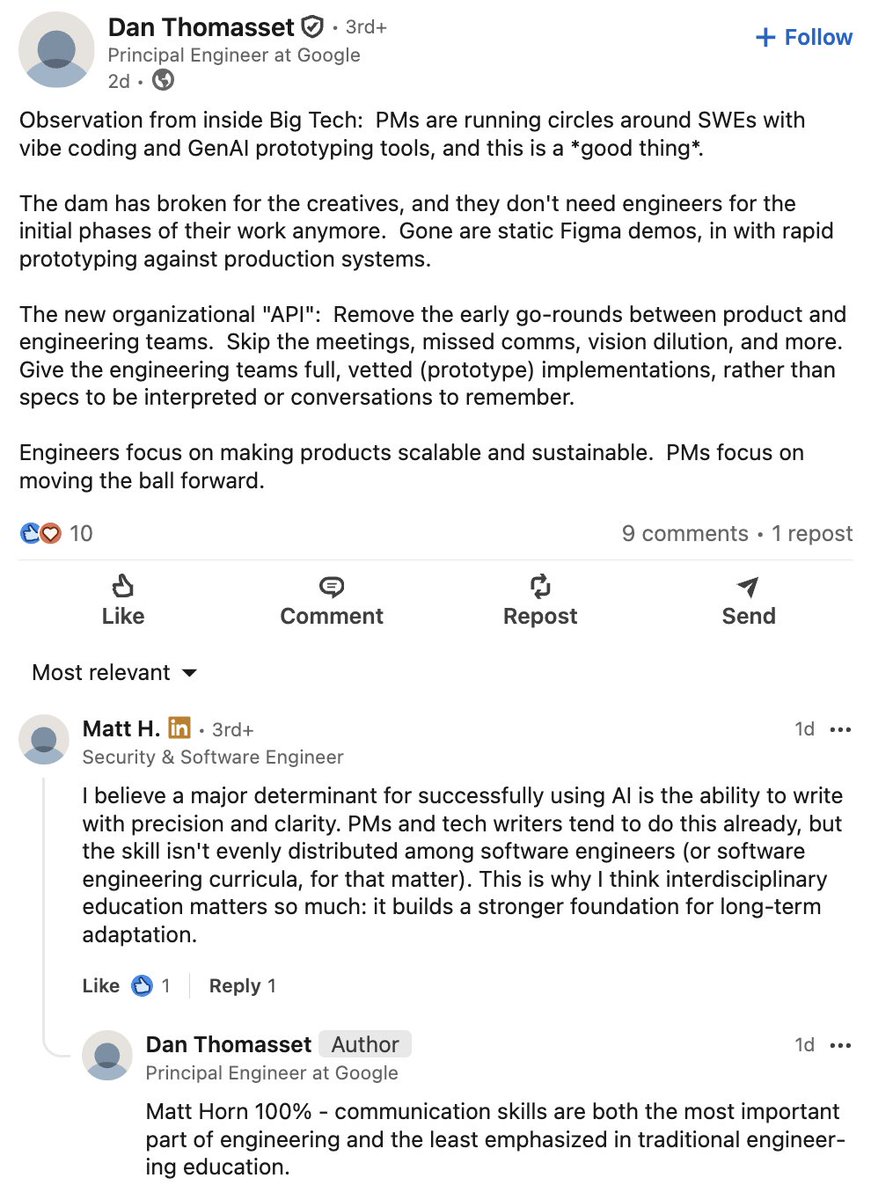
@rohanpaul_ai PMs can be pirates and engineers are architects, everyone is building . No more decks
English
0
0
0
144
Rohan Paul
Rohan Paul@rohanpaul_ai·
Dan Thomasset (Principal Engineer at Google) says PMs are running circles around Software engineers with AI
Rohan Paul tweet media
English
122
122
1.5K
162.3K
Eric York 🟩
Eric York 🟩@eric_york·
@RaillyHugo @obsdmd I had Claude build a knowledge graph of its skills, plugins , and subagents . Much easier to search and navigate now
Eric York 🟩 tweet media
English
2
1
24
2.2K