Kristaps Grinbergs
11.9K posts

Kristaps Grinbergs
@fassko
⏭️ Blockchain, mobile & fullstack dev 👨💻 Developer Relations Engineer @FlareNetworks 🗣️ Speaker, founder 🐈⬛ Cat person 🧭 Orienteering 🌱 Vegan


Our team at @FlareNetworks is looking forward to taking part in a new edition of ETHGlobal Cannes. 🧑💻 This time, we’ll be joining hundreds of builders to create new kinds of applications using Flare Smart Accounts and TEE machines.


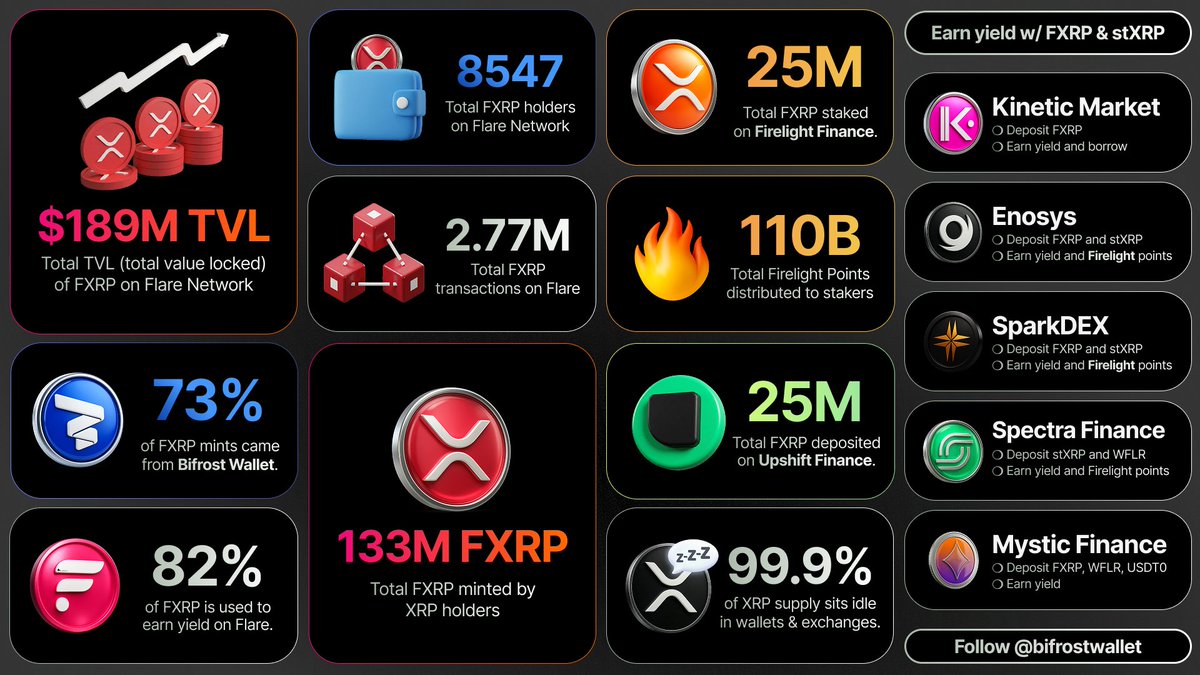
The deposit cap for Firelight has now increased! Following strong demand, users can deploy $FXRP into the Firelight vault, receive $stXRP, and generate Firelight Points while putting assets to work across @FlareNetworks DeFi.


🚨 Early release documentation for Flare Confidential Compute! Let me set expectations clearly: we are preparing for a soft release in which TEEs will be introduced as part of this broader system. There is no public code yet, but I highly recommend learning more about it now. The TLDR is that Flare Confidential Compute gives Flare a way to safely handle the parts of blockchain applications that are difficult or impractical to do fully onchain. Instead of forcing everything into a smart contract, Flare can send certain jobs to secure machines called TEEs, where sensitive logic and private keys can be handled safely. Those machines can then return signed results that Flare can trust and use. On top of that, FCC includes Protocol Managed Wallets (PMWs), which allow Flare-triggered logic to safely sign and execute transactions on other blockchains such as XRPL or Bitcoin, as well as a faster TEE-based version of FDC for data attestations. The simple mental model is this: Flare contracts request an action, secure TEE machines perform the sensitive work, and FCC makes the result usable onchain or across chains.

Truly excited to work with @Yellow network.


Imagine you are trying to build a product where a user pays in $XRP on XRPL, but the thing you want to unlock lives somewhere else: a SaaS backend, an API, an agent, a smart contract, or a workflow that institutions already run on standard financial rails. That is where things usually break. The payment happened, but outside XRPL it is still just chain-specific data, hard to verify, hard to standardize, and hard to use across systems without custom logic or a closed network. What @ProofRails and @Burstnodes are showing is a different future: take a real payment from XRPL, verify it through Flare’s data infrastructure, translate it into an ISO-native financial event, and anchor its proof on @FlareNetworks so it becomes a trusted signal that apps, agents, and other systems can actually build on. That is big in general because it turns payment from an endpoint into infrastructure. The onchain transaction becomes a portable, machine-readable event that can trigger access, settlement, reporting, automation, and new financial products across stacks. And this is especially significant for XRPFi. XRP has always been strong as a payment rail. The missing layer was an open way to make those payments usable in programmable environments. If XRPL payments can be verified and used as valid proof elsewhere with standards and references from Flare, then XRP not only moves value, but can drive new types of workflows and logic in DeFi, applications, agents, and institutional operations. The institutional angle is where this gets even bigger. The same architecture can expand beyond simple user payments into treasury operations, cross-system reconciliation, payment-triggered servicing, compliance evidence, and multi-chain financial workflows where external payment activity needs to become a trusted input for automated systems.



What’s next for XRP utility? @HugoPhilion’s keynote from @wave_of_innov covers it all; Flare 2.0, Smart Accounts, and programmable finance with confidentiality and security. Watch the full talk →youtu.be/lyNcaoOr-6w