Sabitlenmiş Tweet

Real-time arbitrage scanner across 20+ CEX & DEX. 13 strategies — funding, cross-chain, prediction markets, DEX-CEX, listings. Signals, data, microstructure takes. No hype. Free to start: genesisarbitrage.com
English
Genesis Arbitrage
1.1K posts

@genesis_scanner
Real-time crypto arbitrage scanner. 13+ strategies across 20+ CEX & DEX — spreads, funding, cross-chain. Signals and data, not hype.


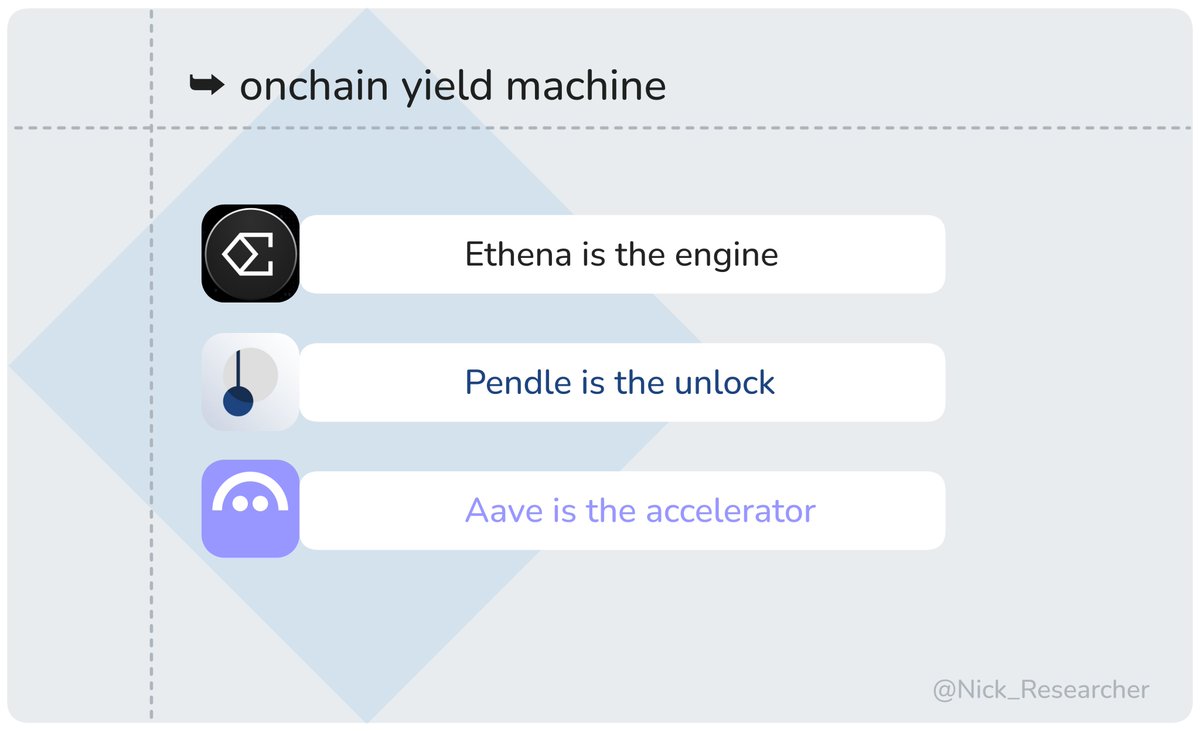
The latest Ethena PTs have been listed on the @aave instance on @Plasma! April USDe PT has been added with a $40 million cap, April sUSDe PT with a $100 million cap. Caps will be quickly raised in the coming days by hundreds of millions in PT capacity as demand scales.





🔥ETH Bulls vs. Bears: Can Ethereum’s Value Flow Back to the Token? Market sentiment has recently plunged to freezing point. The fierce debate over ETH represents a milestone "breakup": David Hoffman, co-founder of Bankless, publicly disclosed that he has liquidated his entire ETH position. In stark contrast, institutions on the other side of the aisle are buying the dip. Tom Lee’s BitMine has been aggressively accumulating ETH, elevating it to a core corporate strategy. On one side, a long-term evangelist has fully capitulated; on the other, public companies and institutional capital are consistently stacking. Is ETH losing its value capture capability, or is it on the verge of a massive institutional re-rating? Biteye has mapped out the core bull and bear arguments for you. 🌟 The Bull Case Bulls do not deny ETH’s recent price weakness, nor do they ignore the market's scrutiny of its value capture. However, they argue that Ethereum’s core thesis remains unbroken. Whether it is stablecoins, RWA, DeFi, Layer 2s, institutional tokenization, or Agentic AI, these novel financial activities still require a secure, neutral, and composable base layer. Ethereum remains the undisputed prime candidate. Therefore, bulls are not betting on a short-term fee rebound; they are wagering that as on-chain finance expands, ETH will be re-integrated into the valuation models of institutional and long-term capital. 1️⃣ Tom Lee @fundstrat | BitMine CEO | XHunt Rank: 202 Core View: Short-term downside is mere noise. In 2026, ETH will experience a structural breakout driven by tokenization + Agentic AI. He maintains his late-2025 target of $7,000–$15,000, asserting that the "ETH thesis is not broken." Key Action: Tom Lee isn't just talking the talk; he is backing it up via continuous accumulation through BitMine. On June 2, BitMine bought approximately 26,497 ETH (~$52 million). This followed a massive buy of 111,942 ETH (~$237 million) in the final week of May, marking one of the largest single-week inflows since the start of 2026. BitMine aims to hold 5% of ETH's circulating supply and is quickly approaching that target. 2️⃣ Raoul Pal @RaoulGMI | Real Vision CEO | XHunt Rank: 45 Core View: ETH is the fundamental operating system of the on-chain economy. Pal’s logic bypasses short-term price action to focus on network value: if you shut down Ethereum today, an immense volume of economic activity across L2s, DeFi, NFTs, and RWAs would instantly collapse. Thus, ETH remains fundamentally undervalued. 3️⃣ Ryan Sean Adams @RyanSAdams | Bankless Co-Founder | XHunt Rank: 115 Core View: Disagrees with David Hoffman's decision to liquidate. Ryan represents the "cautious bull" stance. While admitting Ethereum's window of opportunity has narrowed, he rejects the idea that its long-term potential is dead. Following David's exit—which Ryan called "the end of an era" for Bankless—Ryan disclosed that he still holds his ETH and continues to champion Ethereum as the foundational asset for institutions and the on-chain economy. 4️⃣ Joseph Lubin @ethereumJoseph | Ethereum Co-Founder / SharpLink CEO | XHunt Rank: 56 Core View: ETH is far more than a crypto asset; it is the essential base asset for the future of institutional on-chain finance. Key Insight: In late May, Lubin amplified an article by SharpLink CEO Joseph Chalom, double-downing on his long-term conviction. He believes stablecoins, RWAs, DeFi, smart contract vaults, and Agentic AI financial networks are collectively re-engineering global financial infrastructure—with Ethereum serving as the premier base layer. On May 5, 2026, Lubin noted that Consensys' institutional arm is actively onboarding Ethereum into major global financial market infrastructures, emphasizing: "TradFi keeps choosing Ethereum." SharpLink's Q1 2026 financial report revealed that as of May 4, 2026, the company held 872,984 ETH. 5️⃣ William Mougayar @wmougayar | Author of The Business Blockchain | XHunt Rank: 3559 Core View: ETH is severely mispriced. Ethereum ranks number one across all critical metrics—stablecoin volume, DeFi TVL, tokenized assets, settlement volume, and transaction count—commanding market shares ranging from 21% to 64%. Yet, its market cap accounts for only roughly 10% of the entire crypto market. Mougayar notes: "Ethereum is infrastructure. Just like the internet, value naturally accrues to the base layer, rather than solely depending on App-layer revenues or fees." 6️⃣ Hayden Adams @haydenzadams | Uniswap Founder | XHunt Rank: 25 Core View: David’s exit ironically underscores why the "ETH is money" thesis is correct, though it manifests differently than most expect. Adams believes that as all assets become tokenized, people will choose to hold what they value most rather than relying on a single unit of account. In this paradigm, what matters most isn't who becomes the sole currency, but who provides the cheapest, most efficient, 24/7 asset exchange system. Seen this way, Uniswap on Ethereum operates as a decentralized monetary system, enabling frictionless asset swaps and allowing multiple forms of "money" to compete openly. 7️⃣ Jediwolf @Jediwolf | The Doomed DAO Member | XHunt Rank: 1650 Core View: David Hoffman's premise that "Ethereum is a Giver, not a Taker" is spot on, but his conclusion is backwards. Jediwolf argues that the crypto market is overly obsessed with "extractive value" metrics (high fees, high takes, value capture). Ethereum's uniqueness lies in its refusal to aggressively extract value; instead, it prioritizes provisioning tooling, trust, and infrastructure. Taking on-chain art as an example: Ethereum supplies the entire stack—minting, provenance, settlement, custody, identity, global liquidity, and composability. While this may not pump the token price instantly, it forces artists to price in ETH and collectors to think in ETH, anchoring cultural assets firmly within its ecosystem. 🐻 The Bear Case Beyond price action, internal organizational shifts within the Ethereum ecosystem throughout 2026 have fueled skepticism. Since the beginning of the year, the Ethereum Foundation has seen a wave of departures from senior researchers, protocol leads, and executives, culminating in several high-profile exits in May alone. This highly concentrated timeline has been dubbed by community members and media as the "Spring 2026 Reshuffle." This backdrop has led a segment of investors to fundamentally question ETH's long-term value capture. 1️⃣ David Hoffman @TrustlessState | Bankless Co-Founder | XHunt Rank: 59 Core View: The window for the "ETH is Money" narrative has effectively slammed shut. While Ethereum as a network remains highly successful in providing secure block space for L2s, DeFi, stablecoins, and RWAs, this network growth will not necessarily flow back into the ETH token. In short: Ethereum will keep growing, but the ETH token may not be the primary beneficiary. Consequently, David fully exited his position to reallocate capital to higher-conviction opportunities. 2️⃣ Markus Thielen @markus10x | 10x Research Founder | XHunt Rank: 60383 Core View: On May 16, 2026, 10x Research issued a high-conviction short ETH call. Thielen argues that both the fundamental narrative and institutional flows are deteriorating, boiled down to three core points: (1) ETH lacks traditional structural cash flow; (2) derivatives data shows aggressive short dominance; and (3) institutional capital is actively retreating. Thielen subsequently noted that ETH dropped roughly 10% following their alert, adding that their macro bearish thesis actually materialized as early as October 31, 2025. 3️⃣ Goldman Sachs | Shift from Spot Exposure to Defensive Allocation Core View: While the investment bank has avoided overtly bearish public commentary, its Q1 2026 13F filings reveal a distinct cooling toward spot Ethereum exposure. The data shows Goldman significantly trimmed its crypto ETF positions, adopting a heavily defensive and cautious stance specifically regarding Ethereum-related products. 4️⃣ Harvard Management Company (Harvard University Endowment) Core View: Harvard hasn't released a bearish public thesis, but its portfolio moves speak volumes. After initiating a sizable position in BlackRock’s spot Ethereum ETF (ETHA) in Q4 2025—buying ~3.87 million shares valued at $86.82 million—the endowment completely liquidated the entire allocation in Q1 2026, holding the asset for just a single quarter. 5️⃣ eric @econoar | EIP-1559 Contributor | XHunt Rank: 156 Core View: You cannot blame David for selling; ETH has underperformed the broader crypto market for years. Eric revealed that he agrees with much of David’s logic and has drastically cut his own ETH exposure over the past two years in favor of assets that have vastly outperformed it. However, he doesn't think this underperformance means Ethereum did anything fundamentally wrong. Instead, he points out a blind spot: ETH's aggressive early-stage gains minted an enormous cohort of wealthy insiders, creating massive, long-term structural sell pressure that the market takes years to absorb. Ultimately, Eric advocates for portfolio management over dogmatic ETH maximalism: "The market doesn't lie; there's no point fighting it. If ETH catches fire again, you can always buy back in." 6️⃣ Ignas @DefiIgnas | @PinkBrains_io Co-Founder | XHunt Rank: 383 Core View: Holding ETH has shifted from a consensus default to a contrarian bet. Ignas highlights that its multi-year weakness stems from both shifting market metas and self-inflicted wounds: the L2-centric roadmap has diluted L1 value capture, L1 scaling remains sluggish, UX hasn't moved the needle, and the fee/revenue narrative has withered. While Ethereum retains an unrivaled moat in decentralization, censorship resistance, and cypherpunk ideals, the market currently only optimizes for revenue, volume, and valuation multiples. This is ETH’s core dilemma: it still rules DeFi TVL, but the yield generated leaks to apps, stablecoin issuers, and L2s rather than returning to the L1 token. Furthermore, the "ultrasound money" thesis has faded; low fees benefit users, but without a massive explosion in transaction volume, the burn and deflation engine falls flat. Ignas concludes that for ETH to win back confidence, it must move past philosophy and bring back real users, transaction volume, fees, and explicit value capture. 🌟 Conclusion The most fascinating aspect of this divide is that ETH is no longer treated merely as a faith-based asset exclusive to the crypto-native community. Historically, the Ethereum narrative centered on technical upgrades, ecosystem vibrancy, and developer mindshare; as long as the network was being utilized, the market took it for granted that the token would prosper. Today, that assumption is dead. The market is relentlessly demanding answers: Where is the revenue? Where is the cash flow? Why should capital choose ETH over BTC? Why should an institution hold it long-term instead of treating it as a short-term trading instrument? Exactly how much ecosystem growth translates to the token? This is ETH’s most awkward, yet defining moment. Moving forward, the hurdle for Ethereum isn't proving that its network will survive or that its ecosystem will innovate. The real test is whether ETH can transition from being merely a "utility layer that gets consumed" into a "core asset that institutions continuously buy and hold." That is the ultimate question driving this multi-billion dollar tug-of-war.