

Grets
80 posts
Grets
@gr3tts
Consulting / advising / searching
United Kingdom Katılım Ağustos 2025
1.5K Takip Edilen32 Takipçiler

@HarryScoffin It’s people boycotting flats because of all the negative propaganda. The reason service charges are high are because maintenance, energy and insurance costs are high. Blame the govt regulations, levies and taxes, an not the tenure.
English

Taylor Wimpey has just pulled out of building more apartments in London because of weak demand. Not planning related.
That is people boycotting leasehold flats because they are a terrible buy. Last year, 60% of all London properties sold were leasehold flats, but they made up 90% of all losses. Wake up!
SW1 silence, including from groups who claim to push for radical growth opportunities and represent young people being screwed, is deeply suspect.
BillyTheRetard@HoustonPuddle
@HarryScoffin Weird comment. There can be multiple reasons for London's collapsed house building rate - and they needn't necessarily contradict one another. Would it be useful if every response to your campaign was "a *genuine* group would call for planning reform" Not helpful.
English
Grets retweetledi

Let's give this putter away.
Here's how to win.
• Retweet this tweet
• Fill out the form in the next tweet
Winner can choose the below.
• 3 lie angles (69,70,71)
• 5 sight line options
• RH or LH
• Length
• Chrome or Black shaft
Runs through 5/25 at 5:00 Central. Winner will be selected on 5/25 by 10:00 Central.


English
@DJ_CURFEW “Claude give me some AI slop to make my layoffs sound sexy”
English

Today we reduced headcount by 22%. The business is the strongest it's ever been. So I think it's important to be direct about what I'm seeing and why.
First, I made this decision and I own it. I did it because the way to operate at the highest level of productivity is changing, and to win the future, ClickUp needs to change with it.
Second, this wasn't about cutting costs. Most savings from this change will flow directly back into the people who stay. We'll be introducing million-dollar salary bands. If you create outsized impact using AI, you'll be paid outside of traditional bands.
Most importantly, I have the deepest gratitude for those affected. We're doing this from a position of strength specifically so we can take care of people properly. Everyone affected receives a package aimed at honoring their contributions and easing the transition.
I only see two options: wait for this to play out gradually in the market or be honest about what I'm seeing and act proactively.
THE 100X ORGANIZATION
The primary change is that we're restructuring around what I call 100x org. The goal is 100x output. The roles required to build at the highest level are fundamentally different than they were a year ago.
Incremental improvements to existing systems won't get us there. We need new ones. That means creating enough disruption to rebuild rather than iterate on what's already broken.
The common narrative is that AI makes everyone more productive. It doesn't. Many of the workflows of today, if left unchanged, create bottlenecks in AI systems.
These roles will evolve. But waiting for that to happen naturally means falling behind now.
The 100x org is actually heavily dependent on people - infinitely more than today. This is only possible with 10x people that have embraced and adopted new ways of working.
THE BUILDERS, AGENT MANAGERS, AND FRONT-LINERS
— THE BUILDERS: 10X ENGINEERS
I don't think most companies have internalized what's actually happening with AI in engineering. The common narrative is that AI makes all engineers more productive. That may be true in isolation, but at an organization level - that is the farthest thing from reality.
Here's what we've validated recently at ClickUp: the great engineers, the ones who can orchestrate, architect, and review, are becoming 100x engineers. They're not writing code. They're directing agents that write code. The skill is judgment.
AI makes the best engineers wildly more productive, and everyone else using AI slows these engineers down.
Think about it - the bottlenecks are (1) orchestration - telling AI what to do, and (2) reviewing - what AI did. Everything is leapfrogged and no longer needed.
So who do you want orchestrating and reviewing code?
And how do you want your best engineers to spend their time?
If your best engineers are spending time reviewing other people's code, then this is inherently an inefficient bottleneck. These engineers can review their agent's code much faster than reviewing human code.
The new world is about enabling your 10x engineers to become 100x.
The wrong strategy is to push every engineer to use infinite tokens. Companies doing this are celebrating 500% more pull requests. But customer outcomes don't match the volume of code being generated.
I call this the great reckoning of AI coding, and every company will face this soon if not already.
More code is just another bottleneck to the best engineers, and ultimately to your company's impact as well.
— THE BUILDERS: 10X PRODUCT MANAGERS
Product management and design roles are merging.
Designers that have customer focus, become more like product managers.
And product managers that have intuition for UX become more like designers.
The bottleneck of user research is gone. It takes us just one mention of an agent to kickoff research and analyze results.
The bottleneck of product <> design iteration is also gone. The product builder iterates on their own, along with agents and skills that ensure alignment with quality and strategy.
Also controversial today - I believe that the wrong strategy is to have your PMs shipping code - that just introduces another bottleneck that the best engineers will waste their time on.
To be clear, PMs should be coding but they should do this in a playground to iterate, validate, and scope. That code should not go to production.
Everything outside of managing systems, orchestrating AI, and reviewing output becomes a bottleneck.
That's why the other roles that are critical along with these are the systems managers (to reduce bottlenecks) along with a bottleneck you can't replace - customer meeting time.
— THE SYSTEM MANAGERS
Ironically, the people that automate their jobs with AI will always have a job. They become owners of the AI systems - agent managers. We have many examples of these people at ClickUp.
The underlying systems in which we operate are absolutely critical to get right. I think most companies are delusional to think they can iterate on existing systems and compete in this new world.
You must create enough disruption so that old systems are deprecated entirely. If there's any definition for 'AI native' that's what it is.
— THE FRONT-LINERS
In a world that will become saturated with AI communication, the human touch will matter more than anything to customers.
This is a bottleneck that you shouldn't replace - even when agents are high enough quality to do video meetings.
One-on-one meeting time with customers is something that shouldn't be automated. The systems around the meetings should be - so that front-liners spend nearly 100% of their time with customers.
REWARDING 100X IMPACT
In a world where companies are able to do so much more with less, where does that excess money go?
In our case, much of the savings in this new operating model will flow directly back to those that enabled it.
We must reward people that create productivity accordingly. This aligns incentives on both sides. Plus, in a world where your best people create 100x impact, you can't afford to lose them.
You should aim to retain these employees for decades. The context they have and their ability to efficiently orchestrate and review will be nearly impossible to replace.
Compensation bands of today should be thrown out the door. We're introducing $1 million cash/year salary bands with a path available to nearly everyone in the company if they produce 100x impact by creating or managing AI systems.
THE FUTURE
Nearly every company will make changes like these. The ones that do it proactively will define what comes next.
The future is not fewer people. It's different work, new roles, and better rewards for those who embrace it. We're already seeing entirely new roles emerge, like Agent Managers, that didn't exist a year ago.
ClickUp is positioning to lead this shift, not just internally, but for our customers too. I've never been more certain about where we're headed.
English

At some point Anthropic talked to me informally about potentially joining their Board. I wasn’t interested and wouldn’t have been a good fit. But I did send Dario and Daniela a copy of Aristotle’s “Politics.” Unfortunately, I worry they’ve been too busy to read it.
Overlap: Business & Tech@Overlap_Tech
Dario Amodei: Ideology Won't Survive the Reality of AI "We're going to find that ideology will not survive the nature of this technology. The things I'm talking about are gonna become bipartisan and universal because everyone will recognize the necessity of it." — @DarioAmodei
English

@ContrarianCurse It isn't price fixing if you announce it at a JPM Fireside chat
English

Pretty funny to watch the HDD guys like quietly tell one another each Q to not raise capacity and just extort everyone
then you have Samsung pulling in p5 and wanting to jizz themselves to take back market share and CXMT coming into flash. Some things never change
English


In a workshop on the outskirts of Bletchley (it had to be there, didn't it), on the 26th of March this year, a small British company called Pulsar Fusion did something that has not been done by any other company or government on Earth.
It ignited a controlled plasma inside the test chamber of a working nuclear fusion rocket engine.
The plasma held, along with the chamber. The fusion reaction was the kind of reaction that, contained inside a sufficiently engineered magnetic bottle, will one day take a crewed British vehicle to Mars in 30 days rather than 8 months, and that will, within the working lifetime of the engineers presently building it, make the outer planets of the solar system accessible to anyone with a British passport.
The geography of the achievement deserves a longer moment of pause. Bletchley, in 1942, was where Alan Turing and his colleagues broke the Enigma cipher and almost certainly shortened the war in Europe by two years. Pulsar Fusion's headquarters sits roughly 600 yards from the Hut where they did it.
The country that did the maths inside that hut has just, less than a mile down the road, ignited the plasma that could power the next century of human space travel. There is a continuity of British scientific lineage here that is, on the face of it, almost embarrassingly providential, and it is almost completely unreported in the British press.
It's not quite Kitty-Hawk-to-the-moon in 61 years, but it's close.
Like so many great companies of profound importance, Pulsar Fusion is pretty small. It was founded in 2013, and employs around 50 staff. Its chief executive, Richard Dinan, is a working British physicist who has spent the last decade quietly assembling the team and the capital to do what the world's national space agencies have been promising for 60 years and consistently failing to deliver.
The competing American programmes, principally at NASA's Glenn Research Center and at the Princeton Plasma Physics Laboratory, are years behind on the propulsion side. The competing Chinese programmes are obscure but, on what is known publicly, also behind. The European Space Agency is, as ever, organising a workshop. Pulsar fired its plasma in March and has been preparing the next-stage tests in the months since.
What this kind of capability means, when commercialised, is genuinely vast.
The economic argument for getting a payload to Mars in 30 days rather than 8 months is not principally about the human passengers, though there is one. It is about cargo. Given a 30-day transit, Mars becomes a logistically tractable destination for the kind of infrastructure-build that turns it from a flag-planting science mission into a working industrial site.
The argument for the outer planets is even larger. The asteroid belt alone, on conservative mineralogical estimates, contains more economically viable platinum-group metals than the entire crust of the Earth has been mined for in industrial history. The first country with reliable fusion propulsion is the first country with reliable access to that supply. The country that holds that capacity, fifty years from now, will be holding the most consequential industrial advantage of the 21st century, and there is no obvious second prize.
The standard British response to this kind of thing is to either ignore it entirely, sell the company to an American buyer at series B (the DeepMind path) for fire-sale prices, or fund it at the level of a Whitehall departmental tea and coffee budget (the Skycutter and Orbex paths).
The standard British response will not be sufficient. Pulsar Fusion needs the kind of patient capital that turns a working demonstration into an operational engine, and that, in turn, into a manufacturing capability. The British state, on present form, is structurally incapable of providing it, British pension funds are structurally incapable of investing in it, and the British political class will, on present form, only notice if it somehow manages to swing a leadership election.
I wantt= Pulsar Fusion treated as a national-strategic asset, and beyond that as a potential subject of national destiny.
The Sovereign AI Fund that backed Ineffable Intelligence has a clear template. The Prosperity Zone programme we designed at Progress that anchors heavy industry at SaxaVord and Teesside has the geographic flexibility to include a fusion-propulsion cluster in Buckinghamshire, six miles from the most evocative site in modern British scientific history.
The procurement architecture of every major British defence and space agency should, from this autumn, be writing offtake contracts contingent on Pulsar's milestones. There's nothing extreme about these ideas. We could have been doing it decades ago.
I always conceived of Britain as being as much among the stars as it is on Earth. To buy into the idea of Britain as a culture and polity is necessarily to buy into the concept of the human being as an illimitable force. Our history is littered with happy instances of people of great fortitude hitting upon obstacles and, with a cry of "This will not stop us", clearing the way for our brothers and sisters to follow through.
A small British company in Bletchley has, while nobody was looking, extended that arm of our tradition, by accomplishing one of the most important pieces of scientific engineering of the decade.
The country that produced them is, in a measurable sense, the same country that produced the Bombe, the Colossus, the jet engine, the structure of DNA, and the World Wide Web. The capacity is intact. The political class capable of recognising it must catch up, and will.

English


Talking to the sales reps at Eleven Labs is all you need ot do to understand how well the company is doing
sur4js@sur4js
Eleven labs has all the characteristics of a $100b company in the making
English
@lukas_ohl what enables wage suppression? ultimately it’s that an employer knows someone else will do the job at that low salary otherwise they would raise it. So it’s got worse in the last 5 years especially for low skill jobs due to migration.
English



Something big happened this week: a judge for the first time used Labour's reforms to Judicial Review to halt time-wasting NIMBY objections to a big solar farm. Process slashed from 24 months to 4. First of many. #BuildBabyBuild

English
Model Trains. Stamp Collecting. Pokémon. Golf. Croquet. Home brewing. Shortwave radio. Quilting. Bridge. Warhammer. Solitaire. Miniature ship building.
Master Togan@Getinwithgame
DEVELOP A SEXY HOBBY Money can get her attention in the beginning, but it won’t keep her wet and excited for years. Women stay attracted to men who have interesting, masculine skills and passions outside of work. Things like:
English
@worstall @JonathanLigmas still would be +10 yrs to get closer to normalised housing supply so in that time the only option is demand side taxation.
English

@JonathanLigmas Abolishing the TCPA and paving the green belt is reasonable. Anything else is not.
English
35% of Italian families have second homes, 25% of Iberian, every plot point in those Scandi Noir novels takes place at the summer cottage.
What the fuck is it with Britain where being normal, civilised, European, means punitive tax levels?
Alan MacLeod@AlanRMacLeod
Yes, because you now have two homes.
English
@codyschneider what about the companies that aren’t being listed for sale?
English

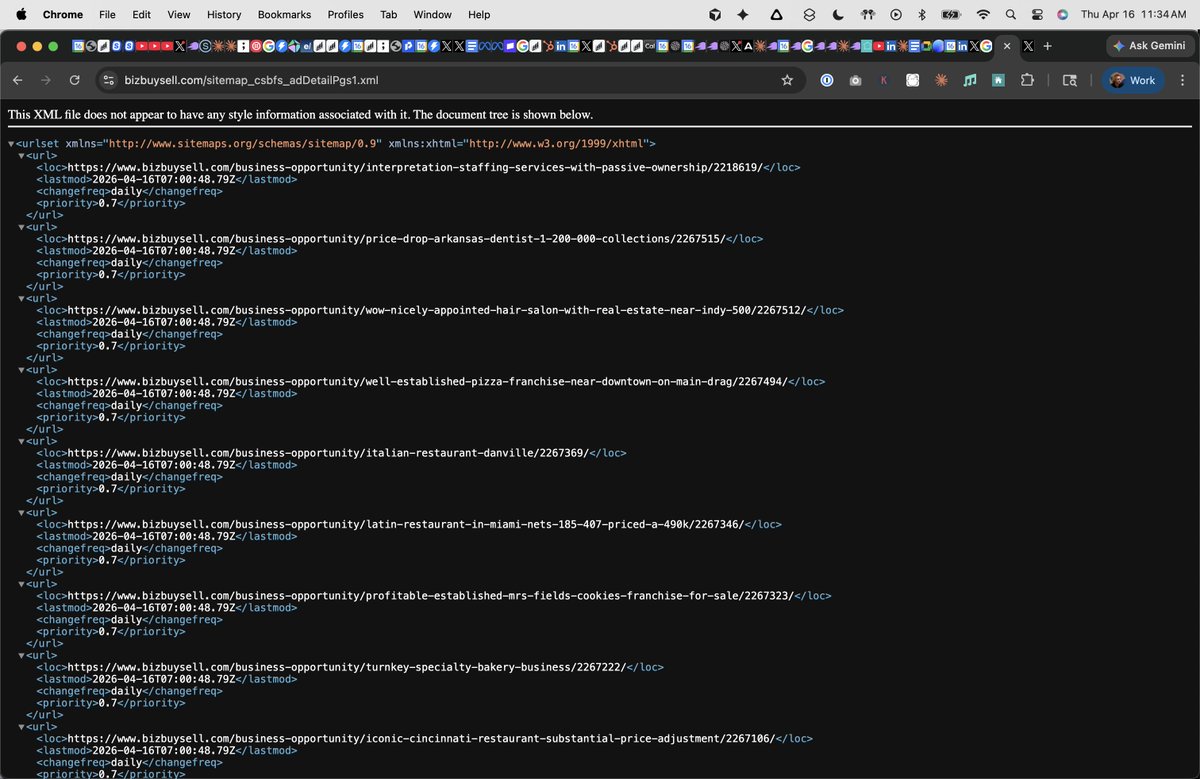
we just built an AI outbound agent for a PE company doing the following
they want to buy businesses
so we set up a agent that is watching the sitemap changes of business sale websites like bizbuysell .com
every new company for sale that gets added, an agent goes and finds the real business based on the public data
we then have an agent find the linkedin of the business owner
then we enrich linkedin profile to find email
then we cold email that person
and another agent is managing the cold email inbox
positive reply it hand raises for a rep to jump in and call them
if you want an agent like this for your go to market or marketing
we can build it for you at Graphed .com
English
@lucas_crupi @hardwarefyi @jimbelosic @sendcutsend @emm0sh @__WORC__ @pronounced_kyle @a16z @jordannoone some thicc neck fellas here
English

The inaugural Kinetic Conference 2026, hosted by @hardwarefyi, is quickly shaping up to be one of the best hardware conferences of the year
Stacked speaker lineup including:
@jimbelosic - CEO @sendcutsend
@emm0sh - Founder @__WORC__
@pronounced_kyle - Partner @a16z
@jordannoone - Co-Founder @zoodotdev
@FilArons - Founder of @DiracInc
@keenanwyrobek - Co-Founder @zipline
@reedogins - Co-Founder of Shinkei Systems
@alexhuckstepp - Founder of Uptool
…plus so many more great ones.
If you’re in SF May 12–13, come learn how modern physical systems are designed, built, and scaled.
Tickets & info 👉 kinetic.hardwarefyi.com Seats are limited!

English
Cannot wait for the job market in 2030. A cleaner at Hudson River Trading on £350k because they hired a quant on £3.5m tc
Politics UK@PolitlcsUK
🚨 NEW: Green leader Zack Polanski will call for policies to end the "affordability crisis" tomorrow - The introduction of a 10:1 pay ratio, whereby the highest-paid employee earns no more than ten times the lowest-paid - Free school meals for all primary and secondary pupils - Universal energy bill support for households and stronger rent controls - A customs union with the EU to cut business costs
English

I love quarterly offsites.
Call me a sicko, but there’s nothing better than a technology-free, 8-hour block to steer your business from 10,000 ft rather than worry about day-to-day blocking and tackling.
Here’s the agenda I’m using to crush tomorrow's leadership offsite, so we can keep hyper-scaling @tenex_labs. Feel free to steal it:
Segue: 15 min
Previous Quarter Review: 30 minutes
Review the VTO: 60 minutes
Break: 15 minutes
IDS: 90 minutes
Lunch: 30 minutes
IDS: 90 minutes
Break: 15 minutes
Establish Quarterly Goals: 120 minutes
Next steps: 10 minutes
Conclude: 5 minutes
Section-by-section breakdown:
Segue
Take 5 minutes, each person should share:
- Best business and personal news in the last 90 days
- What is working in the organization
- What is not working in the organization
- Expectations for the day
Previous Quarter Review
a) Review key metrics:
- Revenue
- COGS
- Gross Profit
- Gross Margin
- Operating Expenses
- Net Profit
b) Review quarterly goals (company & individual):
- Go through all goals and state Done or Not Done. No other commentary at this point.
- Discuss why the missed goals weren’t completed.
- Decide what you want to do with each goal. You have 4 options:
• Carry the goal forward to the next quarter.
• If the goal is 95 percent complete, completing the last 5 percent simply becomes an action item for the To-Do List.
• Reassign the goal to someone else.
• Delete the goal.
VTO review
VTO stands for Vision, Traction, Organizer. It is the one-page window into the most important parts of your business.
- Core values
- Core focus
- Marketing strategy
- 10-year BHAG
- 3-year picture
- 1-year plan
- 90-day goals (rocks)
This is your opportunity to review & revise any parts of the VTO as leadership.
Identify, Discuss, Solve
- List out all of the key issues that are top of mind
- Prioritize the 3 biggest issues
- Go through IDS for each issue:
• Clearly identify the real issue, because the stated problem is rarely the real one.
• For discuss, you get everything on the table in an open environment where nothing is sacred.
• Solve becomes an action item for someone to do. The item ends up on the To-Do List, and when the action item is completed, the issue goes away forever.
- Assign remaining issues to team members as to-dos
Next Quarter Goals
- Team lists everything on the whiteboard that has to be accomplished in the next 90 days.
- Make as many passes at the list as necessary until you’re down to three to seven.
- Once you’ve narrowed your list:
• Set the date that the goal is due
• Make the goal specific, measurable, and attainable.
- Set individual goals
• Once the company goals are set, the members of the leadership team each set their own goals.
• They first carry forward any company goals that they own to their individual list of goals and then come up with their most important three to seven.
- Create the goals sheet
• At the top are the organization’s Goals, and below that are each of the leadership team’s individuals Goals. This Goal Sheet is brought into your weekly meetings to review your Goals.
Next Steps
1. List out todos
2. Assign owners & dates for completion
Conclude
- Everyone takes 2 minutes and writes down:
• Feedback on the meeting
• Whether their expectations were met or not
• Their rating on the meeting from 1 to 10
- Everyone shares what they wrote down
Also shoutout to @EOSWorldwide, the operating model we use to run these offsites and our entire company.
English

Income tax will be dead within five years as AI jobs crisis grows, says Monzo founder lbc.co.uk/article/income…
English
@CoachPapaJohn Scottie hits a robotic tee shot on 18, birdies it. Rory sends it into the trees
English

Scottie will never have an iota of Rory’s aura and legacy, he is a soulless corporate enterprise. Rory is for the people
English

Can I get a favor? If you saw this post, clicked the link, and then did NOT sign up can you please give me a brutally honest answer why not?
Trying to understand better who our ideal customer is and how we can make our offer a no-brainer for them.
Anthony Castrio@AnthonyCastrio
Are you a Software Engineer, PM, or Customer Service Manager making over $150,000 per year? Are you looking for a job? For the equivalent of ~2 hours of your salary we can get you more interviews in a month than you'd know what to do with.
English

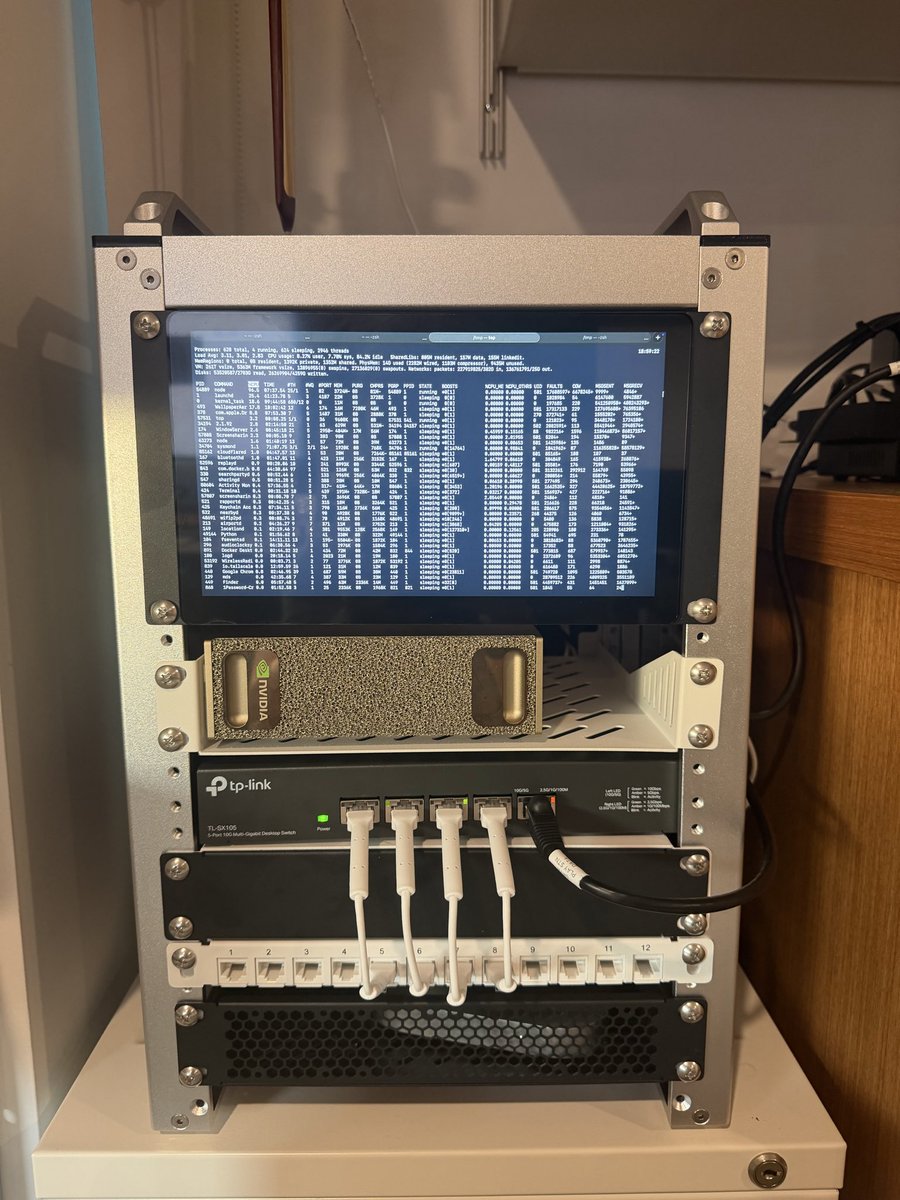
built my openclaw a new home
(mac mini + nvidia dgx spark
in a 8U mini rack)
English
@andrewchen let me guess the 20 something kids you gave $20m to don’t know how to interview so they are dragging it out to try and find any form of signal?
English
noticing a trend of startups replacing standard resumes/interviews with week-long (or at least 3-day weekend) in-office trials. Makes sense in a world of AI-generated resumes and interview responses
Turns out the best signal for whether someone can do a job is watching them actually do the job. took us 100 years of HR to rediscover apprenticeships!!! 😂
English