Sabitlenmiş Tweet
grixate
140 posts

grixate retweetledi

Agents make ugly UIs because they've never seen good design.
We've been fixing that, 2,000 DESIGN.md files from the world's best products, structured for a model to read and learn. Colors, type, spacing, layouts and more.
Free. styles.refero.design
English
grixate retweetledi
grixate retweetledi
grixate retweetledi

A Rust dev just killed Headless Chrome.
It's called Obscura. The open-source headless browser purpose-built for AI agents and scrapers at scale.
Chrome vs Obscura:
- Memory: 200MB+ → 30MB
- Binary: 300MB+ → 70MB
- Page load: 500ms → 85ms
- Startup: 2s → Instant
- Anti-detect: None → Built-in
Single binary. No Node, no Chrome, no dependencies.
Stealth mode is brutal:
→ Per-session fingerprint randomization (GPU, canvas, audio, battery)
→ 3,520 tracker domains blocked by default
→ navigator.webdriver masked to match real Chrome
→ Native function masking so detectors can't sniff it out
Drop-in replacement for Puppeteer and Playwright over CDP. Zero code changes.
If you run agents or serious scraping at scale, this repo prints money.
100% Opensource.

English

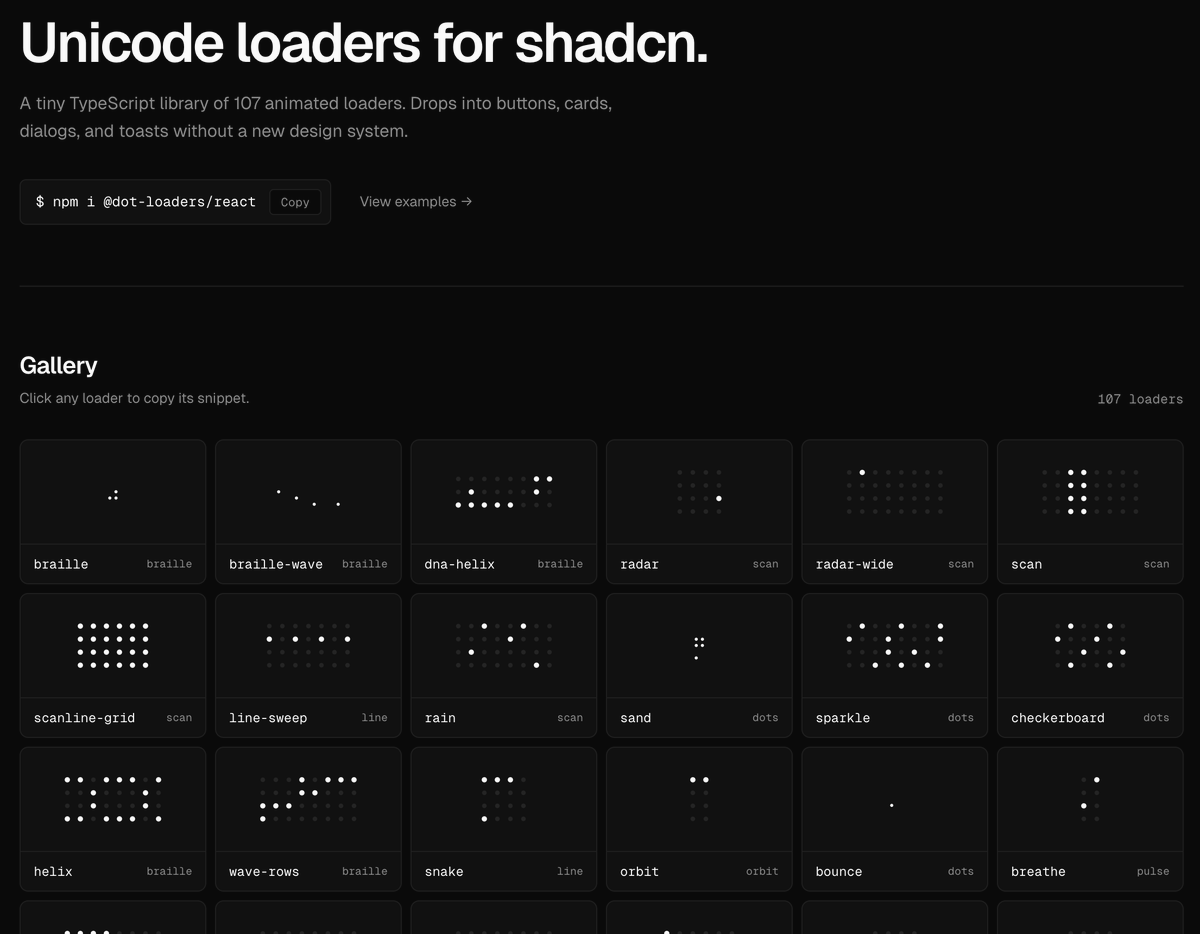
if you use shadcn/ui, your loading spinner is probably a lucide icon with animate-spin
it works. it's also the same spinner everyone else has.
so i shipped dot-loaders — a typescript toolkit for unicode and braille-style loading animations designed to drop into @shadcn components without fighting tailwind or radix
⠋ ⠙ ⠹ ⠸ ⠼ ⠴ ⠦ ⠧ ⠇ ⠏
currentColor inherits, className threads through, prefers-reduced-motion respected by default
under the hood every loader is a typed schema — frames, cadence, effects, symbol map. same definition renders as an svg grid, inline text, or terminal output. zero react dependency in the core package so you can use it outside components too
grixate.github.io/dot-loaders/

English

Karpathy's @karpathy LLM Knowledge Bases post describes something deceptively simple:
-> Dump raw sources into /raw/
-> LLM compiles a living markdown wiki
-> Query the wiki agentically
-> Outputs and lints feed back in
-> The knowledge base compounds with every interaction
No fancy RAG. No complex infrastructure. The LLM maintains indexes, summaries, backlinks, and concept articles. The human rarely touches the wiki directly.
The key insight most people missed: this isn't a note-taking system. It's a knowledge compiler. Raw data in, structured knowledge out, continuously refined.
Now apply this pattern to product development:
Raw sources = user interviews, analytics, support tickets, competitive research, internal discussions
Compiled wiki = structured product knowledge: insights (typed, severity-coded), decisions (with alternatives and reasoning), requirements (with evidence links and confidence scores)
Agentic queries =>
"What decisions am I most likely wrong about?"
"What user evidence contradicts our current roadmap?" "What shipped features have no measured outcomes?"
Feedback loop = every query, every decision, every outcome feeds back into the knowledge base
This is what I've been building as a methodology.
I call it Product Graph. Karpathy proved the pattern works for personal research. Product Graph is the team-scale, product-development-specific version.
grixate@grixate
English

@linear says issue tracking is dead. @karpathy says his tokens now go to knowledge, not code. Both are pointing at the same thing.
The era of static artifacts — tickets, docs, backlogs, wikis — is ending. What's replacing them isn't "AI features bolted on." It's a structural shift: from humans maintaining artifacts to systems maintaining knowledge.
Linear's bet: context replaces tickets. Agents interpret intent and route work instead of humans translating everything into task descriptions.
Karpathy's bet: raw data gets compiled into living knowledge bases that self-maintain, self-lint, and compound with every query.
Both are saying the same thing in different languages: the meta-work layer — the second-order work of organizing what you know — is becoming the domain of AI.
But here's what neither fully addresses: what's the methodology? What's the structure of the knowledge itself?
Karpathy's system is personal. Linear's is execution-focused. Neither covers the full product development lifecycle: from vision → research → decisions → requirements → shipped outcomes.
That's the gap I've been working on. More in this series.
grixate@grixate
English
grixate retweetledi

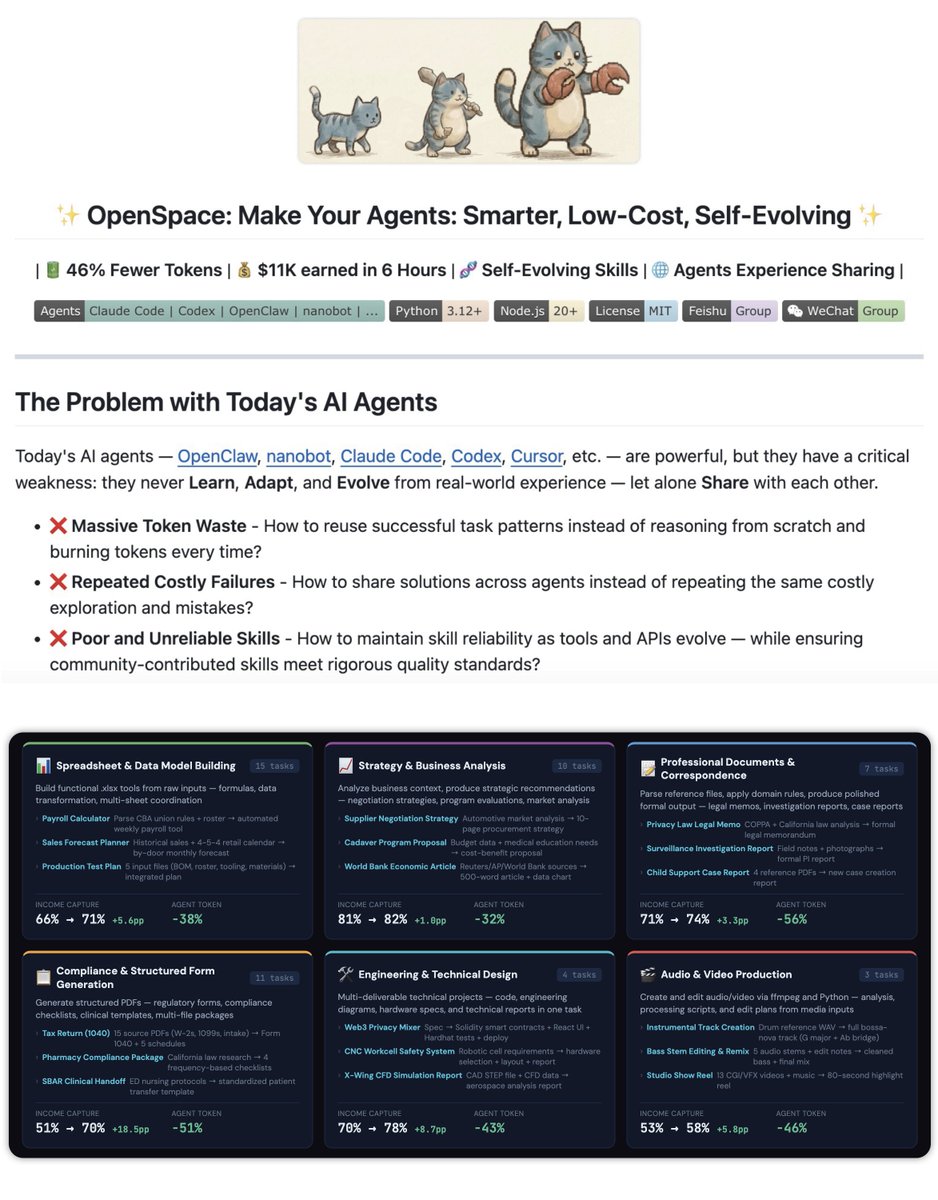
Introducing OpenSpace: The self-evolving engine that makes your AI agents smarter, more cost-efficient, and continuously improving.
✨ 46% fewer tokens through self-evolving skills and shared agent experiences — where every completed task makes every connected agent smarter and more economical. Turn individual progress into collective intelligence.
GitHub: github.com/HKUDS/OpenSpace
Seamless Integration: OpenClaw, nanobot, Claude Code, Codex, Cursor, and more.
- The Problem with Today's AI Agents
Today's AI agents — OpenClaw, nanobot, Claude Code, Codex, Cursor, etc. — are powerful, but they have a critical weakness: they never Learn, Adapt, and Evolve from real-world experience — let alone Share with each other.
❌ Massive Token Waste - How to reuse successful task patterns instead of reasoning from scratch and burning tokens every time?
❌ Repeated Costly Failures - How to share solutions across agents instead of repeating the same costly exploration and mistakes?
❌ Poor and Unreliable Skills - How to maintain skill reliability as tools and APIs evolve — while ensuring community-contributed skills meet rigorous quality standards?
OpenSpace plugs into any agent as skills and evolves it with three superpowers:
- 🧬 Self-Evolution
Skills that learn and improve themselves automatically
✅ AUTO-FIX — When a skill breaks, it fixes itself instantly
✅ AUTO-IMPROVE — Successful patterns become better skill versions
✅ AUTO-LEARN — Captures winning workflows from actual usage
✅ Quality monitoring — Tracks skill performance, error rates, and execution success across all tasks.
- 🌐 Collective Agent Intelligence
Turn individual agents into a shared brain
✅ Shared evolution: One agent's improvement becomes every agent's upgrade
✅ Network effects: More agents → richer data → faster evolution for every agent
✅ Easy sharing — Upload and download evolved skills with one simple command
✅ Access control — Choose public, private, or team-only access for each skill
- 💰 Token Efficiency
Smarter agents, dramatically lower costs
✅ Stop repeating work → Reuse successful solutions instead of starting from zero each time
✅ Tasks get cheaper → As skills improve, similar work costs less and less
✅ Small updates only → Fix what's broken, don't rebuild everything
✅ Real savings: 4.2× better performance with 46% fewer tokens on real-world tasks, delivering measurable economic value. (GDPVal)
#OpenSpace #TokenEfficient #nanobot #AIAgents #OpenClaw

English
grixate retweetledi
grixate retweetledi

This is the coolest thing I've seen all year
templar@tplr_ai
We just completed the largest decentralised LLM pre-training run in history: Covenant-72B. Permissionless, on Bittensor subnet 3. 72B parameters. ~1.1T tokens. Commodity internet. No centralized cluster. No whitelist. Anyone with GPUs could join or leave freely. 1/n
English
grixate retweetledi

Figma shipped a silent patch specifically to kill figma-use — my open-source tool that did what they wouldn't: an MCP server that creates and modifies designs, JSX export, design linting. Then they scrambled to catch up with their own MCP server.
So I spent the weekend recreating @Figma from scratch.
OpenPencil: reads and writes .fig files, AI chat with full design tools, P2P collaboration with zero servers, ~7 MB app. No account, no subscription.
Three days, one developer, MIT license.
openpencil.dev
English
grixate retweetledi

Introducing the official 🐈 #nanobot X account: @nanobot_hku! Feel free to follow us! 😆
English
grixate retweetledi

This is my take on the perfect AI assistant.
A Rust-based agentic operating system designed to scale for large Slack and Discord communities. The channel is the ambassador to the human. Branches think. Workers execute. Nothing ever blocks.
Meet Spacebot 🟣
The biggest issue with OpenClaw is when it's doing work, it can't talk to you. Spacebot's architecture fixes this by design the conversation layer never touches tools. It delegates thinking to branches and heavy tasks to workers, so it's always responsive even with 100 people talking at once.
Dump your memory files, notes, documents and chat histories into a folder — Spacebot turns them into structured memories automatically. Eight typed memory categories, graph associations, hybrid search. Not markdown files. Not vibes in a vector database.
Built-in @OpenCode workers for deep coding sessions. Browser automation. Brave web search. Cron jobs. A skill system compatible with your existing OpenClaw skills. And a gorgeous control UI at spacebot.sh.
The cortex oversees the whole system — auditing memories, actioning goals and todos. You teach your Spacebot by talking to it. Structure and speed over config files and markdown.
Self-hosting is a single Rust binary. Or one-click cloud deploy at spacebot.sh.
This is for teams, communities, and personal assistants. It will blow you away.
⭐️ github.com/spacedriveapp/…
English

@Saboo_Shubham_ Also went with Go for my approach. Called it a Squidbot with advanced scalability (sub agents, federated multiagents), reliable long term memory, advanced security, token safety and budgeting - more to come!
Check it out!
github.com/grixate/squidb…
English

@SipeedIO Published my approach - Squidbot. Also powered by go. Focused on security, long term memory safety, subagents, federated multiagents, token budgeting and more.
Check it out!
github.com/grixate/squidb…
English

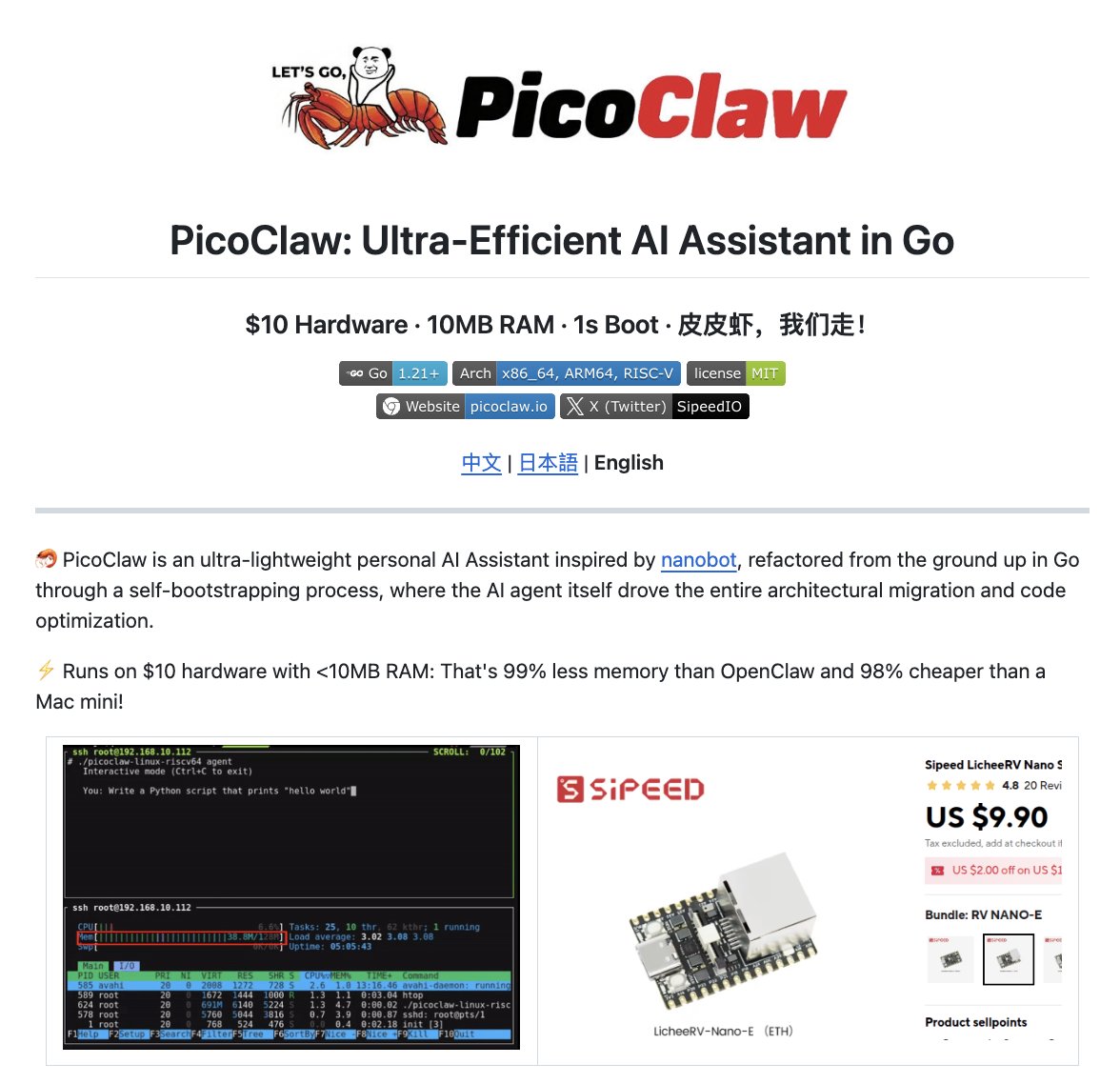
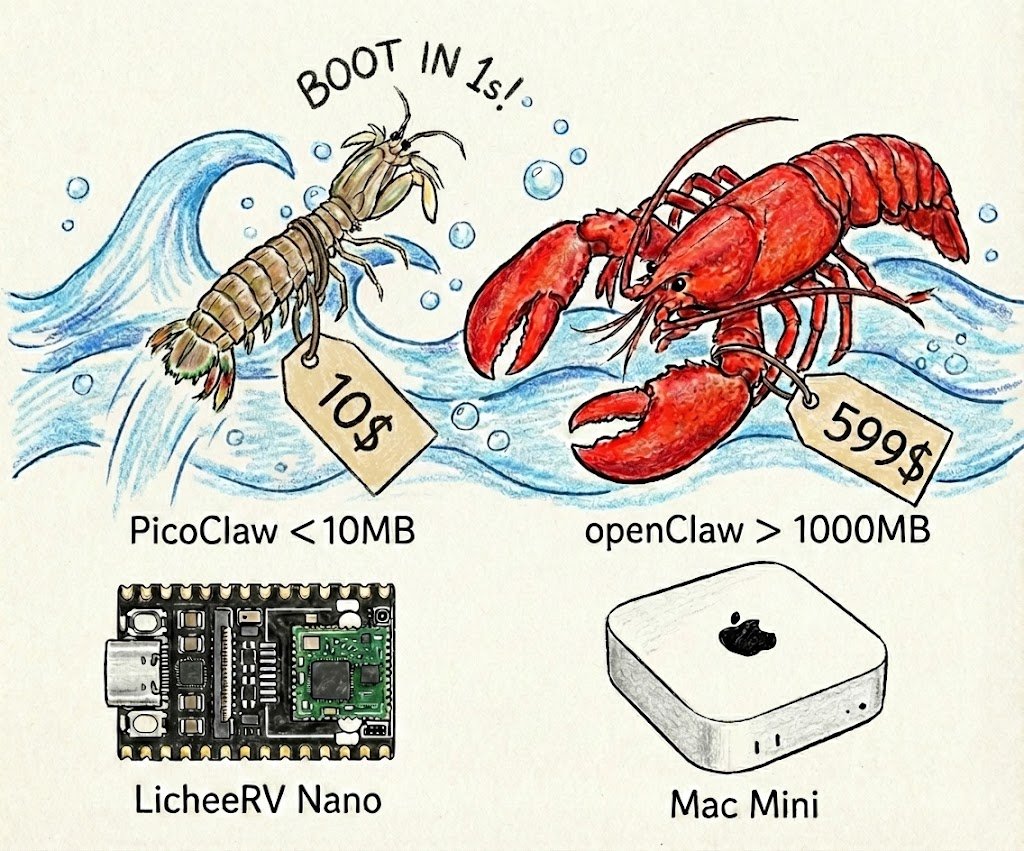
#PicoClaw: AI built the code in hours, matching #OpenClaw’s core features with only 1% code and 1% memory!
Ditch your Mac Mini—now you can run a full AI assistant on $10 RISCV hardware with 10MB RAM~
If it runs Linux, it can now be your personal AI Agent!
github.com/sipeed/picoclaw

English

Reliability-first AI assistant runtime in Go.
OpenClaw-compatible.
Still evolving, but the core is solid.
🦑 github.com/grixate/squidb…
English

Inspired by OpenClaw, I’ve been tinkering on this for the past few weeks, building an AI assistant runtime in Go with a focus on reliability and long-running behavior.
That work turned into Squidbot 🦑
github.com/grixate/squidb…
English