RTHahnMD

996 posts

RTHahnMD banner
RTHahnMD

RTHahnMD

@hahn_rt

Interventional Echocardiographer, Professor of Medicine at Columbia University, New York Presbyterian Hospital.

New York, NY Katılım Haziran 2018
306 Takip Edilen15.7K Takipçiler
Edgar
Edgar@Edgar__K·
This table perfectly maps an O(n) procedural gridlock. 🛑 ​Standardizing biological chaos by stacking endless 'requirements' only increases system latency. In a critical biological system, administrative latency equals thermodynamic loss for the patient. ​The goal shouldn't be to build a bigger, heavier maze of checklists (the M-Tensor) to justify an intervention. The goal is to collapse it. The physician (the H-Oracle) needs an architecture that allows for O(1) execution, bypassing the infinite validation loops. ​We must use data to prune the bureaucratic noise, not just to organize it. The baseline is survival, not compliance. M ⊗ H = 1. 🧠⚡⚖️⚙️✨
English
2
0
0
560
RTHahnMD retweetledi
NEJM
NEJM@NEJM·
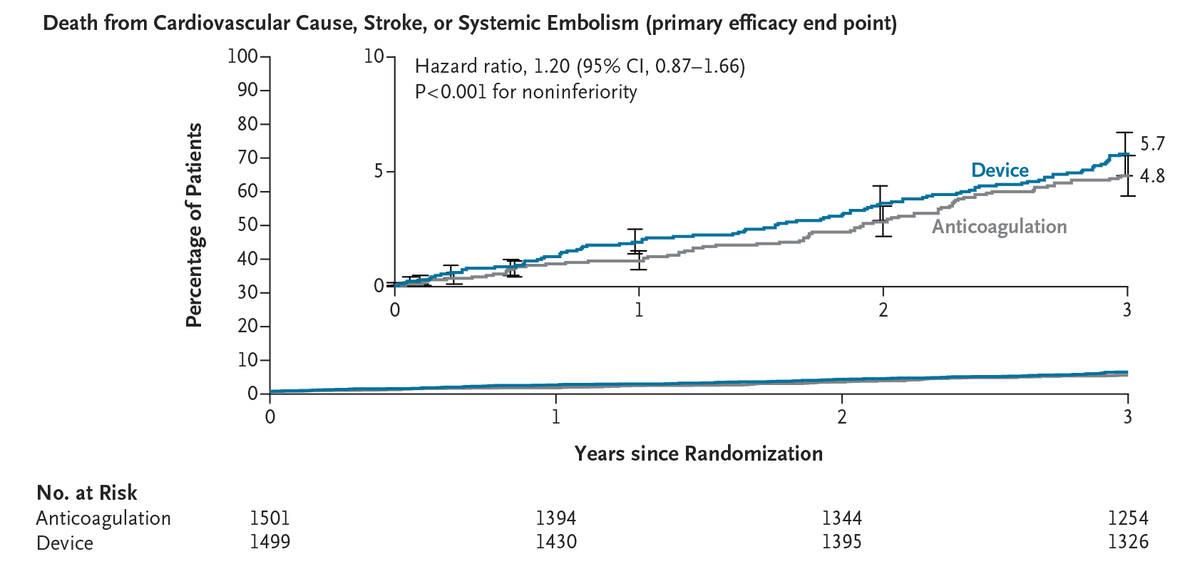
Presented at #ACC26: In patients with atrial fibrillation, left atrial appendage closure was noninferior to NOACs in an analysis of death from cardiovascular causes, stroke, or systemic embolism and was superior for non–procedure-related bleeding. Full CHAMPION-AF trial results: nejm.org/doi/full/10.10… Editorial: Left Atrial Appendage Closure — Should Recommendations Be Expanded? nejm.org/doi/full/10.10… @ACCinTouch
NEJM tweet media
English
12
81
240
141.4K
RTHahnMD retweetledi
John Mandrola, MD
John Mandrola, MD@drjohnm·
#acc26 Six reasons why CHAMPION AF should not change oral anticoagulation for AF I will have a formal post up on @theheartorg but here is a short summary 1) Stroke and Ischemic Stroke went the wrong way. All S -> 33 vs 50 [HR 1.46 95% CI, 0.94-2.27)] IS -> 27 vs 45; [HR = 1.61; 95% CI, 1.00-2.59)] Look at those upper-bounds. 2) NI would not have been met for efficacy had they used a margin with both rate ratio and risk difference, which is standard practice. The margin of 4.8% is based on event rates at 12%, which is 1.4 in relative terms (40% higher). But when event rates come in lower, as they did: 4.8% vs 5.7%, the 4.8% margin is too lenient. The 0.9% higher rate of the primary endpoint has a 95% CI of (-0.8-2.6%), so 2.6% is less than the margin of 4.8%. Now do it with relative risk. It's in table 2. The relative risk is 1.20. The 95% confidence intervals were 0.87-1.66. Note that 1.66> 1.40 so LAAC is not noninferior based on rate ratio margins 3) The primary safety endpoint is flawed because it excludes periprocedural bleeding and uses nonmajor bleeds, such as gum bleeds and bruising. It's open label trial so who which group will complain of more nonmajor bleeding? 4) When counting all events, Watchman barely reduced major bleeds. Also in the main results table is that major bleeds were 83 vs 87 (5.5% vs 5.8%; HR 0.92 95% CI 0.68-1.24) 5) Net Clinical Benefit was also flawed because they used nonprocedural bleeding and nonmajor bleeds. A normal patient would simply say, there were 17 more strokes and only 4 less bleeds. Hardly a good trade. 6) Bayes: trials don't give answers, they update priors. For Watchman, you have PREVAIL failing against warfarin, CLOSURE AF clearly failing against best med Rx (mostly DOACs) so priors are pessimistic. To go from pessimistic priors to enthusiastic posteriors you'd need hugely positive data. CHAMPION is not that. Don't believe the stories that CLOSURE failed due to them using other LAAC devices. In the AMULET IDE trial, Watchman and Amulet were similar. Also, if you believe that German operators are worse than US authors, you need to travel more. Conclusion: Oral anticoagulation for AF is one of the most evidence-based practices in all of medicine. To upend that would take much stronger data. Don't be bamboozled by this trial, which was designed to be positive before the first patient was enrolled. #ACC2026
English
21
113
388
108.9K
RTHahnMD retweetledi
Harlan Krumholz
Harlan Krumholz@hmkyale·
JACC just published 6yr outcomes from the Evolut Low Risk Trial w/additional 7yr follow-up. 1° endpoint (death or disabling stroke): no difference through 6 years. Imp finding: A divergence in reintervention appears beyond year five. @JACCJournals jacc.org/doi/10.1016/j.…
English
3
11
44
33.8K
RTHahnMD
RTHahnMD@hahn_rt·
Two of our @Columbia @HeartValveCntr studies led by Robin LeRUZ made the impactful #tricuspid regurgitation papers list by PCR!! Great overview by @PCRonline! @JACCJournals @ACCinTouch @escardio @Europace
PCRonline 🫀@PCRonline

The top ten impactful papers from 2025 on tricuspid intervention we almost missed! 🔗pcronline.com/News/Whats-new… Transcatheter interventions have rapidly reshaped the management of tricuspid valve disease, with landmark trials establishing feasibility and early clinical benefit. Beyond these pivotal studies, a series of less visible but highly informative papers addressed mechanisms, complications, patient phenotypes, and unintended consequences of intervention. Read this review by @Sticchi_Alex #PCRTricuspid #TreatTR #FixTR #interventionalcardiology

English
1
15
43
6.1K
RTHahnMD
RTHahnMD@hahn_rt·
Join us now at the Philips Training Village for discussion of advances in Imaging for Structural Heart #PCRLV @PCRonline
RTHahnMD tweet media
English
0
2
13
1.6K