hodisr

655 posts

hodisr banner
hodisr

hodisr

@hodisra

built the platform that funded your car. now building the AI that runs the funds behind your mortgage. @fundable__ai

Katılım Şubat 2017
330 Takip Edilen99 Takipçiler
hodisr
hodisr@hodisra·
@AndroOxinu Permanent capital was the pitch. Gates were always the architecture. Semi-liquid PC funds aren't built for LP turnover above 5% concentration. One Swiss exit reveals the structure was never built for liquidity, only for retention.
English
0
0
0
7
hodisr
hodisr@hodisra·
@business Equities trade because there's one tape, one ticker, one closing print. PC has thirty servicers producing thirty tapes. Nuttall is right about the trajectory, but the binding constraint is mark consistency, not investor appetite.
English
0
0
0
18
Bloomberg
Bloomberg@business·
KKR’s co-chief executive officer Scott Nuttall said it was likely that the alternative asset manager would eventually start trading private credit, following early efforts by Apollo to create a market for less liquid debt bloomberg.com/news/articles/…
English
4
3
7
9.8K
hodisr
hodisr@hodisra·
@rcwhalen @Forbes Default rate is the trailing print. The leading signal is amendment activity and PIK toggle frequency, both already running hot. Banks and insurers see headline defaults only when extensions stop covering the deferred coupon. The Forbes frame measures realized loss, not runway.
English
0
0
0
22
hodisr
hodisr@hodisra·
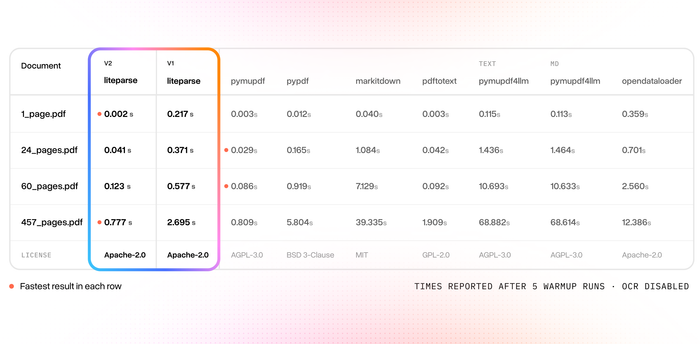
@jerryjliu0 Parser speed is table-stakes. In credit the loan tape lands in thirty schemas from thirty originators. The bottleneck isn't extraction, it's mapping every shape to one canonical model the agent can act on. Parse-quality wins the demo; schema-normalization wins the workflow.
English
0
0
0
846
Jerry Liu
Jerry Liu@jerryjliu0·
We've created the world's fastest PDF parser ⚡️ And it's more accurate than any other open-source, model-free PDF parser out there (pymupdf, pypdf, markitdown, pdftotext, opendataloader, pymupdf4llm) Introducing LiteParse v2 - we rewrote the entire library into Rust and adapted it as native packages for Python and Node. It supports 50+ different document types, can be triggered directly or installable directly within your favorite AI agent. Blog: llamaindex.ai/blog/liteparse… Repo: github.com/run-llama/lite…
Jerry Liu tweet media
LlamaIndex 🦙@llama_index

LiteParse v2.0 is out now, and it is blazing fast + runs everywhere! We rewrote everything from scratch in Rust, and now: - up to 100x faster parsing - install natively in Rust, JS/TS, and Python - a custom WASM package enables browser and edge runtime usage pip install liteparse npm i @llamaindex/liteparse npm i @llamaindex/liteparse-wasm cargo install liteparse Blog: llamaindex.ai/blog/liteparse… Repo: github.com/run-llama/lite…

English
25
76
901
85.6K
hodisr
hodisr@hodisra·
@thecredaily Extensions aren't liquidity. GFC forced sales because no extension mechanism existed, and that's how the clearing price showed up. The Värde frame mistakes deferred price discovery for buffer capacity. Marks stay clean because the mod blocks the realized loss.
English
0
0
0
11
CRE Daily
CRE Daily@thecredaily·
According to Värde Partners’ Tim Mooney and Jim Dunbar, today’s market has something the GFC didn’t: liquidity. Private credit. Loan modifications. Extensions. More ways to avoid forced sales. Season 7 with support from Henry AI. Listen here: credaily.com/podcast/ Watch here: youtu.be/SOYn5cAwhuw?si…
YouTube video
YouTube
English
2
0
2
61
hodisr
hodisr@hodisra·
@snowmaker Trust-by-default works when there's one production DB to access. At a credit fund the agent's 10x moment is upstream of permissions. The data lives across a servicer SFTP, a custodian portal, and the GP's inbox. You build the substrate before you grant access.
English
0
0
0
298
Jared Friedman
Jared Friedman@snowmaker·
One night I quietly gave our AI agent full access to YC's production database. It made the agent 10x more useful. That's what convinced me that trust-by-default is the only way to get the most out of agents.
Y Combinator@ycombinator

Over the past year, we've been building our own internal agent infrastructure at YC: over 350 tools, self-improving skill loops, and a shared organizational brain that gets smarter overnight. In this episode of the @LightconePod, we sat down with YC General Partner Pete @koomen to talk about how he led the effort from the ground up. We cover how giving agents unrestricted access to one database was the key unlock, the self-improving skill loops that get smarter overnight, and why he thinks we've arrived at the personal computer moment for AI. 00:39 — YC's AI Stack 02:15 — The Finance Team Problem That Started It All 05:07 — SQL Access Changes Everything 07:20 — One Database to Rule Them All 09:14 — Jevons Paradox 10:07 — Denormalizing for Agents 12:15 — The Single-Player Era of Agents 14:16 — 350 Tools and a Shared Registry 16:24 — Skillify, DRY, and MECE Resolvers 18:23 — The Self-Improving Dream Cycle 20:26 — The Two-Sentence Pitch Skill 23:06 — How Super Intelligence Compounds 25:10 — Recording Everything as a Building Layer 27:10 — The Shared Organizational Brain 29:18 — Trust-Default Culture as a Requirement 30:44 — Raising the Floor for New Employees 32:35 — Horseless Carriages 34:24 — Why Chat Is the Best Interface for Agents 38:50 — Just-in-Time Software 40:49 — Centralizing vs. Decentralizing AI 43:32 — The Personal AI Revolution

English
37
18
305
43.4K
hodisr
hodisr@hodisra·
@a16z Forward-deployed JVs read as distribution, but the deeper signal is who owns the workflow data. Generic agents fail at credit work not because the model is weak. The data lives in three legacy platforms and a shared inbox. The JV is the route to the substrate.
English
0
0
2
805
a16z
a16z@a16z·
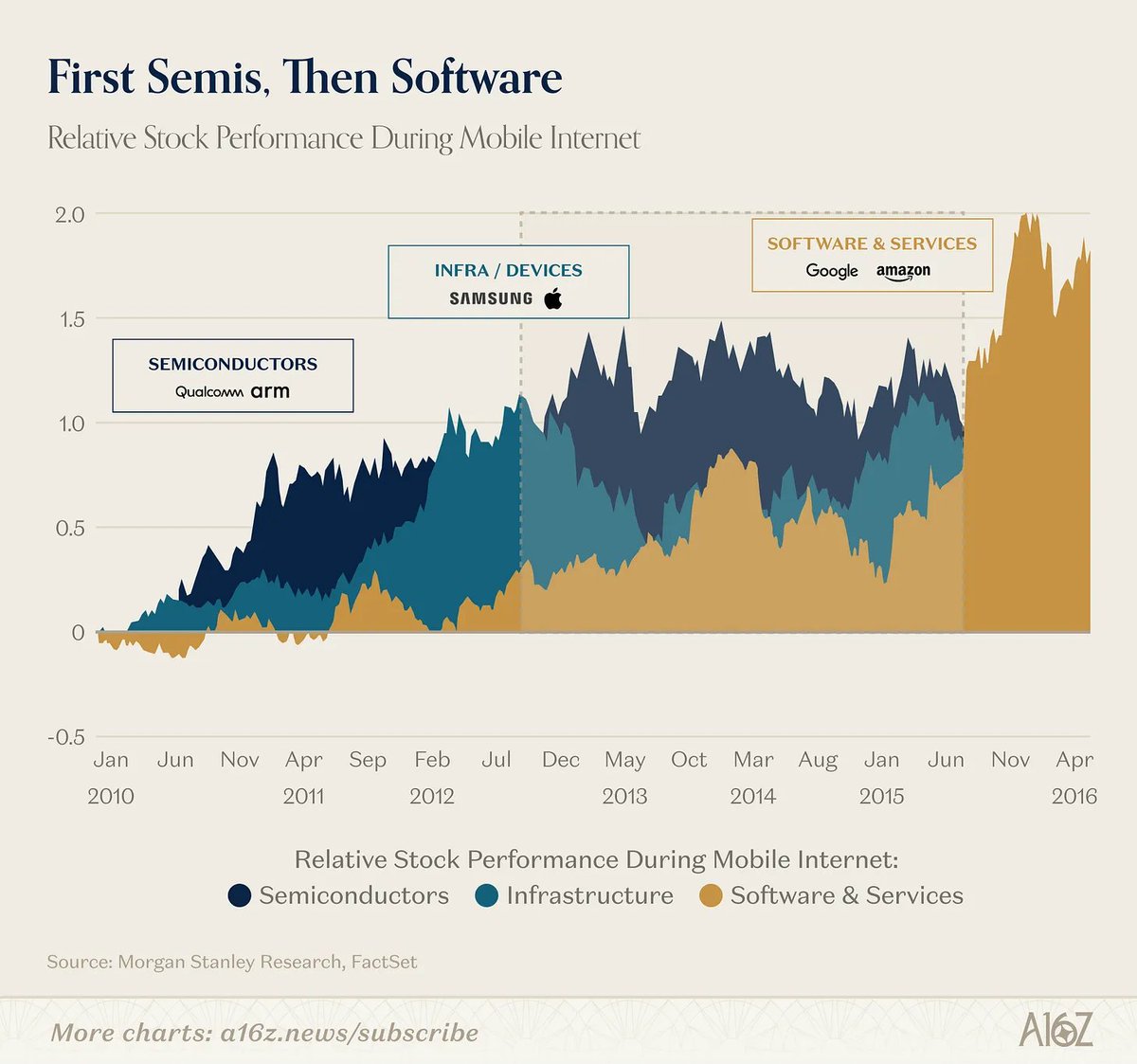
OpenAI and Anthropic are effectively telling the market they can't solve every problem with a generic AI coworker. You don't pour billions into massive forward-deployed joint ventures if you think the next model release is going to take care of it. In the cloud supercycle, semis led and software followed (and you didn't need Qualcomm or ARM to tell you the value was migrating up the stack). In AI, the infra layer itself is telling us the application layer is a separate, massive opportunity they can't fully capture. a16z's @joeschmidtiv on why the app layer isn't dead: a16z.news/p/avoiding-dea…
a16z tweet media
Joe Schmidt IV@joeschmidtiv

x.com/i/article/2059…

English
79
161
1.4K
275.5K
hodisr
hodisr@hodisra·
@claudeai @augmentcode @boltdotnew @coderabbitai @hebbia @WeAreLegora Verticalized agents in the marketplace are the right shape. In finance the rate-limiter isn't model access. The agent needs a canonical view of the portfolio to act, and that view doesn't exist at most funds, it gets built customer by customer before the agent does anything.
English
0
0
0
24
hodisr
hodisr@hodisra·
@cognition @Lux_Capital @generalcatalyst @8vc Horizontal agent infra clears $26B because the IDE is a forgiving surface. Verticalized work like credit underwriting lives across loan-servicer exports, custodian reports, and inboxes. Defending a CFO answer there shifts the moat the moment the workflow stops shipping text.
English
0
0
0
88
Cognition
Cognition@cognition·
1/ We’ve raised over $1B at a $26B valuation, led by @Lux_Capital, @generalcatalyst, and @8vc. Our enterprise usage has grown >10x since the start of this year, and our run-rate revenue grew to $492 M. We launched Devin two years ago as the first AI software engineer. Since then, cloud agents have gone from niche to mainstream, and today they are the fastest growing way to create software.
Cognition tweet media
English
122
153
1.9K
400.3K
hodisr
hodisr@hodisra·
@TheStalwart Query routing inside finance is upstream of the LLM. A credit analyst spends four hours on one file not because tokens cost, but because the answer sits across a loan-servicer export, a custodian report, and the CFO's inbox. Whoever routes that without copying wins the layer.
English
0
0
1
80
Joe Weisenthal
Joe Weisenthal@TheStalwart·
Feels like optimal query-routing technology is going to get very hot.
Ara Kharazian@arakharazian

The average business is spending 13x more on AI tokens than in January 2025, according to @tryramp data. That’s driven growth for OpenAI and Anthropic. While tokens are still a small share of actual business spend (<2% even for the highest spenders), this trend is unsustainable for most businesses. Two players will win out as businesses pivot to cost discipline on AI: — Google and Microsoft, who can more competitively offer cheaper models (they’ll be profitable anyway) — Platforms (Cursor, OpenRouter) that offer access to smart routing and open source models, cheaper than what you get from the main model companies. My comments in @dealbook today.

English
23
18
143
35.8K
hodisr
hodisr@hodisra·
@IlliquidInsight Sticky-capital frame holds until the marks soften. NAIC RBC consumption rises with portfolio quality drift, and the insurer's cap-light return profile compresses just as the AM's own fee book gets tested. Permanent on the way in, less so on the way through.
English
0
0
3
62
Illiquid Insights
Illiquid Insights@IlliquidInsight·
Asset managers love insurance companies. Why? Insurance capital provides: • Sticky, recurring fees • Long duration capital for illiquid bets • No fundraising every 5–7 years Athene is the engine behind Apollo. Everyone has copied the playbook. Full write-up ⬇️
English
2
0
12
1.8K
hodisr
hodisr@hodisra·
@trevornoren @verdadcap Canary works as a metaphor, but in PC the bird is muted by the marks lag. NAV moves quarterly and BDCs report at month-end, so by the time the signal hits an LP statement the mine has already filled. The transmission is real, the readout just trails the move.
English
0
0
0
33
Trevor Noren
Trevor Noren@trevornoren·
Too often in today’s fixation on private credit’s weaknesses, the bigger-picture risk is neglected. To our mind, private credit is more a canary in the coal mine than a systemic threat in and upon itself. The below chart reflects one key reason why. @verdadcap looked at the return of high-yield bonds to the matched public equities for every notch deterioration in credit over the last 20 years. The equity returns were always worse than the debt returns at each downgrade level. Unsurprisingly given their symbiosis, private equity possesses much the same vulnerabilities as private credit—pandemic-era malinvestment, overly concentrated exposure, and widespread “kick-the-can” tactics that have delayed a full reckoning with this downcycle, likely storing up pain. US private equity AUM is more than double US private credit AUM. Today, private-equity-backed companies account for roughly 8% of US employment. Market participants are neglecting that private credit’s challenges are likely evidence of more significant challenges brewing in private equity. What we fear is that turbulence in private credit YTD is a warning shot for tighter financial conditions to come. This is particularly concerning at a time when the US debt burden is ballooning and the war in Iran threatens stagflation amidst persistently higher energy prices. As of writing this, Goldman Sach expected Brent crude at an average of $90 per barrel in the fourth quarter of the year while JP Morgan expected that number to remain above $100 through the end of the year. It is also concerning given increasing signs of US consumer fragility, from record-high credit card debt and rising auto and student loan delinquencies to a savings rate hovering near a record low. And it is concerning given elevated valuations across asset classes. In this era of unprecedented financialization, main street and Wall Street have never been more intertwined. Learn more about Sage Road's new report on "The Private Credit Reckoning": sageroadresearch.com/products/the-p…. Interested in subscribing? Message me.
Trevor Noren tweet media
English
3
2
6
2.3K
hodisr
hodisr@hodisra·
The rail is the easy part. What stalls institutional adoption is the data underneath. Tokenize a loan tape and the tape still lives across loan-servicer exports, custodian reports, and a CFO's email inbox. The wrapper doesn't fix the layer below it. x.com/ConcreteXYZ/st…
Concrete@ConcreteXYZ

1/ Institutions want blockchain rails without blockchain chaos. BlackRock is expanding tokenized Treasuries. Private credit RWAs are crossing record numbers. The signal is obvious: capital wants programmability and settlement efficiency, not unmanaged DeFi risk.

English
0
0
0
29
hodisr
hodisr@hodisra·
The hedge fund seat is the first to get reshaped because the data is already structured. Asset managers are next, but the agent comes after the consolidated tape, not before. That's the actual sequencing missing from the Ken Griffin victory lap. x.com/unusual_whales…
unusual_whales@unusual_whales

Ken Griffin has said that agentic AI is rapidly automating extraordinarily high-skilled elite finance jobs, once done by PhDs over months, in just hours. The realization left him "depressed," per YF.

English
0
0
0
50
hodisr
hodisr@hodisra·
@unusual_whales Citadel runs on one tape. The PhD work AI is eating was extraction across tables that already lived in one system. Run the same exercise at a credit fund where positions sit across servicer files, custodian feeds, and a CFO's spreadsheet. The agent stalls before it starts.
English
0
0
4
755
unusual_whales
unusual_whales@unusual_whales·
Ken Griffin has said that agentic AI is rapidly automating extraordinarily high-skilled elite finance jobs, once done by PhDs over months, in just hours. The realization left him "depressed," per YF.
English
224
183
2.1K
246.6K
hodisr
hodisr@hodisra·
@kshaughnessy2 The secondary trade is the marks audit nobody asked for. NAV says one thing, the clearing price says another, and the spread is structural lag in how PC funds value positions. AI funding pressure didn't break the rules. It forced trades that surface what the rules were hiding.
English
0
0
0
23
kristen shaughnessy
kristen shaughnessy@kshaughnessy2·
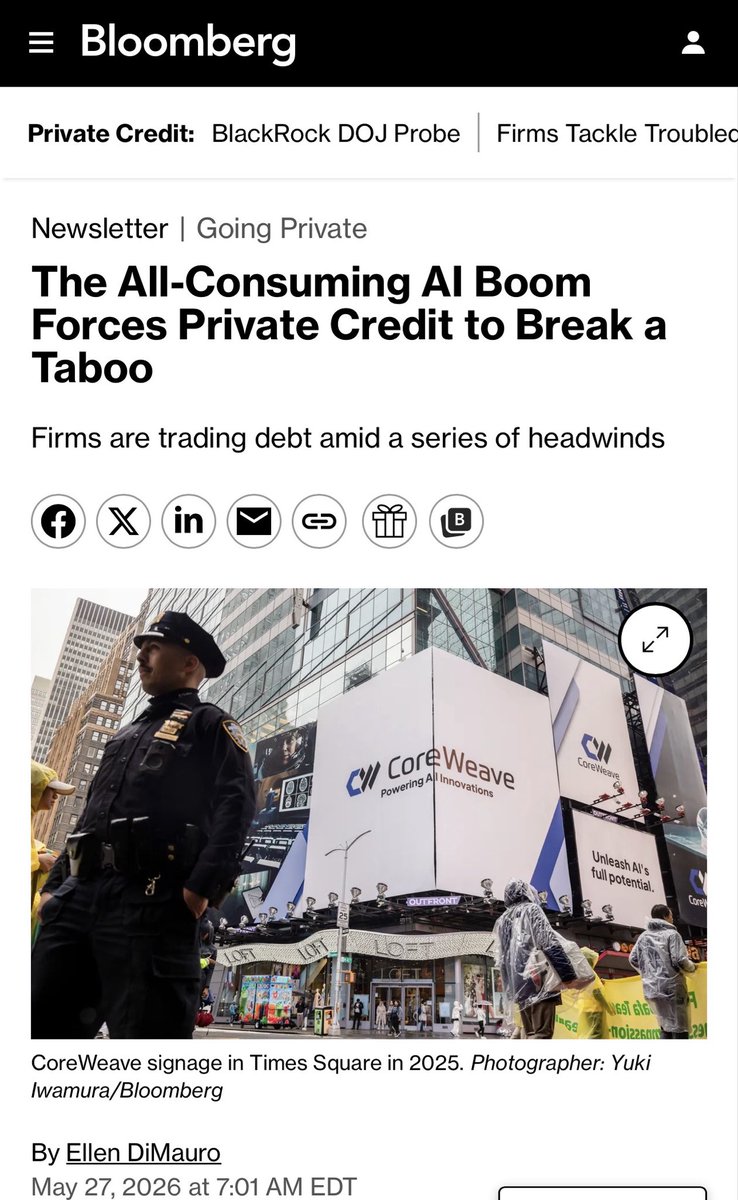
Once-Taboo Private Debt Trading Surges as AI Boom Shatters the Rules “The latest example is the plan to sell a $200 million portion of a private credit loan financing the construction of a CoreWeave data center in Wyoming, according to a memo seen by Bloomberg News….” Bloomberg reports private credit firms are now actively trading debt in a market where selling loans was once considered taboo. The AI boom is driving this shift. The massive funding demands of big tech and AI players like Coreweave are hitting at a time when some funds are struggling to meet investors’ redemption requests. So we are seeing loans becoming more fluid and tradable … a lot like how public markets operate.
kristen shaughnessy tweet mediakristen shaughnessy tweet media
English
6
19
82
2.9K
hodisr
hodisr@hodisra·
@getliquiddotio The 2% reported vs 6.4% bad-PIK gap is the marks-versus-realized story. PIK accrual hides deterioration until refinance, and refinance is exactly what semi-liquid funds can't force on a calendar. Secondary clearing at 70-80 of par is the bad-PIK rate once it actually trades.
English
0
0
1
23
GetLiquid.io
GetLiquid.io@getliquiddotio·
Private credit secondary trading: $50B+ run-rate in 2026. Default rate: 2% (reported), 4.7% (proxy), 6.4% (bad PIK). "Semi-liquid" label: officially under fire. Institutional capital: still allocating - differently. The market is not in crisis. It has outgrown its infrastructure.
GetLiquid.io@getliquiddotio

x.com/i/article/2058…

English
1
0
2
56
hodisr
hodisr@hodisra·
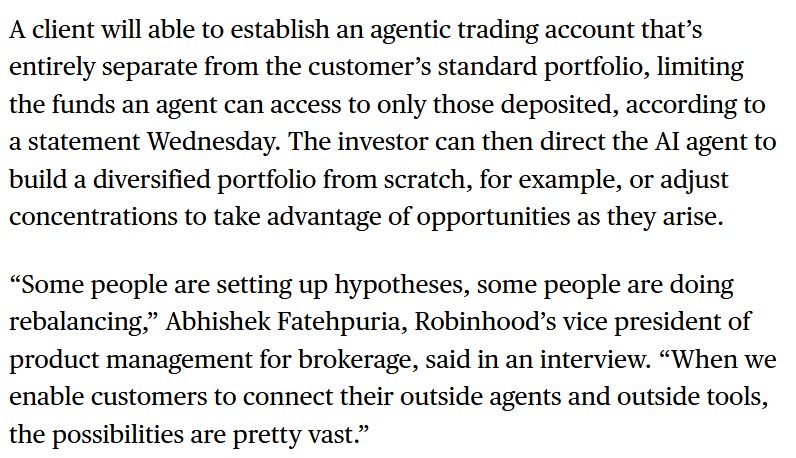
@TheStalwart Robinhood ships this because they own the data layer. Positions, orders, KYC sit in one system the agent can read and act on. The pattern stalls at most asset managers because the fund's data still lives across three legacy platforms and a shared inbox.
English
0
0
0
965
hodisr
hodisr@hodisra·
@ElliottWislar The rotation looks like a returns call. It's a marks-cadence call. HFs price and clear daily, PC marks monthly and clears on a quarter lag, and the lag itself is the asymmetric exposure the allocator just decided to underweight.
English
0
0
0
17
hodisr
hodisr@hodisra·
@business Trading exposures you used to hold means underwriting stops being the binding constraint and ops does. The fund that can value a loan-level position in hours clears at price, the one whose data lives across three platforms and a shared inbox eats the discount.
English
0
0
1
37
Bloomberg
Bloomberg@business·
AI's debt demands mean private credit lenders are starting to trade exposures they once would have kept. Find out more in Going Private. bloomberg.com/news/newslette…
English
3
1
12
11.2K