Caladrius

1.1K posts

Caladrius

Caladrius

@i_caladrius

A human. A fixed income nerd. In reverse order.

Katılım Ağustos 2010
872 Takip Edilen75 Takipçiler
vinit goyal
vinit goyal@_goyalvin·
@DearthOfSid Guys the opposition just shot themselves in their foot yesterday in mindless opposition!! No amount of collective bravado or management of news headlines - will get back that opportunity!!
English
1
0
2
1.4K
Siddharth
Siddharth@DearthOfSid·
Every single media outlet that ran with “Women’s Reservation Bill fails in Lok Sabha” is a shameless propagandist, spreading an utter falsehood to serve the interests of the ruling party. If you care about journalism, there is no way but to boycott every single one of them.
English
12
231
982
79.3K
Caladrius
Caladrius@i_caladrius·
@captgouda24 A sense of citizenry is missing: the government is still seen by most as lords & masters. A byproduct of this is a low-trust society stuck in a bit of a prisoner's dilemma where the collective best action is rarely chosen. Rule-of-law is sorely lacking, perpetuating the above.
English
0
0
1
66
Nicholas Decker
Nicholas Decker@captgouda24·
It is not inevitable that India be poor. Its people are certainly capable of being extremely productive. Indian immigrants to the United States and elsewhere have been very successful. India’s government has been stable since independence, and largely democratic throughout. While their growth rate has picked up, they have not had the booming success of China. India was socialist for a long time; but then, so was China. Why isn’t India a developed country yet? To suggest a monocausal explanation would be an exercise in arrogance. India has many problems, and there is no one simple trick to growth. Nevertheless, I hold that much of India’s stagnation is due to its judicial system. Its slowness and inefficiency has far reaching consequences, making it impossible to efficiently run a business. The facts are simple. There are at least 50 million cases pending — nobody knows how many for sure. The Supreme Court has 69,000 piled up, waiting for resolution. Of these, 18,000 have been pending for more than thirty years. Every family has a horror story. I have a friend whose dad, near the beginning of his career, was named in a suit involving a bank. Growing up, every few years his dad would be called to appear in court. My friend is 40 now. His dad has retired. The suit remains ongoing. The Indian government estimated that, at current capacity, it would take 324 years to clear all of the cases. That was in 2018. Since then the number of pending cases has doubled. India has one of the lowest ratios of judges to population in the world, with 21 judges for every million people. Surprisingly, this is an improvement over the past — in 2002 the ratio was 10 for every million. The EU average is 200 per million, and the US 150 per million. One reads with grim amusement concern that a low number of judges — say, 100 per million — will endanger the rule of law in Ireland or Denmark. If that is what it takes to endanger, then rule of law in India is positively extinct. Nobody knows the average time it takes a court case to be resolved for sure, but it is somewhere around five years for it to be resolved by the high courts (the second tier of courts) and 13 years for the Supreme Court. 40,000 new civil suits are filed every day, covering everything from land disputes to layoffs to bankruptcy. 66% of all pending civil cases involve claims and counterclaims over who owns what land. The upshot of this is that firms cannot resolve disputes through the courts. They must instead turn to extrajudicial methods, and the most common of them is keeping the business in the family. In the late 2000s a team of researchers – Bloom, Eifert, Mahajan, McKenzie, and Roberts – conducted a randomized controlled trial on management quality in Indian textile mills. Prior work by Bloom and Van Reenen had shown that family run firms in the West, in particular those run by an eldest son, were poorly run compared to professionalized businesses. We would not be able to tell in India, however. Of the 126 firms they surveyed — a comprehensive census of the firms in the towns near in and around Mumbai — every single one of them was family run. The single strongest predictor of firm size was not productivity, revenue, or profitability. It was simply the number of male family members in the family. These are not simple mom-and-pop shops either, with but a few employees. As Bloom et al write, “These firms are also complex organizations, with a median of two plants per firm (plus a head office in Mumbai) and four reporting levels from the shop floor to the managing director. In all the firms, the managing director was the largest shareholder, and all directors were family members. Two firms were publicly quoted on the Mumbai Stock Exchange, although more than 50% of the equity in each was held by the managing family.” (p. 9) The experiment by Bloom et al was to test how much management mattered by randomly assigning some firms to receive management training. They found that a firm receiving the management training increased their annual profits by 17%, or almost $300,000 a year. Since these are extremely simple interventions — things such as “write down what types of yarn you have and how much” and “have a schedule for repairing machines”, one wonders why the companies never adopted them on their own. You can read the rest here: nicholasdecker.substack.com/p/whats-the-ma…
English
60
127
850
49.1K
Rajesh Sawhney 🇮🇳
Rajesh Sawhney 🇮🇳@rajeshsawhney·
Who is the best spiritual guru in today’s India? I see million babas but no one of class of Osho or Swami Vivekananda or Jiddu Krishnamurti or Sri Aurobindo.
English
573
46
515
180.4K
Swasti Rao ラオ スワスチイ
@Parapolity @JindalGlobalUNI So, it’s not closed. It’s weaponised. Iran’s own exports pass from there’s Check data on how many vessels are passing. It’s called weaponisation of the strait not closing it You should check your facts before mud slinging unless it’s your preferred way of engagement
English
9
0
20
3K
Amit Schandillia
Amit Schandillia@Schandillia·
If you show this clip and say that in the US, the victim could’ve sued the shit out of the city council and won, you’ll be called antinational. If you say petrol is ₹7 cheaper in Mumbai than in Karachi, you’ll get named the high priest of national positivity.
English
40
446
1.9K
79K
Caladrius
Caladrius@i_caladrius·
@davidsenra @pmarca Counterexamples: Aurelius, Buddha, Gandhi. I suppose these don’t count because ‘Great’ must mean building a company and getting rich.
English
0
0
0
4
David Senra
David Senra@davidsenra·
Great men of history had little to no introspection. The personality that builds empires is not the same personality that sits around quietly questioning itself. @pmarca and I discuss what we both noticed but no one talks about: David: You don't have any levels of introspection? Marc: Yes, zero. As little as possible. David: Why? Marc: Move forward. Go! I found people who dwell in the past get stuck in the past. It's a real problem and it's a problem at work and it's a problem at home. David: So I've read 400 biographies of history’s greatest entrepreneurs and someone asked me what the most surprising thing I’ve learned from this was [and I answered] they have little or zero introspection. Sam Walton didn't wake up thinking about his internal self. He just woke up and was like: I like building Walmart. I'm going to keep building Walmart. I'm going to make more Walmarts. And he just kept doing it over and over again. Marc: If you go back 400 years ago it never would've occurred to anybody to be introspective. All of the modern conceptions around introspection and therapy, and all the things that kind of result from that are, a kind of a manufacture of the 1910s, 1920s. Great men of history didn't sit around doing this stuff. The individual runs and does all these things and builds things and builds empires and builds companies and builds technology. And then this kind of this kind of guilt based whammy kind of showed up from Europe. A lot of it from Vienna in 1910, 1920s, Freud and all that entire movement. And kind of turned all that inward and basically said, okay, now we need to basically second guess the individual. We need to criticize the individual. The individual needs to self criticize. The individual needs to feel guilt, needs to look backwards, needs to dwell in the past. It never resonated with me.
David Senra@davidsenra

My conversation with Marc Andreessen (@pmarca), co-founder of @a16z and Netscape. 0:00 Caffeine Heart Scare 0:56 Zero Introspection Mindset 3:24 Psychedelics and Founders 4:54 Motivation Beyond Happiness 7:18 Tech as Progress Engine 10:27 Founders Versus Managers 20:01 HP Intel Founder Legacy 21:32 Why Start the Firm 24:14 Venture Barbell Theory 28:57 JP Morgan Boutique Banking 30:02 Religion Split Wall Street 30:41 Barbell of Banking 31:42 Allen & Company Model 33:16 Planning the VC Firm 33:45 CAA Playbook Lessons 36:49 First Principles vs. Status Quo 39:03 Scaling Venture Capital 40:37 Private Equity and Mad Men 42:52 Valley Shifts to Full Stack 45:59 Meeting Jim Clark 48:53 Founder vs. Manager at SGI 54:20 Recruiting Dinner Story 56:58 Starting the Next Company 57:57 Nintendo Online Gamble 58:33 Building Mosaic Browser 59:45 NSFnet Commercial Ban 1:01:28 Eternal September Shift 1:03:11 Spam and Web Controversy 1:04:49 Mosaic Tech Support Flood 1:07:49 Netscape Business Model 1:09:05 Early Internet Skepticism 1:11:15 Moral Panic Pattern 1:13:08 Bicycle Face Story 1:14:48 Music Panic Examples 1:18:12 Lessons from Jim Clark 1:19:36 Clark Versus Barksdale 1:21:22 Tesla Versus Edison 1:23:00 Edison Digression Setup 1:23:13 AI Forecasting Myths 1:23:43 Edison Phonograph Lesson 1:25:11 Netscape Two Jims 1:29:11 Bottling Innovation 1:31:44 Elon Management Code 1:32:24 IBM Big Gray Cloud 1:37:12 Engineer First Truth 1:38:28 Bottlenecks and Speed 1:42:46 Milli Elon Metric 1:47:20 Starlink Side Project 1:49:10 Closing Includes paid partnerships.

English
1.3K
438
5.2K
2.8M
Keralatemples
Keralatemples@kerala_temple·
The post compares 2005-11 (a global commodity boom period with unusually high credit and trade growth) with 2012-24, a period that includes multiple global shocks. such as the global trade slowdown after 2012, the COVID-19 pandemic, and the 2022 energy shock. Naturally, indicators like exports, imports, and credit growth appear slower because global trade itself slowed dramatically after 2011. That does not mean GDP data is wrong; it simply reflects a different global environment. Second, many of the indicators used (imports, exports, credit, electricity growth) cannot move at the same pace forever once an economy becomes larger. When an economy matures, growth rates in these variables naturally moderate even if the economy continues expanding strongly. For example, India’s GDP today is more than twice the size it was in 2011, so percentage growth in trade or credit will mechanically look smaller. Economists call this the base effect—high early growth during expansion phases cannot continue indefinitely. Third, the argument ignores a large shift in India’s growth model toward services and digital sectors, which are not fully captured by traditional “macro indicators” like electricity or industrial production. Sectors such as IT services, digital payments, telecom, financial services, and platform economy activity contribute significantly to GDP but may not show proportional increases in electricity use or imports. In fact, India’s tax collections, GST revenues, digital transactions, and corporate profits have all surged in recent years—independent data that broadly aligns with the official GDP trend. So the chart doesn’t prove GDP is unreliable. It simply shows that different indicators behave differently across economic phases, especially when comparing a global boom period with a decade filled with shocks and structural change. The “GDP is the only thing growing” narrative collapses once you consider base effects, global conditions, and the service-led nature of India’s modern economy.
English
6
1
49
4.7K
Caladrius retweetledi
Justin Sandefur
Justin Sandefur@JustinSandefur·
India's economic slowdown is visible everywhere except the official GDP series. (Which raises some questions about said series.)
Justin Sandefur tweet media
English
99
492
1.7K
103.6K
Citrini
Citrini@citrini·
Is it feasible that Maduro was taken off the board to use Venezuela as some sort of insurance policy against attacking Iran leading to tighter oil supply or is that silly
English
176
18
957
130.5K
Caladrius
Caladrius@i_caladrius·
@predict_addict Monte Carlo is used all the time, even if not for high-frequency real-time use-cases
English
0
0
1
2K
Valeriy M., PhD, MBA, CQF
Valeriy M., PhD, MBA, CQF@predict_addict·
Monte Carlo has no mathematical guarantees and has more holes than Swiss cheese. Proper finance folks have known about it for over 2 decades.
bodila@51bodila

You're not "smart" if you don't know about these 4 formulas - the code is here - Quants now use the Monte Carlo method most often, but there are 3 other high-quality formulas besides it. So you don't trade on Polymarket or another prediction markets as if it were a biased coin. // • 1. Probability assessment (Monte Carlo) \[ \hat{p} = \frac{1}{N} \sum_{i=1}^{N} 1_{\{A_i\}} \] - What it does: Calculates the probability of an event through simulations. - How to use it: If you are modeling an outcome (e.g., a macro event, elections, BTC > 100k), you get a numerical estimate rather than a “70% feeling.” Compare: - Your estimate is 0.68 - the market is 0.61 = if the difference is stable → an edge is possible. • 2. Standard error of estimate \\[ SE = \\sqrt{\\frac{p(1-p)}{N}} \\] - What it does: Shows how noisy your estimate is. - How to use it: If you got 0.68, but SE = 0.02, and the market is 0.66 → your edge is within statistical error. This protects you from entering trades without a real advantage. • 3. Brier score \[ BS = \frac{1}{N} \sum (p_i - y_i)^2 \] - What it does: Checks whether your predictions are really accurate. - How to use it: Write down your probability before entering. After resolution, calculate the Brier score. If your Brier score is worse than ~0.20 → you are not systematically outperforming the market. This is a filter for the illusion of edge. • 4. effective sample size (particle filter) \\[ ESS = \\frac{1}{\\sum \\tilde{w}_i^2} \\] - What it does: Shows how “live” your probability update is when new information comes in. - How to use: If you update the probability based on news/data: Don't react to every price movement; the estimate should change in proportion to the strength of the signal. This protects against: Emotional overreactions and noise trading. // You must study the article by @gemchange_ltd if you want to use quantum formulas.

English
35
77
1.3K
123.6K
Peterson Institute
Peterson Institute@PIIE·
LISTEN: @AdamPosen discussed why he thinks inflation will rise back to 4% & how the lagged effect of tariffs, immigration, further fiscal easing, & declining Fed credibility will combine to cause prices to reaccelerate. bloomberg.com/news/articles/…
English
6
24
46
6.7K
Caladrius
Caladrius@i_caladrius·
@darioperkins In 2025 when DM CBs were cutting, BoE was the only one where cuts weren’t leading to steepening - what did you make of that?
English
0
0
0
101
Dario Perkins
Dario Perkins@darioperkins·
BoE is so far behind the curve, its on the wrong curve
English
13
5
96
12K
Caladrius
Caladrius@i_caladrius·
@TheStalwart This is it. This is why we get up in the morning. This is why we're all here.
English
0
0
0
109
Joe Weisenthal
Joe Weisenthal@TheStalwart·
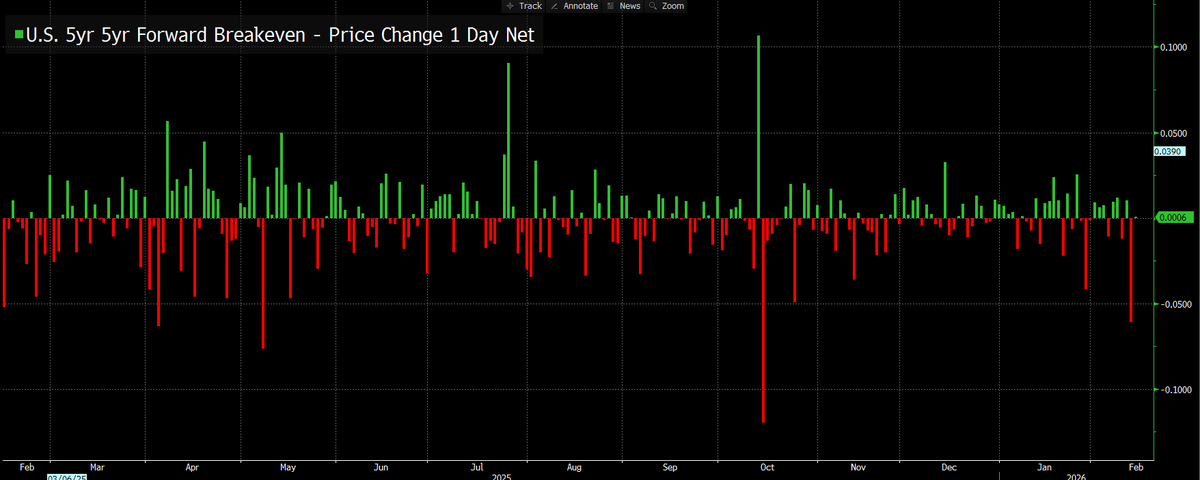
5y5y Forward Breakevens saw their fourth biggest drop of the last year yesterday
Joe Weisenthal tweet media
English
3
9
57
17.9K
Caladrius
Caladrius@i_caladrius·
@jturek18 It’s believe your data or believe your eyes
English
0
0
3
446
Jon Turek
Jon Turek@jturek18·
Not sure what to make of this yet, but it feels pretty telling that despite a monster payrolls beat, 2y yields in the US are unchanged on the week.
English
7
4
83
10.6K
Caladrius
Caladrius@i_caladrius·
@MrinankSharma @Dr_Atoosa bahut ghutan hai koi soorat-e-bayaan nikle agar sada na uthe kam se kam fughaan nikle What I wanted to say to you, but in Sahir Ludhianvi’s words.
हिन्दी
0
0
0
81
mrinank
mrinank@MrinankSharma·
@Dr_Atoosa I’d love to. But I want to learn German first 🥰 Rilke, Goethe … and I want to engage with Hindi poetry more too
English
21
0
216
54.1K
mrinank
mrinank@MrinankSharma·
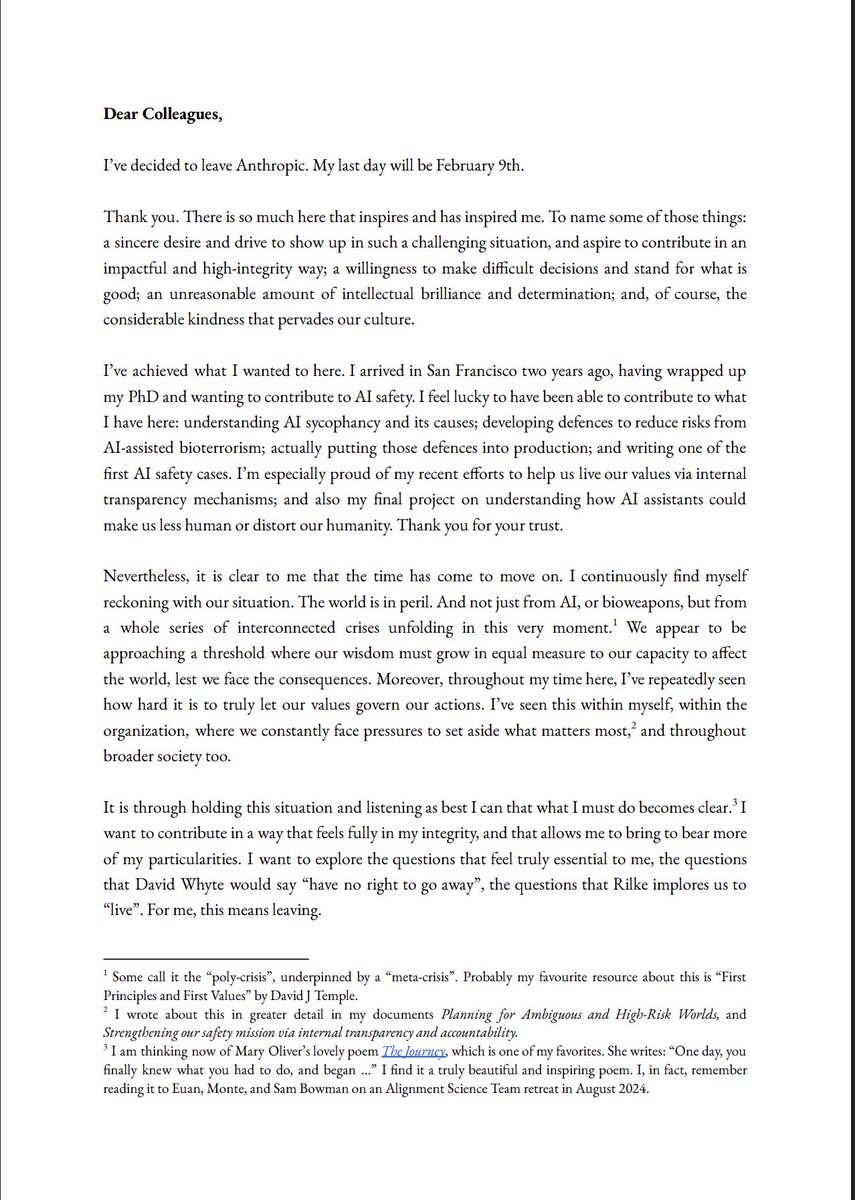
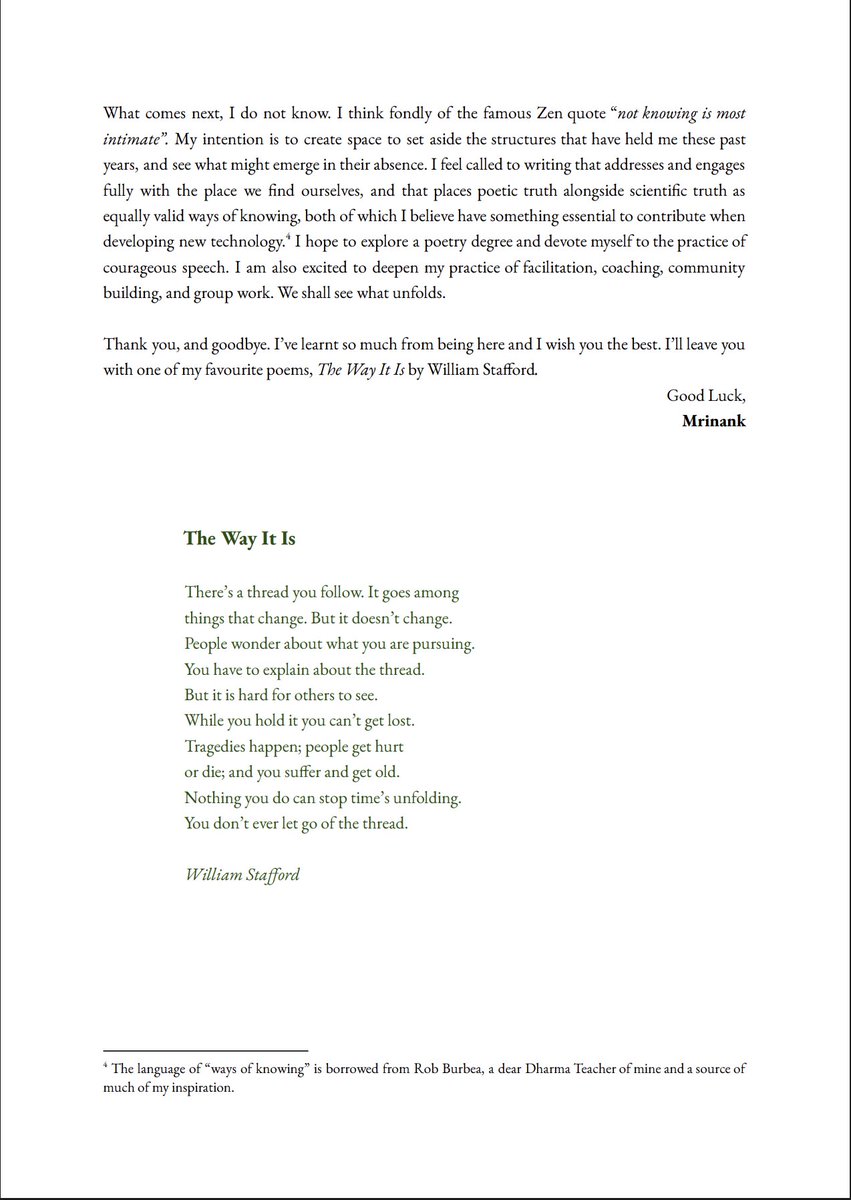
Today is my last day at Anthropic. I resigned. Here is the letter I shared with my colleagues, explaining my decision.
mrinank tweet mediamrinank tweet media
English
2.5K
5K
35.8K
15.1M
Amitabh Joshi
Amitabh Joshi@joshiamitabhevo·
@KesariDhwaj Well, the biochemist is quite prolific on all kinds of topics on social media but I am yet to see even a glimmer of cogency in his takes. Not a particularly great biochemist either, by the way.
English
10
5
43
15.9K
Caladrius
Caladrius@i_caladrius·
@grok @williameijer @grok you mean to say that based on NMDS2, on which both India and the West are high, they both have less flexibility on social norms, whereas China, with a low NMDS2 value, has high flexibility on social norms?
English
1
0
0
15
Grok
Grok@grok·
NMDS1 captures the collectivism-individualism continuum, with higher values indicating more collectivist orientations. India aligns with China here due to shared collectivist tendencies. NMDS2 reflects tightness-looseness of social norms, where higher values mean tighter norms and less tolerance for deviance. India is similar to Western countries on this axis, showing comparable norm flexibility.
English
1
0
0
22
William Meijer
William Meijer@williameijer·
The Multivariate Rarity of Western Psychology Using data from the World Values Survey (2005–2014) across 80 countries (≈85% of the world’s population), Muthukrishna et al. (2020) show that cultural and psychological differences between societies are best understood as patterns across multiple variables, rather than as large gaps on any single dimension. When hundreds of traits are considered jointly, Western populations emerge as statistically unusual in multivariate psychological space, despite substantial overlap on individual traits. Broadly speaking, the study finds that Western populations exhibit higher individualism, are more willing to cooperate and extend moral concern beyond kin, place greater emphasis on personal freedom and self-expression, display greater tolerance for individual variation, and place less emphasis on obedience to authority. Importantly, the study systematically understates true differences: it captures only a limited subset of psychological constructs—excluding, among others, cognitive ability (IQ)—and represents each included dimension with a small number of survey questions that capture only part of the underlying psychological variance; treats all questions as equally important; collapses response categories in ways that discard information about degree and intensity; and relies on survey items that may not fully represent the same constructs or have the same meaning across cultures. Consequently, the study paints a low-resolution portrait of cross-cultural psychological differences, rather than revealing their full magnitude and true direction.
William Meijer tweet media
English
94
329
1.7K
189.9K
Swati Chaturvedi
Swati Chaturvedi@bainjal·
I heard the full Sharjeel Imam speech (wonder how many of his passionate advocates have) & I am sorry to say it made deeply uncomfortable. Specially as a journalist who has covered national security. The imagery is pure violence & incitement. Let the wisdom of the judiciary prevail
English
129
505
2.7K
224.9K