

Sainath 🇮🇳
2.5K posts

Sainath 🇮🇳
@icyanide9
Founder@Analyticore, Palantir Foundry Engineering & Delivery , ex Dukaan, ex Balance
Katılım Ekim 2009
761 Takip Edilen217 Takipçiler
Sainath 🇮🇳 retweetledi

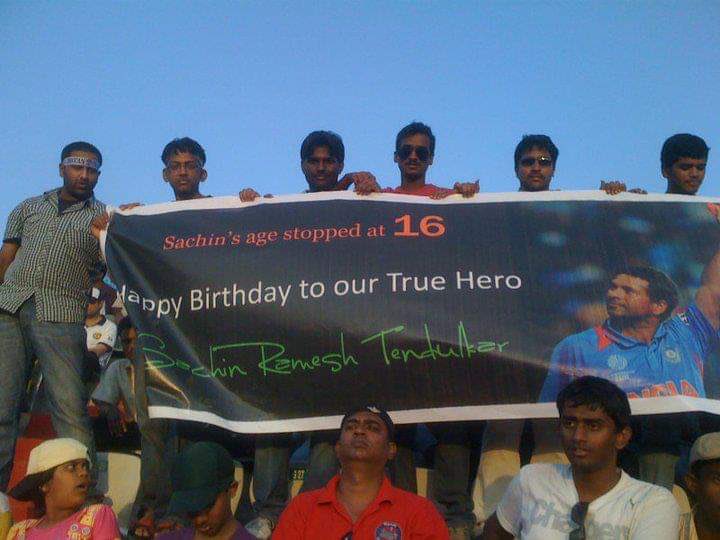
Happy birthday Sachin Tendulkar. Nothing can truly capture the immense burden he has borne for over two decades & the unbelievable following he has around the world. But this prize winning picture by Atul Kamble of him walking out at the Wankhede for his last test innings comes pretty close!

English
Sainath 🇮🇳 retweetledi

The West poured $50 billion into fast breeder nuclear reactors and abandoned every single one. India poured $900 million and just achieved criticality on the first commercially viable one outside Russia.
The US spent $15 billion. Gave up. Japan spent $12 billion. Their Monju prototype had one sodium fire in 1995 and never recovered. The UK spent $8 billion. Germany spent $6 billion. France, Italy, all walked away. Six of the richest nations on Earth concluded this technology was too hard and too expensive to pursue.
India started building in 2004 with an initial budget of $420 million. Twenty-two years, a dozen missed deadlines, and a cost doubling later, the Prototype Fast Breeder Reactor at Kalpakkam just sustained a controlled fission chain reaction. The reactor is now alive.
The reason India never quit is a constraint most people have never thought about. India has only 1-2% of the world's uranium reserves. For a country of 1.4 billion people trying to build energy independence, that's a death sentence if you're running conventional nuclear.
But India has 25% of the world's thorium. The single largest national reserve on Earth.
The problem: you can't just burn thorium the way you burn uranium. A physicist named Homi Bhabha designed a three-stage nuclear program in the 1950s specifically to solve this. Stage 1: burn natural uranium in heavy water reactors, collect plutonium as a byproduct. Stage 2: feed that plutonium into fast breeder reactors, where it breeds MORE plutonium AND converts thorium into fissile uranium-233. Stage 3: burn thorium directly at scale.
India just entered Stage 2. Seventy years after Bhabha drew it up on paper.
The math on the thorium endgame is wild. At current energy consumption rates, India's thorium reserves could power the country for over 700 years. Most nuclear nations are playing a uranium game with maybe 80-100 years of runway. India is playing a completely different game with a 7x longer fuel supply.
The West quit because uranium stayed cheap and sodium coolant is terrifying. It catches fire on contact with air. It explodes on contact with water. Russia's BN-600 had 27 sodium leaks and 14 sodium fires between 1980 and 1997. And Russia kept going anyway because Russia doesn't quit nuclear projects. India watched all of that and kept going too.
When you have 1% of the uranium but 25% of the thorium, the engineering difficulty stops being a reason to quit. It becomes the price of admission to a 700-year energy supply that nobody else can access.
Narendra Modi@narendramodi
Today, India takes a defining step in its civil nuclear journey, advancing the second stage of its nuclear programme. The indigenously designed and built Prototype Fast Breeder Reactor at Kalpakkam has attained criticality. This advanced reactor, capable of producing more fuel than it consumes, reflects the depth of our scientific capability and the strength of our engineering enterprise. It is a decisive step towards harnessing our vast thorium reserves in the third stage of the programme. A proud moment for India. Congratulations to our scientists and engineers.
English
Reminds me of the old BSNL broadband days when high-speed internet was only available between 2:00 AM - 8:00 AM.
Archive@ArchiveExplorer
"Claude usage limit reached. Your limit will reset at 7pm" every. fucking. day. was about to pay $200 for Max. then I read this article 98.5% of tokens - wasted you're not paying for answers. you're paying for Claude to re-read its own homework 30 times spent months blaming Anthropic for being greedy. turns out the problem was how I write prompts 5 minutes of reading basic plan now handles more than my old Max
English
@chadwahl @eliano @christjine @MarketWatch Ontology and FDE are easy words to borrow. Much harder to make them behave like a real system.
English

This might be one of our greatest inventions not only for the unique output we create but the legions of copycats that are destined to fail because they think they can just copy without the culture, tech, and product that it requires.
Most would be better off being original than trying to copy.
English

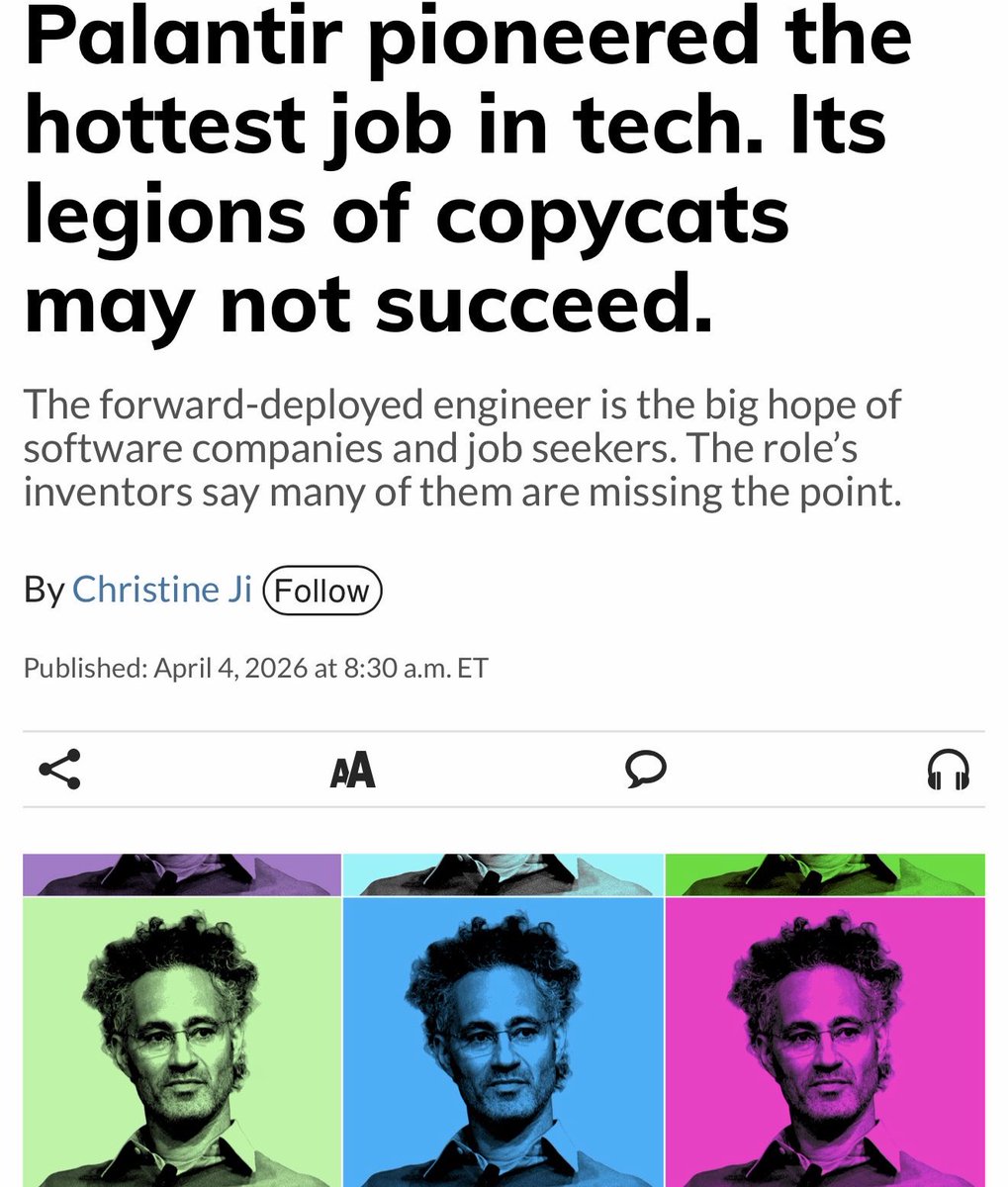
A deep dive on Palantir’s FDEs by @christjine was published yesterday in @MarketWatch
“For years, the rest of Silicon Valley dismissed the FDE role as an unserious gig. Investors shared this opinion, arguing that Palantir was more of a glorified consultancy than a legitimate tech company…. Now companies are looking to copy Palantir’s approach.
Revered today as the “hottest” job in tech, the FDE title is plastered across job boards and employed by companies ranging from AI startups to software-as-a-service behemoths racing to carve out their sphere of influence in the burgeoning enterprise-AI market.”
marketwatch.com/story/palantir…
English
@icyanide9 @ygorz01 We have been doing AI with the Ontology since inception. The difference now is the stochastic models vs deterministic models. Either way the ontology was the grounding mechanism and the orchestration to drive decisions.
English
I was in an agentcamp this week.
If you thought bootcamps were a rocket ship, wait until you experience an agentcamp.
The ambition is 10x.
Palantir OG@PalantirOg
$PLTR Agentic AI Is Here. Palantir’s Been Ready For 20 Years 🎯 Apr 02, 2026 …Established companies like Microsoft (MSFT) and Salesforce (CRM) are attempting to adapt. However, one company did not need to change its approach. 🦾🔮 Palantir’s Unique Edge Palantir has spent nearly twenty years strategically constructing the precise infrastructure that agentic AI requires. Here’s why it is fundamentally ahead: 1. The Ontology Edge Much of enterprise software fundamentally comprises databases, which are essentially rows and columns that house data without comprehending it. To an AI agent, that is merely text. It cannot discern that Row A represents a customer, Row B signifies a product, or that the two are linked by a contract with a delivery deadline. Palantir operates differently. Its “ontology” acts as a digital representation of the business - it recognizes the connections among inventory, logistics, legal restrictions, and customer interactions. An AI agent integrated with that framework has the necessary context to amend a contract, redirect a shipment, or address a compliance concern without human intervention. This is not a capability that competitors can implement quickly. 2. Result-Oriented Contracts Palantir has already evaded the per-seat pricing structure that agentic AI is now rendering obsolete. Its contracts focus on enterprise-wide transformation and demonstrable outcomes - such as a manufacturer significantly shortening supply chain delays. As the market shifts towards compensation for results, Palantir does not need to revamp its commercial strategy. It was ahead of the curve. 3. AgentCamps Palantir has replaced traditional, protracted sales cycles with AIP AgentCamps - intensive, five-day workshops where potential clients create live, functional agents utilizing their proprietary data. This has dramatically shortened the “time-to-value,” reflected in the margin structure. Deployments that once required hundreds of engineers on the ground and extended to months are now accomplished in days. Is The Agentic Movement Already Favoring Palantir? In 2025, the company officially detached from the sluggish growth pattern of government sectors toward commercial business, propelled by agentic AI. U.S. commercial revenue surged 137% year-over-year in Q4 2025, reaching $507 million, with net margins hitting 43% in the same quarter. The count of commercial customers increased by 34%, driven by the swift deployment of its Artificial Intelligence Platform (AIP). For 2026, U.S. commercial revenue is anticipated to surpass $3.1 billion, a 115% increase if projections are met... 🔮🦄🔥 forbes.com/sites/greatspe…
English
@ygorz01 We use our AI FDE along with our Ontology as the backbone but we use multiple different models depending on the task, all are available in the platform.
English
Sainath 🇮🇳 retweetledi

I worked 20 years for a child sex trafficking rescue group. I want you to know this:
90% of Lost Children Are Found Within 30 Minutes.
That statistic should both comfort you and wake you up.
Most lost children are found quickly. But the ones who aren’t? They usually made one mistake.
And here’s the uncomfortable truth:
It’s often the exact thing most parents teach them.
We tell our kids:
“If you get lost, come find me.”
It sounds logical. It sounds empowering.
It’s WRONG!
The Mistake Most Lost Children Make:
When children realize they’re separated, they do three things almost automatically:
They panic.
They wander.
They try to find you.
Every step makes them harder to locate.
From a search standpoint, movement creates chaos.
Parents retrace their steps.
Security scans zones.
Staff lock down areas.
Search works best when movement stops.
When a child keeps walking, they move outside the original search radius. Helpers are looking where they were last seen — not where they’ve wandered.
Stillness increases probability.
Movement expands the problem.
The first lesson is not “go find me.”
It’s this:
Stop. Stay. Yell.
Why Stillness Wins:
Think like a search team.
If a child stays put:
Parents can retrace steps.
Security can scan systematically.
Helpers converge to one fixed location.
The search radius remains small.
If a child keeps moving:
The search area expands.
Adults pass each other.
Missed connections multiply.
Minutes stretch into hours.
Stillness keeps the math on your side.
Teach Them Who to Approach:
The second mistake we make as parents?
We say, “Find an adult.”
Not any adult. Not the nearest stranger. Children need a filter.
Teach them to look for, if at all possible:
A mother with children.
Caregivers who already have kids with them are statistically among the safest people to approach in public settings. They are visible, stationary, and more likely to engage quickly.
It’s a clear, concrete instruction.
Children don’t process vague categories like “safe adult.”
They process visuals.
“Find a mom with kids” is visual.
A Phone Only Helps If the Number Is Known:
We often assume phones solve everything.
They don’t — unless your child can use one. Even young children can memorize a 10-digit phone number with repetition.
But you must train it.
Practice it like a song.
Sing it in the car.
Chant it at bedtime.
Turn it into rhythm.
Repetition becomes recall.
In an emergency, recall matters more than theory.
The Code Word Rule:
One more layer of protection.
Choose a private family code word.
Something only your household knows.
If someone approaches and says:
“Your mom sent me.”
Your child asks:
“What’s the code word?”
No word.
No go.
This simple rule eliminates manipulation attempts instantly.
It gives your child agency without requiring them to evaluate character.
Real Safety Is Training — Not Luck!
We don’t get safer by hoping.
We get safer by practicing.
Teach:
• Phone number
• Code word
• Stop, stay, yell
• Find a mom with kids
Multiple skills.
Simple instructions.
Clear visuals.
Five minutes of training can replace hours of panic. This isn’t about fear. It’s about preparation.
Because when a child gets separated, the clock starts.
And what they do in the first minute determines what the next thirty look like.
That’s real protection.
English

Hard to describe the product velocity across Palantir right now…insane 🌊
Palantir@PalantirTech
Accelerating data migrations from 5 months to 5 days with AI FDE. Deployment Strategist Craig Roberts shows @chadwahl how Palantir AIP is enabling organizations to move beyond legacy systems to new operations and outcomes.
English
Sainath 🇮🇳 retweetledi

Sunil Gavaskar said, “the DJ shouting ‘Boom, Boom, Bumrah’ in between deliveries is totally unfair. In between overs it’s fine, but why do it in between the deliveries, it’s a World Cup game”.

English
Sainath 🇮🇳 retweetledi
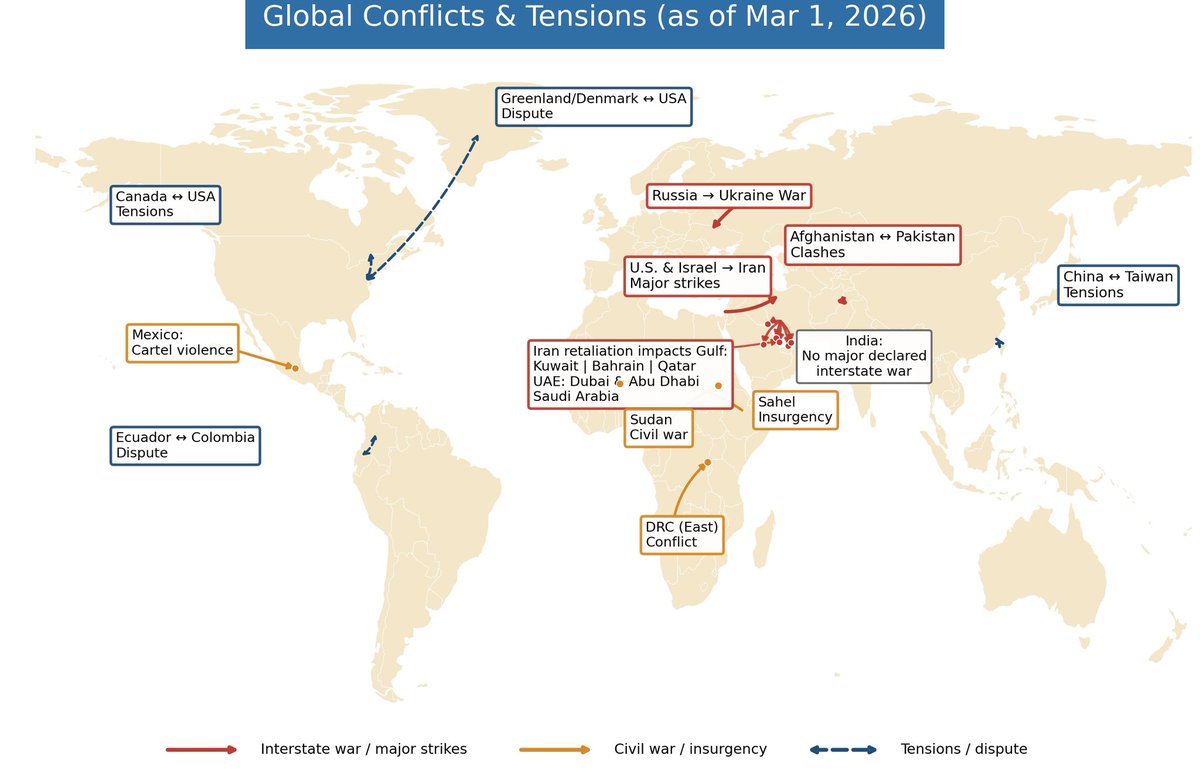
For the next 10 years, India should completely avoid war politics and, outside of strategic defense, just focus on growth politics. Stable, steady, progressive policies for business & investment capital. We have the talent + more coming back now. Key is to avoid unforced errors.
English
Sainath 🇮🇳 retweetledi

An ex-Palantir employee once told me a harrowing story about their first assignment at the company: they were asked, with zero real experience, to go and fix a major global problem with a small team, under extreme time pressure…all with relatively little support from Palantir’s upper ranks. It sounds so lame to say “I can’t share more details,” but…I can’t!
This person figured it out, solved the problem, and credited this and other similar experiences at Palantir with shaping them to an extreme degree.
Palantir produces a crazy number of founders, and many have reported similar “forged in fire” stories.
Ever since hearing the first story, I’ve wanted to know how the company works. Turns out a large part of the answer is @ssankar.
It’s hard to describe how excited I get by a new @JeremySternLA profile. This one delivered, yet again.
This isn’t about Palantir’s stock price or valuation (which, frankly, isn’t at all interesting to us). It is about a man on a mission.
Colossus@colossusmag
Shyam Sankar is Palantir's chief technology officer and the man most responsible for making its business and technology work. He joined in 2006 as employee #13, when Palantir was one of Silicon Valley’s freakshows: a small and somewhat demented chickenhawk of a startup with a buggy demo and no customers. For 20 years, largely from the shadows, he has brute forced it into the spearhead of "defense tech" and a $320 billion company. He embedded with intelligence analysts in Virginia, special operators in Iraq and Afghanistan, and on the factory floors of some of the world’s biggest companies—building and rebuilding software in the field, sometimes with phones taped to his head so he could give and take feedback while keeping his hands free to code. He invented the “Forward Deployed Engineer,” which has since become the object of both skepticism and imitation. Alex Karp, Palantir's mercurial co-founder and CEO, says the company would not exist without him. The same can be said of the modern defense tech industry, many of whose founders cut their teeth working for Shyam. In this deeply reported profile, @JeremySternLA tells the story of the most pivotal but hidden figure behind America’s most controversial company. He also gives the clearest explanation you'll read of what Palantir actually does, whether its valuation is justified or absurd, and what any of this has to do with the company’s mission to save Western civilization. It begins in the Grand Ballroom of The Pierre hotel and winds through Nigeria and India, Florida and California, Iraq and Afghanistan. It ends with a rabbi, a monkey, and a lesson in what it means to buy time in the face of a coming fire. Only in Colossus:
English
Sainath 🇮🇳 retweetledi
Sainath 🇮🇳 retweetledi

Let’s understand what this team did.
Meta has approximately 600,000+ GPUs. Their most junior researcher can reserve 4000 GPUs for tinkering.
This team got 4000 GPUs for training, and they still pulled it off. They have proved to the world that India CAN.
I keep coming back to this picture, because despite very humble beginnings, ISRO today is an institution which is globally best at what they do.
This team has started with global best in its weight class. I’m excited to where we will go.
Thank you team!

Pratyush Kumar@pratykumar
Drop 13/14: The 30B and 105B models, benchmarks, and HF links will all come. But today it is a drop about people. About how our team of just 15 folks gave it their all to do what many doubted as not doable - ie train usefully large, globally competitive models from scratch in India. This team of 15 has now firmly launched @sarvam into its second innings. Yes, we can! @_mohit_singla @anand_404 @kediaharshit9 @AashaySachdeva @sumanthd17 @ArpitDwivedi100 @HarveenChadha @rkal4 @sushil_khyalia @ManavSinghal157 @sohampetkar missing in the pictuere - @selfawareatom @AnnaUpreti Anand @MeghMakwan33973 Utkarsh
English
Sainath 🇮🇳 retweetledi
10-minute delivery in India isn't magic. It's really good engineering.
@albinder and @letsblinkit built tech that most people never see.
We went deep on how it works.
English
Sainath 🇮🇳 retweetledi

After a certain age, your parents slowly become your children.
They ask simple questions, repeat stories, and depend on your patience the way you once depended on theirs. Very few understand this role reversal. What looks like innocence or inconvenience is really time coming full circle. Don’t correct them harshly. Don’t rush them. Care for them the way they once protected you. This is not a burden. It is repayment, quietly wrapped as love.
English
Sainath 🇮🇳 retweetledi

Sainath 🇮🇳 retweetledi

Lifespan is overrated. Healthspan is what really matters. Living to 95 means nothing if your last decade is spent in decline. It’s all about how many healthy, fit, mobile years you truly get on this planet.
English

@DearS_o_n Thank you @icyanide9 for taking this picture. It went viral now.
English