IrenicalProt.

232 posts

IrenicalProt. banner
IrenicalProt.

IrenicalProt.

@irenicalprot

brasileiro | católico reformado ‘escolasticoide’ baxteriano

📍Brasil Katılım Aralık 2023
102 Takip Edilen111 Takipçiler
Gabriel Fernando
Gabriel Fernando@ReformedPwlfter·
Eu e @Cauzitoz somos leigos safados e gurus interpretativos. Devemos colocar na Bio?
Português
1
0
3
251
Caio di Rocco
Caio di Rocco@caiodirocco·
@davieduvirges O Catecismo de Heidelberg inclusive diz: "Pergunta 94. O que Deus ordena no primeiro mandamento? R. Primeiro: para não perder minha salvação, devo evitar e fugir de toda idolatria..."
Português
2
0
7
79
IrenicalProt. retweetledi
Davi Eduvirges
Davi Eduvirges@davieduvirges·
Quando um reformado diz que o eleito "perde a salvação" e outro responde que isso é erro grave, os dois podem ter razão ao mesmo tempo. Eles estão respondendo à mesma pergunta em sentidos diferentes, sem dizer isso. A distinção que resolve o impasse não é nova. Está na escolástica reformada clássica: sentido dividido e sentido composto. (1/4)
Português
3
3
12
621
IrenicalProt.
IrenicalProt.@irenicalprot·
@Felipesmarrques amém. todo mundo afirma a mesma coisa sobre isso. só prova o quanto você é alheio ao debate.
Português
0
0
7
74
Felipe Marques
Felipe Marques@Felipesmarrques·
Joao Calvino sobre Davi: Não há razão para crer-se que a graça fosse totalmente extinta em seu coração; mas apenas que foi possuído de um espírito de enfatuação num ponto específico, e que laborava sob uma fatal insensibilidade ao ponto de expor-se, naquele interim, à ira divina
Português
3
0
2
236
Felipe Marques
Felipe Marques@Felipesmarrques·
“Mas é que vocês não leram um trecho desaparecido de Calvino, escrito em latim e que Turretini encontrou quando fazia escavações arqueológicas em Genebra. Eu sou reformado clássico, por isso vou em busca dessas informações. Lá diz que eleito perde sim a salvação”.
Português
5
0
5
4.1K
IrenicalProt.
IrenicalProt.@irenicalprot·
“For there is no pardon of any new sin without a new act of faith and repentance” — William Perkins
IrenicalProt. tweet media
English
0
1
7
148
Fabricius Spira
Fabricius Spira@graywithin·
William Twisse: "...the mode of reward (for merit), that is, of mercy tempered with justice"
English
1
0
4
305
IrenicalProt. retweetledi
Onku
Onku@OnkuOh·
"The second is Saul's repentance (1 Samuel 15:24). This repentance was as fair and as full in outward expression as David's to Nathan (2 Samuel 12:13). But yet Saul's repentance was not unto life; it failed in four things: First, his confession was without sorrow. He acknowledged his sin, but we read not that his heart smote him for his sin, or that his heart was broken for his sin, as David's was. Secondly, Saul's confession was not free, but forced from him by Samuel with the dint of argument. But David's heart smote him for numbering the people, and he confessed the sin before God smote his people with the plague (2 Samuel 24:10). Thirdly, Saul's confession was by way of diminution. He labored to lessen his sin and to put the fault upon the people (1 Samuel 15:21, 24). But true confession of sin is with the aggravation of the sins we confess. Thus did David (2 Samuel 24:10, 17), and thus did Daniel and Ezra (Daniel 9, Ezra 9). Fourthly, Saul's confession was mingled with pride (1 Samuel 15:30). He desired honor with the people, though he had no respect from God nor from Samuel. True confession is an humble confession (Ezra 9:6). The third is Ahab's repentance. His repentance was so great and so remarkable that God bade Elijah take notice of it (1 Kings 21:27, 29). His repentance is expressed in four particulars: he rent his clothes, put on sackcloth, fasted, lay in sackcloth, and went softly. But yet it was not a repentance unto life; it failed in three particulars. First, it was but an outward repentance. All the forenamed expressions were outward; he rent his garments, but his heart was not rent. And therefore God rewarded him only with an outward reward (1 Kings 21:29). Ahab was like a ripe plum that is soft without, but has a hard stone within. Secondly, it was a worldly and carnal repentance, for fear of the loss of his kingdom, and for fear of the dogs that Elijah threatened should lick up his blood. Thirdly, it was a repentance for sin, but not from sin. You shall read in Scripture not only of a repentance for sin (2 Corinthians 12:21, Revelation 9:20), but also of a repentance from sin (Acts 8:22), and "repentance from dead works" (Hebrews 6:1). Now Ahab did not repent from his sin, for in the next chapter he is as bad as ever he was. The fourth is the Israelites' repentance. You shall read often of their repentance (1 Samuel 7:6; Judges 2:1-3; Judges 10:10). But their repentance was not unto life; it failed especially in two particulars. First, it was only and merely for fear of the Lord; it was repentance only when they were in distress, as appears often in the book of the Judges and also in Psalm 78:34. Secondly, it lasted only as long as the rod lasted; when the affliction was past, they returned to their sins again (Psalm 78:36-37; Judges 4:1; Judges 6:1). They were just like iron, which while it is in the fire is soft and malleable to anything, but when it is taken out of the fire, grows presently hard again; or like water, that while it is upon the fire is very hot, but when taken off, presently grows cold. And this, I fear, is all the repentance that many have in these days. Some are so bad as not to repent at all, even in these killing days; but they that do repent, I fear it is only for fear of the rod, and it will last no longer than the rod lasts. The Lord give us hearts to search our hearts whether it be not so. The fifth is the repentance of Judas. The text says he repented, confessed his sin, and made satisfaction (Matthew 27:3-4). He also justified Christ's innocency and took shame to himself in going to the high priests to confess his sins. But yet his repentance was not unto life, though there be many in the world that pretend to a right repentance who cannot plead so much to justify their repentance as Judas can. It failed in diverse particulars. First, he sorrowed for what he had done, but he was not reformed from what he had done, for he that murdered Christ before, murdered himself presently after. It was no life-reforming sorrow. Secondly, Judas repented not out of hatred of the sin that he had committed, but only to quiet his conscience; he felt a hell in his conscience, and to quiet that, he repented. Thirdly, this repentance was wholly legal, only for fear of hell, and it was wholly without hope of mercy. It was a desperate repentance, and it drew him not to Christ, but to the gallows. True repentance is out of love to God, and it is always mixed with hope (Ezra 10:2). The sixth is the heathen man's repentance. There is in a heathen man a natural conscience, and when he sins against the light of nature, this natural conscience will accuse and condemn him, and this oftentimes worketh a natural and moral repentance. [...] This I relate to the shame of thousands of Christians. But yet this was not a repentance unto life. For here, nature reforms nature; refined nature reforms nature abominably profaned; sober Alexander reforms drunken Alexander. Here is no turning to God, no eye to God's glory, no sorrow for displeasing God. It is a repentance upon natural and moral grounds, which is not a repentance unto heaven. Thus, many repent of their gaming, and of their drinking and whoring, because it destroys their estate, their bodies, or their good names. This is a natural repentance upon natural grounds, but not a repentance unto life. Thus you see what that repentance is which is not unto life. It is our duty to examine whether we exceed these six sorts. There are many that are cried up for great professors that come short of them. And it must needs be a miserable thing to come short of those that come short of heaven. [...] Our confession of sins must be with shame and confusion of face, with heart-breaking sorrow; it must be free and voluntary, not forced; it must be an humble and self-abasing confession. Our repentance must not only be outward as Ahab's was, but inward also; it must be a rending of the heart, a pricking at the heart. Sin must not only be oculi dolium (grief of the eye) but it must be cordolium (grief of the heart). Our repentance must not only be for sin, but from sin. We must not repent for fear of the rod only, as the Israelites did; for this is to repent out of self-love, and not out of love to God. This repentance may be in a man that hath no grace. This is to fear hell, not sin. Neither must our repentance vanish as the morning dew. We must not return to our vomit after the affliction is over. This is to act as a dog, not as a Christian. This will bring utter desolation (Ezra 9:13). This is to mock God who will not be mocked, or rather it is to mock ourselves into hell. Our repentance must not be only to quiet conscience, to escape hell, as Judas's was, but it must be a filial evangelical repentance, arising out of love to God whom we have offended, and out of hatred of sin, and it must always be mingled with hope of mercy. Our repentance must arise not only from natural and moral, but from supernatural and theological grounds and principles. Now I come to show more particularly what is that repentance which is a repentance unto life; a repentance never to be repented of. For the brief answer to this, you must know that true repentance is a medicine made of Christ's blood that must have five ingredients in it. And if any one of these ingredients be wanting, the medicine will not avail us unto salvation. It is a golden chain that must have five links, and if one link be wanting, the chain is of little use. The five links of this golden chain are: First, godly sorrow for sin. Secondly, a hearty confession of sin. Thirdly, a sincere endeavor to forsake all sin. Fourthly, satisfaction for sin. Fifthly, a turning to God by new obedience. First, there is godly sorrow for sin. God hath tied sin and sorrow together with adamantine chains; and a woman may as soon look to be delivered of a child in a dream, as for a man to repent without sorrow. Sorrow indeed is the daughter of sin, but God hath made the daughter to be a means to destroy the mother. You must not look to fly to heaven with pleasant wings; you must not look to dance with the devil all day, and sup with Christ at night; to live all your lives long in Delilah's lap, and then to go to Abraham's bosom when you die. Wheresoever there is true repentance there will be sorrow for sin. But this sorrow, it must be a sorrow caused for God's sake; a sorrow more for the offense done against God than for the punishment due unto us. It must be a repentance towards God, as it is called in Acts 20:21, because it eyes God and his offense more than the punishment. It is called a lamenting after the Lord (1 Samuel 7:2). It is a mourning for Christ whom we have pierced by our sins (Zechariah 12:10). Not so much a mourning for the misery we have brought upon ourselves by our sins, as for the dishonor we have brought to Christ. It is a mourning for sin as sin, as it is offensivum Dei, aversivum a Deo, as it is an act of disobedience, an act of unkindness, as it is an act polluting and defiling the soul, making the soul unlike God and like the devil; an act that will bring the soul to the devil. True sorrow must not be only attrition but contrition, which is the grinding of sin to powder. A rock may be broken in pieces, and yet be hard still. True sorrow is when our rocky hearts are ground to powder, and made soft and pliable to do and suffer whatsoever God shall require at our hands. It is (as one saith) annihilatio voluntatis, a swallowing up of our own wills in God's will. Secondly, there will be also true confession of sin. Even as a stomach when it is surcharged with too great fullness is never quiet till eased by vomit; so if the conscience be overladen and brim-full of sorrow for sin, it will never be at ease till sin be vomited up by confession. Sin in the conscience is as a thorn in a man's foot, as needles in the flesh, or as poisonous matter in a sore, which lieth burning and aching with pain. In such cases, there is no rest unless the sores be lanced and the poison expelled. Confessio peccati est medicina peccati (saith Nazianzen); it is vomitus sordium animae. David did but purpose to confess his sin, and God forgave him (Psalm 32:5). He that hideth his sins shall not prosper, but he that confesseth and forsaketh them shall have mercy (Proverbs 28:13). Judah (which signifieth Confession) got the kingdom from Reuben. True confession of sin is the way to the kingdom of heaven. In confession we accuse ourselves, and we judge ourselves. By accusing ourselves we put the devil out of office. And by judging ourselves worthy of damnation, we put God out of office; for if we judge ourselves, we shall not be judged of the Lord. This is the second link of the chain. But here you must remember that this confession must not be like unto Saul's confession, but like the confession of Ezra, Daniel, and David. The third link of the golden chain of repentance is an inward sincere endeavor to forsake all sin everlastingly. All poenitentia is in vain without resipiscentia. It is to no purpose to repent for your sins unless you repent from your sins; for a man to say he repents of sin, and yet doth not forsake it, he speaks a contradiction. As for a man to say that he is changed from a fool to a wise man, and yet remains a fool, he saith that which is a contradiction; so for a man to say he repents of his swearing, and yet to swear; to say he is turned from his adultery, and yet remains an adulterer, he saith a contradiction. As Tertullian saith excellently, He that repents with a contradiction, God will pardon him with a contradiction: thou repentest, and yet continuest in thy sins; God will pardon thee, and yet send thee to hell; there is a pardon with a contradiction. True repentance must be joined with an endeavor to forsake sin. But then we must remember that this forsaking of sin must have four properties: First, it must be inward. We must put away evil from before God's eyes (Isaiah 1:16). We must do that which is good in God's eyes, as the good kings of Israel are said to do. A man may go to hell for the inward desire to sin, though he should never commit any outward act of sin. It is not enough to restrain sin, but we must endeavor to mortify it. A lion chained is a lion still. Secondly, it must also be sincere. Two things make a good Christian: good actions and good aims. Though a good aim doth not make a bad action good (as we see in the case of Uzzah), yet a bad aim makes a good action bad, as we see in the case of Jehu. We must forsake sin not for worldly respects or self-ends, but we must say with Joseph, How can I commit this thing and sin against my God?. Thirdly, it must be universal. We must make conscience to abstain from every sin, as well as from any sin. We read (Judges 8:30-31) that Gideon had seventy sons and one bastard; and that bastard was afterward the means to kill all his seventy sons. Give me leave to apply this in a spiritual sense. Though thou hast seventy good duties, and yet if thou hast one bastardly sin which thou delightest in, this sin will take away the benefit and comfort of all thy good duties. Fourthly, it must be everlasting. It is not enough to fall out with sin, and afterwards to be friends again; but we must so hate it as never to be reconciled. The prodigal child never returned to his prodigality; nor David to his adultery. The fourth link of the golden chain of repentance is satisfaction for sin. This is a part of repentance much abused by the Papists, and seldom spoken of by our Divines; but of great use if rightly understood. The Papists teach that Christ by His death satisfied for the guilt of sin, and for the eternal punishment; but as for the temporal punishment of sin, Christ left that to us to satisfy for by deeds of penance here, and by Purgatory hereafter. But this doctrine is false and heretical. First, it is a derogation to the full satisfaction of Jesus Christ; He is a perfect Savior. Secondly, this makes every man in part his own savior. Thirdly, this takes away the freeness of forgiveness of sins. Fourthly, this takes away all the comfort of afflictions. For if afflictions be satisfactions to God's vengeance, and part of the temporal curse due to sin, where is the comfort of affliction?. Fifthly, what can a poor creature contribute to satisfy an infinite God?. All satisfaction must be de propriis, of something that is our own. And what can we give to God to satisfy Him, but that which He hath first given to us?. Besides, satisfaction is a just proportionable recompense for an injury: and what proportion between the action of a finite creature and the wrath of an infinite God?. And therefore satisfaction in a Popish sense is abominable; but in a Catholic Orthodox sense, it is a point of great consequence. A true penitent sinner will make satisfaction to God, to the Church, to his brother, and to himself. First, he will make satisfaction to God. Not in a Popish sense, not by tendering up his repentance as a recompensation to the injury offered to the great God by his sin; but by presenting Christ and his satisfaction for an atonement. And therefore the Jews in the Old Law, when they had committed a sin, they were to bring a sacrifice, and first to confess their sins over the sacrifice, and then to offer up the sacrifice for a propitiation. This sacrifice was a type of Christ. He that will procure pardon from God of sin must not only mourn for it, confess it, and turn from it; this is not sufficient to procure pardon because our repentance at the best is imperfect, and we must repent for the defects that cleave to our repentance. But if we would procure pardon, we must tender up Jesus Christ by faith to make up the breach that sin hath made. We must repent, but not trust to our repentance. He that trusteth to his repentance makes an idol of it, and makes a Christ of it. We must not bottom ourselves upon repentance, but upon Christ only. Secondly, he will make satisfaction to God's Church. If he hath offended it by any scandalous sin, he will take shame to himself in a public way of reparation. For this purpose did David write his penitential Psalms, which are Psalms of David's satisfaction to God's Church for the offense he had given to it. Thus Solomon wrote his Book of Ecclesiastes to make recompensation to the Church of God, which he had wronged by his apostasy. And I trust (through God's mercy) to see this discipline put in execution in England. Thirdly, he will make satisfaction to his brother, to his body, and to his soul. First, to his body. If thou hast wronged thy brother in his good name, which is more precious to him than his life, God will not accept of thy repentance unless thou endeavorest to make up the injury thou hast done to his good name. Many go to hell for want of practicing this. This is no easy duty. For a man's good name is like a white piece of paper, which when once blotted, can hardly be made clean again without some remainder of defilement. So again, if thou hast wronged thy brother in his goods, God will not accept of thy repentance unless thou endeavorest with Zacchaeus (according to thy ability) to make restitution. This is a lesson for all men, but especially for soldiers to lay to heart. Secondly, he will make satisfaction to his soul. If thou hast been a moral cause to make thy brother sin, it is not enough for thee alone to repent, but thou must endeavor not only out of charity, but out of justice, to bring thy brother to repentance also. If thou hast persuaded a woman to lewdness, a man to drunkenness, it is thy duty to make them soul-restitution: a doctrine little preached, and less practiced; but of absolute necessity, in regard of thy endeavor at least to do it. For want of this soul-satisfaction, many souls miscarry. Fourthly, he will make satisfaction to himself. If he hath injured his body by intemperate eating and drinking, and his soul by taking too much liberty in things indifferent, he will take a holy revenge upon himself; of which you shall read in 2 Corinthians 7:11. Holy revenge is a necessary companion of true repentance. This holy revenge consisteth in fasting, and in abstaining from lawful delights when they prove soul-snares. If thou hast sinned by frequenting such and such company, thou must be revenged of thyself by wholly abstaining from their company. If thou hast sinned by the abuse of lawful games, thou must wholly renounce them. If by immoderate love of the world, thou must be revenged of thyself by a greater measure of charity to the poor. Thus Saint Paul did beat down his body, and brought it into subjection (1 Corinthians 9:27). When Hilarion felt his lusts boiling, and his body prone to filthiness, he said, Ego faciam, aselle, ut non calcitres, I will keep this ass from kicking, by abstinence. This part of repentance is little regarded nowadays though there cannot be true repentance without it. A true penitent will be revenged of his sins, as Cranmer was of his right hand, which he first burnt in the fire (when he was at the stake) because with that he had subscribed to Popery. Thus the Ephesian converts (Acts 19:19) burnt their books before all men: and the women that had prided themselves in their looking-glasses, brought them to the building of the Tabernacle (Exodus 38:8). Thus ought every true penitent to do. The fifth and last link of the golden chain of repentance is turning unto God by newness of life. Man by sin turneth his back upon God, and wandereth from God as the prodigal child from his father. Now repentance is a returning back unto God. And therefore in the Old Testament, it is expressed under this name: it is called a turning unto God. It is not enough to cease from evil, but we must also do good. As a man cannot go with one leg, nor a bird fly with one wing; no more can any man mount up to heaven by forsaking of sin, if he doth not also labor to turn to God. And this is the consummation of repentance, and the happiness of it. Whereas disobedience estrangeth us from God, who is our light and life, in whose presence is fullness of joy, repentance brings us back again into the love, favor, and friendship of God. And therefore Luther saith well, That optima & optissima poenitentia est nova vita: which saying, though condemned by Pope Leo the Tenth, yet certainly it is a most excellent saying. Repentance without reformation is a deformation; it is a foundation without a building. All sorrow, confession, and forsaking of sin without this turning unto God by holiness of life, is fruitless and unprofitable. And thus you have the golden chain with all the five links. Now what remains, but: First, that all you that pretend to a right repentance, be persuaded to examine yourselves whether you have this medicine with the five ingredients, this golden chain with the five links. There are some that will confess their sins, but it is with dry eyes and hard hearts. Others that will mourn for their sins, but not forsake them. Others will forsake some sins, but not all. Some forsake sin outwardly but not inwardly: some forsake sin, but do not turn to God: some forsake sin, but do not make restitution. If a child be born without his legs, or arms, or eyes, we say it is a monster, a deformed child: such a monstrous kind of repentance most people have. Some have a leg of repentance, some have an arm of repentance, but few have the whole child of repentance. Herod had a leg of repentance, he reformed in many things; but his repentance was but a lame repentance. Balaam had a kind of repentance, and so had Jehu; but it was but a monster, not the perfect child of repentance. Examine seriously and let conscience speak: Hast thou the child of repentance formed in thee with every limb in truth, though not in perfection?. Say not thou repentest aright unless thou hast all the links of this golden chain. Secondly, labor to put on this golden chain this day. It will be an excellent ornament to Lords, Ladies, and Gentlemen. The Lord give you hearts to do it. Repentance is Christ's gift, He is at God's right hand to give it. Sue to Him for it, and He will bestow it upon you. And be sure to remember this truth of God: If any one link of this chain be wanting thou canst not be saved. For I am not now preaching of points in difference between us and the Papists, or between Protestant and Protestant; but of those things which all will confess to be true. If any one of these ingredients be out of the medicine, this medicine of repentance will do thee no good. And therefore labor to thy utmost endeavor by prayer and all other means to obtain all five this day. I say, this day, for this day God calls, and you call; God calls for repentance, and for present repentance, and for a complete repentance; and you call for mercy for your Armies; for present mercy, and for a complete mercy. Would you have God hear you, and will not you hear God?. Consider whether this be equal: Would you have God give you a good return of your prayers, and will not you give God a good return of His Word?. The occasion of our meeting this day, is to pray to God, that God would be pleased to own our forces, for we know not how soon they may be engaged; and that God would be pleased to fight our battles, and not to suffer us to miscarry as we have done lately. Now do you think God will regard your prayers this day, if you do not repent this day?. It is not praying, but it is the penitent prayer that prevails with God. It is in vain to recruit your armies, if you recruit your sins: God looks for penitent prayers, humble prayers. Let the Parliament of England never forget the 7th of Joshua 10-12. Get thee up, saith God to Joshua, why liest thou on the ground? There is a sin committed, and I will not hear thy prayers till the sin be removed. Let the Parliament of England remember the battles of the children of Israel against the Benjamites; though their cause was never so good, yet notwithstanding because they were idolaters, and because they did not manage their cause well, therefore God suffered them twice to miscarry. Let the Parliament of England never forget the story of the people of Israel (1 Samuel 4) that went out and carried the Ark of God with them, and went out to fight against the Philistines who were the enemies of God, and yet they miscarried because of their iniquities. And let the Parliament of England never forget the 23rd of Deuteronomy 9: When your hosts go forth to fight against your enemies, then keep yourselves from every evil way; then, then especially. A repenting Parliament; a repenting Army; and a repenting people; what miracles might not they do?. The Lord make the Army, the Parliament, and all the people such. Amen, Amen." — Edmund Calamy the Elder, Englands antidote against the plague of civill warre, pp. 34-43.
Onku tweet media
English
1
1
3
1.2K
IrenicalProt. retweetledi
Fabricius Spira
Fabricius Spira@graywithin·
Estius: "Although it must not be denied that original sin is the lack of justice — or rather, of original justice (justitia originalis) — which was owed to each one being born, yet its formal character (ratio) is more fully expressed by what exceeds a mere privation."
English
0
1
2
349
IrenicalProt. retweetledi
Luther's disciple
Luther's disciple@BeatusGerhard·
"We also concede this: that Mary received the gifts of sanctification in a higher degree than the rest of the saints"—Dr. Gerhard (C. C., book II, part III, art. XXI, ch. IV)
English
0
5
12
427
IrenicalProt. retweetledi
Inquisitor
Inquisitor@WesternCatholik·
"[T]hose whose disagreement is not fundamental (as between Lutherans and Reformed, and also between Episcopalian and Presbyterian Englishmen) not only can, but also ought to, constitute the same ecclesiastical communion." John Alphonse Turrettini, Theological Thoughts, V.1 p.25
Inquisitor tweet media
English
1
7
39
1.9K
IrenicalProt.
IrenicalProt.@irenicalprot·
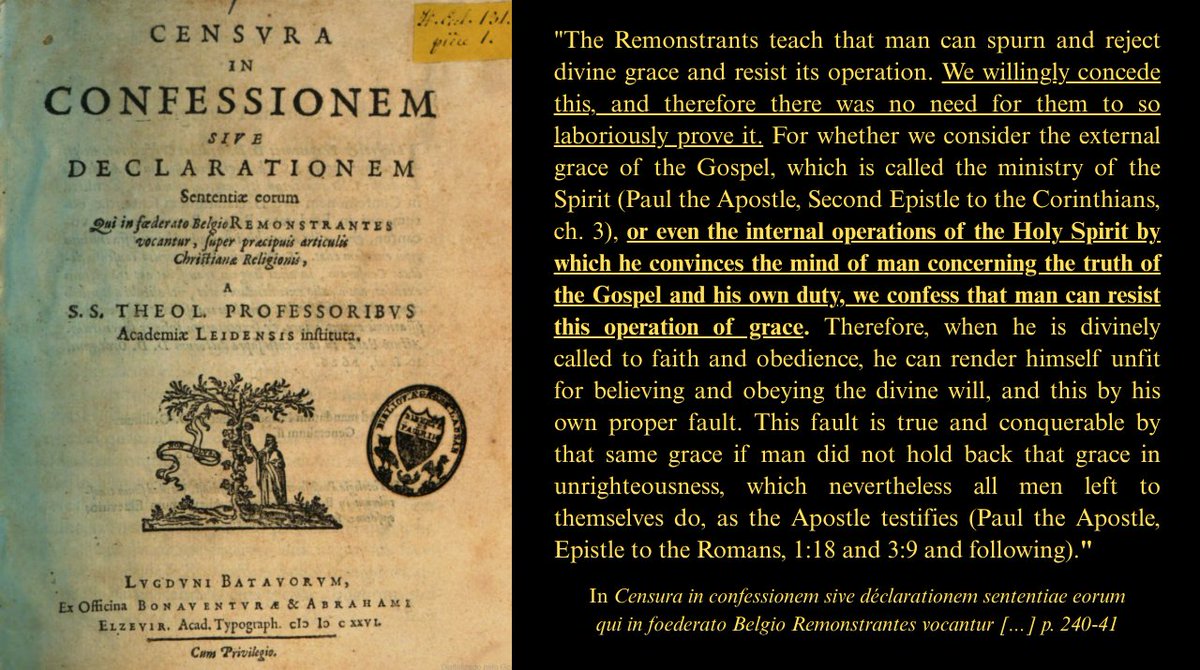
The Divines of Leiden on whether man can resist God's grace.
IrenicalProt. tweet media
English
0
6
13
709
IrenicalProt.
IrenicalProt.@irenicalprot·
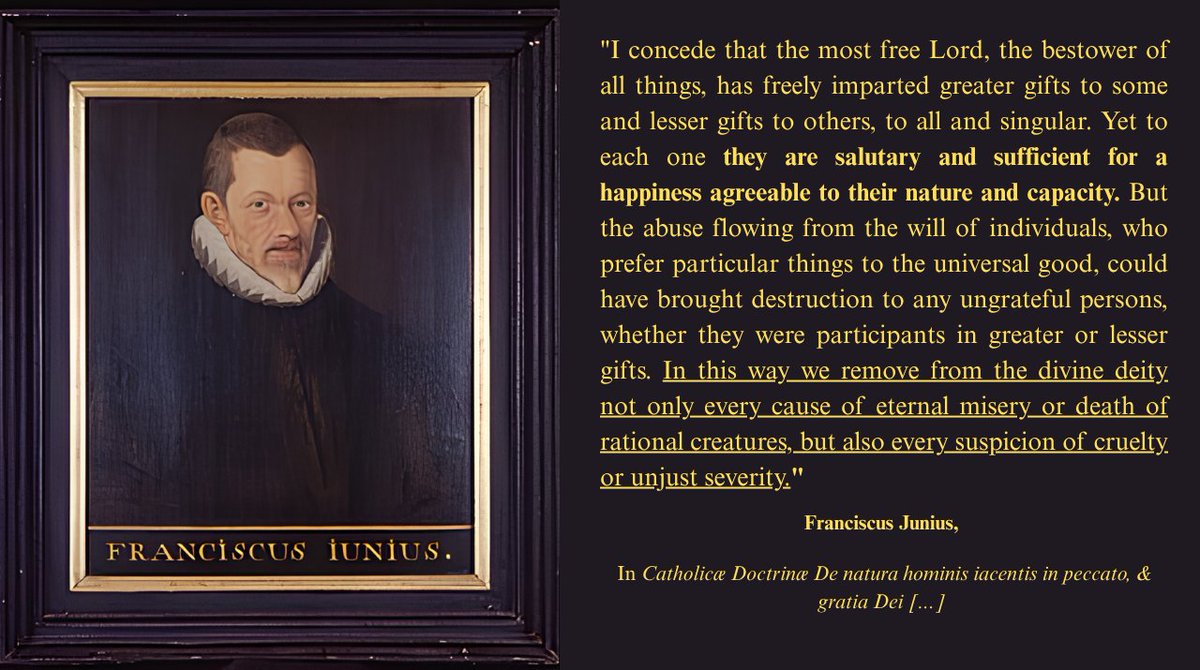
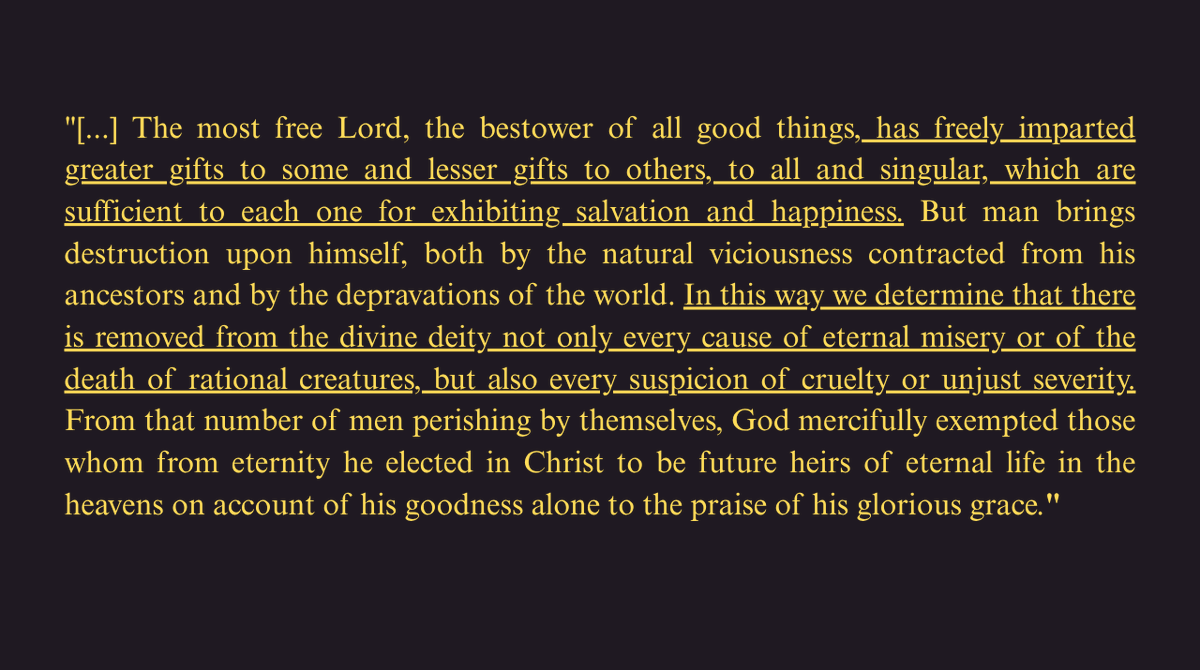
Franciscus Junius on whether sufficient grace for salvation is given to all.
IrenicalProt. tweet mediaIrenicalProt. tweet media
English
0
0
2
195
IrenicalProt. retweetledi
Inquisitor
Inquisitor@WesternCatholik·
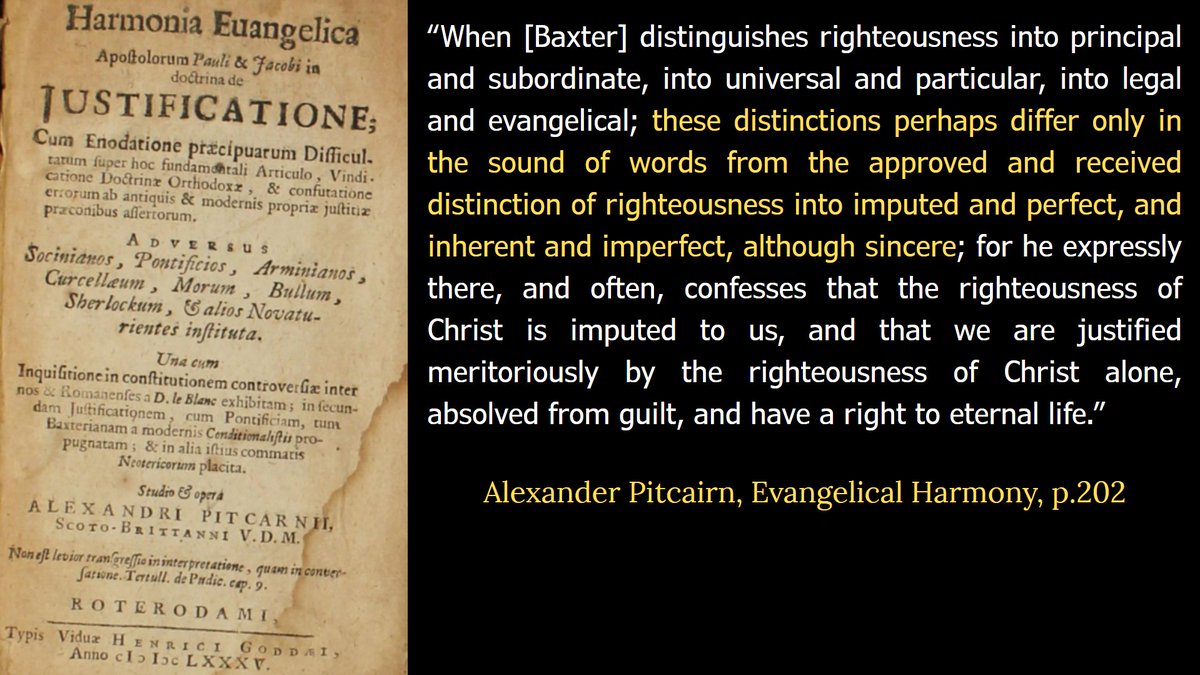
"[Baxter] distinguishes righteousness into principal and subordinate, into universal and particular, into legal and evangelical; these distinctions perhaps differ only in the sound of words from the approved and received distinction of righteousness into imputed... and inherent"
Inquisitor tweet media
English
0
2
18
929
IrenicalProt. retweetledi
Inquisitor
Inquisitor@WesternCatholik·
"as to the sum of the matter, little or nothing of a distinction between Turrettin and Baxter appears... together with Dr. Baxter, Dr. Turrettin teaches in the second justification" Alexander Pitcarn, Evangelical Harmony Between Paul and James
Inquisitor tweet media
English
4
8
37
2.6K