Vivek Rawat

204 posts

Vivek Rawat

Vivek Rawat

@its_vicky2603

Eh?

Ghaziabad,Uttar Pradesh Katılım Mayıs 2022
1K Takip Edilen38 Takipçiler
Vivek Rawat retweetledi
Sumanth
Sumanth@Sumanth_077·
A single 𝗖𝗟𝗔𝗨𝗗𝗘.𝗺𝗱 file that makes Claude Code 10x more powerful! This repo distills Andrej Karpathy's observations on LLM coding pitfalls into four actionable principles. The problem Karpathy identified: LLMs make wrong assumptions without asking. They overcomplicate code - writing 1000 lines when 100 would do. They change unrelated comments and code they don't understand. They don't surface tradeoffs or push back when they should. This 𝗖𝗟𝗔𝗨𝗗𝗘.𝗺𝗱 file fixes it with four principles: Think Before Coding - Don't assume. State assumptions explicitly. Present multiple interpretations when ambiguity exists. Push back when a simpler approach exists. Stop when confused and ask for clarification. Simplicity First - Minimum code that solves the problem. No features beyond what was asked. No abstractions for single-use code. No speculative flexibility. If 200 lines could be 50, rewrite it. Surgical Changes - Touch only what you must. Don't improve adjacent code or refactor things that aren't broken. Match existing style. Every changed line should trace directly to the request. Goal-Driven Execution - Define success criteria and loop until verified. Transform "fix the bug" into "write a test that reproduces it, then make it pass." Strong success criteria let Claude loop independently. The key insight from Karpathy: LLMs are exceptionally good at looping until they meet specific goals. Don't tell it what to do - give it success criteria and watch it go. Install as a Claude Code plugin or add to your project as 𝗖𝗟𝗔𝗨𝗗𝗘.𝗺𝗱. 55k+ GitHub stars. I've shared the link in the replies!
Sumanth tweet media
English
15
46
405
25.6K
Vivek Rawat retweetledi
elvis
elvis@omarsar0·
Building a personal knowledge base for my agents is increasingly where I spend my time these days. Like @karpathy, I also use Obsidian for my MD vaults. What's different in my approach is that I curate research papers on a daily basis and have actually tuned a Skill for months to find high-signal, relevant papers. I was reviewing and curating papers manually for some time, but now it's all automated as it has gotten so good at capturing what I consider the best of the best. There are so many papers these days, so this is a big deal. You all get to benefit from that with the papers I feature in my timeline and on @dair_ai. The papers are indexed using @tobi qmd cli tool (all of it in markdown files along with useful metadata). So good for semantic search and surfacing insights, unlike anything out there. I am a visual person, so I then started to experiment with how to leverage this personal knowledge base of research papers inside my new interactive artifact generator (mcp tools inside my agent orchestrator system). The result is what you see in the clip. 100s of papers with all sorts of insights visualized. I keep track of research papers daily, so believe me when I tell you that this system is absolutely insane at surfacing insights. This is the result of months of tinkering on how to index research and leverage agent automations for wikification and robust documentation. But this is just the beginning. The visual artifact (which is interactive too) can be changed dynamically as I please. I can prompt my agent to throw any data at it. I can add different views to the data. Different interactions. I feel like this is the most personalized research system I have ever built and used, and it's not even close. The knowledge that the agents are able to surface from this basic setup is already extremely useful as I experiment with new agentic engineering concepts. I feel like this knowledge layer and the higher-level ones I am working on will allow me to maximize other automation tools like autoresearch. The research is only as good as the research questions. And the research questions are only as good as the insights the agents have access to. Where I am spending time now is on how to make this more actionable. I am obsessed about the search problem here. The automations, autoresearch, ralph research loop (I built one months ago) are easier to build but are only as good as what you feed them. Work in progress. More updates soon. Back to building.
Andrej Karpathy@karpathy

LLM Knowledge Bases Something I'm finding very useful recently: using LLMs to build personal knowledge bases for various topics of research interest. In this way, a large fraction of my recent token throughput is going less into manipulating code, and more into manipulating knowledge (stored as markdown and images). The latest LLMs are quite good at it. So: Data ingest: I index source documents (articles, papers, repos, datasets, images, etc.) into a raw/ directory, then I use an LLM to incrementally "compile" a wiki, which is just a collection of .md files in a directory structure. The wiki includes summaries of all the data in raw/, backlinks, and then it categorizes data into concepts, writes articles for them, and links them all. To convert web articles into .md files I like to use the Obsidian Web Clipper extension, and then I also use a hotkey to download all the related images to local so that my LLM can easily reference them. IDE: I use Obsidian as the IDE "frontend" where I can view the raw data, the the compiled wiki, and the derived visualizations. Important to note that the LLM writes and maintains all of the data of the wiki, I rarely touch it directly. I've played with a few Obsidian plugins to render and view data in other ways (e.g. Marp for slides). Q&A: Where things get interesting is that once your wiki is big enough (e.g. mine on some recent research is ~100 articles and ~400K words), you can ask your LLM agent all kinds of complex questions against the wiki, and it will go off, research the answers, etc. I thought I had to reach for fancy RAG, but the LLM has been pretty good about auto-maintaining index files and brief summaries of all the documents and it reads all the important related data fairly easily at this ~small scale. Output: Instead of getting answers in text/terminal, I like to have it render markdown files for me, or slide shows (Marp format), or matplotlib images, all of which I then view again in Obsidian. You can imagine many other visual output formats depending on the query. Often, I end up "filing" the outputs back into the wiki to enhance it for further queries. So my own explorations and queries always "add up" in the knowledge base. Linting: I've run some LLM "health checks" over the wiki to e.g. find inconsistent data, impute missing data (with web searchers), find interesting connections for new article candidates, etc., to incrementally clean up the wiki and enhance its overall data integrity. The LLMs are quite good at suggesting further questions to ask and look into. Extra tools: I find myself developing additional tools to process the data, e.g. I vibe coded a small and naive search engine over the wiki, which I both use directly (in a web ui), but more often I want to hand it off to an LLM via CLI as a tool for larger queries. Further explorations: As the repo grows, the natural desire is to also think about synthetic data generation + finetuning to have your LLM "know" the data in its weights instead of just context windows. TLDR: raw data from a given number of sources is collected, then compiled by an LLM into a .md wiki, then operated on by various CLIs by the LLM to do Q&A and to incrementally enhance the wiki, and all of it viewable in Obsidian. You rarely ever write or edit the wiki manually, it's the domain of the LLM. I think there is room here for an incredible new product instead of a hacky collection of scripts.

English
137
442
4.5K
461.3K
Vivek Rawat retweetledi
Mustafa
Mustafa@oprydai·
become a generalist. specialization makes you efficient. generalization makes you dangerous. what it actually means: • learn across domains → math, physics, software, economics, biology. patterns repeat across fields. • connect ideas → innovation happens at the intersection, not inside silos. • adapt fast → when one field shifts, you don’t collapse, you pivot. • see systems → specialists see parts, generalists see the whole • build end-to-end → from idea → design → implementation → delivery the world rewards specialists in stable environments. it rewards generalists when things are changing. right now, everything is changing. don’t just go deep. go wide, then stack depth where it matters.
Mustafa tweet media
English
209
988
5.2K
259.1K
Vivek Rawat retweetledi
Shubham Saboo
Shubham Saboo@Saboo_Shubham_·
This is getting way too real! I can now get on a video call with my OpenClaw Agents to chat with them face to face. All i need to do is to send them a Google meet invite.
English
306
485
5.4K
670.5K
Vivek Rawat retweetledi
Manthan Gupta
Manthan Gupta@manthanguptaa·
Water just went from a simple workflow engine to a full agent harness framework for Python. The infrastructure around your AI agents: orchestration, resilience, approval gates, sandboxing, MCP, and more. Works with LangChain, CrewAI, OpenAI, Anthropic, or your own agents. Here's everything 🧵
Manthan Gupta@manthanguptaa

Building multi-agent systems today is harder than it should be. Most frameworks are rigid or too fluid, opinionated, and don’t play well with others. Meet Water - a simple, composable multi-agent framework. 🌊 Water is: • Lightweight, composable, and open-source • Multi-agent by design • Framework agnostic - bring agents from OpenAI Agents SDK, LangChain, Google ADK, or anywhere • Built for structured flows (sequential, parallel, looped, conditional)

English
9
9
48
5.5K
Vivek Rawat retweetledi
Sahil Bloom
Sahil Bloom@SahilBloom·
Nobody tells you this: You can win by just embracing what most people avoid. Wake up early. Focus. Move your body. Eat real foods. Obsess over one thing. Read old books. Be present. Listen intently. Change your mind. Have difficult conversations. The recipe for a good life.
English
220
425
3.7K
76.5K
Vivek Rawat retweetledi
Max Blade
Max Blade@_MaxBlade·
The simplest rule to blow up your income, followers, etc.. EVEN when you have no idea what your doing is : "Always Produce" Paul Graham taught me this, and it changed my life. overthinking, feeling sorry for yourself, or anything that is not producing will always get you nothing. If you don't know what to produce ( this is normal ) then just produce anything. the act of producing will naturally guide you to what you should be producing. The MORE you produce, the better you get at producing and learning what you should produce. This is painful because you feel like you are wasting time, and just creating non-sense until one day you produce something that thousands of people love and it changes your life.
English
70
176
2.1K
83.1K
Vivek Rawat retweetledi
Arpit Bhayani
Arpit Bhayani@arpit_bhayani·
Let me talk about something obvious but with a bit of quantification... Theoretically, both arrays and linked lists take O(n) time to traverse, but here's what actually happens when you benchmark by summing 100k integers - Array: 68,312 ns - Linked List: 181,567 ns Summing an array is ~3x faster than LinkedList. Same algorithm, same complexity, but wildly different performance. The reason is cache behavior. When you access array[0], the CPU fetches an entire cache line (64 bytes), which includes array[0] through array[15]. The next 15 accesses are essentially free. Arrays hit the cache about 94% of the time. Linked lists suffer from pointer chasing. Each node is allocated separately by malloc(), scattered randomly in memory. Each access likely requires a new cache line fetch, resulting in a 70% cache miss rate. This is a good example of why Big O notation tells only part of the story. Spatial locality and cache-friendliness can make a 2-3x difference even when the theoretical complexity is identical. I am sure you would have known this, but this crude benchmark quantifies just how fast cache-friendly algorithms can be. Hope this helps.
English
58
63
1.4K
73K
Vivek Rawat retweetledi
Sindhu Biswal
Sindhu Biswal@sindhubiswal·
Prompting is now an engineering constraint, not a creative one. Most users treat AI like a search bar instead of a junior staffer. Uploading a style guide as a reference file works because it bypasses the model's tendency to drift mid-conversation. Use a markdown file for instructions to keep token usage low and logic tight. Context beats long prompts every time
English
1
2
12
5.2K
Crafters Warrior
Crafters Warrior@tech_crafters·
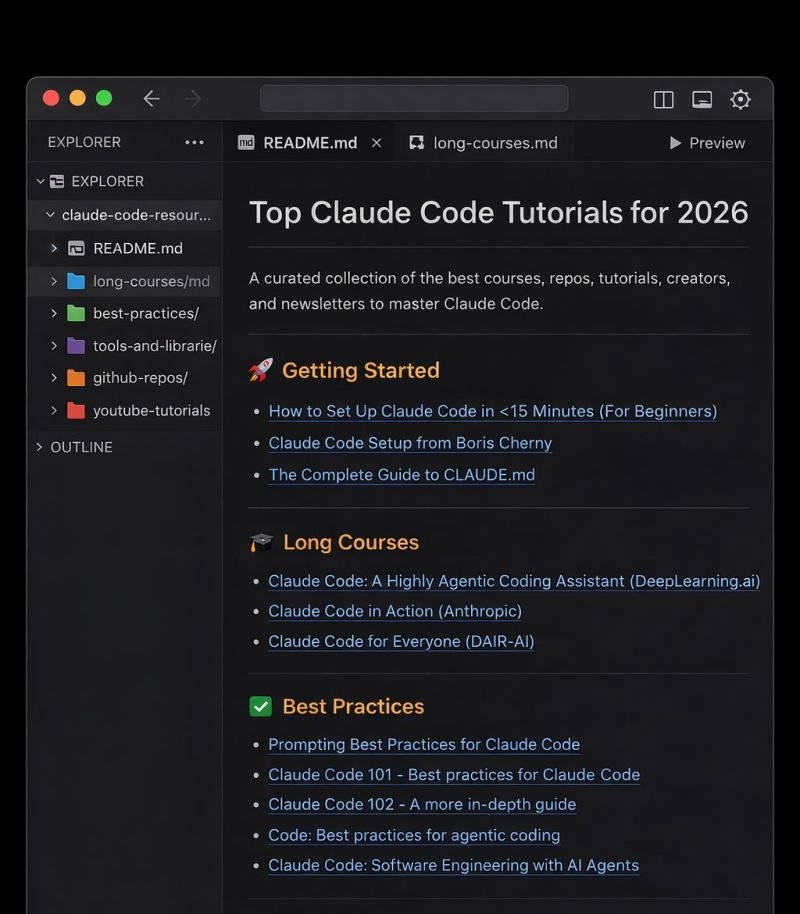
You won’t lose to AI. You’ll lose to someone who mastered Claude Code first. I put together every resource you need to go from curious about Claude Code to actually shipping with it. This Includes: 🚀 3 Getting Started resources 📚 4 Long Courses 🧠 4 Best Practices guides 🛠 3 Tools & Libraries 🐙 8 battle-tested GitHub repos 📺 6 YouTube tutorials from builders actually using it 👥 6 creators worth following 📧 6 newsletters to stay sharp This isn't theory. It's the exact stack people are using to build real products right now. If you want Free Access Like , RT comment : Send Follow Me is MUST so that i can DM you
Crafters Warrior tweet media
English
74
38
102
4.9K
Vivek Rawat retweetledi
Shubham Saboo
Shubham Saboo@Saboo_Shubham_·
DO NOT "Delete your CLAUDE.md files" just yet. READ THIS POST once before you do. ETH Zurich researchers tested whether CLAUDE AGENTS md files actually help coding agents or not. they tested 138 real GitHub issues across 4 coding agents. they wanted to know one thing: do context files actually help agents write better code? The success metric was: did the agent ship a working patch? not tokens, not speed. working code. two findings came out of it and most people are only citing one: auto-generated context files (the ones you get from running /init) hurt task resolution by 0.5-2% and bump your inference cost by 20%. that part is true. but human-written ones improved performance by 4%. that's the result from same study. the reason auto-generated files hurt is actually kind of funny once you see it. agents are obedient. they follow whatever's in the file. so when a generated file adds unnecessary requirements, the agent does more testing, more file traversal, burns upto 22% more reasoning tokens, and still produces worse results than if you'd given it nothing at all. now this is interesting: when researchers stripped all existing documentation from the repos, auto-generated files suddenly went from hurting to helping by 2.7%. repos with good documentation don't need a generated context file because the agent was already going to find that information on its own. /init just repackages what's already there. what actually works in a context file is stuff the agent can't find on its own. which test runner to use. which package manager you prefer. repo-specific commands that aren't obvious. the researchers proved this by tracking actual tool usage: mention uv in your context file and the agent uses it. don't mention it and the agent almost never reaches for it on its own. so no, don't delete it. but if you ran /init and committed whatever came out, that's the thing to delete. the study doesn't say CLAUDE.md is useless. it says auto-generated, bloated ones are. delete the auto-generated one. write a minimal human one. or don't write one at all if your repo is well-documented. just stop letting the loudest take win over the actual DATA.
Shubham Saboo tweet media
English
17
12
97
10.9K
Vivek Rawat
Vivek Rawat@its_vicky2603·
Hey @elonmusk I will be doing a live stream at the pinnacle of Mount Everest. Will @Starlink work there ? If yes, then I will do it .
English
0
0
0
10
Vivek Rawat retweetledi
Shimazu.S
Shimazu.S@ShimazuSystems·
I built my own graphics library and got a whole map of my city onto a device with only 64kb of free RAM using my own rendering method written entirely in C & assembly, and a converter that take GeoJSON files and compresses them - this one went from 5mb to 34kb in my proprietary binary format, uses linedraw vector rendering to keep the entire memory buffer at only 8kb of RAM whilst tiling larger maps In short Screw google, aint no reason maps needs to be gigabytes of RAM to use
English
676
2.5K
29.3K
1.4M
Vivek Rawat retweetledi
Alex Finn
Alex Finn@AlexFinn·
Something big is happening. First Mac Minis. Now Mac Studios. Completely sold out. When I bought 2 Mac Studios a month ago my wait was 14 days. Now the wait is 54 days. The world has changed more in the last month than in the previous 100 years combined. The world's first true AI agent released. Open models became frontier. $10,000 computers started selling out. It is so obvious and clear what is happening on this planet right now. Everyone is going to want personal, private, super intelligent AI assistants sitting on their desk. If you put it in the cloud you are handing all your data and information to corporations. You are being limited by subsidized tokens. You are being surrounded by carefully placed guardrails Within a year compute will be a luxury. Only the early adopters and the mega rich will have access. If you do not have an incredibly deep understanding of OpenClaw, LLMs, and local compute right now, you are on a one way trip to the permanent underclass
Ray Fernando@RayFernando1337

People are waking up. Mac Studio hardware 54+ days out...FML

English
353
211
2.5K
613.3K
Vivek Rawat retweetledi
Aadit Sheth
Aadit Sheth@aaditsh·
The most dangerous addiction today isn't a substance. Research on 100,000 people confirms that heavy short-form video use is just voluntary cognitive decline. We are actively training our brains to fail at hard tasks. If you can simply sit with a problem for 10 minutes without swiping, you have a massive competitive advantage. Basically, boredom is the new IQ.
Aadit Sheth tweet media
English
318
4.2K
19.6K
2.7M
MotionViz
MotionViz@Motion_Viz·
2 months ago: Abandoning projects by week 4. Today: Zero abandoned projects. The shift? Stopped re-planning. Stopped re-researching. Stopped re-debating decisions I already made. The system: - Claude thinks through problems - NotebookLM remembers every decision - Markdown tracks what ships When someone joins my project now: → Point them to the .md files → Point them to the NotebookLM notebook → They're up to speed in 1 hour, not 1 week. Reply "SYSTEM" and I'll DM you the exact workflow.
MotionViz tweet media
English
689
47
774
60.8K