Sai Subramanyam

80 posts

Sai Subramanyam banner
Sai Subramanyam

Sai Subramanyam

@itsme_rss

Vishakhapatnam, India Katılım Temmuz 2017
70 Takip Edilen9 Takipçiler
Sai Subramanyam
Sai Subramanyam@itsme_rss·
@MNageswarRaoIPS Never heard of such spine-chilling history about the seeds sown by biased authorities, in the telugu state, which eventually crippled the brahmin communities, thereby the sanctity of the Hindu eco-system. The Dravidian cancer has infested us by propagating anti brahmin narratives
English
0
0
0
53
M. Nageswara Rao IPS (Retired)
M. Nageswara Rao IPS (Retired)@MNageswarRaoIPS·
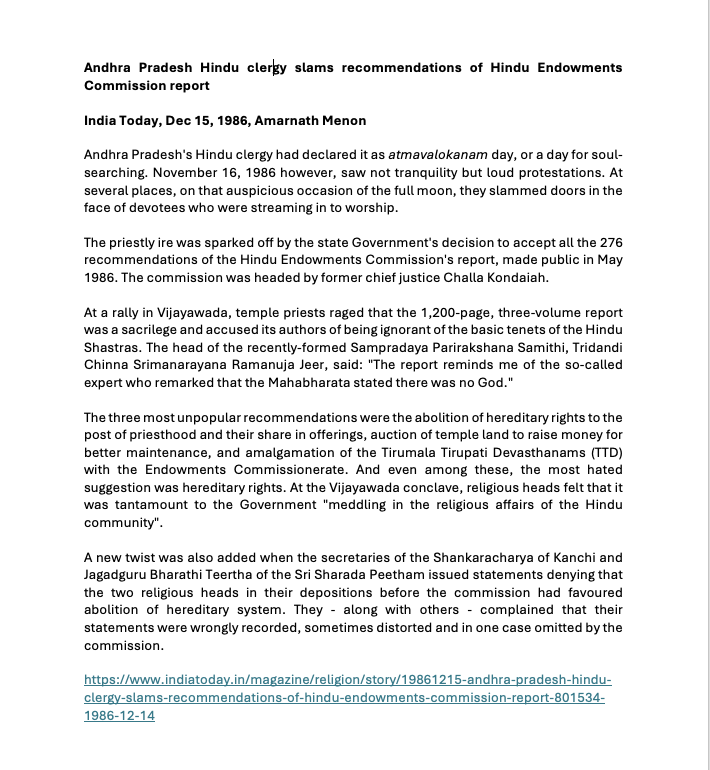
Why do Telugu Brahmins have no love lost for Telugu Desam Party? The present-day Andhra Pradesh was part of Madras Presidency till 1953. In AP both Reddys and Kammas are land owning agricultural castes with considerable influence. Since early 20th century CE, as Reddys came to dominate the Congress party the Kammas gravitated towards the Justice Party even though it was essentially a Dravidian Party, as it was the only viable political alternative to the Congress in the erstwhile Madras Presidency. Several of them also joined the Communist Party of India but its popularity was limited. Historically, the Kammas, the Reddys, et al have been torchbearers of Sanatana Dharma in Telugu areas, and they all hugely patronised Brahmins and Hindu religion. However, as both Justice Party and Communist Party were/are doctrinally Anti-Hindu in general and Anti-Brahmin in particular, the Kammas came internalize certain Anti-Brahmin attitude, even though at individual level they continue to patronise Sanatana Dharma and Brahmins. After formation of Andhra State in 1953 by division of Madras Presidency, and the subsequent formation of united Andhra Pradesh by including Telugu speaking areas of the Hyderabad State in 1956, Congress became a colossus and dominated the politics in the then united AP, with no viable political opposition to it. Since Justice Party was essentially a Dravidian Party it did not command much following in Telugu areas after division of Madras Presidency, Kammas became political orphans as Reddys dominated the Congress. So, they diverted their energies to entrepreneurship and business. Come 1980s. The public humiliation of the then sitting Chief Minister of Andhra Pradesh Sri T. Anjaiah (who incidentally was a Reddy) by Rajiv Gandhi, who was only an MP then, during his visit to Hyderabad, created a wave of uproar against Congress for denting Telugu Atma Gauravam, which led to formation of @JaiTDP Telugu Desam Party by late Nandamuri Taraka Rama Rao (NTR). It swept the Assembly elections in 1983 with a landslide majority. NTR was highly spiritual person and a Sanatani Hindu. At individual level he patronised Brahmins since his cinema days. However, after he became CM of AP some cunning Kamma intellectuals and bureaucrats having Anti-Hindu and Anti-Brahmin mindset inherited from the Justice Party, glibly convinced him to take measures to improve the administration of Temples and Endowment Department. So, in 1984 the NTR Government constituted a Hindu Endowment Commission by appointing Retired Chief Justice of AP Sri Challa Kondaiah as its head. Justice Challa Kondaiah (1918 – 2001), who was a Kamma, hailed from Anantapur district which was part of the erstwhile Madras Presidency. He studied Law in Madras Law College, and practiced law in Madras High Court and later in AP High Court. He seemed to have been influenced by the ideology of the then Justice Party as the Dravidian Movement was at its peak during mid-20th century which period coincided with his student days and youth in Madras. Further, as already mentioned above, as the Congress was dominated by Reddys, Kammas gravitated towards Justice Party which was the only political alternative. The Challa Kondaiah Commission submitted its recommendations in 1986 suggesting enactment of new law replacing the Andhra Pradesh Charitable Hindu Religious and Institutions and Endowments Act, 1966 and the Tirumala Tirupati Devasthanams Act, 1979. I have no hesitation to castigate it as one of the most Anti-Hindu and Anti-Brahmin Reports ever submitted by a public authority, for, it was essentially a distilled version of the ideology of the Justice Party. Sadly, the protests👇of Hindu clergy were ignored and a new Andhra Pradesh Charitable Hindu Religious and Institutions and Endowments Act, 1987 was enacted. The Act struck at Brahminism which is the pivot of the wheel of Hindu religion. Some of its obnoxious Anti-Hindu provisions are as under: “Section 16. Abolition of hereditary trustees - Notwithstanding any compromise or agreement entered into or scheme framed, or judgment, decree, or order passed by any court, tribunal or other authority or in a deed or other document prior to the commencement of this Act and in force on such commencement, the rights of a person for the office of the hereditary trustee or mutawalli or dharmakarta or muntazim or by whatever name it is called shall stand abolished on such commencement.” “Section 25. Fixation of dittam - (1) The trustee of a religious institution or endowment, other than a math or specific endowment attached thereto, shall within a period of ninety days from the date of commencement of this Act or the date of founding of the religious institution or endowment, other than a math or specific endowment attached thereto, and after consultation with the Sthanacharya or where there is no such Sthanacharya, the archaka or archakas concerned, submit proposals, for fixing the dittam in the institution or endowment and the amounts to be spent therefor to the Commissioner, the Deputy Commissioner or the Assistant Commissioner, as the case may be, having jurisdiction over such institution or endowment.” Note: As per section 3 (11), ‘"dittam’ means the schedule of articles and other requirements of worship or offering in connection with the daily dhupa, deepa, naivedyam, pachikam, paricharikam and other general, special or periodical services, ceremonies or observances in the institution, endowment, math or specific endowment, as the case may be." “Section 34. Abolition of hereditary rights in Mirasidars, Archakas and other office holders and servants – (1) (a) Notwithstanding anything in any compromise or agreement entered into or scheme framed or sanad or grant made or judgement, decree or order passed by any Court, Tribunal or other authorities prior to the commencement of this Act and in force on such commencement, all rights, whether hereditary, contractual or otherwise of a person holding any office of the Pedda Jeeyangar, Chinna Jeeyangar, a Mirasidar or an Archaka or Pujari or any other office or service or post by whatever name it is called in any religious institution or endowment shall on the commencement of this Act stand abolished; (b) Any usage or practice relating to the succession to any office or service or post mentioned in clause (a) shall be void; (c) All rights and emoluments of any nature in cash or kind or both accrued to and appertaining to any office or service or post mentioned in clause (a) and subsisting on the date of commencement of this Act shall on such commencement stand extinguished.” “Section 144. Abolition of shares in Hundi and other rusums - Notwithstanding any judgement, decree or order of any Court, Tribunal or other authority, or in any scheme, custom, usage or agreement, or in any manual prepared by any institution or in any Farmana or Sanad or any deed or order of the Government to the contrary governing any charitable or religious institution or endowment, all shares which are payable or being paid or given or allowed at the commencement of this Act to any Trustee, Dharmakartha, Mutawalli, any office holder or servant including an Archaka or Mirasidar and share or shares, in the Kanukas offered either in kind or in cash or both by the devotees either in Hundi, Plate or otherwise, or any rusum in the Archana or Seva tickets and tickets for tonsuring or any rusums collected from the person for the performance of marriage or Upanayanam and the like, all offerings made in the premises of the Temple or at such places as may be specified by the Trustee, all Prasadams and Panyarams offered either by the Temple or devotee, and such other kinds of offerings, all shares in the lands of the institution or endowment allotted or allowed to be in possession and enjoyment of any archaka, office holder or servant towards remuneration or otherwise for rendering service and for defraying the ‘Paditharam’ and other expenses connected with the service or management of the Temple, shall stand abolished with effect on and from the commencement of this Act.” The subsequent Congress Governments amended the Act in 1990 and 2017 bringing in certain marginal changes to assuage the hurt feelings of Hindu clergy, but its Anti-Hindu and Anti-Brahmin core and essence remain unchanged. The Act led to industrial scale vilification and pauperisation of Hindu clergy, subordination of Hindu priestly class to Endowment officials and all sorts of criminals and shady characters who get appointed to the Temple Boards, systematic undermining of sampradayas and defiling of Hindu Temples and sacred places, mismanagement and encroachment of thousands of acres of Temple lands and misappropriation of properties. As a result of such concerted legal and official attack on Hindu clergy, there is now acute shortage of Hindu clergymen to quench the spiritual hunger of Hindus leading to De-Hinduisation of Telugu Hindus, and thereby it paved way for Christian Missionaries to poach Hindus on massive scale. It must be noted that Dharmacharyas, Peethadhipatis, Purohits, Pujaris, Archakas, Pundits, et al have to be patronised and taken care of so well that they focus and work entirely for survival and intergenerational transmission of Hindu Dharma. As there is no governmental and official patronage to them in a secular polity, the offerings given by the devotees in Temples and Hindu sacred places remain the only means of their sustenance. Sadly, the Challa Kondaiah Commission delivered a death blow by hitting at the prana nadi of Hindu religion. Hope the powers-that-be understand the gravity of the problem and do the needful sooner than later. @ncbn
M. Nageswara Rao IPS (Retired) tweet media
English
49
201
423
57.6K
Sai Subramanyam
Sai Subramanyam@itsme_rss·
@kakatiyawarlord Despite his efforts to build a strong economy in India, his character is being assassinated repeatedly, till today. Ref: Scam 1992 webseries (Harshad Mehta case).
English
0
0
0
0
Sai Subramanyam
Sai Subramanyam@itsme_rss·
@KiranKS In ancient scriptures, it is called as PURVA PAYODHI (Eastern Ocean).
English
0
0
0
0
Kiran Kumar S
Kiran Kumar S@KiranKS·
Why is it a Bay of "Bengal"? Why wasn't it named Bay of Andhra, Bay of Kalinga, Bay of Madras etc.?
English
14
9
18
0
Sai Subramanyam
Sai Subramanyam@itsme_rss·
@Rnb_SayZ But not in reverse pattern, right? This year is going like a replay mode of same movie we watched last year. But this time in FAST FORWARD mode.
English
1
0
0
0
Sai Subramanyam retweetledi
Edward Snowden
Edward Snowden@Snowden·
Holy shit
English
157
1.9K
13.5K
0
Sai Subramanyam retweetledi
Prof. K.Nageshwar
Prof. K.Nageshwar@K_Nageshwar·
Under #RafaleDeal Dassault, MBDA have to transfer technology to DRDO for LCA indigenous engine Kaveri. CAG says no technology transfer has happened yet. No one questioned #Rafale combat competence. Deal allegedly dubious.
English
5
17
99
0