

Justin Mart
987 posts

Justin Mart
@j_mart
prev: Corp Dev + Ventures @coinbase, Eng & Data @coinbase, Nuclear Eng @ch2mhill
Austin, TX Katılım Ocak 2009
1.3K Takip Edilen4.2K Takipçiler

Introducing Onchain Group (OG).
After leaving Coinbase, I spent time reflecting on what was actually worth working on.
My background was as a venture investor — pattern matching, working with founders, and figuring out what’s coming next. What I realized, though, was that the most energizing part wasn’t investing. It was working with teams to define strategy and bring the right transaction into existence, like architecting the Coinbase <> Morpho deal — a new kind of onchain alliance that combined product, capital, and distribution to create an entirely new category and market.
It made me wonder: was this a one-off, or the start of something new?
Having been in crypto for nearly a decade, this is the most dynamic the space has felt. Onchain products are becoming real businesses, tokens are becoming real assets, and regulatory clarity is opening up an entirely new design space — introducing a new class of capital structuring opportunities.
Over the past year, working closely with founders, it became clear that this wasn’t a one-off, but the first of many.
The opportunity design space is just beginning — from tokens turning on fees, to restructurings, to equity-like conversions, to acquisitions and distribution partnerships involving tokens.
Teams are realizing that getting this right is no longer optional. As onchain products mature into real businesses, taking ambitious steps toward the right capital structure becomes a requirement — and the market is beginning to reward those who do it well.
In our conversations with builders, investors, and stakeholders over the past year, it became clear that nobody was exploring this area the right way — with an early-stage mindset, cryptonative intuition, and institutional rigor all at once.
So we started Onchain Group.
OG exists to define and execute the transactions that create new markets and shape this new system.
If crypto is the software upgrade to finance, then capital structure needs to evolve alongside it — requiring ambitious strategy and creative execution.
Onchain Group@onchaingroup_
English
So ironic when AI is likely to bring the most dramatic improvement to quality of life humanity has ever seen.
Massive PR fail
Brad Gerstner@altcap
AI is deeply unpopular. According to Pew, sadly only 17% of Americans think AI will have a positive impact. In China, 83% believe AI will be positive. A token tax & political backlash is coming unless the narrative changes. 🇺🇸👀🧐
English

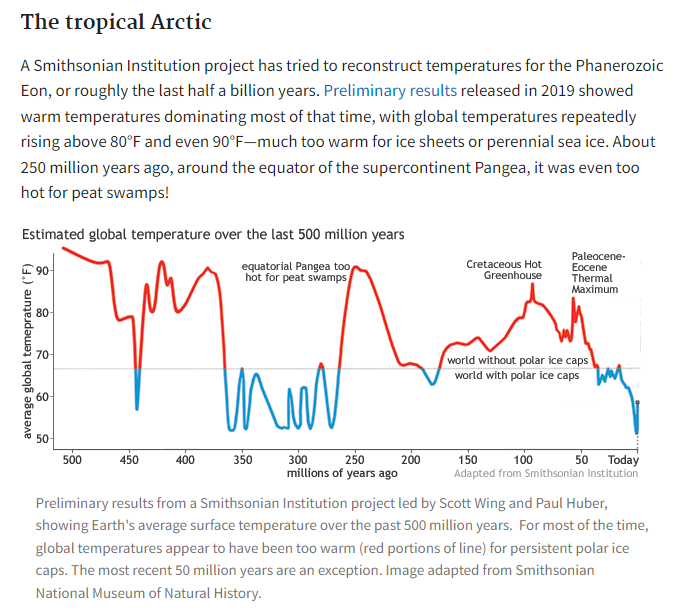
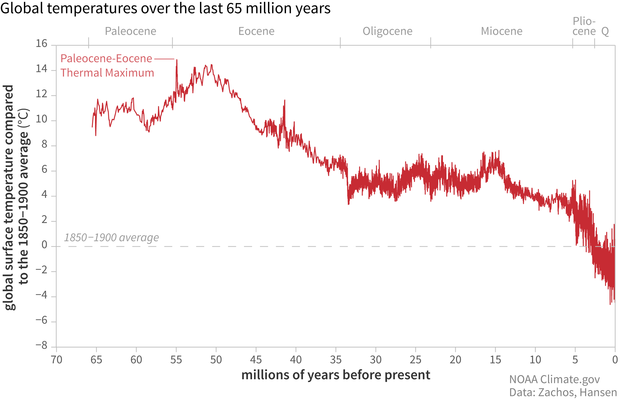
@LynAldenContact @MichaelAArouet Help me understand. What’s the relevance of this graph? You’re saying the earth was much warmer *millions* of years ago, but who cares? It’s clearly warming today, and it seems precarious that humans will continue to exist unaffected if it continues to warm.
English

@MichaelAArouet Even when one accepts the consensus that humanity has contributed to climate change, the context looks quite a bit different when one zooms out, using the same consensus data.
English

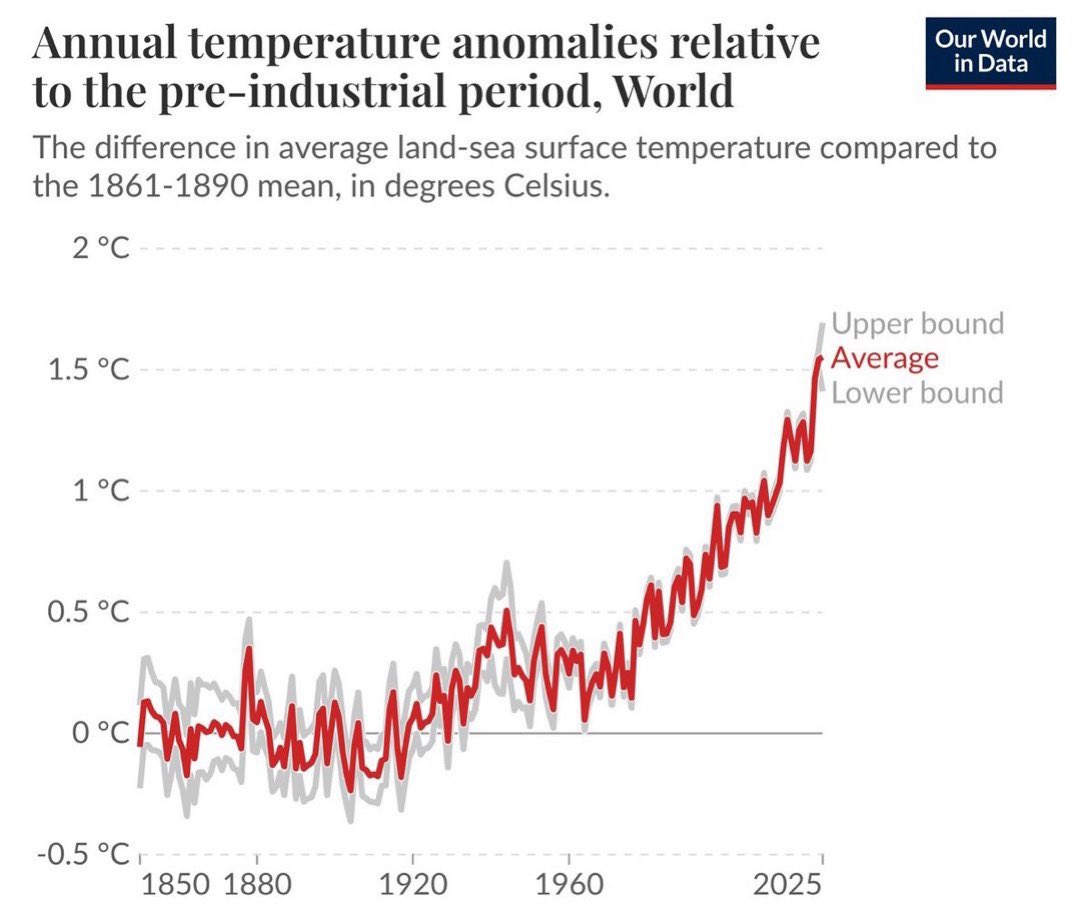
Can someone please explain why there are still people questioning man-made climate change?
How much more evidence do they need?
English


Today I hit my 5 year anniversary at Coinbase.
When Coinbase acquired Bison Trails I was distraught. I had in my mind that I wanted to build Bison Trails into a $60bn business. I don't know why that number, it's just the one I had in my head. I thought the day would come when we would acquire Coinbase.
I was so intent on making Bison Trails great that after we got acquired I felt adrift. We had a successful outcome, but it wasn't the one I had in mind. I didn't know what my new goal should be, what I was working towards, or why I should stay at Coinbase (other than to vest).
I remember talking to @JoeLallouz about it and he suggested I think about what I really want and set a new goal for myself. I thought really hard and the only desire I had was "to make crypto win." So I started working towards it, prioritizing my work at Coinbase based on what I thought was the most important thing to do to accomplish that outcome. It's why I worked for years on policy and regulatory issues even though that was completely outside my normal scope.
Lately the thought I keep having is that I want to make Coinbase into a generational company. I think Coinbase is incredible, but what's truly special about it is that the only way it'll become a generational company is by making crypto win. There are a lot of players in crypto that are massively successful, but actually hurt the industry they're part of. They want to win, even at the expense of crypto ethos and ideals. Fuck that. If Coinbase wins, crypto will win. That's why I'm working just as hard today as when I started at Bison Trails 7 years ago.
Don't play short term games. Don't launch tokens to dump and dip. Play long term games with long term people. Make the world a better place. Believe in something.

English
There’s a general axiom inherent to social media today:
The most sensational interpretation is pushed first.
Take this post as the example👇. The worst interpretation is some terrible conclusion about AI doomerism. But is that really the salient conclusion? Likely not
Saoud Rizwan@sdrzn
head of anthropic’s safeguards research just quit and said “the world is in peril” and that he’s moving to the UK to write poetry and “become invisible”. other safety researchers and senior staff left over the last 2 weeks as well... probably nothing.
English

I'm joining @tempo to work on stablecoins
Tempo is working on the most important problem in finance: building a global payments network that is fast, inexpensive and transparent.
Excited to be working with @matthuang, @gakonst, @liamihorne and the rest of the team!
English
I don’t understand.
Why do they insist on tying the two poles together such that any incident where a limb is on the inside of the pole, the skier is thrown off balance and crashes??
Seems like a very easy fix. Lindsey gets a DQ, not an airlift.

English

After nearly seven years, I wrapped up my time at Coinbase. Grateful for the people, proud of what we built, and excited for what’s next.
Started a new chapter as a Venture Partner at @hiFramework , spending more time with founders continuing to build out our industry.
English
Justin Mart retweetledi

We have reached a stage in our country where there are only two sides to every issue and every incident. Each side lives in protected echo chambers which are provided with a curated set of ‘facts’ and/or video footage from certain camera angles that are consistent with the preexisting views and conclusions of that side.
Individuals are ‘convicted’ of serious crimes in the headlines, by politicians appealing to their base, and ultimately in the minds of the public, or they are exonerated, before all of the facts are in and a detailed investigation has been completed.
This is not good for America. We need to go back to a world where we suspend judgment and await the conclusions of a detailed investigation before we convict or exonerate. Let’s not forget that a man is presumed innocent until proven guilty.
Rushing to judgment helps no one and harms us all. It also greatly elevates the temperature, which keeps potential targets of law enforcement and those who enforce our laws on edge, massively increasing the risk to all.
We need to take a deep breath and reserve judgment before this gets even more out of control.
English

Alcaraz > Paul
Bublik > de Minaur
Zverev > Rublev
Medvedev > FAA
Musetti > Fritz
Djokovic > Mensik
Shelton > Ruud
Sinner > Darderi
Alcaraz > Bublik
Medvedev > Zverev
Djokovic > Musetti
Sinner > Shelton
Alcaraz > Medvedev
Sinner > Djokovic
Sinner > Alcaraz
Slovenščina


Politicians have a 6th sense for the preservation of their career.
Most concerning is that Ro, and others in his ilk, have determined that the Overton window has shifted and social capital can be spent on proposing increasingly socialist ideals.
In the past, his proposal would be political suicide (rightly so), but today it may well be galvanizing (we’ll see).
The tea leaves are shifting, the foundations for class warfare are being laid, and socialist ideals are more and more in vogue.
How do we fight that?
Ro Khanna@RoKhanna
My district is $18 trillion, nearly 1/3 of US stock market in a 50 mile radius. We have 5 companies with a market cap over a trillion dollar companies. If I can stand up for a billionaire tax, this is not a hard position for 434 other members or 100 Senators. Those saying that we wouldn't have a future NVIDIA in the Bay if this tax goes into effect are glossing over Silicon Valley history. Jensen was at LSI Logic and his co-founders at Sun. He started NVIDIA in my district because of the semiconductor talent, Stanford, innovation networks, and venture funding. We have 37 times the VC money as Austin given the innovation ecosystem & Florida isn't even on the map. Jensen wasn't thinking I won't start this company because I may have to one day pay a 1 percent tax on my billions. He built here because the talent is here. AI was created with our tax dollars. ImageNet was created by Fei-Fei Li at Stanford using NSF money. This was a visual database. Hinton presented at an ImageNet conference his famous paper. The seminal innovation in tech is done by thousands often with public funds. NSF, DARPA, Stanford, Berkley, San Jose State, Santa Clara and the UCs are the foundation for what has made Silicon Valley a powerhouse. It's why we won 5 Nobel Prizes this year in the UC system. Yes, we need entrepreneurs to commercialize disruptive innovation. Stanford blazed a trail in licensing technology & partnering with the private sector. The university enabled companies like Google which began as a research project called BackRub, looking at back links to rank pages. And entrepreneurs like Brin & Page reap huge rewards when they succeed. But the idea that they would not start companies to make billions, or take advantage of an innovation cluster, if there is a 1-2 percent tax on their staggering wealth defies common sense and economic theory @paulkrugman @DAcemogluMIT @baselinescene. We cannot have a nation with extreme concentration of wealth in a few places but where 70 percent of Americans believe the American dream is dead and healthcare, childcare, housing, education is unaffordable. What will stifle American innovation, what will make us fall behind China, is if we see further political dysfunction and social unrest, if we fail to cultivate the talent in every American and in every city and town. The industrial revolution saw soaring inequality in Britain for nearly 60 years. On the continent, it lead to revolutions in France with worker uprisings (1848) and contributed to one in Russia (1917). America's central challenge is to make sure the AI revolution works for all of us, not just tech billionaires. So yes a billionaire tax is good for American innovation which depends on a strong and thriving American democracy.
English
@0xrwu Congrats on your first week! Coinbase is an incredible place to work
English

Just wrapped up our first week at Coinbase (which also happens to be a Surge week). My observations:
1. CB is really becoming the “everything exchange”. The number of things they have in their pipeline is insane.
2. CT gives CB too much shit for being biased towards Base. This was the complete opposite in the consumer org: everyone wants the user to win, and that means offering maximal asset coverage.
3. They’re taking onchain (“DEX”) very seriously. Solana trading is imminent.
4. The people here are smart and kind. And I’m not just saying that because everyone else does: it really does feel like a championship team that wants to win.
5. The way CB is doing onchain trading is the end state: single CB balance you can use to trade anywhere.
6. It’s still Day One: there’s still a lot of work to do. Faster data & execution, better discovery, and tighter trading feedback loops.
English

I'm joining @ycombinator as a Visiting Partner, with a focus on crypto. If you're an ambitious founder building in crypto that's interested in applying, ping me (DMs open).
Y Combinator has been critical to foundational crypto builders: from @coinbase to @axiomexchange to @opensea (and 70 more).
In the next decade, we expect there to be hundreds more companies building on blockchains: defi protocols, social networks, new blockchains, stablecoin-powered financial apps, games, infra, wallets and more. They'll need to navigate security, regulatory, global expansion, token issuances, onramps/offramps, usability, and more.
In the past, I've supported founders with everything from brainstorming initial company ideas (@OpenSea) to auditing their smart contracts (@dYdX) to helping lead some of their most innovative bets (@coinbase).
On a personal level, YC was transformational for me in 2012, giving me the hard lessons to build ambitious early stage ideas. It served me well when helping nurture products like USDC, @coinbasedev, and x402.
Excited to give back to the YC community that has given me so much.
English
If history is any guide counterpunchers like Tien can crack top 10 but struggle to beat the top 5.
Ferrer
Simon
Coria
De Minaur
Etc
There are some rare exceptions though: Hewitt, Chang, Medvedev notably.
But to challenge Sinner and Alcatraz? Much harder. That’s why Fonseca is hyped a bit more, his play style could do it
English

Rafa Nadal:
"I think Sinner and Alcaraz need someone to push them... Fonseca? I think he's still young and not in a position to think about that. They need someone to push them a bit because they've set themselves apart from everyone else and in any form they can beat anyone, until they come up against that other player. Those of us watching from the outside have the feeling that even if they play badly, they're going to keep winning and reaching all the finals."
[Cadena SER]

English
I seem to be confused on the exact in context definitions of induction vs deduction here. Nevertheless, here’s what I generally mean: New LLM architecture with a perfect long-horizon value function and inference-time learning is still, ultimately, just an optimization function chasing a frozen score.
How you are able to redefine and update the score is what matters. AGI would require something that is dynamic, self aware, and capable of open ended self improvement.
Nothing here addresses this, ergo talk of “alignment” seems premature. This new model paradigm is incredibly impressive, but still stuck in the same box.
That said, where am I wrong? I hope I am, AGI closer to reality is far more exciting
English

@j_mart @kjaved_ You seem to be confusing training and in-context reasoning. Obviously the training itself is not doing deduction, but that doesn't mean the LLM itself does not or cannot perform induction!
(And such deduction can be used for training, if they wanted to fine-tune iteratively.)
English

I am pleasantly surprised by Ilya. He has identified some key aspects of intelligence that are largely absent from the popular AI discourse. These are:
1. Intelligence is about the ability to learn and not about knowing many things. The right goal is a system that can learn from experience in deployment.
2. A value function is needed for human-like sample-efficient learning. It can provide dense feedback (TD learning) in the absence of reward.
Both of these are essential and doable. A key bottleneck is that we don't have algorithms that can learn reliably using similar amounts of compute as inference. Such algorithms are needed if we are to learn continually. I think we are close. We just don't have enough people working on finding these algorithms.
I am also glad that Ilya acknowledged that to make progress we need more ideas and not just more compute. I would predict that the key algorithmic improvements can be made with a relatively small amount of compute.
A handful of GPUs with many CUDA cores (5090s or better) per person, or a couple of state-of-the-art multicore CPUs (9995 WX or better) per person, are enough to find the right algorithm.
Large scale demonstrations would only be important to convince the rest of the world that you have found the right recipe for learning.
*Tensor Cores are not flexible enough for trying new ideas quickly.
Dwarkesh Patel@dwarkesh_sp
The @ilyasut episode 0:00:00 – Explaining model jaggedness 0:09:39 - Emotions and value functions 0:18:49 – What are we scaling? 0:25:13 – Why humans generalize better than models 0:35:45 – Straight-shotting superintelligence 0:46:47 – SSI’s model will learn from deployment 0:55:07 – Alignment 1:18:13 – “We are squarely an age of research company” 1:29:23 – Self-play and multi-agent 1:32:42 – Research taste Look up Dwarkesh Podcast on YouTube, Apple Podcasts, or Spotify. Enjoy!
English
Because the fundamental loop hasn’t changed.
Moving to an algorithm that defines a value function and adjusts the training process to be sample-efficient is truly a transformational jump, but it still just pushes the question back to “how do we define a value function?”
Which is still the central barrier to AGI that can truly reason (deduction) vs simple probabilistic pattern matching (induction).
Would love to hear where I’m wrong, but it still seems like a massive breakthrough is still needed to move out of this induction loop
English
@davidmanheim @kjaved_ I think you’re confusing what’s happening here.
This phase shift is not going to produce AGI, it’s just the next iterative step in the induction loop. AGI would require deduction (this is still induction), so “alignment” in this context is still unnecessary.
English
@kjaved_ "A value function is needed..."
Yes, we might in fact need to find a well specified reward function to maximize in order to make AGI. But it seems like that's either saying we need to solve alignment, or that we don't care if it's arbitrarily dangerous.
x.com/kjaved_/status…
Khurram Javed@kjaved_
I am pleasantly surprised by Ilya. He has identified some key aspects of intelligence that are largely absent from the popular AI discourse. These are: 1. Intelligence is about the ability to learn and not about knowing many things. The right goal is a system that can learn from experience in deployment. 2. A value function is needed for human-like sample-efficient learning. It can provide dense feedback (TD learning) in the absence of reward. Both of these are essential and doable. A key bottleneck is that we don't have algorithms that can learn reliably using similar amounts of compute as inference. Such algorithms are needed if we are to learn continually. I think we are close. We just don't have enough people working on finding these algorithms. I am also glad that Ilya acknowledged that to make progress we need more ideas and not just more compute. I would predict that the key algorithmic improvements can be made with a relatively small amount of compute. A handful of GPUs with many CUDA cores (5090s or better) per person, or a couple of state-of-the-art multicore CPUs (9995 WX or better) per person, are enough to find the right algorithm. Large scale demonstrations would only be important to convince the rest of the world that you have found the right recipe for learning. *Tensor Cores are not flexible enough for trying new ideas quickly.
English