
Sabitlenmiş Tweet
james
159 posts

james
@jamess_web3
crypto trader • kol • DEFI • solana 🤝
Katılım Şubat 2024
9 Takip Edilen7.3K Takipçiler


Since holding anything in crypto feels too risky right now, the safer side of the market is clearly stables. Instead of letting them just sit idle, I deposited a part of my holdings into Binance USD1 to farm WLFI
I had already decided I wouldn’t go back into the market, but this setup offered a relatively low-risk way to stay exposed while still earning.
Made about $300 so far from just holding stable, enough to cover groceries for the next couple of weeks
The campaign is still ongoing until April 17, 135M WLFI tokens allocated
Binance@binance
135,000,000 $WLFI tokens. No individual cap. Hold $USD1 on Binance to share the prize pool. 🔸 Last 7-day APR: up to 8.08% (variable) 🔸 Spot, Funding, Margin & Futures accounts eligible 🔸 Weekly rewards distributed every Friday Campaign runs Mar 20 – Apr 17. Details 👉 binance.com/en/support/ann…
English
james retweetledi

An AI agent can now on the internet make payments even with no API key.
This is now possible through @stripe's new Machine Payments Protocol (MPP) which is an open standard for how AI agents and machines pay each other online.
MPP is an open standard rather than a proprietary Stripe-only product.
—
Think of MPP as “payments for the agentic internet.” Instead of subscriptions or API keys, services can be paid per-use, per-second, or per-task automatically.
MPP is an application-layer protocol for programmable payments between machines.
It is a protocol that lets one software actor request payment from another, with enough structure to support different underlying rails.
In plain English, MPP is trying to solve how an agent can discover a service, learn the price, authorize payment, complete the payment over whatever rail is available, and receive the resource or result all without manual signup, checkout screens, API keys, or a human in the loop?
This means that there is no account setup and no API keys . Rather it boasts of:
• per-use access
• support for agentic commerce
• use cases like data queries,
• communication APIs, search, research, A/B testing, feedback, and human task marketplaces
Notably, MPP is payment-rail agnostic with stablecoins, cards (via @stripe/ @Visa ) and even Bitcoin supported from day one.
—
MPP’s strongest utility is in situations where normal SaaS billing breaks down with early use cases already live:
● Per-call and per-query services
Instead of registering an account and adding a card while storing an API key or
getting a monthly invoice, an agent can:
• discover a service
• pay on demand
• use it once and move on
This is ideal for search, scraping, data, inference, analytics, routing, and orchestration.
● Cross-provider agent toolchains
An autonomous agent may use ten external services in one job. MPP would let it:
• pay each provider directly
• choose based on price/performance
• switch dynamically without human account provisioning
• keep auditable machine-readable payment trails
That is much closer to how cloud compute is consumed programmatically.
● Micropayments and streaming
Many machine interactions are too small or too dynamic for subscriptions:
• fractions of a cent per request
• per-token model usage
• per-second communication
• per-byte delivery
• dynamic metered access
MPP seems designed for these cases.
● Human-in-the-loop task markets
With MPP, agents can hire humans for feedback, testing, social tasks, and A/B tasks.
That extends MPP beyond APIs into a broader labor marketplace.
In that model:
• the buyer is a machine
• the worker may be human
• the payment commitment still needs machine-readable enforcement
That could be a large category if agents increasingly outsource specialized edge cases.
@tempo’s posts also mention future enterprise features and use cases beyond agents:
• global payouts
• remittances
• embedded finance
• tokenized deposits
All these suggest that MPP may become a general protocol for programmable treasury and operational payments, not only AI agents.
—
Here’s a simplified version of MPP's architecture :
• Service advertises price
• Agent creates payment intent
• MPP routes to chosen payment method
• Payment proof is verified
• Access is unlocked (API, data, service, etc.)
—
Stripe’s involvement matters because Stripe brings the strongest bridge from internet-native developer workflows to mainstream payments infrastructure.
Stripe seems to be betting that with time the real market will be broader:
• some machine payments will use stablecoins
• some will use cards
• some will use Bitcoin flows
• enterprises will want compliance, abstraction, retries, reporting, and familiar payment primitives.
Knowing this, developers will want one protocol, not a separate integration for each rail.
That is the strategic significance of MPP.
The biggest problem in agent commerce is economic interoperability and MPP is one solution to this problem.
h/t :
@jeff_weinstein ( Introducing MPP )
@dwr ( Rails and extensibility )
@uttam_singhk ( Comparison with x402 )
@cuysheffield
@matthuang

English
james retweetledi
The internet was built around humans.
You open a browser, search for information, compare options, and manually complete a transaction.
Every layer of the digital economy from discovery to checkout assumes a human is navigating the process.
But that assumption is starting to break.
AI agents are evolving from passive assistants into autonomous actors capable of researching, negotiating, and executing transactions on behalf of users.
Instead of manually comparing flights, sourcing software tools, or ordering groceries, users will increasingly delegate these tasks to intelligent agents.
And this shift exposes a fundamental limitation of today’s internet:
The web was never designed for machine-to-machine commerce.
There is no universal framework that allows AI agents to:
• discover merchants
• authenticate identity
• negotiate pricing
• securely execute transactions across the web
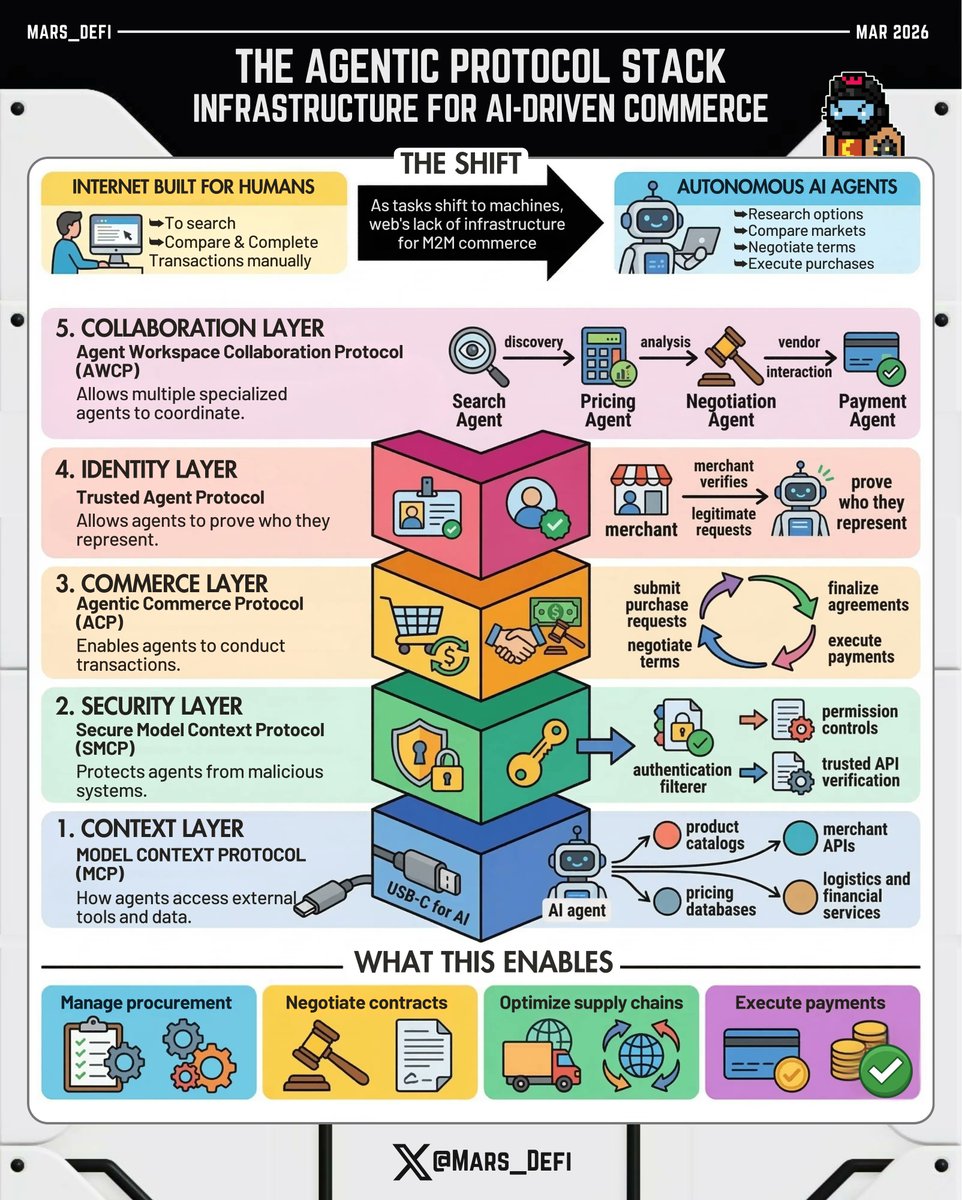
To support this new model of interaction, a new infrastructure layer is beginning to emerge often described as the Agentic Protocol Stack.
—
Just as the internet evolved into layered infrastructure with TCP/IP for networking and HTTP for web communication , the agent economy is beginning to develop its own protocol stack.
Each layer solves a specific problem required for autonomous systems to operate economically.
—
At the foundation of this stack sits the Context Layer, powered by the Model Context Protocol (MCP).
Before an AI agent can act, it must first gather information.
MCP provides a standardized way for AI systems to connect to external tools and data sources such as:
• product catalogs
• pricing databases
• merchant APIs
• logistics platforms
• financial services
Instead of building custom integrations for every service, agents can access external systems through a shared interface.
Developers often describe MCP as “USB-C for AI”, because it allows models to plug into tools and information sources in a consistent way.
Put simply:
MCP is how agents read the internet.
—
But access alone is not enough.
Autonomous systems interacting with external services introduce new security risks. AI models can be vulnerable to:
• prompt injection attacks
• malicious APIs
• impersonation attempts
• data poisoning
This is where the Security Layer comes in through the Secure Model Context Protocol (SMCP).
SMCP extends MCP by introducing safeguards such as:
• authentication between agents and services
• permission management
• trusted API verification
• audit logs for agent activity
These mechanisms ensure agents interact only with verified systems and that their actions remain secure and auditable.
—
Once an agent can safely gather information, it needs the ability to act on it economically.
This is handled by the Commerce Layer, built around the Agentic Commerce Protocol (ACP).
ACP standardizes how autonomous agents conduct transactions. It defines how agents:
• submit purchase requests
• negotiate service terms
• finalize agreements
• execute payments
If MCP enables agents to analyze information, ACP allows them to turn that analysis into economic activity.
In simple terms:
ACP is how agents transact.
—
However, once agents begin interacting directly with merchants, another challenge emerges which is identity.
Merchants must be able to answer a basic question:
Is this request coming from a legitimate agent representing a real user or organization?
Without identity verification, agent-driven commerce would quickly become vulnerable to automated fraud.
This problem is addressed by the Identity Layer, often referred to as the Trusted Agent Protocol.
This layer allows agents to cryptographically prove who they represent and what permissions they have, ensuring merchants can verify that a request is legitimate before executing a transaction.
—
Finally, most real-world workflows will involve multiple specialized agents working together.
A single task might include:
Search Agent -> product discovery
Pricing Agent -> cost analysis
Negotiation Agent -> vendor interaction
Payment Agent -> transaction execution
The Collaboration Layer, enabled by the Agent Workspace Collaboration Protocol (AWCP), allows these agents to share data, coordinate decisions, and operate within shared task environments.
Instead of isolated systems exchanging messages, agents can collaborate within structured workflows to complete complex operations autonomously.
—
Taken together, these layers form the early architecture of a machine-driven economic layer on the internet.
In a mature agent economy, AI systems could:
• manage procurement
• negotiate service contracts
• optimize supply chains
• execute payments autonomously
Commerce becomes programmable.
Websites increasingly function as APIs.
Consumers shift from operators to delegators.
And AI agents become economic actors interacting directly with digital markets.
This is why the development of the Agentic Protocol Stack matters.
It represents the infrastructure required for an internet where machines don’t just access information rather they participate in the economy itself.
English
After the explosive $燃烧马 100x, the next story is here. This time the focus shifts to #GAMEFI, bringing the classic 斗地主 gameplay fully on-chain. Entertainment, competition, and #MEME culture together create strong community momentum. Launch tonight 20:18 on #FOURMEME featuring $FOUR地主.
Four地主@FourDiZhu
💹爆燃倒计时!今晚北京时间20:18(UTC 12:18) #FOUR地主 准时引爆 #FOURMEME! 🏆重磅已就位: - AVE热搜榜第一 已砸钱锁定! - BTOK开屏广告 霸屏上线,已正式投放! - AVE热搜将于今晚20:50左右正式登顶,流量核弹即将来袭! 🔥更大动作还在路上! 多渠道营销火力全开,铺天盖地引爆! #FOUR地主 不是普通的meme,它是 #FOURMEME 平台上第一颗真正闪耀的链上 GAMEFI 革命级宝石!💎 🃏首创玩法、链上创新、沉浸式体验……全部等你来亲手解锁! ✅准备好你的BNB,准时蹲点,冲就完事儿了!🚀 #FOURMEME #FOUR地主 #BNBChain #GameFi #Meme革命
English
@MutantApeJack @beyond__tech 30% of tokens go to the community. Big incentive
English

Bitcoin finally gets its interoperability layer🪙
@beyond__tech's Echoports is how you get in early: Ordinals mint, March 12, 0.000999 BTC.
Quietly one of the more interesting things dropping this month.
Beyond | Connecting Bitcoin@beyond__tech
Introducing Echoports: @beyond__tech’s Ordinals collection. Echoports are dual-utility digital artifacts providing significant ownership in Bitcoin’s interoperability layer. 🔸Mint: 12 March 2026 🔸Supply & Price: 5555 | 0.000999 BTC Full collection details linked below 👇🔗
English
@MutantApeJack @beyond__tech $5M vs. $3B FDV. The math is a no-brainer
English
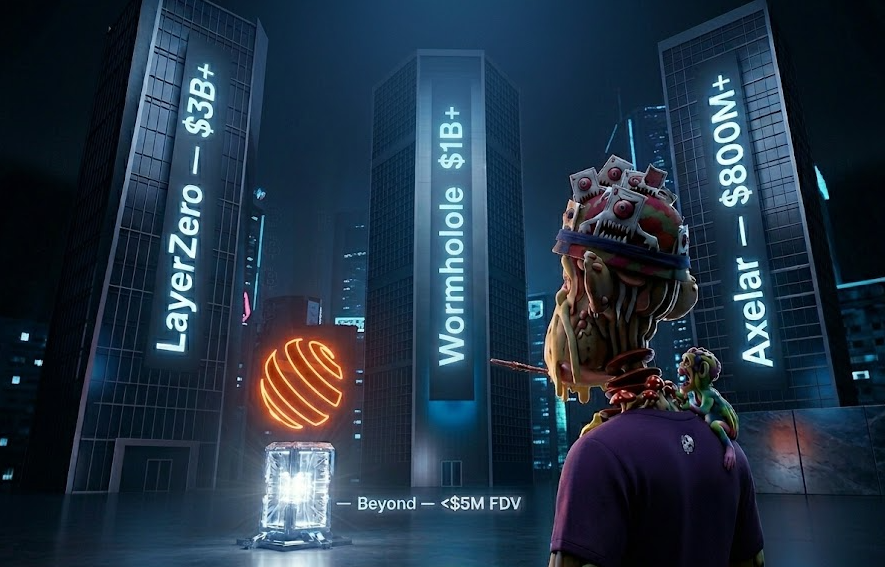
LayerZero peaked at $3B+ FDV
Wormhole: $1B+
Axelar: $800M+
@beyond__tech the interop layer for Bitcoin L1, is launching at under $5M FDV.
This is the quietest entry point of the cycle, I know which one I'm betting on.
English

james retweetledi
Most teams treat Liquidity Bootstrapping Pools (LBPs) like a template problem where they copy what worked before, tweak a few numbers, hope for the best.
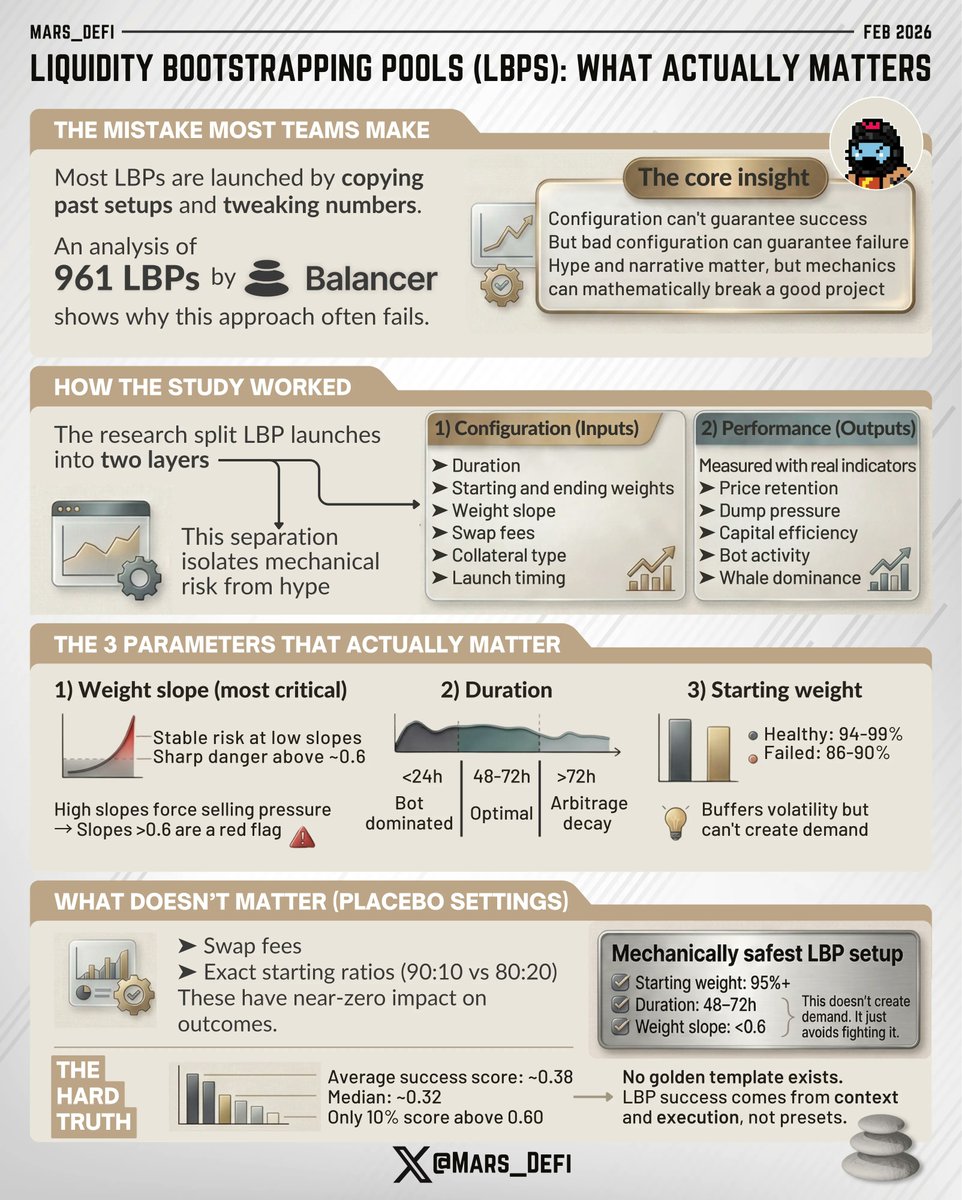
I have gone through @Balancer’s analysis of 961 LBPs across Ethereum, Polygon, and Arbitrum and this report shows why this approach fails and where configuration actually matters.
Here’s everything you need to know.
—
The core insight:
• Configuration can’t guarantee success but it can guarantee failure.
• Marketing, community, and narrative still dominate outcomes but bad mechanics can mathematically force a good project to fail.
How the study was done:
The research separated LBP launches into two clean layers:
● Configuration (Inputs)
Things teams control:
• Duration
• Starting & ending weights
• Weight slope (speed of price decay)
• Swap fees
• Collateral type (stable vs volatile)
• Timing (weekday vs weekend)
● Performance (Outputs)
Instead of vanity metrics like raw volume, the study focused on physics-based indicators:
• Price retention (did the token hold value?)
• Dump pressure (sell vs buy imbalance)
• Turnover ratio (capital efficiency)
• Bot activity (first-block sniping)
• Whale dominance (price control by top traders)
This separation is critical because it isolates mechanical risk from hype.
—
The 3 parameters that actually matter
●. Weight slope.
This is the most important parameter. It is the speed of price decay.
Findings:
• Risk stays relatively stable at low slopes
• Sharp danger cliff at ~0.6
• Above this level, dump pressure becomes almost inevitable
Interpretation:
• A steep slope forces selling pressure regardless of demand.
• Any slope > 0.6 should be treated as a red flag.
● Duration:
Duration forms a U-shaped risk curve:
<24h: Too short indicating bot dominance
48–72h: Optimal for best capital efficiency
>72h: Worse as arbitrage bots exploit slow decay
This means that Longer duration does not automatically translate to safer.
The optimal window is 48–72 hours.
● Starting weight:
High starting project weight:
Healthy pools: ~94–99%
Failed pools: ~86–90%
This acts as a volatility buffer but it is not a success guarantee.
It helps absorb early noise but cannot save weak demand.
What doesn’t matter (placebo parameters)
The data from the report clearly shows that swap fees and exact starting ratios (90:10 vs 80:20) have near-zero impact on outcomes.
They’re preference settings, not safety levers.
—
LBPs are about minimizing resistance
There is no profit formula.
But there is a mechanically robust configuration:
• Statistically safest LBP setup
• High starting weight: 95%+
• Medium duration: 48–72 hours
• Flattened slope: < 0.6
This doesn’t create demand but it simply ensures the pool doesn’t fight it.
—
The uncomfortable truth was that most LBPs don’t perform well
Across all launches:
• Average success score: ~0.38
• Median: ~0.32
• Only 10% of LBPs scored above 0.60
A “perfect” launch is statistically rare as most pools:
• Fail to retain price
• Attract too few real buyers
• Survive volatility but collapse after launch
However the analysis showed that no magic parameter exists.
Infact, the correlation analysis delivered a surprising result:
• No single configuration parameter predicts success.
• For duration, weights and fees, none could individually correlate strongly with good outcomes.
This means that there is no “golden” LBP template proving that success comes from a mix of context and execution, not presets.
English
🔥 $BURGERは2月25日12:00 pm UTC にGate.io取引所に正式上場します。
Odin.fun Top 1 Bitcoin Runesプロジェクト:BTCネイティブのインテリジェントな実行・決済インフラを構築し、AIエージェントがBTCを現実世界の消費に統合します!
🍔 文化的シンボルから現実世界の機能へ。ビットコインエコシステムの新たな旅が始まります。
👉 公式Twitterをフォローしてください: @CryptoBurgerBTC
#CryptoBurger #Gateio #Bitcoin #Runes

日本語

Been watching the RWA space for a long time, and this might interest you…
RWAs on Ethereum just crossed $15B.
That’s roughly a 200% increase YoY.
And no, this isn’t some random narrative pump. This is tokenized treasuries, money market funds, private credit, actual traditional financial products moving on-chain.
A year ago we were sitting around $4–5B. Now it’s $15B+.
That kind of growth doesn’t happen from retail degen activity alone. That’s institutional capital testing infrastructure and getting comfortable.
We’ve got players like BlackRock putting tokenized funds on-chain. JPMorgan experimenting. Big names slowly stepping into public blockchain infrastructure instead of just talking about it.
What’s interesting isn’t just the number, It’s what it signals.
Ethereum isn’t just hosting DeFi apps anymore, it’s becoming settlement infrastructure for real capital markets.
Stablecoins proved blockchain could handle digital dollars.
RWAs are proving it can handle traditional finance.
$15B might still look small compared to global markets, but the growth rate? That’s the part people should be paying attention to.

English
james retweetledi
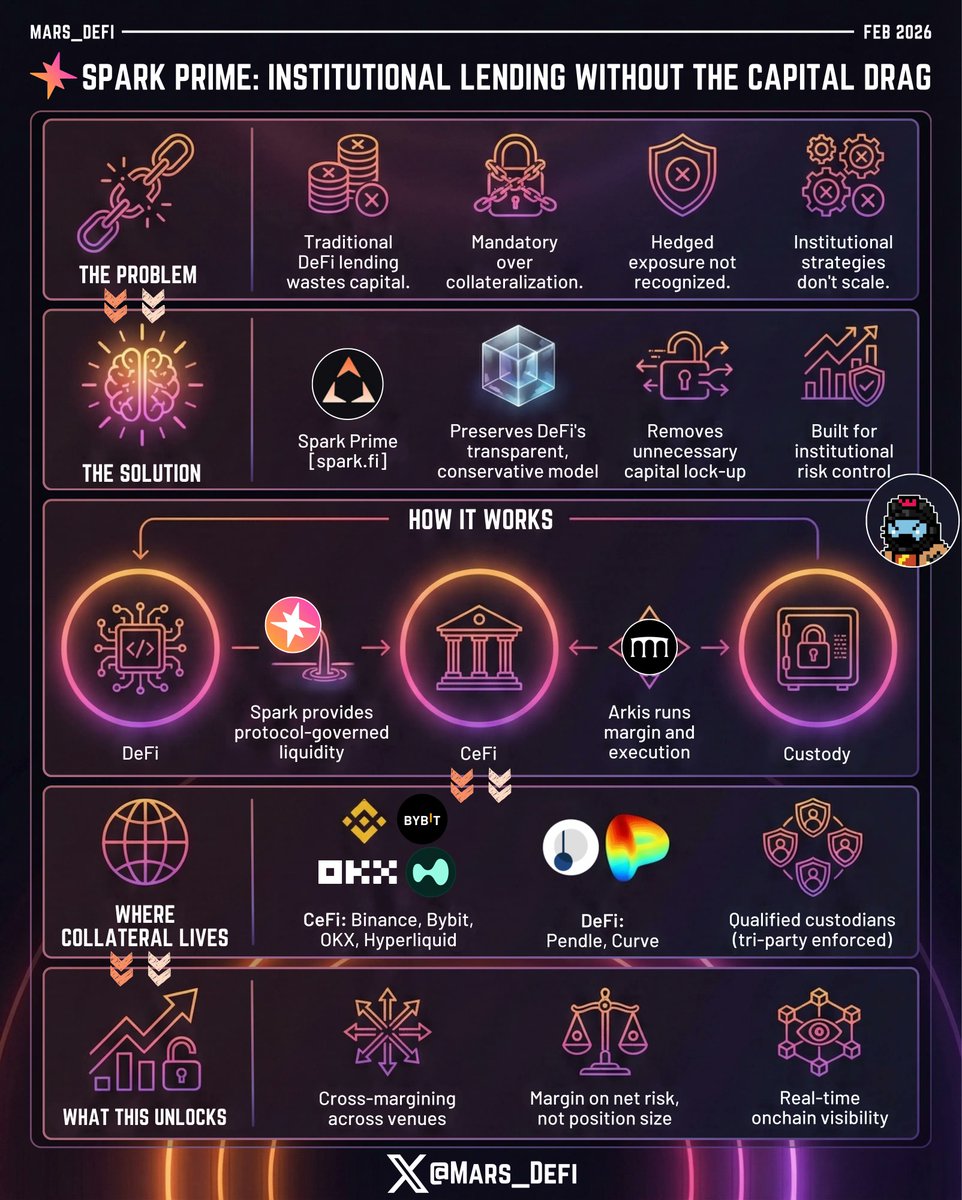
Traditional DeFi lending works, but it’s brutally inefficient for institutions.
Borrowers are forced to over-collateralize every position, even when they already hold hedged or offsetting exposure elsewhere .
@sparkdotfi Spark Prime is built to fix that.
The goal is simple:
• Keep DeFi’s over-collateralized, transparent, resilient model
• Remove the capital waste that makes institutional strategies unscalable
Spark Prime unlocks capital-efficient borrowing while staying conservative where it matters: risk control.
—
Spark Prime sits at the intersection of DeFi, CeFi, and custody.
At the core:
• Spark supplies protocol-allocated liquidity governed by strict risk frameworks
• Arkis provides the margin engine and execution layer
Together, they allow:
• Cross-margining across DeFi, centralized exchanges, and qualified custodians
• Margin set on net risk, not gross position size
• Real-time visibility into positions via onchain data
Collateral and exposure can live across:
• CeFi venues like @binance , @Bybit_Official , @okx , @HyperliquidX
• DeFi protocols like @pendle_fi and @CurveFinance
• Qualified custodians under tri-party enforcement
This creates a walled execution environment which is efficient like unsecured lending, but still collateralized and governed.
—
Spark Prime is designed for institutional crypto borrowers, especially:
• Hedge funds running delta-neutral or basis strategies
• Funds needing CeFi liquidity and DeFi transparency
• Institutions bound by custody, compliance, and risk mandates
Hedge funds already dominate DeFi borrowing. Spark Prime simply gives them an infrastructure that actually fits their workflows.
To know more make sure to read the post below .
Spark@sparkdotfi
Announcing Spark Prime: CeDeFi Margin Lending Powered by @ArkisXYZ's margin technology, Spark Prime enables institutional borrowers to deploy collateral seamlessly across DeFi and CeFi venues. Spark Prime provides: ▪ More resilient delta-neutral lending supported by over-collateralized positions. ▪ Enhanced capital efficiency relative to traditional DeFi lending markets. ▪ A more transparent DeFi. Opaque funds lead to hidden risks, but with Spark Prime, positions are visible in real time through protocol-level data and transparency mechanisms.
English
Been following the games since the first round (was a tough one😅)
Killed the second round of course, team midnight black for the win!
Now waiting on the next reveal because maximum points i want, maximum points i must get 🌚🔥
Fanon@Fanonclub
Team @brave chose 18 and 24 lockers to open - Tada! #Bravegames @AttentionToken @MythicalGames @MidnightNtwrk
English
@Defibecc @RobinhoodApp Robinhood going from brokerage app to chain operator is a pretty big shift.
English
Robinhood Chain Launches Public Testnet
If you’ve followed @RobinhoodApp over the years, you’ll know it started out as an app that made stocks, ETFs, options, and eventually crypto accessible to everyone, all commission free.
Now, they’re building their own blockchain, the Robinhood Chain.
Robinhood launched the public testnet for its blockchain built as an Ethereum L2 on @arbitrum, open for devs to test, build, and experiment.
Being built as an ETH L2 network means it gets Ethereum’s security and ecosystem while adding speed, scalability, and the ability to handle financial-grade apps.
▪️What Robinhood Chain Can Do
Robinhood Chain has big ambitions:
• Tokenized RWAs: Stocks, ETFs, and other financial instruments could become programmable on-chain.
• 24/7 trading with instant settlement: No market hours, no middlemen slowing things down.
• DeFi-style liquidity and self-custody: Users could hold and move assets without centralized control.
▪️Why This Matters
• Developers now have access to network entry points and detailed documentation.
• Robinhood Chain is compatible with standard Ethereum development tools, meaning if you’ve built on Ethereum or Arbitrum before, you can jump right in.
• Big players like @Alchemy, @chainlink, @LayerZero_Fndn, @trmlabs, and @AlliumLabs are already testing integrations and more will join as the testnet grows.
• The goal is to find bugs, stabilize the system, and prepare for the mainnet.
▪️How to get involved
Robinhood is putting $1 million USD toward the 2026 Arbitrum Open House program to support developers on the testnet and future mainnet.
They’re hosting global online Buildathons in New York City, Dubai, London, and Singapore, plus in-person Founder Houses in New York City and London.
Devs and institutions can get started, find docs, and access testnet resources at docs.robinhood.com/chain/
So yes, @RobinhoodApp launching a public testnet isn’t the full blockchain you trade stocks on today, but it’s the first real step toward that future.
Robinhood is trying to bring traditional finance to on-chain channels, where assets move faster, cheaper, and with more freedom.
English
@doncrypto @aztecnetwork $AZTEC listing spree is insane for a project this early don’t you think?
English

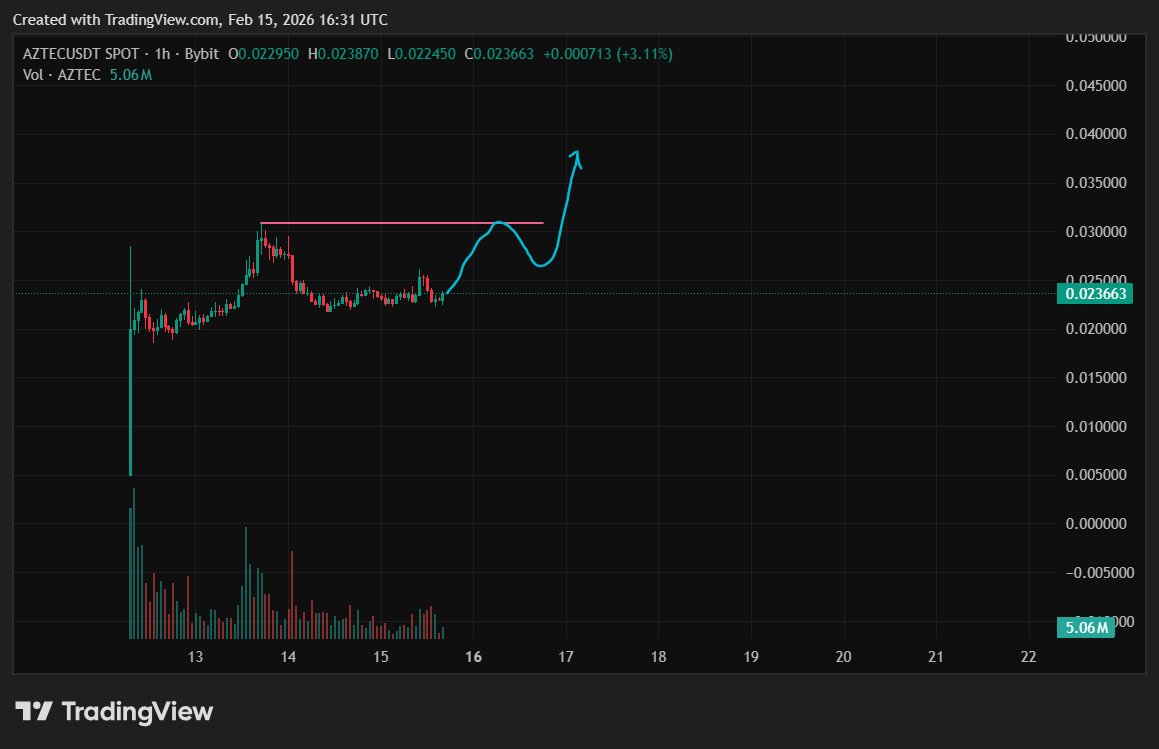
okay… i’m really excited about what @aztecnetwork is building
Most crypto tx's today are basically done in a glasshouse; everyone can see your wallet, your transactions, your activity
What if you could change that?
That is what aztec is doing
———————<>———————
Aztec is a privacy-first Layer 2 on Ethereum that finally makes it possible to use smart contracts without broadcasting everything to the world
Think:
👉 private transactions
👉 private app activity
👉 real confidentiality on-chain
and this isn’t some privacy add-on… Aztec is built from the ground up for it
The wild part? The Aztec team literally built the modern privacy stack that the entire industry uses today:
- Invented PLONK, now used by zkSync, Polygon, Mina + more
- Created Noir, now a top 5 fastest-growing zk dev ecosystem
next big catalyst: Alpha Network ships before end of Q1 2026 [this is when real privacy apps start going live]
$AZTEC is the token powering it all
Used for staking, securing the network, governance, and gas.
Right now it’s still early:
MC: $67.99M | FDV: $244M
920M already staked
ATH MC was $87M
and in just 1 days $AZTEC is listing on:
Coinbase, Kraken, Bybit, Kucoin, Gate, Bitmart, Bitvavo!
do you think we’re ready for this level of privacy in crypto…
or should everything stay out in the open forever?
welp, whether we're ready or not, it seems privacy is coming back as the narrative…
and $AZTEC feels like one of the cleanest early bids before the wave hits
English
@Defibecc @LayerZero_Core A lot of chains compete on performance. Very few rethink the structure itself.
English
For years, blockchains have tried to scale without breaking their core principles.
But most of them still share the same architectural limitation.
@LayerZero_Core ’s new system, called Zero, is their attempt to rethink that limitation.
Today, every validator repeats the same work. Every transaction gets downloaded and executed across thousands of machines. That redundancy keeps networks secure, but it also creates a hard ceiling on performance.
Zero proposes a different model.
Instead of forcing every validator to replay every transaction, Zero uses ZK-proofs to separate execution from verification. One group, called Block Producers, executes transactions and generates proofs. Another group, Block Validators, simply verifies those proofs.
Validators no longer have to redo all the work. They just check that the work was done correctly.
This shift allows Zero to move away from the traditional “single-core” design most blockchains rely on.
Instead of everything competing for the same resources, Zero can run multiple “Atomicity Zones” in parallel, similar to how a modern multi-core computer runs different processes at once.
To make this possible, the team focused on four major areas:
• Storage (QMDB)
• Parallel execution (FAFO)
• Real-time ZK proving (Jolt Pro)
• High-throughput networking (SVID)
Their target is 2M transactions per second per Zone.
For context, Ethereum processes around ~15 transactions per second on L1, and Solana in the thousands.
The scale of what Zero is aiming for is several orders of magnitude higher.
But the bigger argument isn’t just about speed. It’s about structure.
Zero claims decentralization doesn’t scale by making validators more powerful. It scales by reducing how much work each validator has to do.
If it works as described, this isn’t just another high-performance chain. It’s an attempt to rethink blockchain design from the ground up.
Interested to see how this plays out in practice.
LayerZero@LayerZero_Core
English
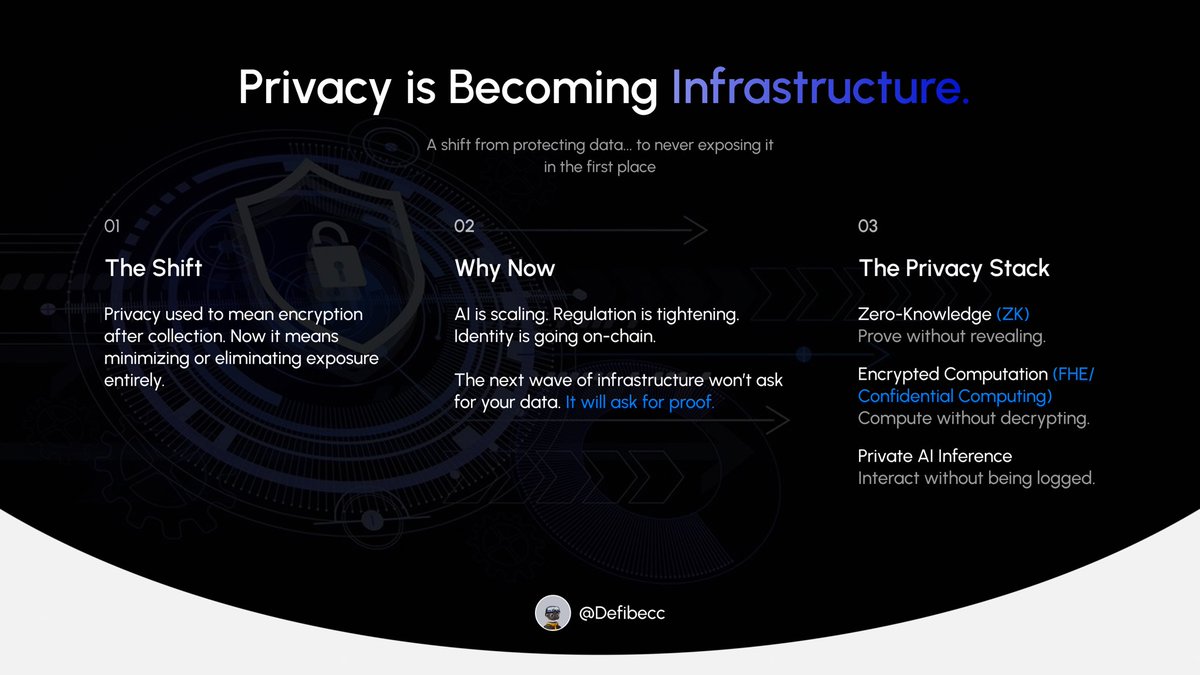
Privacy is one of narratives that’s been building quietly in the background and is now becoming unavoidable across tech, AI, and Web3.
For a long time, privacy mostly meant encrypted messaging, VPNs, or private transactions. But that view is changing fast.
The focus now is less about protecting data after it is collected and more about designing systems where data is either minimized or never exposed in the first place.
A lot of this shift is driven by Zero-Knowledge (ZK) technology.
ZK allows users or apps to prove something is true without revealing the underlying data. It sounds technical, but it unlocks very real use cases:
• Private transactions
• Identity verification without exposing personal info
• Confidential smart contracts
• Privacy-preserving KYC
ZK is becoming one of the most important infra layers being built across chains and identity systems.
Another area gaining momentum is encrypted computation, technologies like Confidential Computing and Fully Homomorphic Encryption (FHE) allow data to remain encrypted even while it is being processed.
This is especially important as AI adoption grows. There’s increasing demand for systems where users can interact with AI models without their prompts, data, or inputs being stored, logged, or used for training.
▪️ Notable Projects
We’re already seeing several projects push this privacy-first design forward.
• @aztecnetwork - Building privacy infra on ETH through programmable private transactions and ZK rollups, setting itself as a key player in private DeFi and on-chain apps.
• @nym - Hides metadata to keep communications truly private, even when messages are encrypted.
• @zama - Building fhEVM, letting smart contracts compute on encrypted data without ever exposing it.
• @RAILGUN_Project - Privacy layer for ETH and DeFi, shielding transactions while letting users interact with protocols.
• @nillion - Infra for private computation, letting data be processed without ever exposing raw information.
• @anoma - Blockchain where users express “intents” instead of public transactions, keeping details private by design.
• @UmbraPrivacy - Private ETH wallet and payment system that hides transaction details and recipient info.
• @fhenix - Builds FHE-powered ETH rollups for fully private smart contracts and applications.
Privacy is also becoming a big part of AI..
It’s no longer just about who built the model. People are starting to question what happens to the data behind it.
Concerns around exposed training data, stored prompts, and AI misuse are pushing more focus toward encrypted processing and private AI inference.
Platforms like @ProtonPrivacy and other confidential AI frameworks are already exploring this.
At its core, it’s about building trust in how AI handles data, on the regulatory side, things are getting more complicated, not easier.
Governments are rolling out stricter rules around digital identity, AI compliance, and verification.
Pushing more interest toward privacy tools that let people prove things about themselves without revealing everything, like selective disclosure and ZK verification.
Privacy isn’t something you add on later anymore. It’s becoming the backbone of everything… AI, Web3, identity.
The real question now isn’t if it matters. It’s who’s going to build it right from the start.
English
@Defibecc @WarpGameCHAIN @zama ZKsync experimenting with staking feels like an important signal for L2 economics.
English
Hello Frens, welcome to a new week🔥
Let’s break down some of the key moves, and events shaping the week ahead.
▪️Token Events & Listings
• @WarpGameCHAIN ($WRP) - IDO runs Feb 10th -12th and TGE goes live Feb 12th.
• @Zama ($ZAMA) - KuCoin GemPool is ongoing (Feb 2th - 17th), with tokens distributed through the launchpool.
• @ChimpxAI presale and TGE discussion scheduled for Feb 9, 10:30 UTC
▪️Network Activity / Product Releases
• @vechainofficial adjusts DBA and lowers max allocation per dApp (Feb 2–9) - Incentives realigned and treasury supported; core tokenomics unchanged.
• @vechainofficial / VeBetterDAO governance upgrade enters approval phase (Feb 9th - 16th). Adds rewards for active voters and introduces delegated “Navigator” voting to improve funding and decision-making.
• BIM DAO proposal live for voting (Feb 2–9) - A small test fundraising via ApeBond targeting $25k USDC.
• @megaeth public mainnet launch on Feb 9th
• @SushiSwap partners with Jupiter for Solana launch (Feb 9)
• @ZKsync launches ZKnomics staking pilot (Feb 9) – Pilot staking rewards roll out for ZK holders.
• FIP‑101 for @fractal_bitcoin (Feb 11) – Adds permissionless indexing layer into block rewards.
▪️Events & Conferences
• @Ripple hosts XRP Community Day (Feb 11th - 12th). A series of live X Spaces covering $XRP products, ecosystem innovation, and future utility with @Ripple leaders and partners.
• Consensus Hong Kong 2026 takes place this week. Industry leaders gather for deals, discussions, and new narratives.
• Solana Breakout virtual conference runs Feb 10th - 12th, featuring @solana builders and ecosystem projects.
▪️Tokenomics & Unlocks
• $AVAX unlock (Feb 11th) - Unlock of 1.67M tokens (0.32% of released supply)
• $APT unlock (Feb 10th) - Unlock of 11.31M tokens (0.69% of released supply)
• $STRK unlock (Feb 15th) - Unlock of 127.00M tokens ( 4.61% of released supply)
• $CONX unlock (Feb 15th) - Unlock of 1.32M tokens (1.56% of released supply)
▪️Other notable updates
• @akashnet session with @akavenetwork covering practical use of integration, verifiable storage, and egress-free fees for AI, on Feb 9th, 6:00 PM UTC.
• @AskVenice Token emission reduction (Feb 10) - Supply emissions cut by 25% (8M to 6M tokens per year).
• @binance will delist spot pairs for $ACA, $CHESS, $DATA, $DF, $GHST, and $NKN on Feb 13th, 3 AM UTC).
• @Immutable - Starting Feb 11th, Immutable X will enter read-only mode. Users need to migrate assets to the new Immutable chain, as API writes will no longer be supported.
That’s a wrap for the week. Plenty to watch, stake, and move on, keep your eye on what comes next.

English
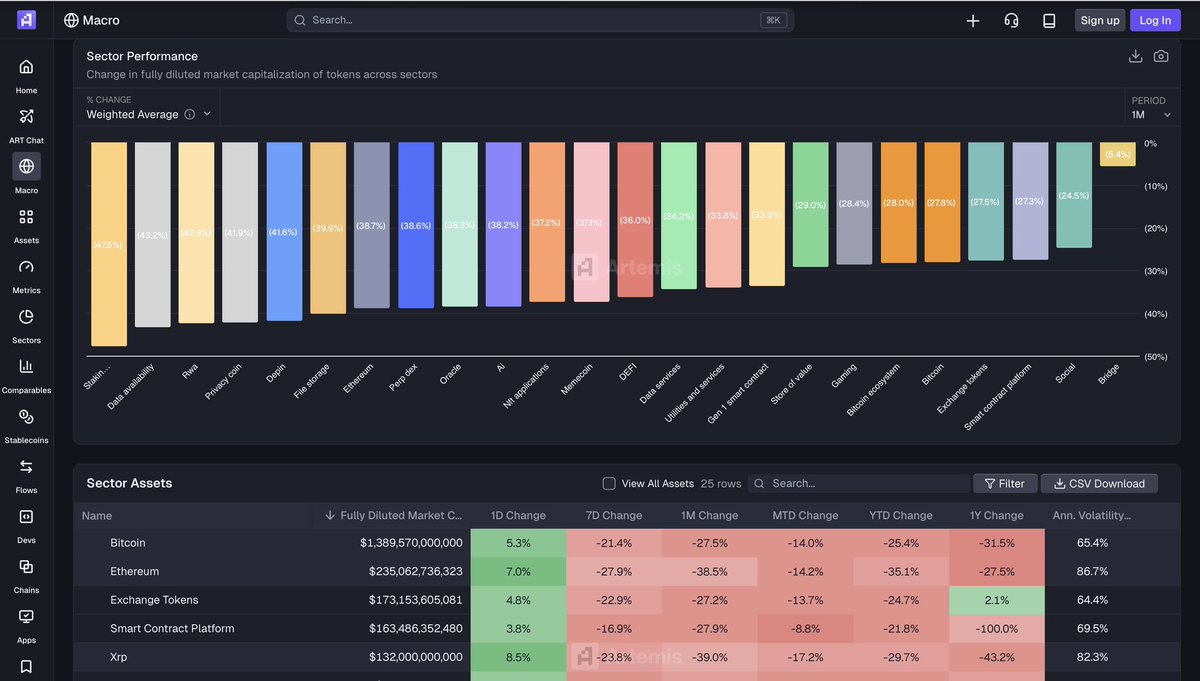
Looking at sector performance on a 1M basis, this isn’t a narrative specific drawdown, it’s systemic.
Most sectors are down between ~25% and ~40%, including infrastructure heavy categories like staking, data availability, RWAs, DePIN, AI, and ETH adjacent sectors.
When both core infrastructure and user-facing sectors are hit this hard, it usually means money is leaving the market, not rotating within it.
Bitcoin and BTC related sectors are still down, but they’re holding up better than the rest.
This matters because when uncertainty rises, capital tends to move toward the most liquid and trusted assets.
Higher-risk areas like memecoins, DeFi, and apps are seeing deeper losses. That’s typical when risk appetite drops. These sectors usually benefit the most when money is flowing in, and suffer first when it pulls back.
Some memecoins are pumping, but it’s isolated. That’s different from the whole market turning risk-on.
Important to note, everything is moving together.
When almost all sectors are red at the same time, jumping between narratives rarely works. Market conditions matter more than individual projects right now.
At this stage, the market usually goes one of two ways:
• pressure continues if money keeps leaving
• or selling slows, and value starts to appear quietly
No clear signal yet, but this is the part of the cycle where watching which sectors hold up best is more useful than forcing trades.
Right now, the market isn’t rewarding confidence, but it will definitely reward patience. Remember to stay liquid.
WAGMI frens, never give uppp🩵
English