

Jay Gunson
3.2K posts
Jay Gunson
@jgunson
Product Design @Watershed. Previously @SweepThePlanet. Wouldn't mind being an astronaut. Dad of 2. 🇬🇧 in 🇺🇸
San Francisco, CA Katılım Mayıs 2009
1.3K Takip Edilen334 Takipçiler

Animation but make it subtle 🖤
Jakub Krehel@jakubkrehel
Details from the new @interfere_ website
English
@tomjohndesign Fair, and this is definitely where I still use Figma - but I just prefer it to be ignorant of the data (to some extent). Anyway, always interested to hear more about process from one of the top designers in the game. ✌️
English

@jgunson The day is yes, but the layouts and how the data is represented, no.
English
This is incredible.
I'm seeing people bashing this but I'm pretty sure they've never had to go through the pain of working and trying to recreate complex web apps in Figma to tweak layouts and try new variants -- remove cards, update copy, try different information density, etc.
I'm now able to work directly from the Vercel dashboard as the source of design truth and then explore layout changes in the canvas. This is such a big unlock for me I can't even begin to explain it.
I just recreated basically all of the data-heavy core UI of Vercel (something that was nearly impossible to do before) with ACTUAL data in less than 5 minutes.
Charts, lists, tables, filters, all one-shotted. This is crazy crazy crazy.
Dylan Field@zoink
English
@tomjohndesign I’m speaking purely to your point around designing data heavy applications - much easier to work directly with the data in its current form (strings, Booleans, enums etc.) vs. extract it and manage it in an entirely new one (layers, frames, etc.).
English
@tomjohndesign Interesting, personally I’ve found wrangling 1000s of layers / frames more difficult. Now of course you can invest in components and tokens, but that already exists in code.
English
English

@karrisaarinen @ryolu_ To be v clear: I don’t think anyone is wrong, just seems there’s some mis-communication :-)
English

code isn't a cage, it's the only material that's actually boundless. you can rebuild, restructure, and reimagine faster than any other medium in human history. the idea that working in code locks you into existing patterns is only true if you're afraid of the material.
the truth only reveals itself when you build. not when you think about building, not when you sketch possibilities in a protected space – when you actually make the thing real and let reality talk back. sketches and explorations feel free because they let you avoid the hard questions. building forces you to answer them, and that's where you discover what actually works.
this whole framework of separating design into phases – first explore freely, then invite constraints, then build – that's just bureaucracy for the creative process. it linearizes something that should be iterative and alive. you end up spending so long "searching" in the wrong medium that by the time you touch the real material, you're too invested in your early idea to start over. you get one round of exploration, then commitment. that's not protecting creativity, that's limiting it.
the best work happens when you can iterate in the actual material. build, learn, rebuild, learn again. code lets you do this faster than any sketch ever could. it shows you the edge cases, the emergent behaviors, the interactions that only exist when the system is real. constraints aren't something you invite later when you're ready – they're what reveal the elegant solution you couldn't see in the abstract.
architects don't sketch free from physics then invite gravity later. they think through materials from the first line because they understand that the material is where truth lives. the sketch works because it's compressed material knowledge, not fantasy protected from reality. software should be the same. understanding the system deeply – the primitives, the data models, the capabilities – doesn't limit your imagination, it expands it. it shows you what's actually possible instead of what's merely conceivable.
separating "design" from "the medium" doesn't protect exploration, it protects you from learning whether your idea works until it's too late to really change it. the valuable suffering isn't the searching phase where everything feels possible. it's when you build something and reality pushes back and forces you to find something better. that's where craft lives. that's where breakthroughs happen.
treating code as something you "graduate to" after the real thinking is done – that's the actual cage. it means designers who don't understand what the material can do, building in a fantasy space, then handing off half-formed ideas to people who have to make them real. the translation loss isn't just in the handoff, it's in the thinking. great software comes from people who can think at every level, from the loose idea to the interaction to the data structure, all at once.
the future isn't about protecting phases or preserving separation. it's about getting closer to the true material, faster. it's about tools that let you think and build and iterate in the same motion, so you can discover what actually works instead of committing to what seemed good in a sketch.
code isn't the enemy of exploration, it's the only place exploration becomes real.
Karri Saarinen@karrisaarinen
English


@jarredsumner and look at me now, 3 beautiful children and lightning fast builds
English
was trying to trick sora into generating sydney sweeney by asking it to make a jeans commercial with a girl who’s named after the capital of australia, and it pops up like hi im canberra lmfao
English



@tomjohndesign Just your average day when you design software for a living. Welcome to the grumpy old man club. 😆
English
I don't know why I recorded this. Not sure if I should even post it.
But I just can't believe how bad the signup flow for Google Veo is.
Genuinely.
How can Google make an AI that can generate videos like that, and then put out such a bad signup flow??
Am I taking crazy pills?
English
@tomjohndesign AI design tools aren’t (yet) capable of production UI/UX, at least not for those with taste. But this is too narrow. If, via AI, the medium shifts from vectors to code, why not design in code? AI is redrawing the boundaries of design and we should take up the mantle of frontend.
English
I think one of my bigger beefs with "AI design tools" is that I absolutely don't believe that they'd be able to make something nuanced.
Take this share popover for example:
So... deceptively... simple. I've designed a few of these in my day and it's never as simple as "add a menu for sharing".
- It's thinking through how your structure permissions
- If security/privacy is default opt-in or opt-out
- If links can be generated, need to be regenerated, are an invite mechanism or just a url with their own permissions and access issues.
- Roles for each invited member, access levels, revoking access
- Submenus for email pre-filling and suggestions as well as input fields with chips that render after commas or selections
And on and on.
The UI is one thing, then there's the implementation, then theres the strategy. It needs to be compact, easy to understand, and also scalable for orgs with groups and hundreds of members.
It needs to convey who's where and if someone shouldn't be there in the first place.
Don't even get me started on how these UIs get more complicated if you have seat based pricing.
Maybe I'm just a troglodyte, but I just don't think that AI can actually make good products via prompting.
Someone prove me wrong.


English
@ryolu_ @cursor_ai This x1000. I’ve been building / coding my entire “design career”, it’s just now with tools like @cursor_ai I can go much further, and with the necessary elements that the rest of my (any) engineering team requires (i.e. with testing, performance, security, etc. accounted for).
English
the distinction between designers and engineers is dissolving.
creation shouldn’t be split by titles, handoffs, or silos. the future belongs to builders — people who dream, design, and bring ideas to life.
with @cursor_ai, the gap between thought and reality is collapsing. no more mockups thrown over walls. no more translation layers. just one continuous flow from imagination to execution.
we’re building a world where anyone can create software. no “coding” credentials required. no barriers between vision and realization. just tools that adapt to how you think, feel, and build.
soon, no one will ask “designer or engineer?”
they’ll ask: “what are you building?”
we’re just getting started. the tools are early. the canvas is wide open.
and the next decade belongs to the builders. not the ones with the most technical skills — but the ones with the boldest ideas.
English
@soleio @benblumenrose The talent stack is collapsing before our eyes. @scottbelsky is right. Exciting time to be alive.
English

English

say hi if you see me 👋🏻
Gavin Nelson@Gavmn
I will be at Config this year! looking forward to meeting some more designers
English

Can't quite believe it's #Config2025 next week! If you're in town and want to hang out, say hi. Excited to meet some new folks and show you what we've been cookin' 👀

English
@thenickpattison Love this. Feel like we need an @figma football (soccer) game over in Beach Chalet… who’s with me?
English

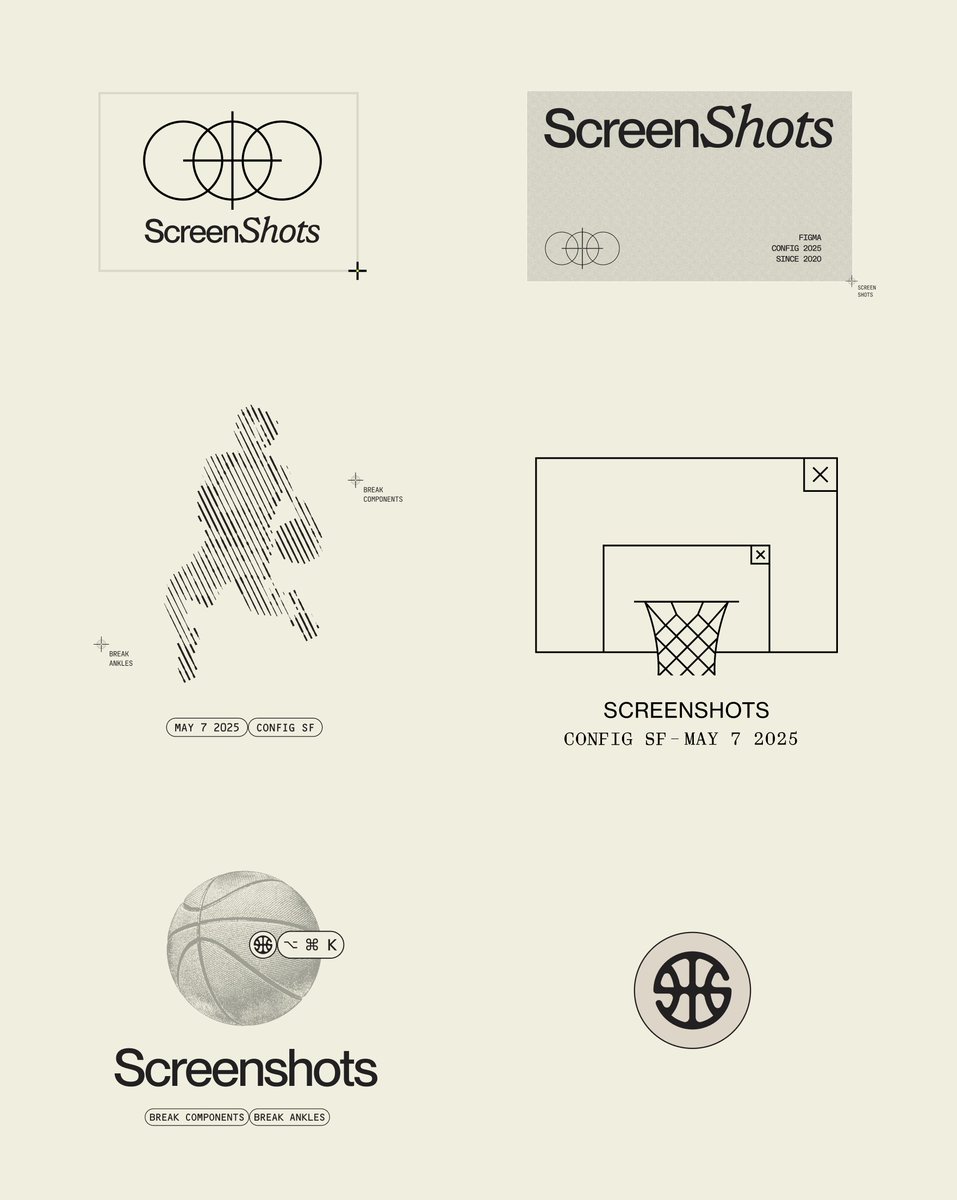
We whipped up some quick concepts for the Config bball game called Screenshots. What are we feeling folks?
English

@kenwheeler Sign. Me. Up.
Just moved here from the UK and for the life of me I can’t find a carpeted pub with a dart board, and some god awful / angel derived lager for £2.20.
Bring back “shit, but knows it” as a vibe.
English
my dream is to one day open a quaint degenerate outpost right in the heart of wine country with light beer on draft, wings, big buck hunter hd. darts. ufc. open til 3am.
English
napa is a gorgeous place, unlike anything i’ve ever seen, with some of the best wine and food i’ve ever encountered but holy shit do i need a coors light and a plate of wings right now
English
Big up @JordanAmblin and team - @raycastapp for iOS is looking bang tidy (as us Brits like to say). 👌
English