
Josh Herritz retweetledi
Josh Herritz
39.8K posts


Josh Herritz
@jherritz
Obsolete Data Wrangler | AI, data, startups, code, economic development, YIMBY, urbanism, current events and running
Madison, WI Katılım Haziran 2008
5.5K Takip Edilen1.6K Takipçiler


Josh Herritz retweetledi
Josh Herritz retweetledi

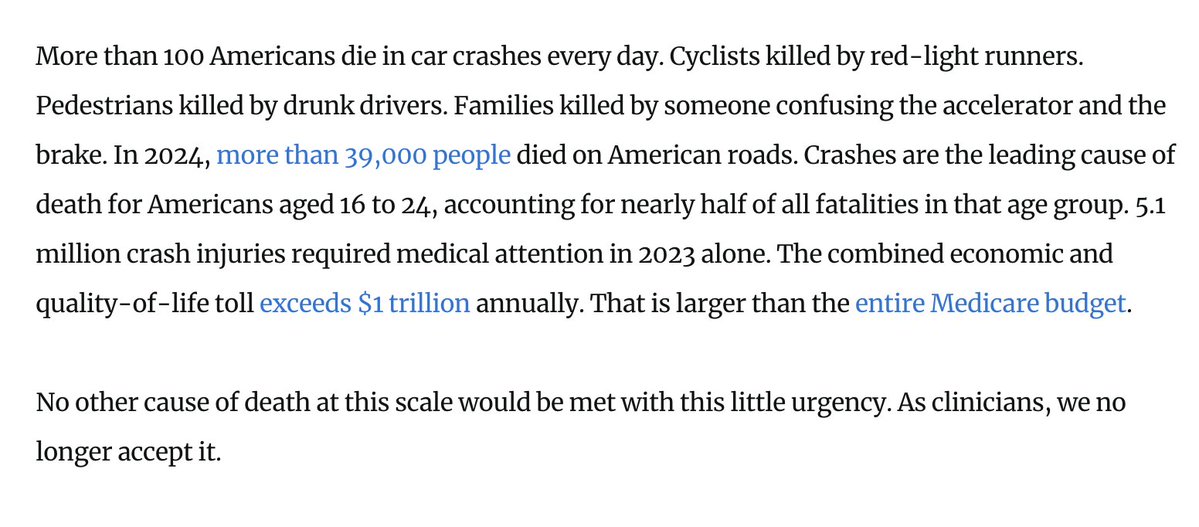
"The combined economic and quality-of-life toll exceeds $1 trillion annually. That is larger than the entire Medicare budget.
No other cause of death at this scale would be met with this little urgency. As clinicians, we no longer accept it."
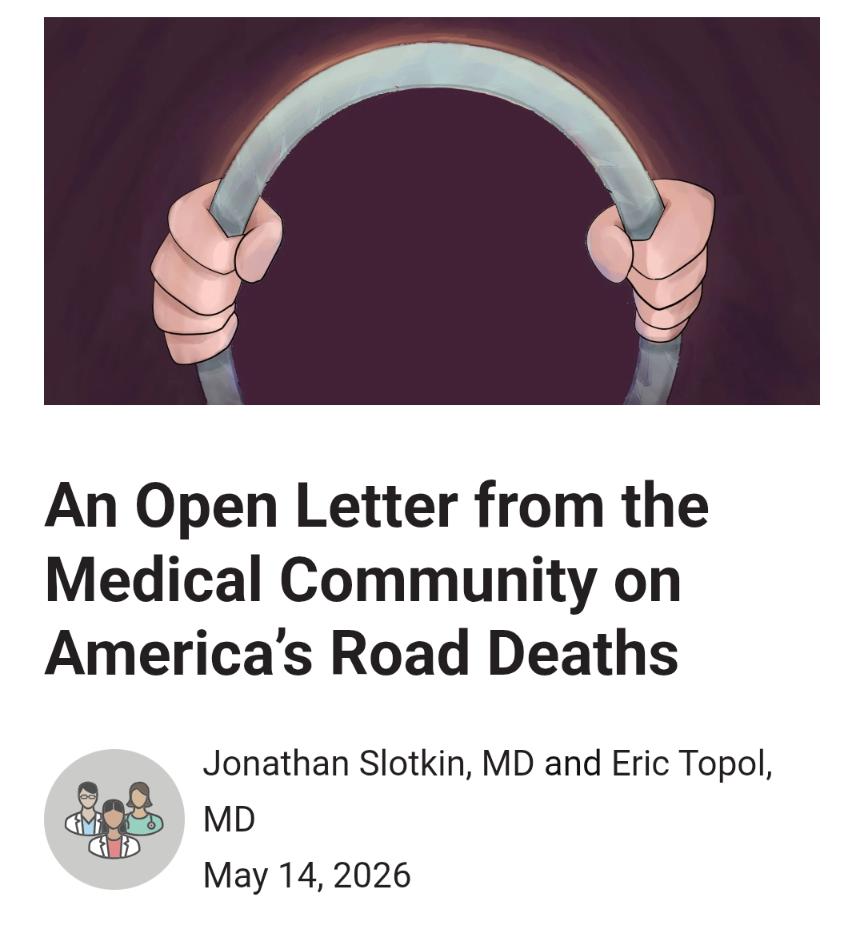
Families for Safe Streets National@Fam4SafeStreets
"We are not anti-car or anti-driver. We are anti-crash." The medical community is turning its attention to the traffic violence epidemic that's been tolerated in the U.S. for too long🩺 Check out the op-ed by Drs. @EricTopol and Jonathan Slotkin 👉opmed.doximity.com/articles/an-op…
English
Josh Herritz retweetledi

"We are not anti-car or anti-driver. We are anti-crash." The medical community is turning its attention to the traffic violence epidemic that's been tolerated in the U.S. for too long🩺
Check out the op-ed by Drs. @EricTopol and Jonathan Slotkin 👉opmed.doximity.com/articles/an-op…

English
Josh Herritz retweetledi

The technology is already largely here, with consistent trend over many years, disrupting consumer and industry workflows. Demonstrating leaps of progress each year. Building largest companies in the world in the blink of an eye.
And yet likely less than ten people in the world don’t think of it in too small terms.
English
Josh Herritz retweetledi

This is an incredibly unstrategic fight to pick but every time I wade into a battle over whether to allow eighth graders to take algebra I just want to say "actually, a good school offers algebra in sixth grade and a great school offers it in third."
English
Josh Herritz retweetledi

Tens of thousands of Americans die in car crashes each year, millions more are injured.
Motor vehicle fatalities are a serious threat to our safety, and autonomous vehicles like @Waymo present a solution.
Thank you @EricTopol & @slotkinjr for bringing attention to this matter.
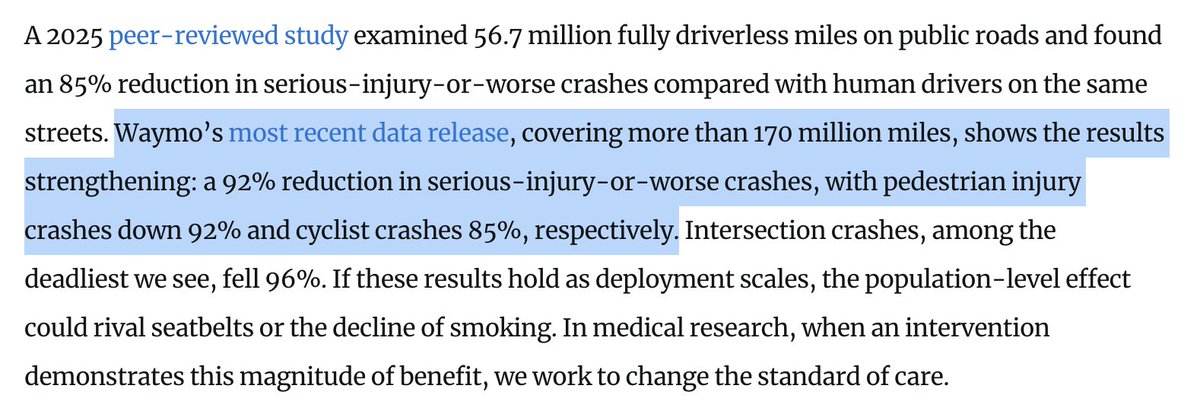
Eric Topol@EricTopol
Our open letter today on autonomous driving and prevention of serious accidents and road deaths w/ @slotkinjr Adding signatories for those supportive opmed.doximity.com/articles/an-op…
English
Josh Herritz retweetledi

Josh Herritz retweetledi

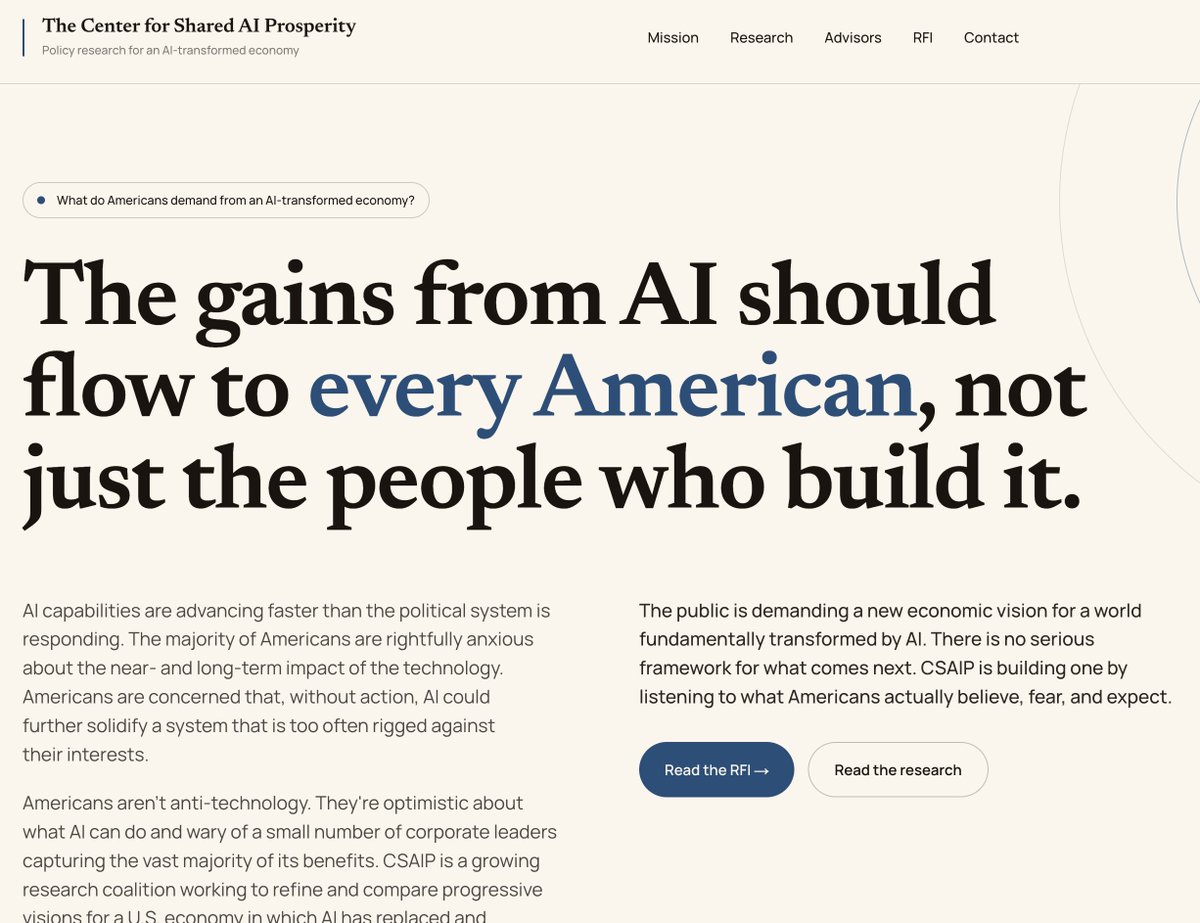
Very excited to launch a project I've been helping out with the last couple months.*
The Center for Shared AI Prosperity is an attempt by an, other than me, very impressive team (so far including @davidshor, @katz_morris, @StefFeldman, @maidinoff, Lindsay Lamont, Jesse Stinebring, @joshhendler, @goldman, and Lilah Penner Brown) to force DC policy elites to take the impending economic impacts of advanced AI more seriously.
We do not think this is a normal economic shock, though we are deeply uncertain about what kind of economic shock it will be. We could be left with a world of extreme power and wealth concentration, increasing political instability arising from that growing inequality, and deep questions about how to fund governments that have for a century-plus relied on income and payroll taxes.
Our main purpose as an organization is to surface tractable ideas to reform and grow the safety net to meet the moment; to restructure the labor market so workers are still valued and fairly paid; to remake the tax code so that the gains from AI are shared widely; and to experiment with ways of giving average Americans concrete shares in the AI surplus.
To that end, we're running a Request for Ideas, and we're offering $3,000 for the best proposals. Top ideas will get rigorous polling from Blue Rose Research to see how Americans feel about them.
We are trying to solicit submissions from a wide pool, and purposefully don't want to just ask the usual think tanks, economists, academics, etc. (Though we want them too!) If you have ideas that you think could be useful, please don't hesitate to apply. Feel free to reach out to me if you have any questions about the program.
Read more here: csaip.org
*Obligatory disclaimer: I'm doing this on my personal time, not in my capacity at Coefficient Giving. Nothing I or CSAIP say necessarily reflects CG's views.
English
Josh Herritz retweetledi
Pretty soon we're going to have a design genre called sprawl-to-trails, similar to rails-to-trails. Repurposing infrastructure that isn't necessary.
English
Josh Herritz retweetledi

Josh Herritz retweetledi

This is a really, really great podcast ep. It makes it crystal clear why AI's effect on jobs is going to be complex and hard to predict.
Given that, the labs should spend less time drafting expansive, new social contracts that Americans haven't asked for yet, and more time helping us measure and understand how the economy is changing.
freesystems.substack.com/p/the-politics…
Derek Thompson@DKThomp
New pod: THE SMARTEST CASE AGAINST THE AI JOBS APOCALYPSE AI is the first technology that seems to automate the same cognitive sectors that absorbed work during previous waves of automation. For that reason, many people worry that it will destroy tens of millions of jobs imminently. But after I review the evidence showing that AI is not clearly destroying work today—and might even be stimulating demand for certain tech jobs— I brought on the great @alexolegimas to talk about the best reasons to doubt the doomsday narrative. We talk about all sorts of economic principles—lump of labor fallacy, income elasticity, Jevon's Paradox—but maybe his most interesting point is about the nature of desire and status. Desire is insatiable, and technology will never solve for status. Even in a world where AI can automate many tasks, status might go up rather than down or flat. And status motivates a lot of economic activity. So even in a world where AGI is very good at 99% of existing tasks is still a world where people will want to send their money to things that are perceived as "scarce" and "status-enhancing." You can create a lot of jobs on this basis alone. You could argue that this is how economic transformations have always worked. Our economy is a rough register of human desires. And in a world where artificial intelligence automates some tasks, it might not destroy work so much as it moves dollars and labor toward new desires in new sectors of the economy. The pet care economy wasn't really a thing in 1800. Now it's a >$100 billion business, made possible by the fact that a richer country moved dollars and workers from corn farms to bespoke poodle manicure spas. It is easy to imagine that AI could automate many tasks and even some jobs. What's harder to imagine is that we'll be permanently stuck in an disequilibrium where people with disposable income aren't trying to satisfy their desires and burnish their status. And in a world where AI is abundant, the question we should be asking about the future of work is: What will be scarce? What will be kind of jobs will be produced as desire and status shift, once again? open.spotify.com/episode/74OPgO…
English
Josh Herritz retweetledi

New pod: THE SMARTEST CASE AGAINST THE AI JOBS APOCALYPSE
AI is the first technology that seems to automate the same cognitive sectors that absorbed work during previous waves of automation. For that reason, many people worry that it will destroy tens of millions of jobs imminently.
But after I review the evidence showing that AI is not clearly destroying work today—and might even be stimulating demand for certain tech jobs— I brought on the great @alexolegimas to talk about the best reasons to doubt the doomsday narrative.
We talk about all sorts of economic principles—lump of labor fallacy, income elasticity, Jevon's Paradox—but maybe his most interesting point is about the nature of desire and status.
Desire is insatiable, and technology will never solve for status. Even in a world where AI can automate many tasks, status might go up rather than down or flat. And status motivates a lot of economic activity. So even in a world where AGI is very good at 99% of existing tasks is still a world where people will want to send their money to things that are perceived as "scarce" and "status-enhancing." You can create a lot of jobs on this basis alone.
You could argue that this is how economic transformations have always worked. Our economy is a rough register of human desires. And in a world where artificial intelligence automates some tasks, it might not destroy work so much as it moves dollars and labor toward new desires in new sectors of the economy. The pet care economy wasn't really a thing in 1800. Now it's a >$100 billion business, made possible by the fact that a richer country moved dollars and workers from corn farms to bespoke poodle manicure spas.
It is easy to imagine that AI could automate many tasks and even some jobs. What's harder to imagine is that we'll be permanently stuck in an disequilibrium where people with disposable income aren't trying to satisfy their desires and burnish their status. And in a world where AI is abundant, the question we should be asking about the future of work is: What will be scarce? What will be kind of jobs will be produced as desire and status shift, once again?
open.spotify.com/episode/74OPgO…
English
Josh Herritz retweetledi

The Second Scaling Law remains undefeated. If you want better hacking (or math, or science, or crossword puzzle solving) out of an LLM, just add thinking tokens. There doesn't seem to be any plateau so far.
Natália 🔍@natalia__coelho
Very important update from UK AISI. This is a meaningful change from the previous report. Here’s what the new data would look like for “Mythos Preview (new)” with $ on the x-axis:
English
Josh Herritz retweetledi

I think a lot of people tend to overrate dislike of AI as the cause of anti data center sentiment. This NYT piece is a funny mirror image of an anti data center article, but about warehouses. I think people mostly don't like big buildings primarily used for consumers far away
Adam Ozimek@ModeledBehavior
People are mad about data centers, they're mad about warehouses. Boy if neoliberalism hadn't killed all the factories people would be mad about them too. nytimes.com/interactive/20…
English
Josh Herritz retweetledi

Josh Herritz retweetledi

Rubio: Ukrainians developed new tactics, techniques, equipment, technology creating sort of hybrid asymmetrical warfare. That's impressive. Russians losing 5 times more soldiers a month. Ukrainian Armed Forces are strongest, most powerful armed forces in all of Europe right now.
English
Josh Herritz retweetledi

A few weeks ago, I joined @AnthropicAI as a Geopolitical Analyst! So excited to join the team at an important juncture in the US-PRC competition in AI.
We just published a paper that explains some of our thinking on that competition, why maintaining US AI leadership is critical to ensure the safe and responsible deployment of AI, and why the window of opportunity for policy action is now. Would love to hear your thoughts!
Anthropic@AnthropicAI
We've published a paper that explains our views on AI competition between the US and China. The US and democratic allies hold the lead in frontier AI today. Read more on what it’ll take to keep that lead: anthropic.com/research/2028-…
English
Josh Herritz retweetledi

I am skeptical of the data center NIMBYs and incredulous at the extremist pro-data center posts from some of the tech guys on here.
If the facilities are economically lucrative, cut a deal with locals to make it worth their while. This shouldn't be a huge thing.
English
Josh Herritz retweetledi

Strong letter to ODNC w 35 members of Congress calling for a federal process on cyber vuln disclosure
This caught my eye. The USG *should* be monitoring for sudden jumps in AI capabilities per se, not just cyber
A Situational Awareness Room, if you will.
documentcloud.org/documents/2812…

English