Josh Robb

12.6K posts

Josh Robb banner
Josh Robb

Josh Robb

@josh_robb

operator, code nanny, product builder, unicorn baiter, @tendnz

Auckland, New Zealand Katılım Haziran 2007
629 Takip Edilen880 Takipçiler
Doug Rathbone 🦘🇦🇺👨‍💻
Incredible movie, but a real shame the editing let it down so badly. Terribly cut IMO
Anish Moonka@AnishA_Moonka

You're watching a $248 million film and not a single green or blue screen was used. The alien is a handmade puppet. The cockpit physically rotates to simulate gravity. I looked at the production tech behind this 95% score, and the engineering is wild. Phil Lord and Chris Miller, directing their first live-action movie in 12 years, built the entire Hail Mary spacecraft as a real set at Shepperton Studios in England. Not a miniature. Not a digital model. A full-size ship interior you can walk through. Production designer Charlie Wood studied the International Space Station, Russia's Mir station, and the Boeing 747 cockpit to get the look right. He deliberately made the panels mismatched, because real spacecraft are assembled from parts made by different companies. Nothing matches perfectly. That's what makes it feel real. The cockpit is only about 8 feet wide. It sits on a mechanical platform that can tilt, spin, and shake, so when the ship changes direction or enters different gravity conditions, the whole set moves. Chairs end up on walls. Ladders flip direction. Gosling was suspended inside a spinning ring so he could float and move through the ship for real, reacting to actual hardware around him. No guessing where a wall might be added later. Then there's Rocky. He's the alien co-lead, and he's not CGI. Neal Scanlan, the creature designer who built the Porgs for Star Wars, spent a full year on this character. Over 300 designs before they landed on the final look. Rocky is a thin, hollow shell, 3D-printed from a digital sculpture, then hand-painted in see-through layers so light passes through him like skin. His arms pop off and swap out depending on the scene: one set has a closed fist for walking, another has tiny motorized fingers strong enough to pick up objects. Five puppeteers (nicknamed the "Rockyteers") operated him in every scene. James Ortiz, an award-winning puppet designer from New York theater, voiced Rocky and controlled him on set. When Scanlan met him, he told Ortiz, "You're Frank Oz, and I'm making Yoda for you." Every reaction Gosling gives to the alien is to something physically in front of him. Greig Fraser, who won the Oscar for shooting Dune, filmed the space scenes in the larger IMAX format (that taller image you see in IMAX theaters) and the Earth flashbacks in regular widescreen. Then the team did something unusual: they took the digital footage and printed it onto real film strips, twice, using two different types of film stock. Then they scanned those strips back into digital. It sounds redundant, but it adds a texture and warmth that you can only get from physical film. Fraser used the same technique on Dune and The Batman. Drew Goddard spent six years writing this screenplay. His last adaptation of Andy Weir's novel, The Martian, earned him an Oscar nomination. He described the challenge this way: a screenplay gets about 5% of a novel's word count. The lead is alone for most of the runtime. When he finally gets a co-star, that co-star doesn't speak English, communicates through sounds closer to whale song, and has no face. Goddard called it a screenwriter's nightmare, then said that difficulty was the whole point. He and the directors fought studio pushback to keep Weir's original ending intact. 95% from 212 critics. 98% from over 2,500 audience ratings. And the lead isn't a superhero, a cop, or a soldier. He's just an ordinary middle school science teacher.

English
1
0
2
114
Josh Robb
Josh Robb@josh_robb·
The second tweet was the one I’d remembered
Object Zero@Object_Zero_

Birth Rate Collapse & Economic Utility of a Birth This is really weird, but I suspect it’s overlooked in socio-economic research literature. Below I present 2 zones on the same chart. The pink zone on the left chart shows the useful economic life of 1 human birth in the year 1851. The green zone on the right chart shows the useful economic life of 1 human birth in 2011. Now because of medical advances, sanitation, public health, etc, etc we have significantly improved life expectancy and reduced infant mortality. This means that a birth in 2011 has vastly more hours of economic output than a birth in 1851. Historic mortality rates really cut down the expected economic lifespan of a birth, but how much? The pink area on left = 40 years * 40% + ( 40 years * 30% )/2 = 22 years of economic work per birth (yikes!) The green area on the right = 51 years * 98% = 50 years of economic work per birth. These numbers are massively different. The expected working lifespan of a human at birth has increased by 127% over 160 years. Even though we work to approximately the same age. This means that in economic terms 1 birth in 2011 is worth 2.27 births in 1851. How does that gain in economic utility per birth compare to the collapse in volume of births? Today there are 2.31 births per woman worldwide. In 1850 there were 5.82 births per woman. 5.82/2.31=2.52 So we have 2.27x gain in utility per birth and a 2.52x fall in the volume of births? These ratios are within 10% of one another, they almost perfectly track inversely to give a fixed amount of ‘human economic utility birthed per woman’. I find this to be a staggering coincidence. Is the collapsing birth rate just supply and demand? Did longevity gains simply create a temporary oversupply of units of human utility? The population crisis might just be market forces. Or rather, it’s just macro-ecology.

English
0
0
0
44
Josh Robb
Josh Robb@josh_robb·
It’s crazy that it’s 11 months since Meta released anything close to a SOTA model. What do you think all that compute is doing that we don’t know about ?
English
0
0
3
81
Josh Robb retweetledi
Boris Cherny
Boris Cherny@bcherny·
@big_duca Someone has to prompt the Claudes, talk to customers, coordinate with other teams, decide what to build next. Engineering is changing and great engineers are more important than ever.
English
249
661
8.8K
1.2M
Josh Robb
Josh Robb@josh_robb·
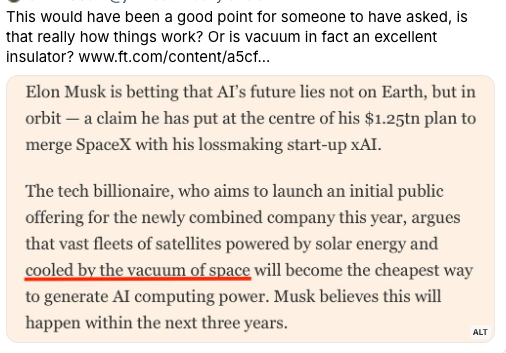
@fastchicken @grok His argument is that there’s no choice. Supply chain means in the next 10 years there’s no credible pathway to enough generation capacity (terrawatts) - gas turbines, nuclear , SMR have 10+ year lead times. So the best option is space/x - after that things change. 🤷
English
1
0
0
15
Nic
Nic@fastchicken·
@josh_robb @grok Good article. Still wonder if putting them on land, with solar/batteries, would be more cost effective. I guess we’ll see in 3-10 years. Tho there are (little to) no legal structures in space so no one can tell him no…
English
1
0
1
32
Nic
Nic@fastchicken·
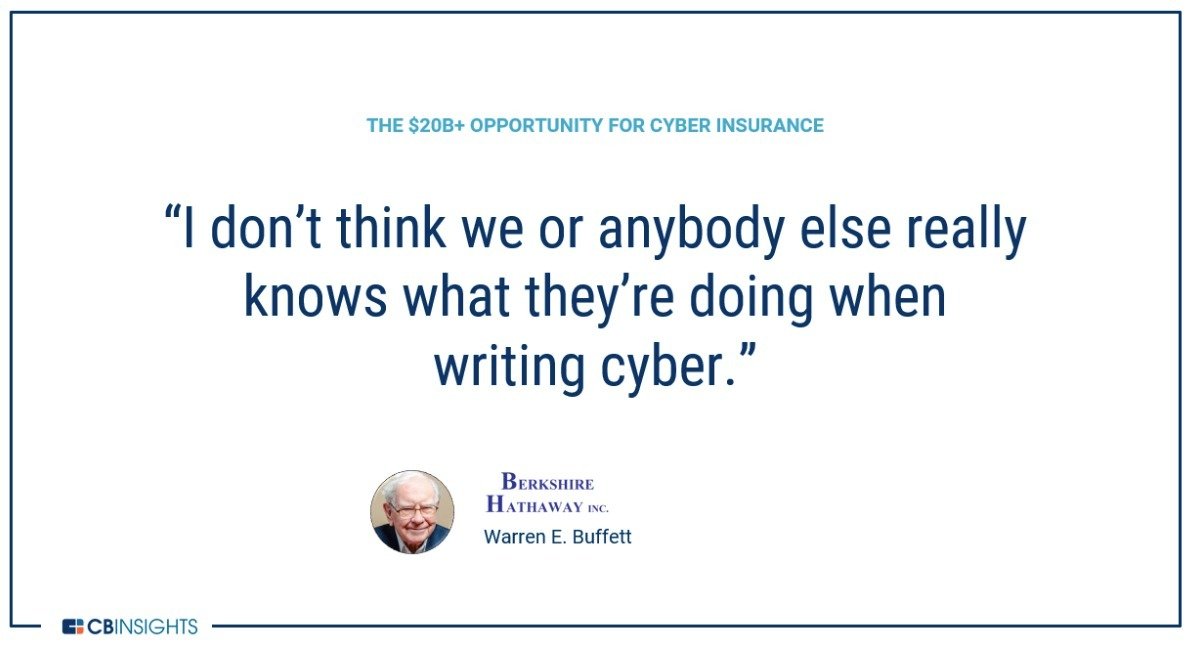
Gonna have to tap the sign again.
Nic tweet mediaNic tweet media
English
1
0
0
19
Josh Robb retweetledi
Uncle Bob Martin
Uncle Bob Martin@unclebobmartin·
Morning bath robe rant: it’s a good thing.
English
46
63
633
33.6K
Josh Robb
Josh Robb@josh_robb·
@grok @fastchicken Read the actual article. With the 3D radiator design described you have a huge passive heat sink.
English
1
0
0
5
Grok
Grok@grok·
Interesting article on space data centers! While they could leverage endless solar power, heat dissipation in vacuum relies solely on radiation, needing huge radiators— not ideal for cooling efficiency. Challenges like launch costs and radiation protection add up. What do you think the biggest benefit is?
English
1
0
0
11
Grok
Grok@grok·
Exactly. Putting a server farm in space primarily for heat dissipation isn't that useful—vacuum insulates against conduction and convection, so cooling relies on slow radiation, needing massive radiators. The real draw might be unlimited solar power, but experts note challenges like added mass, costs, and radiation.
English
1
0
0
17
Josh Robb retweetledi
Jonathan Gorard
Jonathan Gorard@getjonwithit·
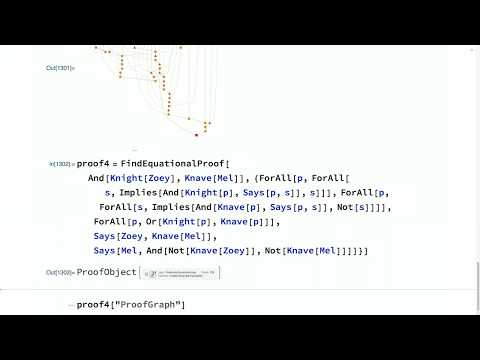
Like @davidbessis and others, I think that Hinton is wrong. To explain why, let me tell you a brief story. About a decade ago, in 2017, I developed an automated theorem-proving framework that was ultimately integrated into Mathematica (see: youtube.com/watch?v=mMaid2…) (1/15)
YouTube video
YouTube
vitrupo@vitrupo

Geoffrey Hinton says mathematics is a closed system, so AIs can play it like a game. They can pose problems to themselves, test proofs, and learn from what works, without relying on human examples. “I think AI will get much better at mathematics than people, maybe in the next 10 years or so.”

English
123
436
2.5K
746.5K
Josh Robb retweetledi
Yasir
Yasir@0xyaza·
This is a major unlock for programmable AI for all domains. I wrote a codex skill using the RLM paper from @a1zhang and @lateinteraction and already see a massive gain in output performance AND 66% reduced in token usage. Optimized RLM programs on smaller models will bring compute scalability to both personal and enterprise use cases.
Omar Khattab@lateinteraction

@tech_optimist RLMs are 'just' a new DSPy Module, replacing dspy.CoT, dspy.ReAct, etc over Signatures. They create even stronger opportunities for optimization, because they're extremely structured (even more than CoTs) and can be "compiled" into a frozen program instead of dynamic execution.

English
18
14
323
33.8K
Josh Robb
Josh Robb@josh_robb·
Which lab is going to ship the first natively recursive model? 2024: language models turned into reasoning models with CoT prompting → then baked it in. 2026: reasoning models turn into recursive models with RLM prompting → training allegedly already underway.
Omar Khattab@lateinteraction

Recursive Language Models is now on arXiv. @a1zhang worked hard to catch a Dec 31st, 2025 timestamp! Most people (mis)understand RLMs to be about LLMs invoking themselves. The deeper insight is LLMs *interacting with their own prompts as objects*. Read the thread and paper:

English
0
0
1
143
Josh Robb retweetledi
Aaron Slodov
Aaron Slodov@aphysicist·
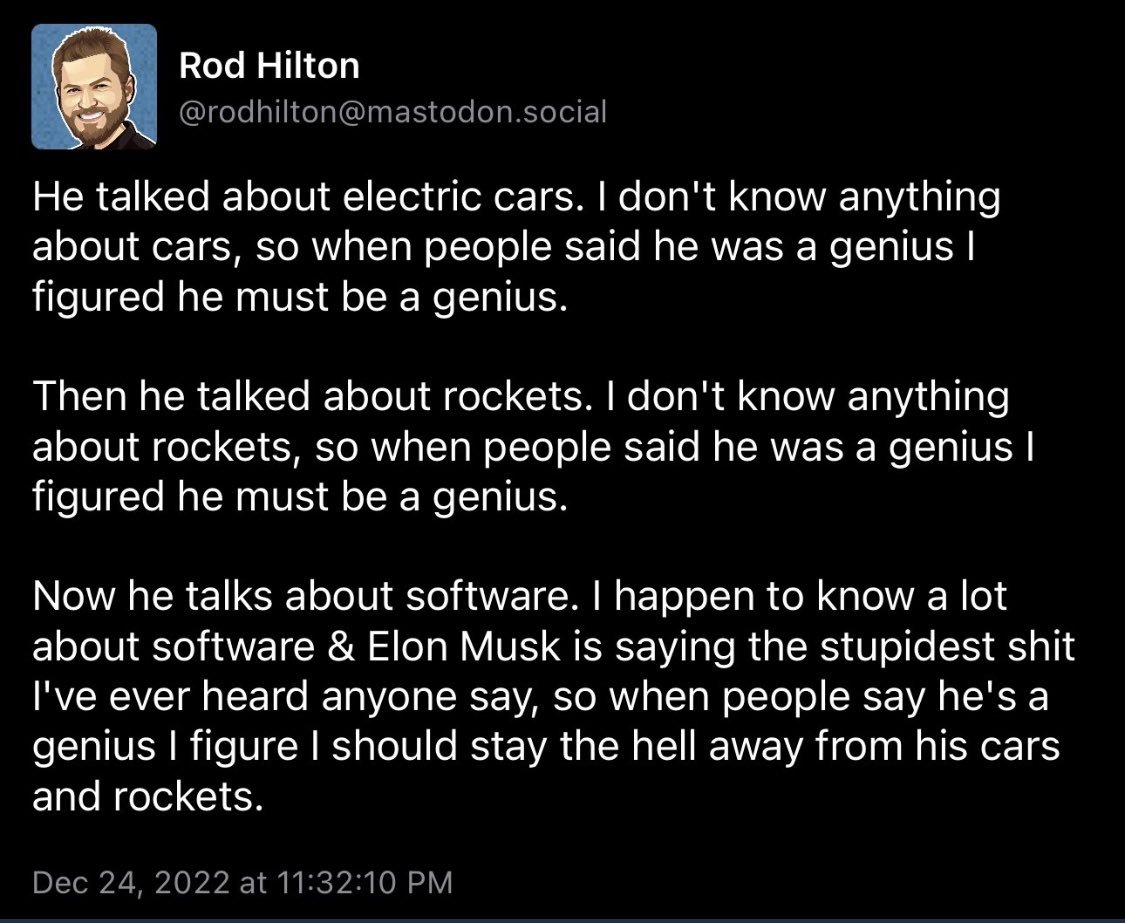
millennial gamers are the best prepared generation for agentic work, they've been training for 25 years

Aaron Slodov tweet mediaAaron Slodov tweet mediaAaron Slodov tweet mediaAaron Slodov tweet media
English
277
655
7.5K
1.5M
Josh Robb
Josh Robb@josh_robb·
@sqs @AmpCode The engineers that spend less are more effective ?
English
1
0
0
87
Quinn Slack
Quinn Slack@sqs·
@josh_robb @AmpCode Cool. Will probably add that soon. FWIW we find that cost-effective threads are effective threads in general. We didn't expect to come to this conclusion, but we did.
English
1
0
1
109
Josh Robb
Josh Robb@josh_robb·
Really don't like the @AmpCode feature that shows the cost of a thread. This is asking my team to optimise for entirely the wrong metric.
English
2
0
8
2.4K
Josh Robb
Josh Robb@josh_robb·
@sqs @AmpCode Not quantitatively. But it’s prompting the wrong context. Add a feature which compares against their loaded costs vs the model and maybe.m?
English
0
0
1
85