Doctor as Designer

62.4K posts

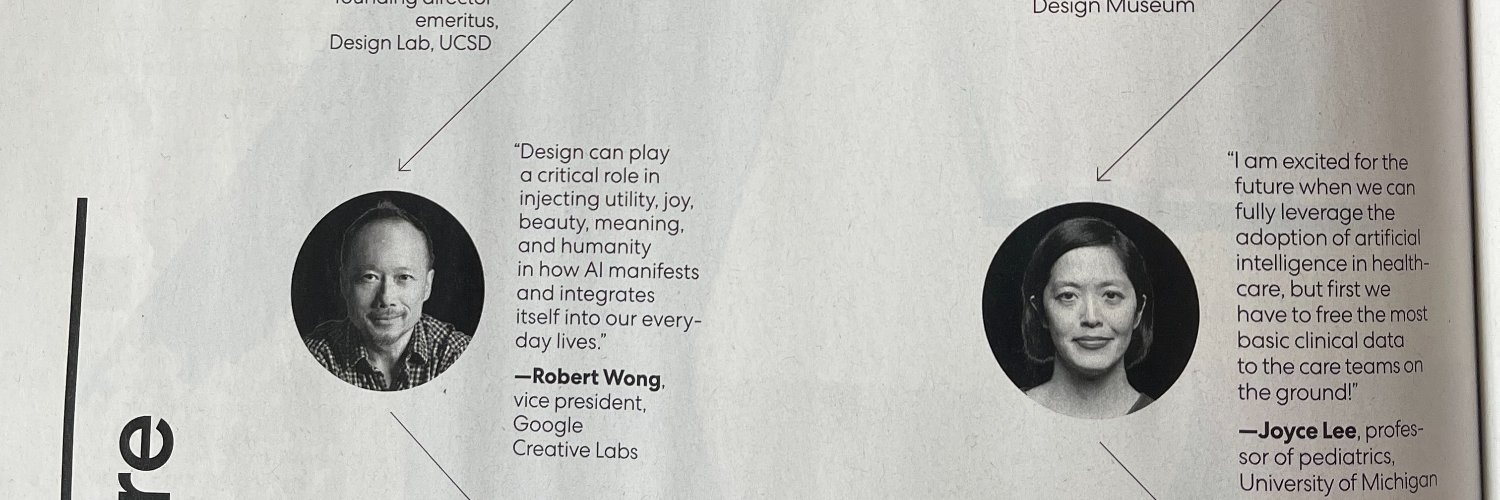
Doctor as Designer banner
Doctor as Designer

Doctor as Designer

@joyclee

Joyce Lee, MD, MPH Checking out https://t.co/57VYyyxDPm @ACMIO @umichmedicine #tableau #hit #ai #learninghealthsystems #HealthDesign
Ann Arbor, MI Katılım Ekim 2008
2.9K Takip Edilen12.3K Takipçiler
Doctor as Designer retweetledi
Greg Feingold
Greg Feingold@GregFeingold·
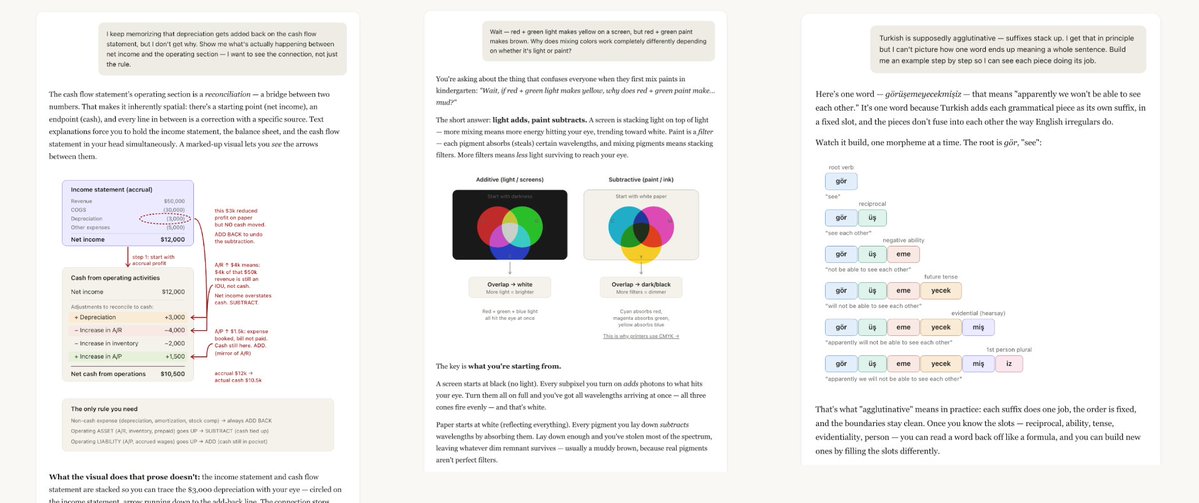
The new interactive diagrams feature in Claude is seriously amazing. Go make some cool charts!

Greg Feingold tweet media
English
11
27
408
22.4K
Doctor as Designer retweetledi
Elijah Meeks
Elijah Meeks@Elijah_Meeks·
I can see Bret Victor's Explorable Explanations in every Claude prototype and data story and yet we don't really seem to be celebrating the democratization of the form and instead it seems more like we're scared that we lost the ability to keep these barbarians out.
English
2
2
16
1.1K
Doctor as Designer retweetledi
Andrej Karpathy
Andrej Karpathy@karpathy·
💯 "If you build it, they will come." :) ~Every business you go to is still so used to giving you instructions over legacy interfaces. They expect you to navigate to web pages, click buttons, they give out instructions for where to click and what to enter here or there. This suddenly feels rude - why are you telling me what to do? Please give me the thing I can copy paste to my agent.
Andrej Karpathy tweet media
English
111
188
2.3K
145.8K
Doctor as Designer retweetledi
Aaron Levie
Aaron Levie@levie·
The future of work will look something like what Boris is describing. Anthropic is hiring engineers because people who know what they’re doing still have to tell the agents what to do, review their work, and integrate that work into a broader system. This will be true of other types of work as well; we will just move to higher levels of abstraction. It may be hard to imagine how that doesn’t lead to the evaporation of work, but once you consider all the natural limitations of agents it becomes clearer what the roles will look like. Also, as you automate one part of a process you quickly discover the bottlenecks in another part of the process. Many new forms of work will grow simply because another type of work became more efficient and eventually is constrained somewhere else in the system. This is how you can square the idea that more and more of today’s tasks can be automated, yet you still end up needing people to manage all those tasks.
Boris Cherny@bcherny

@big_duca Someone has to prompt the Claudes, talk to customers, coordinate with other teams, decide what to build next. Engineering is changing and great engineers are more important than ever.

English
102
96
1K
275.5K
Doctor as Designer retweetledi
Aaron Levie
Aaron Levie@levie·
We’re entering a period where talent will care about a company’s agentic stack since it drives their productivity and is a signal to where the company’s going. Companies will compete on token budget and agentic tools, similar to how they competed for managers based on headcount.
Apoorva Mehta@apoorva_mehta

if you are thinking about joining a team, ask them for their ai token usage graph. if it's not exponential, reconsider.

English
43
43
411
74.4K
Doctor as Designer retweetledi
Ihtesham Ali
Ihtesham Ali@ihtesham2005·
Top students at Stanford have a secret NotebookLM workflow. Took me 3 weeks of digging through study groups to crack it. Most people dump their PDFs into NotebookLM and ask basic questions. These students do something completely different. They upload their lecture notes, then immediately ask: "What are the 3 most likely exam questions from this material?" But the wild part is, they don't stop there. They follow up with: "Now create a study guide that connects these concepts to last week's readings" and "Generate practice problems that combine today's material with previous assignments." The result? They're not just reviewing. They're predicting what professors want and connecting dots across the whole course. I tested this on my own research. Instead of 6 hours of manual cross-referencing, I got comprehensive analysis in 15 minutes. The secret isn't about taking better notes. It's about getting NotebookLM to think like your professor.
Ihtesham Ali tweet media
English
48
392
3.2K
437.9K
Nav Toor
Nav Toor@heynavtoor·
Everyone is hyped about Claude… but barely anyone knows how to actually use it to replace real work. I collected 700+ mega prompts that turn Claude into a full-blown productivity engine. Comment "AI" and I’ll DM you everything.
Nav Toor tweet media
English
3.7K
204
2.7K
413.7K
Doctor as Designer retweetledi
Aditya Agarwal
Aditya Agarwal@adityaag·
It's a weird time. I am filled with wonder and also a profound sadness. I spent a lot of time over the weekend writing code with Claude. And it was very clear that we will never ever write code by hand again. It doesn't make any sense to do so. Something I was very good at is now free and abundant. I am happy...but disoriented. At the same time, something I spent my early career building (social networks) was being created by lobster-agents. It's all a bit silly...but if you zoom out, it's kind of indistinguishable from humans on the larger internet. So both the form and function of my early career are now produced by AI. I am happy but also sad and confused. If anything, this whole period is showing me what it is like to be human again.
English
467
1.8K
15.8K
3.3M
Doctor as Designer retweetledi
Aaron Levie
Aaron Levie@levie·
Hard to know exactly how this nets out, but if I had to bet on AI simplifying the legal space or making it more complex, I’m going with the latter. When you drop the cost of anyone asking a legal question and generating increasingly more exotic and bespoke conditions, you will only increase the amount of human legal work downstream from that. The ABA pegs active attorneys having gone from roughly 400,000 in 1975 to roughly 1,375,000 in 2025. In that time period we invented the PC, word processor, shared legal databases, and 50 other things that would have made law more efficient. But instead we have more lawyered precisely because of that efficiency. I suspect this will happen in more fields than we anticipate at the moment. Especially in healthcare, engineering, and many other highly demanded and high skilled areas of work as we create all new use-cases for the work.
Agustin Lebron@AgustinLebron3

Corporate lawyer, yesterday: "LLMs have increased my workload because every client thinks they're a lawyer now."

English
71
46
478
144.8K
Doctor as Designer retweetledi
Stuart Blitz
Stuart Blitz@StuartBlitz·
I think if you distill down the characteristics of key hires as you grow a company it's really only 1) trust and 2) competence. Not much else matters.
English
3
1
10
754
Doctor as Designer retweetledi
Claude
Claude@claudeai·
Claude in Excel is now available on Pro plans. Claude now accepts multiple files via drag and drop, avoids overwriting your existing cells, and handles longer sessions with auto compaction. Get started: claude.com/claude-in-excel
English
1.1K
4.5K
44.6K
23.4M
Elijah Meeks
Elijah Meeks@Elijah_Meeks·
Finally deleted my bluesky. Sigh. It was just so boring over there. Now I need to dig up some #dataviz folks to follow here. Who's a good data visualization follow these days on Twitter?
English
5
0
21
2.1K
Andrew Pannu
Andrew Pannu@andrewpannu·
Most obesity pipelines are still trying to beat GLP-1 efficacy. That's no longer the game. The belief that value runs through efficacy alone made sense when the question was feasibility: could incretins deliver durable, meaningful weight loss at scale? That question has been answered. Injectable GLP-1s have established a de-risked efficacy reference point. Not a hard ceiling, but a validated benchmark across multiple molecules and sponsors. Strategic uncertainty has shifted from whether meaningful weight loss is achievable to how it can be delivered, accessed and paid for at scale. This is the part many pipelines miss: beating current efficacy benchmarks alone is no longer sufficient. Even a superior injectable faces the same payer scrutiny, access friction and incumbency advantages that constrain existing GLP-1s. The bottleneck has moved. I used @sleuthinsights to map 174 Phase 2+ obesity assets across two dimensions that matter for commercial viability: expected efficacy potential (mechanism class, incretin co-agonism, clinical validation) and patient/payer access (route, dosing burden, tolerability and inferred cost pressure). The result is an access–efficacy frontier. Not a theoretical performance race, but a real-world optimization problem. The pattern is striking. Late-stage capital, BD interest, and Pharma portfolio focus cluster around assets that sit on or push the frontier. Assets far from it (particularly those low on both access and efficacy) face structural commercial headwinds regardless of scientific novelty. Two distinct strategies are emerging to expand the frontier: 1. Oral GLP-1s like orforglipron and VK2735 illustrate horizontal expansion - not because all orals are inherently patient-friendly, but because select programs meaningfully relax specific access constraints while remaining close to the injectable efficacy reference. This isn’t a claim that efficacy no longer matters. It’s a recognition that, in a payer-managed category, access friction often becomes a key constraint once efficacy is de-risked. 2. Combo strategies like cagrilintide+semaglutide and amycretin attempt diagonal expansion, pairing efficacy preservation with differentiated tolerability, durability or muscle-sparing profiles. The bet is that selectively closing efficacy or tolerability gaps can unlock value even when access improves only marginally. These are illustrative examples of strategic direction, not predictions of winners - the point is the framework. Frontier expansion does not require majority market share: even assets serving narrower segments can shape payer dynamics, portfolio strategy and capital allocation. If you're positioning an obesity asset or evaluating the space, the question becomes "where does this sit on the frontier, and what would it take to move it?" Mapping that requires structuring assets across mechanistic, clinical, and access dimensions at scale. That's what we built Sleuth to do. Comment below for a hi-res PDF of the visual.
Andrew Pannu tweet media
English
19
28
175
52.1K
Doctor as Designer retweetledi
Jon Steinsson
Jon Steinsson@JonSteinsson·
To be at the very top of any endeavor takes very hard work. I don't think academia is fundamentally different from, say, sports or business in this regard. Not everyone needs to want to be the next Michael Jordan or Daron Acemoglu. But some do and that is great.
Benjamin Manning@BenSManning

One thing I’ve noticed: truly top-tier academics almost never talk about academia the way this article does. They’re super intense, sure—but they also truly love the work. I once went to a public writing seminar from @metrics52, and he said something like “Academia is a competitive endeavor, but it’s the most wonderful endeavor I’ve ever pursued.” I think pieces like this might reflect some authorial selection into rationalizing personal dissatisfaction with outcomes/career decisions...

English
5
16
177
31K