John Garry

677 posts

John Garry banner
John Garry

John Garry

@jpatrickgarry

Asking questions. Trying to be useful.

Brooklyn, NY Katılım Şubat 2018
659 Takip Edilen283 Takipçiler
Legion
Legion@uselegion·
A great fund doesn't have to be a big one. Emerging managers backing founders early in 2026 (part 2): 1. Matt Hartman (@MattHartman): Factorial Capital. Ex-Betaworks, backed Hugging Face early. Pre-seed into deeply technical and frontier-AI founders. 2. Colin Gardiner (@ColinGardiner): Yonder VC. Ex-Outdoorsy CRO. Solo GP writing first checks into marketplaces. 3. Kevin Costa (@KevinJDCS ): Belief Capital. Finds founders straight off X. Leads pre-seed in AI, robotics and infrastructure across Europe and the US. 4. Alex Witt (@AlexLWitt): Verda Ventures. Ex-Celo CFO. Backs fintech and stablecoin infra in emerging markets. 5. Nate Cooper (@Nrcoope): Barrel Ventures. Seed food and consumer. Early into Olipop, Haus and Clove. 6. Ben Zises (@bzises): SuperAngel dot Fund. Day-zero consumer, proptech and future of work. 150+ companies with a big syndicate behind him. 7. J. Patrick Garry (@jpatrickgarry): Garry Elevator. Ex-Notre Dame investment office. Early checks into community ownership, governance and media. 8. Suds Sridharan (@ItzSuds): SF1. Made 80 angel bets before 25, now runs his own fund writing first money into AI-native founders. 9. Rachel ten Brink (@rtenbrink1): Red Bike Capital. Co-founded Scentbird. Pre-seed fintech, vertical SaaS and consumer. 10. Jamie Gull (@jamiegull): Wave Function Ventures. Ex-SpaceX. Just closed a $15M fund for hardware deep tech across aerospace, defense and energy. 11. Richard Blankenship (@RichardDreamVC): Dream Ventures. Co-founded Prizeout. Early-stage consumer, CPG and web3 out of Las Vegas. 12. Mo El-Bibany (@mobibany): Page One Ventures. Early deep tech, life sciences and B2B software where disciplines converge. 13. Lucas Vaz (@lucasbagnocvaz): Ravelin Capital. Ex-Village Global. Pre-seed into critical software: infra, defense-adjacent and fintech. 14. Yigit Ihlamur (@yihlamur): Vela Partners. Ex-Google. An AI-native quant fund that soft-commits fast using its own tooling. 15. Heston Berkman (@hberkman): Banter Capital. Ex-SignalFire and BoxGroup. Generalist pre-seed consumer. Who else belongs on here? Tag them below. And save it for your next raise.
English
14
2
76
19.1K
John Garry
John Garry@jpatrickgarry·
@Erica_Wenger @endowment_eddie Agree. I've been wondering if a cooperative fund of funds would fix the fee issue. No LP would fund it, but intellectually interesting.
English
0
0
1
25
Erica Wenger
Erica Wenger@Erica_Wenger·
@endowment_eddie 100% - the fees structure is one of the reasons why I don’t have the interest
English
1
0
0
396
Erica Wenger
Erica Wenger@Erica_Wenger·
I don’t have the time or genuine interest to actually do this but wow I feel like I’d build a killer fund of funds As an emerging GP you have an insane pulse on who does great deals, who actually helps their founders, who you think of for deals, etc
English
15
1
64
10.7K
John Garry
John Garry@jpatrickgarry·
We think this is happening again. garryelevator.com/post/historic-…
MoundLore@MoundLore

In much of the Midwest, the grain elevator functioned as a coordinating system, not a landmark. Its operation set daily labor cycles. When the leg started, hauling began. When the pit backed up, everything downstream slowed. Truck lines, rail access, meal breaks, school pickups, even store hours adjusted to whether grain was moving or sitting. Rail timing was not abstract. Elevators were built where sidings allowed loading, and trains responded to volume. Active elevators meant trains slowed, stopped, or waited. Once throughput dropped, rail behavior changed permanently. That shift alone altered how towns related to the outside world. The elevator also operated as a financial intermediary. Grain wasn’t always sold immediately. It was stored, advanced against, or held until prices improved. Credit decisions were made locally, based on harvest history, land knowledge, and reputation. This created a feedback loop between agriculture, cash flow, and daily stability. Weather knowledge concentrated there. Moisture levels, spoilage risk, and bin temperature were tracked continuously. People understood coming storms, heat waves, and storage failures through physical indicators, not forecasts. The elevator acted as an early-warning system tied directly to survival. When an elevator closed, the impact was not just job loss. The town lost synchronization. Labor became asynchronous. Rail service decoupled. Businesses shifted from predictable hours to defensive ones. Time stopped being shared. Most of these structures still stand because they were built to last. Their persistence isn’t symbolic. It’s infrastructural. They mark where coordination once existed and where it was removed. The grain elevator mattered because it aligned people, capital, transport, and time into one system. When it disappeared, those systems didn’t vanish. They fractured.


English
1
0
3
404
melody kim
melody kim@melodyskim·
I predict the next iteration of user generated content will be mini-apps
English
4
0
5
4.1K
John Garry
John Garry@jpatrickgarry·
@jaesmail The structure of the modern, mainstream internet has killed agency in a lot of people our age. Going to take a lot of imagination to recover.
English
1
0
1
49
John Garry
John Garry@jpatrickgarry·
@orrdavid Kochland is an exceptional business history. Manages to respect and critique KI at the same time.
English
0
0
1
46
David Orr
David Orr@orrdavid·
Koch encouraged every employee to be on the lookout for ways to expand the business, and then they chased the best leads.
David Orr tweet mediaDavid Orr tweet media
English
5
2
54
7.3K
John Garry
John Garry@jpatrickgarry·
Yeah, I totally agree. I think of DeFi as “kinder” than TradFi, even though you can get rekt. At least you know the rules and can fit them to your life rather than hoping the rules don’t change and having to restructure your life around them anyways. Ditto with most of the institutions you listed. Current iterations are getting more feudal, brittle, anti-agency by the day.
English
0
0
2
25
jihad
jihad@jaesmail·
@jpatrickgarry conceptually. crypto is “softer” than traditional banking in that it is more malleable, increases agency.
English
1
0
0
23
John Garry
John Garry@jpatrickgarry·
@jaesmail Conceptually or in their current iterations? (Deposit-holding institutions vs. JPM for example)
English
1
0
0
29
jihad
jihad@jaesmail·
@jpatrickgarry Universities (maybe trad careers as an institution) Banking News/newspapers
English
1
0
0
23
Will Manidis
Will Manidis@WillManidis·
@jpatrickgarry i found my copy in a street free library in cambridge mass, i still wonder how in the world it ended up there
English
2
0
11
1.9K
Will Manidis
Will Manidis@WillManidis·
mckinsey and sequoia have both written incredible internal firm histories. what other great “biographies of the firm” exist?
Will Manidis tweet mediaWill Manidis tweet media
English
46
39
1.2K
80.2K
Joe Weisenthal
Joe Weisenthal@TheStalwart·
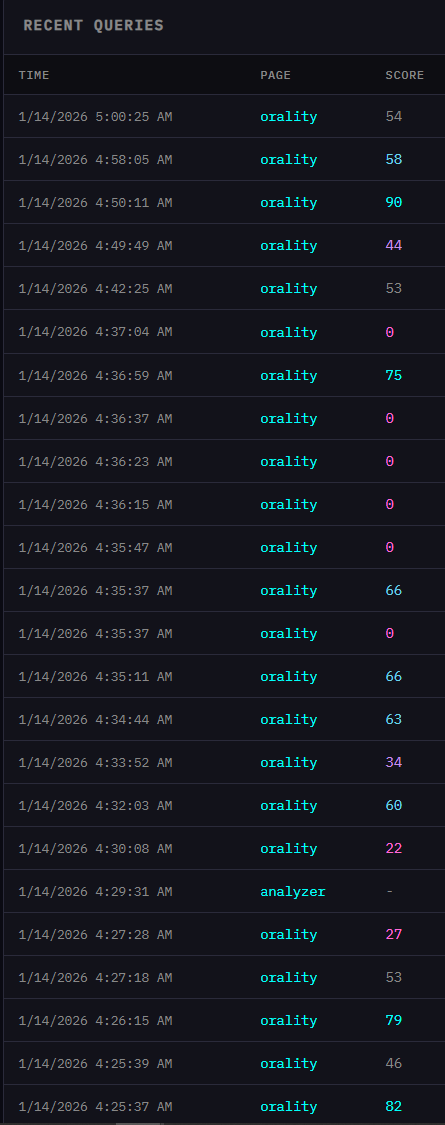
Yesterday was @Havelock_AI's biggest day ever. Made some tweaks to the scoring system, because we were getting too many extreme scores, though still a lot of work to do. Anyway, HavelockAI v0.02 is currently live. Before publishing anything today, see your Havelock Score.
Joe Weisenthal tweet mediaJoe Weisenthal tweet mediaJoe Weisenthal tweet media
English
10
3
92
43.2K
John Garry
John Garry@jpatrickgarry·
@johnpalmer Don’t know if this is serious, but if so can I join?
English
0
0
0
30
John Palmer
John Palmer@johnpalmer·
Recently been playing in a weekly touch football game with a bunch of men in their 30s It’s too physically straining and intense to ever be mainstream but I must say it’s great
John Palmer@johnpalmer

I called it last year. Ping pong still hasn’t reached its peak but I’m already thinking about what’s next… Strong intuition that foot posture, GOATA training, gait analysis is up next. As for sports I need to see how the ping pong arc plays out

English
1
0
6
2.1K
John Garry
John Garry@jpatrickgarry·
@WillManidis Have been reading Persig’s Lila, this story feels like the embodiment of dynamic versus static quality
English
0
0
0
42
Will Manidis
Will Manidis@WillManidis·
There is a parable from the Sufi teacher Bawa Muhaiyaddeen that I keep revisiting. Beetles fly around a brush fire, each trying to describe its totality. One sees only heat, another smoke, another light. The King Beetle, unsatisfied, hurls himself into the fire. He is utterly transformed by the flame, finally understanding the whole in his last moments. This is, of course, a useful way to think about our relationship with a loving and omnipotent God. We cannot understand our lives and our place in creation simply from an outsider’s perspective. Necessarily, the only way to figure out what is "really going on here" is to hurl yourself into it fully. Attempting outside inspection yields nothing useful because you are totally and utterly within it. As I revisit the story, I find the failures of the other beetles useful for thinking about what it means to live a life of faith. First, there is the Professor. He approaches the mystery with his credentials and logic. "That's no mystery to me," he says. He returns with detailed observations. They may be technically accurate, but his words have "neither light nor heat." This is the trap of pure intellectualism: believing that naming something is the same as knowing it. The Professor can catalog the fire's properties without ever being warmed by it. Second, the Lieutenant. His motivation is personal wealth. "I'll earn the King's favor," he thinks. "One day all he has will be mine." He returns with a narrative description, speaking of ash clouds that look like vanishing birds. The King rebukes him: "We didn't ask what it seems like, we asked what it is!" The Lieutenant gives us aesthetics without understanding. He is moved by the fire's beauty, but he approaches it as something to use for status or reward. Even his genuine encounter becomes transactional. Finally, the King. Without hesitation, without looking back, he flies into the flame. He understands the fire in its totality only by being utterly transformed by it. There is a chapter in Mere Christianity where C.S. Lewis asks whether the Christian life is hard or easy. His answer is, essentially, that it is the hardest possible thing until you stop trying to do it yourself. Then it isn't. The Professor and the Lieutenant both fail because they are still trying to get something from the fire—knowledge or reward—while keeping themselves intact. The King gives up on that project entirely. He allows himself to be utterly transformed, and only via that transformation and total release can he reach any understanding at all.
English
6
1
75
7.9K
Ho Nam
Ho Nam@honam·
Agree that position sizing is more important than picking. I’ve observed the outcomes of different approaches to investing retirement accounts over 20+ years by some great investors. First of all, everyone (including ones that beat the index over decades) will make mistakes. Concentration on a few good stocks can make up for the inevitable losers and also for “missing out” on many great ones. A diversified portfolio can perform well but it puts enormous pressure on picking - a few have to perform spectacularly well since a small position will not move the needle until it grows Either way, the key to superior performance over long periods is inactivity. Must let it compound. Hard to keep up otherwise. I’d say impossible, if the accounts are taxable. Over time, even diversified portfolios, if performing well, start to look concentrated.
Finding Compounders@F_Compounders

“Position sizing was 70 to 80% of the game. The reason that struck me is because, first of all, purportedly George Soros made money on fewer than 30% of his trades.” What Stanley Druckenmiller taught Michael Mauboussin on investing

English
15
31
303
98.3K