
Sabitlenmiş Tweet

A historical lens on #VentureCapital by @_TheFamily. One of my favorite pieces. Ecosystem is more than a buzzword. Technology will be the backbone of the brave new world. #vc
salon.thefamily.co/a-brief-histor…
English
Mo El-Bibany
10.1K posts

@mobibany
venturing. founder @pageonevc.

ANTHROPIC TO PAY SPACEX $1.25B PER MONTH THROUGH MAY 2029 Is Claude scraping X?



SpaceX's IPO prospectus (S-1 filing) is now officially public! You can read the full document here: sec.gov/Archives/edgar…


In the next few days we'll be ramping up Claude inference on Colossus. Grateful to be partnering with SpaceX here. We are going to need to move a lot of atoms in order to keep up with AI demand, and there's nobody better at quickly moving atoms (on or off planet Earth)

Out of all the announcements at @Google I/O today, this is the one closest to my heart - our foundational research on Co-Scientist was published in @Nature and we announced its broad availability via @GeminiApp for Science. When you are suffering from a disease, time is everything. As our collaborator and @StanfordMed Professor Dr. Gary Peltz reminds us, there are thousands of diseases out there with zero treatments. There is simply so much left to solve. Our goal with Co-Scientist has been to give scientists superpowers and help them get to these answers faster - compressing the scientific process from months and years down to hours and days. Much like Galileo's telescope helped us look into the stars, Co-Scientist is designed to help us make sense of the vast complexity of biological and scientific data. It is among the first examples of a truly general-purpose multi-agent system for scientific discovery. The core research question behind it was: How can an AI system engage in the rigorous, structured thinking that’s the hallmark of science and scientists? To tackle this, Co-Scientist builds on the principles of self-play and self-improvement underpinning @GoogleDeepMind breakthroughs like AlphaGo, generalizing them to scientific reasoning through self-debates. Since our preprint last year, we have further improved its capabilities and have been validating it in collaborations with scientists across over 100 institutions globally, spanning both academia and industry. And we are thrilled to see the emergence of a new form of AI-human scientist collaboration that's already leading to important new insights, discoveries and peer reviewed publications - from understanding antimicrobial resistance (published in @CellCellPress) to decoding plant immunity, to identifying new treatments for liver fibrosis (Advanced Science), cancer, neurodegenerative diseases like ALS and the grand challenge of aging. I have always believed AI's greatest promise is accelerating scientific discovery and advancing human health. My genuine hope for the future is that AI tools like Co-Scientist help democratize science, giving anyone, anywhere the means to pursue their child-like curiosity and change the world. This work was done with stellar team mates spanning @GoogleDeepMind @GoogleResearch, @googlecloud and @GoogleLabs especially Juro Gottweis (@Mysiak ), who is the heart and soul of this effort. Special thanks also to all our wonderful collaborators: Gary Peltz, @CostaT_Lab, @jrpenades, @_e_d_v_ , @iambyronic, @OpsBug, @jgooten, @omarabudayyeh Ritu Raman, Ryan Flynn, Filippo Menolascina, Velia Siciliano, Clare Bryant, Matt Onsum, Katherine Labbé and more. Nature paper link - lnkd.in/e8qBEJFv Google DeepMind blog - lnkd.in/etYeahMy Gemini for Science - labs.google/science.

A big day for multi-agent AI to accelerate biomedical discovery, hypothesis generation, designing experiments with proof points of new candidate drugs (cancer, fibrosis, macular degeneration, antimicrobial resistance, and more) 2 @Nature reports @GoogleDeepMind @FutureHouseSF nature.com/articles/s4158… nature.com/articles/s4158…

Out of all the announcements at @Google I/O today, this is the one closest to my heart - our foundational research on Co-Scientist was published in @Nature and we announced its broad availability via @GeminiApp for Science. When you are suffering from a disease, time is everything. As our collaborator and @StanfordMed Professor Dr. Gary Peltz reminds us, there are thousands of diseases out there with zero treatments. There is simply so much left to solve. Our goal with Co-Scientist has been to give scientists superpowers and help them get to these answers faster - compressing the scientific process from months and years down to hours and days. Much like Galileo's telescope helped us look into the stars, Co-Scientist is designed to help us make sense of the vast complexity of biological and scientific data. It is among the first examples of a truly general-purpose multi-agent system for scientific discovery. The core research question behind it was: How can an AI system engage in the rigorous, structured thinking that’s the hallmark of science and scientists? To tackle this, Co-Scientist builds on the principles of self-play and self-improvement underpinning @GoogleDeepMind breakthroughs like AlphaGo, generalizing them to scientific reasoning through self-debates. Since our preprint last year, we have further improved its capabilities and have been validating it in collaborations with scientists across over 100 institutions globally, spanning both academia and industry. And we are thrilled to see the emergence of a new form of AI-human scientist collaboration that's already leading to important new insights, discoveries and peer reviewed publications - from understanding antimicrobial resistance (published in @CellCellPress) to decoding plant immunity, to identifying new treatments for liver fibrosis (Advanced Science), cancer, neurodegenerative diseases like ALS and the grand challenge of aging. I have always believed AI's greatest promise is accelerating scientific discovery and advancing human health. My genuine hope for the future is that AI tools like Co-Scientist help democratize science, giving anyone, anywhere the means to pursue their child-like curiosity and change the world. This work was done with stellar team mates spanning @GoogleDeepMind @GoogleResearch, @googlecloud and @GoogleLabs especially Juro Gottweis (@Mysiak ), who is the heart and soul of this effort. Special thanks also to all our wonderful collaborators: Gary Peltz, @CostaT_Lab, @jrpenades, @_e_d_v_ , @iambyronic, @OpsBug, @jgooten, @omarabudayyeh Ritu Raman, Ryan Flynn, Filippo Menolascina, Velia Siciliano, Clare Bryant, Matt Onsum, Katherine Labbé and more. Nature paper link - lnkd.in/e8qBEJFv Google DeepMind blog - lnkd.in/etYeahMy Gemini for Science - labs.google/science.

Lots of news today. Don't have energy to write a hit tweet, so here's list 1. Our work on doing lab-in-the-loop with agents was published in Nature 2. We announced our first research partnership with a pharmaceutical company 3. We made new persistent code-writing agent


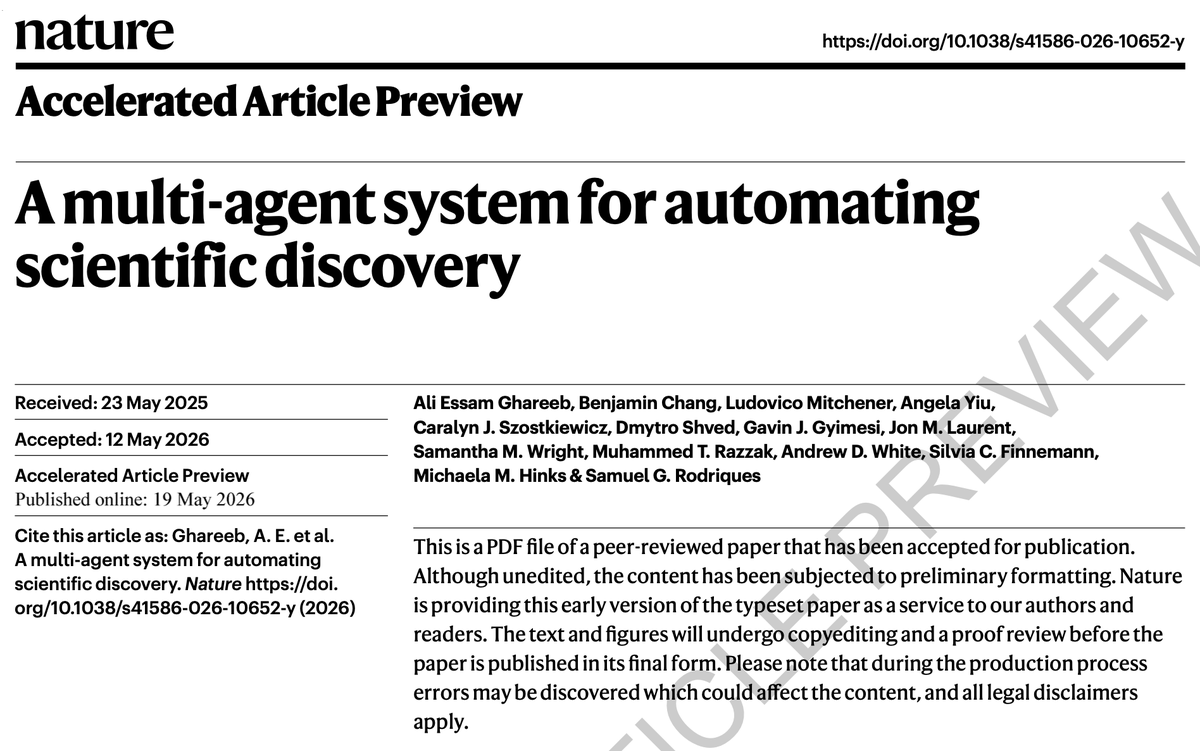
Today we all lost our jobs..... Three Nature papers showing that scientists in the conventional sense are obsolete At least read the first one.... the AI replaced all things that the scientist does .... nature.com/articles/s4158…


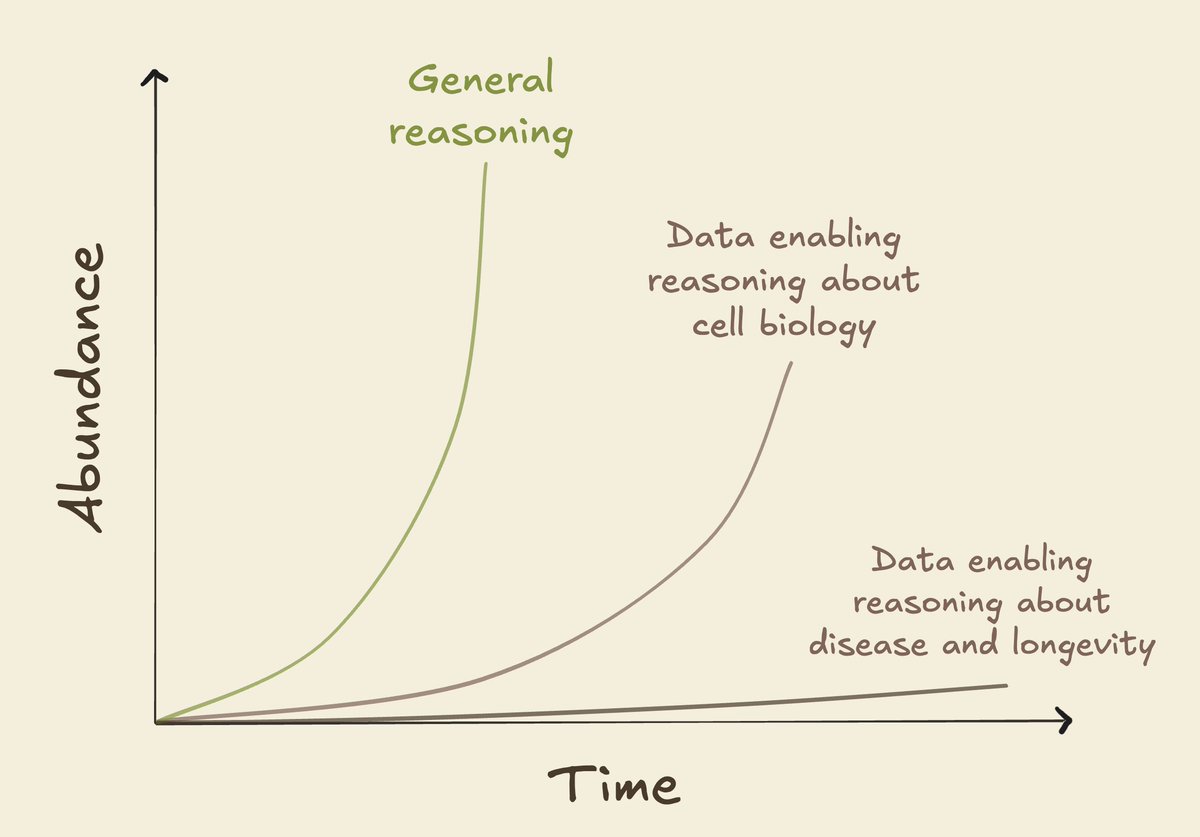


Lots of news today. Don't have energy to write a hit tweet, so here's list 1. Our work on doing lab-in-the-loop with agents was published in Nature 2. We announced our first research partnership with a pharmaceutical company 3. We made new persistent code-writing agent

We live in a golden age of biology. So why are people still dying from disease? Because discovery and development move slower than they should. Today, we’re partnering with Incyte to change that. Kosmos is now the first agent that can compress months of drug development into weeks, from the earliest stages of scientific discovery through to FDA approval. @Incyte will be the first company to deploy it across their pipeline. Work that used to take a team of scientists months now happens in weeks. Patients can't wait, and neither can we.
