Madelyn Heart

173 posts

Madelyn Heart banner
Madelyn Heart

Madelyn Heart

@madelynheart_

Chief of Staff @pillar_vc | formerly @opentrons

Boston, MA Katılım Aralık 2019
161 Takip Edilen333 Takipçiler
Madelyn Heart retweetledi
Thomas
Thomas@titanioustom·
In the month of March we raise awareness for this debilitating disease, and as we wrap up I felt it appropriate to write a short piece to highlight how proud we are to get to work with Ashley Abel, Ph.D. and the team at Metri Bio. Read more here: pillar.vc/investing/immo…
English
2
7
10
1.5K
Madelyn Heart retweetledi
Simon Kohl
Simon Kohl@saakohl·
Today we're launching Latent-Y: the world's first autonomous agent for drug design, lab-validated end to end. Give it a research goal. Latent-Y reasons, designs, iterates, and delivers lab-ready antibodies, autonomously or collaboratively, with the biological reasoning of a PhD protein design expert. Technical report: tinyurl.com/latent-y-techr… Blog post: latentlabs.com/latent-y Apply for access: platform.latentlabs.com
English
36
147
869
119.7K
Madelyn Heart retweetledi
Jude Wells
Jude Wells@_judewells·
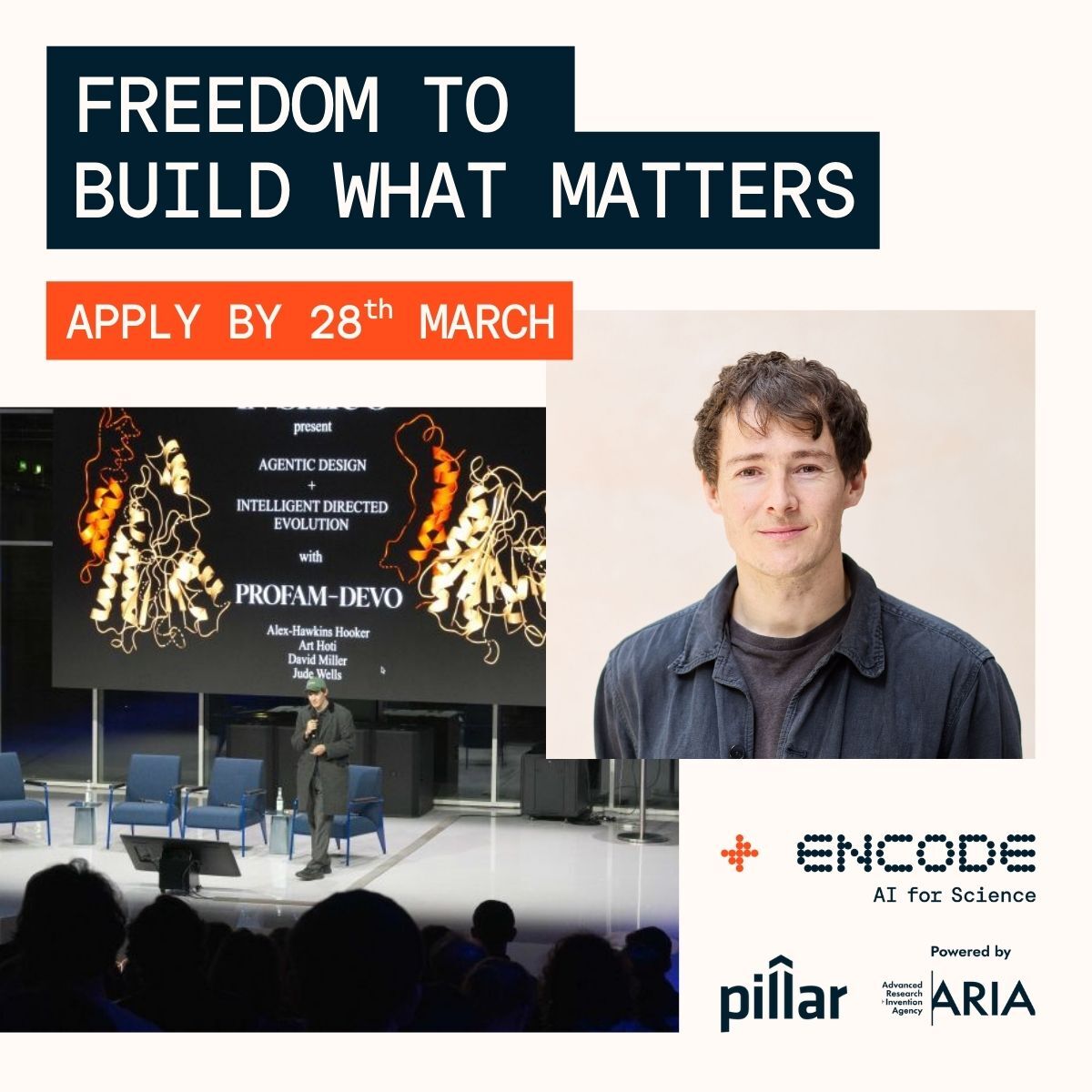
I'm 6 months into this fellowship, and it's been brilliant. If you've got ideas at the intersection of AI and science and want to take a shot at making them real then I can't think of a better opportunity. 8 DAYS LEFT TO APPLY TO JOIN COHORT 2. @encode_pillarvc @ARIA_research
Jude Wells tweet media
English
2
8
44
4.9K
Madelyn Heart retweetledi
Tony Kulesa
Tony Kulesa@kulesatony·
Science is our calling. It's January 2026 and in some vague but very real sense, the glimmers of AGI are here. You can toss off a goal and an AI agent will happily chug away. We can do anything. But what is worthy of doing? We're not here for the AI romantic companions, the vibes reels, and the marketing outbound. If we can do anything, we're going to do science. Science is how we build the world we actually want. It's how we will solve the problems we'll be proud to tell our children we dedicated ourselves to. We want to hear from the people pushing AI to the limits in pursuit of science. The window is open. The weird and the serious are moving fast. Incredible things are happening in labs, warehouses, and basements. Over the next couple of weeks, we’ll be gathering in three cities—San Francisco, London, and Boston. We’ll have some visionary speakers joining us. Link below.
Tony Kulesa tweet media
English
9
32
210
15K
Madelyn Heart retweetledi
Sarah Hodges
Sarah Hodges@hodges·
There’s been a lot of talk about whether Boston is still a great place to build (we're bullish) — but talk doesn’t build companies. We’re moving into 30k+ sq ft this fall. How should we use it to actually help founders? Ideas welcome.
English
2
5
10
884
Madelyn Heart retweetledi
Sam Rodriques
Sam Rodriques@SGRodriques·
Science is too slow. At Edison, we are integrating AI Scientists into the full stack of research, from basic discovery to clinical trials. We want cures for all diseases by mid-century. We have raised a $70M seed to get started. Join us. We need cracked software engineers who want to work on finding cures rather than selling ads and generating slop. If you’re reading this, you’re probably a candidate. We need brilliant AI researchers who want to figure out how AI will accelerate real-world science. We need scientists and researchers with deep expertise in biology, biotech, and pharma who want to figure out how to integrate AI deeply into scientific workflows, from ideation to experimentation, and how to measure success or failure. We need extraordinarily talented generalist operators across BD, sales, product management, and partnerships who can focus on getting our tools into the hands of pharmaceutical companies. If any of these roles sound like you, get in touch. We are also expanding access to our platform. Our goal is to accelerate science writ large. To that end, we will continue to give academics and students 650 credits/mo indefinitely. I can’t promise we’ll keep this up forever, but we will try. Kosmos will still cost 200 credits, and the other agents (Analysis, Literature, etc.) will cost 1 or 2 credits. All paid users will have access to our regular agents, like our Analysis agent, Literature agent, and so on, for free via the UI. API access will still be paid, and users without a paid subscription will continue to get 10 credits per month for those agents. Our $200/mo subscription for 650 credits/mo is staying in place for now, but might be phased out at our next major product update. Along the lines of accelerating science, we’re also doing a major release of PaperQA today, our flagship open source literature agent, as part of our commitment to open science. In the short run, expect major improvements to Kosmos, including the ability to automatically access data, the ability to steer its exploration, and the ability to converse directly with its world model. In the long run, expect exponentially increasing rates of scientific discoveries, in biology and elsewhere. Our round is led by Triatomic Capital, Spark Capital, and a major US institutional biotech investor. We are also joined in this round by existing investors Pillar VC and Susa Ventures, two exceptional early-stage funds who backed us at founding, along with Striker Venture Partners, Hawktail VC, Olive VC, and a host of exceptional angels that includes famous AI researchers, the CEOs of multiple frontier AI labs, and leadership of major biotech and pharma companies.
Sam Rodriques tweet media
English
134
171
1.6K
242.7K
Madelyn Heart retweetledi
Sam Rodriques
Sam Rodriques@SGRodriques·
@sama Thanks!! Anyone who is interested can try Kosmos for themselves here: platform.edisonscientific.com All possible in large part due to the amazing work you guys have been doing at OpenAI. Keep it up, and the next few years are going to be awesome.
English
40
78
518
159.3K
Madelyn Heart retweetledi
Jason Carman
Jason Carman@jasonjoyride·
!!! This is big. AI creating REAL value doing REAL science... Who would have thought?
Sam Rodriques@SGRodriques

Today, we’re announcing Kosmos, our newest AI Scientist, available to use now. Users estimate Kosmos does 6 months of work in a single day. One run can read 1,500 papers and write 42,000 lines of code. At least 79% of its findings are reproducible. Kosmos has made 7 discoveries so far, which we are releasing today, in areas ranging from neuroscience to material science and clinical genetics, in collaboration with our academic beta testers. Three of these discoveries reproduced unpublished findings; four are net new, validated contributions to the scientific literature. AI-accelerated science is here. Our core innovation in Kosmos is the use of a structured, continuously-updated world model. As described in our technical report, Kosmos’ world model allows it to process orders of magnitude more information than could fit into the context of even the longest-context language models, allowing it to synthesize more information and pursue coherent goals over longer time horizons than Robin or any of our other prior agents. In this respect, we believe Kosmos is the most compute-intensive language agent released so far in any field, and by far the most capable AI Scientist available today. The use of a persistent world model also enables single Kosmos trajectories to produce highly complex outputs that require multiple significant logical leaps. As with all of our systems, Kosmos is designed with transparency and verifiability in mind: every conclusion in a Kosmos report can be traced through our platform to the specific lines of code or the specific passages in the scientific literature that inspired it, ensuring that Kosmos’ findings are fully auditable at all times. We are also using this opportunity to announce the launch of Edison Scientific, a new commercial spinout of FutureHouse, which will be focused on commercializing our agents and applying them to automate scientific research in drug discovery and beyond. Edison will be taking over management of the FutureHouse platform, where you can access Kosmos alongside our Literature, Molecules, and Precedent agents (previously Crow, Phoenix, and Owl). Edison will continue to offer free tier usage for casual users and academics, while also offering higher rate limits and additional features for users who need them. You can read more about this spinout on our blog, below. A few important notes if you’re going to try Kosmos. Firstly, Kosmos is different from many other AI tools you might have played with, including our other agents. It is more similar to a Deep Research tool than it is to a chatbot: it takes some time to figure out how to prompt it effectively, and we have tried to include guidelines on this to help (see below). It costs $200/run right now (200 credits per run, and $1/credit), with some free tier usage for academics. This is heavily discounted; people who sign up for Founding Subscriptions now can lock in the $1/credit price indefinitely, but the price ultimately will probably be higher. Again, this is less chatbot and more research tool, something you run on high-value targets as needed. Some caveats are also warranted. Firstly, we find that 80% of Kosmos findings are reproducible, which also means 20% are not -- some things it says will be wrong. Also, Kosmos certainly does produce outputs that are the equivalent to several months of human labor, but it also often goes down rabbit holes or chases statistically significant yet scientifically irrelevant findings. We often run Kosmos multiple times on the same objective in order to sample the various research avenues it can take. There are still a bunch of rough edges on the UI and such, which we are working on. Finally, we are aware that the 6 month figure is much greater than estimates by other AI labs, like METR, about the length of tasks that AI Agents can currently perform. You can read discussion about this in our blog post. Huge congratulations to our team that put this together, led by @ludomitch and @michaelathinks: Angela Yiu, @benjamin0chang, @sidn137, Edwin Melville-Green, Albert Bou, @arvissulovari, Oz Wassie, @jonmlaurent. A particular shout out to @m_skarlinski and his team that rebuilt the platform for this launch, especially Andy Cai @notAndyCai, Richard Magness, Remo Storni, Tyler Nadolski @_tnadolski, Mayk Caldas @maykcaldas, Sam Cox @samcox822 and more. This work would not have been possible without significant contributions from academic collaborators @mathieubourdenx, @EricLandsness, @bdanubius, @physicistnevans, Tonio Buonassisi, @BGomes_1905, Shriya Reddy, @marthafoiani, and @RandallBateman3. We also want to thank our numerous supporters, especially @ericschmidt, who has been a tremendous ally. We will have more to say about our supporters soon!

English
3
7
109
13.6K
Madelyn Heart retweetledi
Sam Rodriques
Sam Rodriques@SGRodriques·
Today, we’re announcing Kosmos, our newest AI Scientist, available to use now. Users estimate Kosmos does 6 months of work in a single day. One run can read 1,500 papers and write 42,000 lines of code. At least 79% of its findings are reproducible. Kosmos has made 7 discoveries so far, which we are releasing today, in areas ranging from neuroscience to material science and clinical genetics, in collaboration with our academic beta testers. Three of these discoveries reproduced unpublished findings; four are net new, validated contributions to the scientific literature. AI-accelerated science is here. Our core innovation in Kosmos is the use of a structured, continuously-updated world model. As described in our technical report, Kosmos’ world model allows it to process orders of magnitude more information than could fit into the context of even the longest-context language models, allowing it to synthesize more information and pursue coherent goals over longer time horizons than Robin or any of our other prior agents. In this respect, we believe Kosmos is the most compute-intensive language agent released so far in any field, and by far the most capable AI Scientist available today. The use of a persistent world model also enables single Kosmos trajectories to produce highly complex outputs that require multiple significant logical leaps. As with all of our systems, Kosmos is designed with transparency and verifiability in mind: every conclusion in a Kosmos report can be traced through our platform to the specific lines of code or the specific passages in the scientific literature that inspired it, ensuring that Kosmos’ findings are fully auditable at all times. We are also using this opportunity to announce the launch of Edison Scientific, a new commercial spinout of FutureHouse, which will be focused on commercializing our agents and applying them to automate scientific research in drug discovery and beyond. Edison will be taking over management of the FutureHouse platform, where you can access Kosmos alongside our Literature, Molecules, and Precedent agents (previously Crow, Phoenix, and Owl). Edison will continue to offer free tier usage for casual users and academics, while also offering higher rate limits and additional features for users who need them. You can read more about this spinout on our blog, below. A few important notes if you’re going to try Kosmos. Firstly, Kosmos is different from many other AI tools you might have played with, including our other agents. It is more similar to a Deep Research tool than it is to a chatbot: it takes some time to figure out how to prompt it effectively, and we have tried to include guidelines on this to help (see below). It costs $200/run right now (200 credits per run, and $1/credit), with some free tier usage for academics. This is heavily discounted; people who sign up for Founding Subscriptions now can lock in the $1/credit price indefinitely, but the price ultimately will probably be higher. Again, this is less chatbot and more research tool, something you run on high-value targets as needed. Some caveats are also warranted. Firstly, we find that 80% of Kosmos findings are reproducible, which also means 20% are not -- some things it says will be wrong. Also, Kosmos certainly does produce outputs that are the equivalent to several months of human labor, but it also often goes down rabbit holes or chases statistically significant yet scientifically irrelevant findings. We often run Kosmos multiple times on the same objective in order to sample the various research avenues it can take. There are still a bunch of rough edges on the UI and such, which we are working on. Finally, we are aware that the 6 month figure is much greater than estimates by other AI labs, like METR, about the length of tasks that AI Agents can currently perform. You can read discussion about this in our blog post. Huge congratulations to our team that put this together, led by @ludomitch and @michaelathinks: Angela Yiu, @benjamin0chang, @sidn137, Edwin Melville-Green, Albert Bou, @arvissulovari, Oz Wassie, @jonmlaurent. A particular shout out to @m_skarlinski and his team that rebuilt the platform for this launch, especially Andy Cai @notAndyCai, Richard Magness, Remo Storni, Tyler Nadolski @_tnadolski, Mayk Caldas @maykcaldas, Sam Cox @samcox822 and more. This work would not have been possible without significant contributions from academic collaborators @mathieubourdenx, @EricLandsness, @bdanubius, @physicistnevans, Tonio Buonassisi, @BGomes_1905, Shriya Reddy, @marthafoiani, and @RandallBateman3. We also want to thank our numerous supporters, especially @ericschmidt, who has been a tremendous ally. We will have more to say about our supporters soon!

English
272
640
3.7K
730.6K
Tom Westgarth
Tom Westgarth@Tom_Westgarth15·
The end of August marked my final day on secondment – a ‘tour of duty’ into the UK government – where I helped with the delivery of the AI Opportunities Action Plan. It was the proudest work of my career. Here are the highlights from my time there 1/9🧵
Tom Westgarth tweet media
English
15
7
225
62.1K
Madelyn Heart retweetledi
Tom Westgarth
Tom Westgarth@Tom_Westgarth15·
Doubling the number of Encode AI for science fellows shows that government can move quickly to seize fantastic opportunities. I've met with most of the fellows now and can't wait to see them do incredible things
Tom Westgarth tweet media
English
1
2
16
2.4K
Madelyn Heart retweetledi
Portal Biotech
Portal Biotech@PortalBiotech·
@PortalBiotech Closes $35M Series A to Deliver World's First Full-Length Single-Molecule protein Sequencer. Breakthrough proteomics platform technology unlocks full-length protein sequencing and characterisation, accelerating drug development & diagnostics #proteomics #nanopore
Portal Biotech tweet media
English
0
2
5
202
Madelyn Heart retweetledi
Aviv Spinner
Aviv Spinner@AvivSpinner·
My friend @c_sheare has a spotlight talk at ICML and @Harvard halted all travel-related $$$. Travel grants promised to PhD students: gone. I asked @kulesatony if there was anything Pillar could do, one day later he posts this. F*cking awesome -- thank. you @pillar_vc !!!!!
Tony Kulesa@kulesatony

University budgets everywhere are getting slashed, and we hear many PhD students with accepted ICML papers can no longer afford to attend. We are stepping in to offer travel grants for researchers who lost funding. Sponsored by Pillar VC, Ormoni Bio, Latent Labs, and Cimulate

English
1
2
9
1.2K
Madelyn Heart retweetledi
Tony Kulesa
Tony Kulesa@kulesatony·
University budgets everywhere are getting slashed, and we hear many PhD students with accepted ICML papers can no longer afford to attend. We are stepping in to offer travel grants for researchers who lost funding. Sponsored by Pillar VC, Ormoni Bio, Latent Labs, and Cimulate
Tony Kulesa tweet media
English
5
35
129
29.3K
Madelyn Heart retweetledi
Tom Westgarth
Tom Westgarth@Tom_Westgarth15·
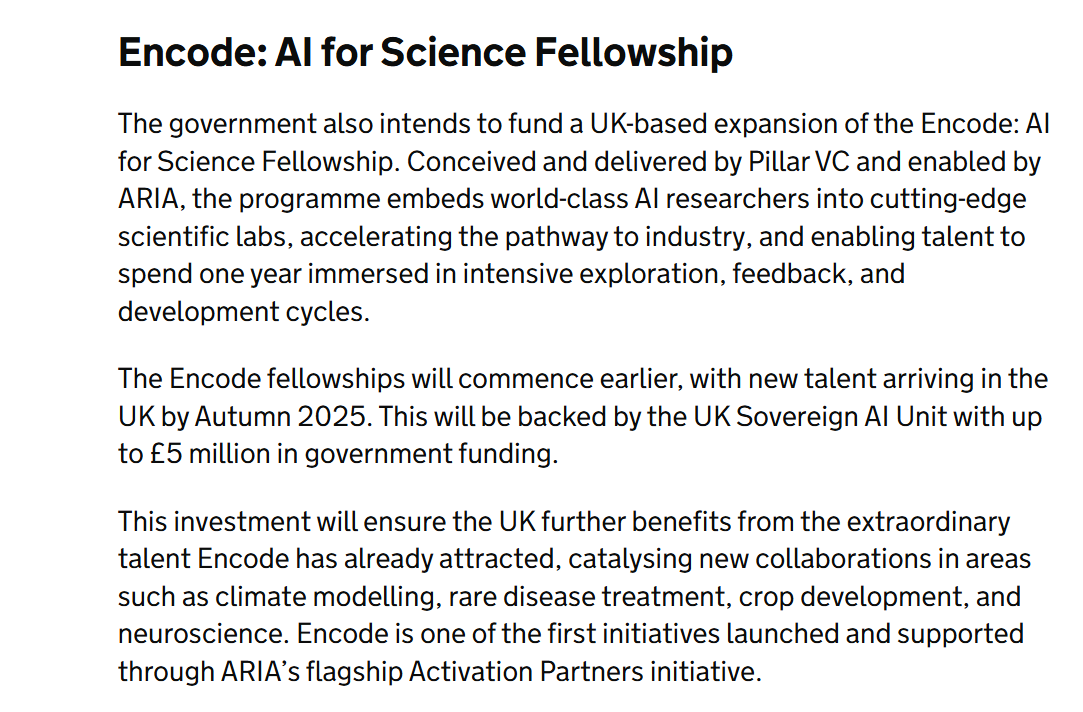
🚨Happy to have helped the Sovereign AI Unit back Encode's AI for Science Fellowship, scaling the phenomenal @pillar_vc programme set up for @ARIA_research This will increase the pipeline of top talent working in the UK on the SovAI's priority AI areas 🇬🇧🧪🤖
Tom Westgarth tweet media
Leah Eliz Morris@leahelizmorris

We're so excited to share that the UK Government intends to fund an expansion of the @pillar_vc Encode: AI for Science Fellowship.

English
1
5
33
4.3K
Madelyn Heart retweetledi
Tom Westgarth
Tom Westgarth@Tom_Westgarth15·
Thank you to @leahelizmorris @madelynheart_ @kulesatony for designing such a brilliant programme that encourages international researchers to choose the UK as their home! These efforts are critical to ensuring that the UK can build the breakthroughs and companies of tomorrow.
English
1
1
4
364
Madelyn Heart retweetledi
Sam Rodriques
Sam Rodriques@SGRodriques·
Today, we’re announcing the first major discovery made by our AI Scientist with the lab in the loop: a promising new treatment for dry AMD, a major cause of blindness. Our agents generated the hypotheses, designed the experiments, analyzed the data, iterated, even made figures for the paper. The resulting manuscript is a first-of-a-kind in the natural sciences, in which everything that needed to be done to write the paper was done by AI agents, apart from actually conducting the physical experiments in the lab and writing the final manuscript. We are also introducing Robin, the first multi-agent system that fully automates the in-silico components of scientific discovery, which made this discovery. This is the first time that we are aware of that hypothesis generation, experimentation, and data analysis have been joined up in closed loop, and is the beginning of a massive acceleration in the pace of scientific discovery that will be driven by these agents. We will be open-sourcing the code and data next week. Robin is a multi-agent system that uses Crow, Falcon, and Finch, the agents on our platform, to generate novel hypotheses, plan experiments, and analyze data. We asked Robin to find a new treatment for dry age-related macular degeneration. Robin considered the disease mechanisms associated with dry AMD, proposed a specific experimental assay that could be used to evaluate hypotheses in the wet lab, and proposed specific molecules we could test in that assay. We tested the molecules and gave it the resulting data, which it analyzed before proposing more experiments. In the end, it identified Ripasudil, a Rho Kinase inhibitor (ROCK inhibitor) that is approved in Japan for several other diseases, which seems very promising as potential treatment for dry AMD. It also identified specific molecular mechanisms that might underlie the effects of Ripasudil in RPE cells, from an RNA sequencing experiment it proposed. To be clear, no one has proposed using ROCK inhibitors to treat dry AMD in the literature before, as far as we can find, and I think it would have been very difficult for us to come up with this hypothesis without the agents. We have also run the proposed treatment by several experts in AMD, who confirm that it is interesting and novel. Moreover, this project was fast: with Robin in hand, the entire project took about 10 weeks, which is way shorter than it would have taken if we had been doing all of the in-silico components ourselves. Important caveats: We are real biologists at FutureHouse, so I want to be clear that although the discovery here is exciting, we are not claiming that we have cured dry AMD. Fully validating this hypothesis as a treatment for dry AMD will take human trials, which will take much longer. Also, this discovery is cool, but it is not yet a "move 37"-style discovery. At the current rate of progress, I'm sure we will get to that level soon. Congratulations to the team. Congratulations in particular to Robin, which generated the hypotheses, proposed the experiments, analyzed the data and generated the figures. And major congratulations also to the human team, which built Robin: @MichaelaThinks, @agreeb66, @benjamin0chang, @ludomitch, Mo Razzak, Kiki Szostkiewicz, and Angela Yiu.
English
111
690
3.6K
1.1M
Madelyn Heart retweetledi
Andrew White 🐦‍⬛
Andrew White 🐦‍⬛@andrewwhite01·
The plan at FutureHouse has been to build scientific agents and use them to make novel discoveries. We’ve spent the last year researching the best way to make agents. We’ve made a ton of progress and now we’ve engineered them to be used at scale, by anyone. Today, we’re launching the FutureHouse Platform: an API and website to use our AI agents for scientific discovery. It’s been a bit of a journey! June 2024: we released a benchmark of what we believe is required of scientific agents to make an impact in biology, Lab-Bench. September 2024: we built one agent, PaperQA2, that could beat biology experts on literature research tasks by a few points. October 2024: we proved-out scaling by writing 17,000 missing Wikipedia articles for coding genes in humans. December 2024: we released a framework and training method to train agents across multiple tasks - beating biology experts in molecular cloning and literature research by >20 points of accuracy. May 2025: we’re releasing the FutureHouse Platform for anyone to deploy, visualize, and call on multiple agents. I’m so excited for this, because it’s the moment that we can see agents impacting people broadly. I’m so impressed with the team at FutureHouse for us to execute our plan in less than 1 year. From benchmark to wide deployment of agents that can exceed human performance on those benchmarks! So what exactly is the FutureHouse Platform? We’re starting with four agents: precedent search in literature (Owl), literature review (Falcon), chemical design (Phoenix), and concise literature search (Crow). The ethos of FutureHouse is to create tools for experts. Each agent’s individual actions, observations, and reasoning is displayed on the platform. Each scientific source is considered from retraction status, citation count, record of publisher, and citation graph. A complete description of the tools and how the LLM sees them is visible. I think you’ll find it very refreshing to have complete visibility into what the agents are doing. We’re scientific developers at heart at FutureHouse, so we built this platform API-first. For example, you can call Owl to determine if a hypothesis is novel. So - if you’re thinking about an agent that proposes new ideas, use our API to check them for novelty. Or checkout Z. Wei’s Fleming paper that uses Crow to check ADMET properties against literature by breaking a molecule into functional groups. We’ve open sourced almost everything already - including agents, the framework, the evals, and more. We have more benchmarking and head-to-head comparisons available in our blog post. See the complete run-down there on everything. You will notice our agents are slow! They do dozens of LLM queries, consider 100s of research papers (agents ONLY consider full-text papers), make calls to Open Targets, Clinical Trials APIs, and ponder citations. Please do not expect this to be like other LLMs/agents you’ve tried: the tradeoff in speed is made up for in accuracy, thoroughness and completeness. I hope, with patience, you find the output as exciting as we do! This truly represents a culmination of a ton of effort. Here are some things that kept me up at night: we wrote special tools for querying clinical trials. We found how to source open access papers and preprints at a scale to get to over 100 PDFs per question. We tested dozens of LLMs and permutations of them. We trained our own agents with Llama 3.1. We wrote a theoretical grounding on what an agent even is! We had to find a way to host ~50 tools, including many that require GPUs (not including the LLMs). Obviously this was a huge team effort: @m_skarlinski is the captain of the platform and has taught me and everyone at FutureHouse how to be part of a serious technology org. @SGRodriques is the indefatigable leader of FutureHouse and keeps us focused on the goal. Our entire front-end team is just half of @tylernadolsk time. And big thanks to James Braza for leading the fight against CI failures and teaching me so much about Python. @SidN137 and @Ryan__Rhys , for helping us define what an agent actually is. And @maykc for responding to my deranged slack DMs for more tools at all times. Everyone at FutureHouse contributed to this in some way, so thanks to them all! This is not the end, but it feels like the conclusion of the first chapter of FutureHouse’s mission to automate scientific discovery. DM me anything cool you find!
Andrew White 🐦‍⬛ tweet media
English
20
64
435
38.6K