Shawn Scully
267 posts

Shawn Scully
@maketaster
AI product guy | ex-AIML @Apple, Turi (acq. ) | founder | physics @Stanford, @Cornell | from Maine in Seattle | I post on AI, product, yurts, & tasty things.


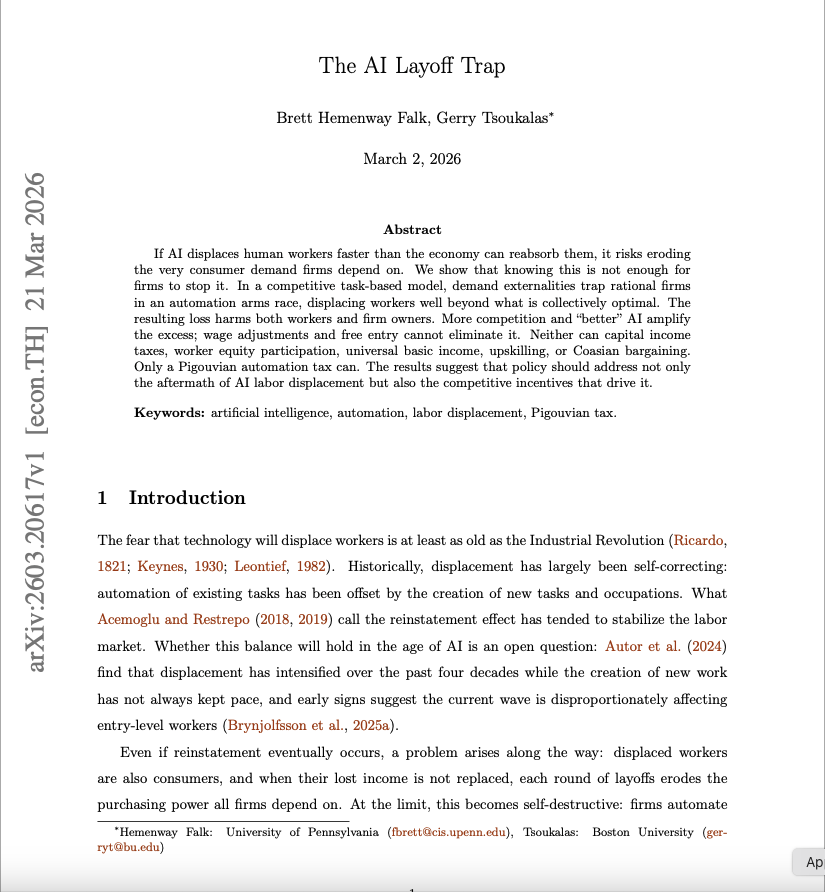
Two economists just published a mathematical proof that AI will destroy the economy. Not might. Not could. Will — if nothing changes. The paper is called "The AI Layoff Trap." Published March 2, 2026. Wharton School, University of Pennsylvania. Boston University. Peer reviewed. Mathematically modeled. The conclusion is one sentence. "At the limit, firms automate their way to boundless productivity and zero demand." An economy that produces everything. And sells it to nobody. Here is how you get there. A company fires 500 workers and replaces them with AI. A competitor fires 700 to keep up. Another fires 1,000. Every company is behaving rationally. Every company is following the incentives correctly. And every company is building a trap for itself. Because the workers who were fired were also customers. When they lose their jobs faster than the economy can absorb them, they stop spending. Consumer demand falls. Companies respond by cutting costs — which means automating more workers — which means less spending — which means more falling demand — which means more automation. The loop has no natural exit. The researchers tested every proposed solution. Universal basic income. Capital income taxes. Worker equity participation. Upskilling programs. Corporate coordination agreements. Every single one failed in the model. The only intervention that worked: a Pigouvian automation tax — a per-task levy charged every time a company replaces a human with AI, forcing them to price in the demand they are destroying before they pull the trigger. No government has implemented this. No major economy is seriously discussing it. Meanwhile the numbers are already tracking the curve. 100,000 tech workers laid off in 2025. 92,000 more in the first months of 2026. Jack Dorsey fired half of Block's workforce and said publicly: "Within the next year, the majority of companies will reach the same conclusion." Nobody is doing anything wrong. Companies are following their incentives perfectly. That is exactly the problem. Rational behavior. At scale. Simultaneously. With no mechanism to stop it. Two economists built the math. The math leads to one place. Source: Falk & Tsoukalas · Wharton School + Boston University · arxiv.org/pdf/2603.20617


There is a tremendous amount of progress happening in World Models. Multiple labs have raised more than $1B. WMs were the star of GTC. They are a real path to embodied AI. So @PimDeWitte & I wrote a comprehensive 19k word overview of World Models. notboring.co/p/world-models


This is the big f**king deal. Cursor acquired for $60BN by xAI I sat down with @jasonlk and @rodriscoll to discuss the deal, along with the biggest news in tech this week: - Anthropic Hits $1TRN in Secondary Markets - Anthropic Launches Claude Code - Rippling Hits $1BN in ARR - Cerebras Files for IPO My notes below: 1. This $60B deal actually makes sense The potential $60 billion acquisition of Cursor by xAI/SpaceX is an industrial "marriage made in heaven". Cursor has an exploding business with billions in ARR but "shitty" gross margins because they lack their own compute and models. Elon Musk has the massive Colossus GPU data center and a model (Grok) but effectively no revenue, making the vertical integration of these two companies a strategic fix for both. 2. How Claude Design Will Hurt Figma Anthropic’s Claude Design is a full design application, not just a set of prompts or skills. It poses an existential threat because it allows product and engineering teams to bypass the traditional 30-day designer turnaround. By enabling "normal people" to design and move into production immediately, it will "maim and nibble" at Figma’s growth over the coming quarters. 3. I used to think MAUs and WAUs were the dumbest metric. Now I think it's the most important. In the B2B world, usage metrics like MAUs, WAUs, and DAUs are now more critical than revenue. If usage isn't growing faster than revenue, it's a sign of a struggling startup or "stealth churn," where users have stopped active engagement despite the company still collecting fees. In the AI age, the ultimate test of a product's value is whether people are actually using its AI features daily. 4. Why the biggest fintech players are in for a shock. Existing moats for fintech giants like Brex and Ramp are weakening as the selection criteria for vendors shifts. Customers are no longer prioritizing a dashboard's UI; they care which API works best with their autonomous AI agents. If a new vendor offers a superior API that allows an "AI VP of Finance" to automate tasks like collections, companies will switch vendors in a single week. 5. Agent fabric is the layer that manages all your agents The defining 2027 challenge is the "agent fabric". The infrastructure needed to manage and secure hundreds of autonomous agents. This gives a massive advantage to incumbents like Salesforce. They are positioning themselves as the trusted governance layer to guardrail agents and prevent them from going rogue


What is the single best health investment you’ve ever made?

On an accidental tyranny of programmers holding back interface invention, from my recent talk: andymatuschak.org/tat/

Imagine every pixel on your screen, streamed live directly from a model. No HTML, no layout engine, no code. Just exactly what you want to see. @eddiejiao_obj, @drewocarr and I built a prototype to see how this could actually work, and set out to make it real. We're calling it Flipbook. (1/5)