Matt Schettenhelm

3.8K posts

Matt Schettenhelm banner
Matt Schettenhelm

Matt Schettenhelm

@mattschett

Bloomberg Intelligence, Analyst-Litigation & Policy. TMT suits, FCC & FTC, after a decade practicing law. @umich, @gwlaw. Opinions mine, RTs≠endorse.

Washington DC Katılım Nisan 2012
1.1K Takip Edilen1.4K Takipçiler
Matt Schettenhelm retweetledi
Roger Parloff
Roger Parloff@rparloff·
Today’s DC Cir oral argument in @AnthropicAI v. @DeptofWar went better for Anthropic than I expected, thought that might not mean victory. The panel was Judges Karen LeCraft Henderson (Reagan/George HW Bush); Greg Katsas (Trump); Neomi Rao (Trump). 1/11
English
4
14
49
5K
Matt Schettenhelm
Matt Schettenhelm@mattschett·
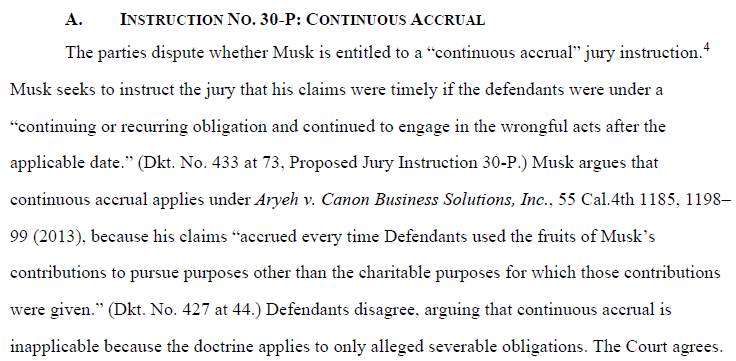
Musk starts as a significant underdog in any appeal to the Ninth Circuit in his OpenAI loss, in my view. I'd expect an appeal to focus in significant part on the judge's refusal to give this jury instruction on "continuous accrual."
Matt Schettenhelm tweet media
English
0
0
2
96
Matt Schettenhelm
Matt Schettenhelm@mattschett·
Judge Karen Henderson coming out strongly against the Department of War in Anthropic case: "This is a spectacular overreach" by the Dept. of War. But Judges Katsas and Rao seem much more deferential, concerned about court jurisdiction.
English
0
0
0
120
Matt Schettenhelm retweetledi
Ashley Capoot
Ashley Capoot@ashleycapoot·
Musk v. Altman is over, but do not fear, there's more AI litigation happening today! A federal appeals court in Washington, D.C., is set to hear arguments in Anthropic’s lawsuit over its blacklisting by the Pentagon. cnbc.com/2026/05/19/ant…
English
0
3
3
376
Matt Schettenhelm retweetledi
CSPAN
CSPAN@cspan·
Chief Justice John Roberts notifies everyone in the Supreme Court oral argument of a flyover: "I don't know why they didn't check with me."
English
26
78
835
362K
Matt Schettenhelm retweetledi
Nathan Dean
Nathan Dean@nathandeanDC·
It was an absolute pleasure for @NYCStein and I to bring back our first three-time guest @HenriettaVeda, co-founder and director of economic policy at Veda Partners, to @BBGIntelligence Votes & Verdicts podcast. We discussed what role Congress will play in the future of the Iranian conflict, the outlook for the US midterms, and something that's not getting a ton of press, what will President Trump focus on in 2027-2028? (hint: the word rhymes with sheriff but starts with a "T"). Apple: podcasts.apple.com/us/podcast/tre… Spotify: open.spotify.com/episode/04ioKT…
Nathan Dean tweet media
English
0
1
4
886
Matt Schettenhelm
Matt Schettenhelm@mattschett·
@MatthewKeysLive Yes, thanks. Still no separate emergency request for a stay of the PI decision during this appeal. Briefing on a request like that would've played out in days/weeks, not months.
English
0
0
0
39
Matt Schettenhelm
Matt Schettenhelm@mattschett·
Nexstar appealed, but if it's going to add an emergency plea to halt Friday's preliminary injunction, the company is sure taking its time in asking. Maybe still a small window to do so, but it's closing fast. Meanwhile, lawsuit/stay plea challenging FCC still just sits. $NXST
Matthew Keys@MatthewKeysLive

...Nexstar is expected to appeal whatever injunction is issued to the Ninth Circuit Court of Appeals. Their emergency application is likely to trigger a stay of whatever injunction is ordered, under Ninth Circuit precedent. $NXST


English
2
2
2
2K
Matt Schettenhelm
Matt Schettenhelm@mattschett·
@nickVrusso Hard to say for sure. Possible they’re taking a wait-and-see approach with an eye on antitrust case. Also possible that (likely) conservative-leaning panel writing up a decision to deny relief now.
English
1
0
1
76
Nick Russo
Nick Russo@nickVrusso·
@mattschett Any idea why it’s taking so long with the D.C. court hearing the FCC ownership waiver challenge?
English
1
0
0
115
Matt Schettenhelm retweetledi
Dudes Posting Their W’s
Dudes Posting Their W’s@DudespostingWs·
Dad gets emotional in the stands after finally seeing his son make it to the big leagues
English
297
1.9K
36.2K
898.4K
Matt Schettenhelm
Matt Schettenhelm@mattschett·
This is my take too. No matter the technical legal outcome, AT&T and Verizon will almost certainly "win" by cementing what the government conceded about the extremely limited effects of FCC forfeiture orders.
Brent Skorup@bskorup

Post-argument: seems like a clear win for regulated parties. Justice Kavanaugh summed it up to AT&T's counsel: "It seems like you've won on the law going forward one way or the other. Your reply brief begins: 'The government's in retreat.' That's absolutely correct."

English
0
1
1
475
Matt Schettenhelm retweetledi
Brent Skorup
Brent Skorup@bskorup·
Post-argument: seems like a clear win for regulated parties. Justice Kavanaugh summed it up to AT&T's counsel: "It seems like you've won on the law going forward one way or the other. Your reply brief begins: 'The government's in retreat.' That's absolutely correct."
English
1
1
1
667
Matt Schettenhelm retweetledi
Chris Walker
Chris Walker@chris_j_walker·
It would be fascinating if the Supreme Court held that a civil penalty imposed by a federal agency basically means nothing (and is not enforceable) unless the agency brings a collection action in federal court.
Thomas Berry@Thomas_A_Berry

I was in the courtroom for today's Supreme Court arguments in AT&T v. FCC, on the Seventh Amendment right to a jury in FCC punitive enforcement proceedings. The government has conceded so much already in this case that the justices seemed frustrated by the almost metaphysical quality of the remaining question: Is an FCC finding of liability and order of forfeiture itself a punishment (triggering the jury right), or is the punishment only when the government *collects* the amount ordered? The government now insists that anyone may ignore a final forfeiture order from the FCC and wait to be sued by the government, and that the forfeiture order carries no stigma or negative consequence on its own until it is actually paid and affirmed. As Jeffrey Wall argued for the carriers, that is not how telecom companies have understood the system for decades. Indeed, his most forceful argument was one based on experience; it appears no telecom company has *ever* chosen to ignore an FCC final order, not pay the fine, and wait to be sued for collection. Nonetheless, some justices seemed open to the idea of writing an opinion holding that an FCC final forfeiture order is (as Wall put it) not even a paper tiger, but just paper. It is possible the Court will go that route, clarify that such an order on its own may carry no stigma and may not be used against a company in any way, and leave the current system in place in which there is no jury until the government comes to collect. Nonetheless, such an opinion would be cold comfort to those who for decades have treated such orders as serious and binding, without the government ever disclaiming that understanding. As with the doctrine of "constitutional avoidance," all too often the government takes a maximalist view of its own powers until those powers are challenged in court, when the government changes its tune and adopts a minimalist view just in time to save the scheme from being struck down. The simpler and better approach would be for the Court to simply hold, as it did in Jarkesy, that the agency enforcement scheme at issue in this case is punitive and thus triggers the jury right.

English
5
5
54
13.2K
Matt Schettenhelm retweetledi
Thomas Berry
Thomas Berry@Thomas_A_Berry·
This morning the Supreme Court will hear arguments in consolidated cases challenging the @FCC's authority to impose massive civil penalties without a jury trial. After an administrative proceeding in front of an agency judge and without a jury, FCC issued final forfeiture orders against @ATT and @Verizon, finding them liable for alleged violations of federal data-protection rules and assessing penalties totaling more than $100 million combined. Although these cases are about the FCC, the stakes extend far beyond telecommunications policy. If the FCC wins, it would allow agencies across the federal government to impose binding judgments first and offer a jury trial only later, if the government chooses to pursue collection. That reverses the constitutional order. The Seventh Amendment protects the right to a civil jury trial in “suits at common law.” As the Supreme Court recently reaffirmed in SEC v. Jarkesy, government actions seeking civil penalties are historically analogous to common-law actions in debt—cases that were tried before juries. The jury is not merely a procedural formality. It is a structural protection against arbitrary government power, ensuring that ordinary citizens stand between the state and the imposition of punishment, whether that punishment is criminal or civil in nature. Yet under the Communications Act, the FCC investigates alleged violations, makes factual findings, determines liability, and imposes binding monetary penalties all in-house, without a jury. These forfeiture orders are not advisory. They declare companies “liable,” create a debt to the United States, and carry immediate consequences, including reputational harm and future regulatory exposure. That is why @CatoInstitute has filed an amicus brief supporting the carriers in the case, co-authored by @bskorup and @AMXenos, in which we argue that the FCC’s forfeiture scheme violates the Seventh Amendment right to a jury. In response, the government argues that the statute offers a supposed escape hatch: a company can refuse to pay and wait for the Department of Justice to bring a collection action in federal court, where a jury trial would be available. But as we explain in our brief, that “choice” is illusory. To preserve even the possibility of a jury trial, a company must openly defy a final agency order, risk additional regulatory retaliation, and endure years of uncertainty. Unsurprisingly, it appears no company has ever taken that option. Companies instead pay and seek review in a court of appeals—where no jury is available and where factual review is deferential to the agency. Our brief makes another, structural point. The government cannot have it both ways on the statute of limitations. To preserve penalties under the five-year statutory limit, the government treats the FCC’s forfeiture proceeding as “enforcement.” But when faced with the Seventh Amendment, it claims the same proceeding is merely “initial.” A process that is final enough to preserve penalty claims cannot simultaneously be too preliminary to trigger the jury right. We urge the Court to adopt a straightforward rule: when an agency proceeding culminates in final agency action and is treated as enforcement sufficient to preserve civil penalties, it constitutes the adjudication of a legal claim for money. In such cases, the Seventh Amendment requires a jury before liability is conclusively determined. A later, optional enforcement suit cannot retroactively cure a Seventh Amendment violation. At the Founding, the jury’s role was antecedent—not remedial. Because the carriers’ liability was determined before they had access to a jury, the Supreme Court should rule that their Seventh Amendment rights were violated.
English
1
8
24
28.6K