Johnny Soraker

3K posts

Johnny Soraker banner
Johnny Soraker

Johnny Soraker

@metus

No longer posting here. Hoping to soon regain faith in social media and start posting at https://t.co/rZTaeVCA7e

Amsterdam, The Netherlands Katılım Nisan 2008
842 Takip Edilen1.2K Takipçiler
Johnny Soraker retweetledi
Travis Akers 🇺🇸
Travis Akers 🇺🇸@travisakers·
A message from a Kindergarten teacher: After forty years in the classroom, my career ended with one small sentence from a six-year-old: “My dad says people like you don’t matter anymore.” No sneer. No malice. Just quiet honesty — the kind that cuts deeper because it’s innocent. He blinked, then added, “You don’t even have a TikTok.” My name is Mrs. Clara Holt, and for four decades, I taught kindergarten in a small Denver suburb. Today, I stacked the last box on my desk and locked the door behind me. When I started teaching in the early 1980s, it felt like a promise — a shared belief that what we did mattered. We weren’t rich, but we were valued. Parents brought warm cookies to parent nights. Kids gave you handmade cards with hearts that didn’t quite line up. Watching a child sound out their first sentence felt like magic. But that world slowly slipped away. The job I once knew has been replaced by exhaustion, red tape, and a kind of loneliness I can’t quite describe. My evenings used to be filled with construction paper, glitter, and glue sticks. Now they’re spent filling out digital reports to protect myself from angry emails or lawsuits. I’ve been yelled at by parents in front of twenty-five children — one filming me with his phone while I tried to calm another child mid-meltdown. And the kids… they’ve changed too. Not by choice. They arrive tired, anxious, overstimulated. Their tiny fingers know how to swipe a screen before they can hold a crayon. Some can’t make eye contact or wait in line. We’re expected to fix all of it — to patch the gaps, heal the trauma, teach the curriculum, and document every move — in six hours a day, with resources that barely fill a drawer. The little reading corner I once built, full of soft beanbags and paper stars, was replaced by data charts and “learning metrics.” A young principal once told me, “Clara, maybe you’re too nurturing. The district wants measurable results.” As if kindness were a weakness. Still, I stayed. Because of the small, holy moments that no spreadsheet could measure — a whisper of, “You remind me of my grandma.” a shaky note that read, “I feel safe here.” a quiet boy finally meeting my eyes and saying, “I read the whole page.” Those tiny sparks were my reason to keep showing up. But this last year broke something in me. The aggression grew sharper. The laughter in the staff room turned to silence. The light went out of so many eyes. I watched brilliant teachers — my friends — vanish under the weight of burnout, their joy replaced by survival. I felt myself fading too, like chalk on a board that’s been wiped one too many times. So today, I began my goodbye. I pulled faded art off the walls and tucked thirty years of handmade cards into a single box. In the back of a drawer, I found a letter from a student from 1998: “Thank you for loving me when I was hard to love.” I sat on the floor and cried. No party. No applause. Just a handshake from a young principal who called me “Ma’am” while checking his notifications. I left my rocking chair behind, and my sticker box too. What I carried with me were the memories — the faces of hundreds of children who once trusted me enough to reach out their hands and learn. That can’t be uploaded. It can’t be measured. It can’t be replaced. I miss when teachers were partners, not targets. When parents and educators worked side by side, not in opposition. When schools cared more about wonder than numbers. So if you know a teacher — any teacher — thank them. Not with a mug or a gift card, but with your words. With your respect. With your understanding that behind every test score is a heart that cared enough to try. Because in a world that often overlooks them, teachers are the ones who never forget our children.
English

3.3K
22K
112.3K
6.4M
Johnny Soraker retweetledi
Nick #RespiratorsFilterPathogens😷 Anderegg
If Florida drops vaccine mandates, society is probably officially over. I really, really, really don’t think most people get that herd immunity is the only thing keeping measles from ripping through the population, and a measles infection wipes out all pre-existing immunity 1/3
English
526
4.5K
36.1K
1.9M
Johnny Soraker retweetledi
The Nobel Prize
The Nobel Prize@NobelPrize·
This year’s chemistry laureates Demis Hassabis and John Jumper have developed an AI model, AlphaFold2, to solve a 50-year-old problem: predicting proteins’ complex structures. Check out two examples of protein structures determined using AlphaFold2. First up, a bacterial enzyme that causes antibiotic resistance. The structure is important for discovering ways of preventing antibiotic resistance. Animation: ©Terezia Kovalova/The Royal Swedish Academy of Sciences #NobelPrize
English
75
1.8K
5.6K
710.6K
Johnny Soraker retweetledi
Thomas Wolf
Thomas Wolf@Thom_Wolf·
Self-care life hack: if you feel a bit down/tired, paste the url of your website/linkedin/bio in Google's NotebookLM to get 8 min of realistically sounding deep congratulations for your life and achievements from a duo of podcast experts 😂
English
111
340
4K
610.4K
Johnny Soraker retweetledi
Google DeepMind
Google DeepMind@GoogleDeepMind·
Learning to play even 1️⃣ video game is an achievement for AI - but understanding instructions and applying them to unseen games is even harder. 🎮 Join host @fryrsquared and researcher Frederic Besse as they explore the complex world of AI agents – programs that can learn, adapt, and act in virtual environments. ↓
English
6
46
201
31.7K
Johnny Soraker retweetledi
Yann LeCun
Yann LeCun@ylecun·
BS. The EU also has free speech. In fact, the only EU countries that violate free expression have far-right governments, like Hungary. The US and the EU have slightly different ideas about what speech is okay and what speech isn't. Both restrict defamation, fraud, child pornography, speech integral to illegal conduct, speech that incites imminent lawless action, speech that violates intellectual property law, true threats, false statements of fact, and commercial speech such as advertising. The US also restricts "obscenity", which the EU doesn't (Europe is way freer than the US in that dimension). The US also frowns upon speech that demeans religion, even if it's not illegal. Much of the EU doesn't (e.g. see the Charlie Hebdo saga). The EU restricts hate speech (e g. "incitement to racial hatred") and Holocaust denial, which the US doesn't. It is this type of speech that helped bring about Fascism in 1930s Europe. They don't want a repeat. That's why Karl Popper famously said that in order to preserve themselves, democracies must be intolerant to intolerance. en.wikipedia.org/wiki/United_St…
English
847
236
3K
536K
Johnny Soraker retweetledi
Tobias Rees
Tobias Rees@tobias_rees·
being a bohemian, to a large degree, means being a person that doesn’t fit in/is not reducible to existing categories or use cases. it often means being called a do no good. it is unfortunate — bc the value that people who exist in between known categories can bring is enormous.
English
0
1
2
197
Johnny Soraker retweetledi
Nando de Freitas
Nando de Freitas@NandoDF·
Hmmm, from what I see my colleagues in AI at Google London work bloody long ours and are extremely committed. This guy once came to London and told us to abandon Torch and use TensorFlow. That set the field of AI back by at least 6 months.
English
45
102
2.4K
415.4K
Johnny Soraker retweetledi
Andrej Karpathy
Andrej Karpathy@karpathy·
# RLHF is just barely RL Reinforcement Learning from Human Feedback (RLHF) is the third (and last) major stage of training an LLM, after pretraining and supervised finetuning (SFT). My rant on RLHF is that it is just barely RL, in a way that I think is not too widely appreciated. RL is powerful. RLHF is not. Let's take a look at the example of AlphaGo. AlphaGo was trained with actual RL. The computer played games of Go and trained on rollouts that maximized the reward function (winning the game), eventually surpassing the best human players at Go. AlphaGo was not trained with RLHF. If it were, it would not have worked nearly as well. What would it look like to train AlphaGo with RLHF? Well first, you'd give human labelers two board states from Go, and ask them which one they like better: Then you'd collect say 100,000 comparisons like this, and you'd train a "Reward Model" (RM) neural network to imitate this human "vibe check" of the board state. You'd train it to agree with the human judgement on average. Once we have a Reward Model vibe check, you run RL with respect to it, learning to play the moves that lead to good vibes. Clearly, this would not have led anywhere too interesting in Go. There are two fundamental, separate reasons for this: 1. The vibes could be misleading - this is not the actual reward (winning the game). This is a crappy proxy objective. But much worse, 2. You'd find that your RL optimization goes off rails as it quickly discovers board states that are adversarial examples to the Reward Model. Remember the RM is a massive neural net with billions of parameters imitating the vibe. There are board states are "out of distribution" to its training data, which are not actually good states, yet by chance they get a very high reward from the RM. For the exact same reasons, sometimes I'm a bit surprised RLHF works for LLMs at all. The RM we train for LLMs is just a vibe check in the exact same way. It gives high scores to the kinds of assistant responses that human raters statistically seem to like. It's not the "actual" objective of correctly solving problems, it's a proxy objective of what looks good to humans. Second, you can't even run RLHF for too long because your model quickly learns to respond in ways that game the reward model. These predictions can look really weird, e.g. you'll see that your LLM Assistant starts to respond with something non-sensical like "The the the the the the" to many prompts. Which looks ridiculous to you but then you look at the RM vibe check and see that for some reason the RM thinks these look excellent. Your LLM found an adversarial example. It's out of domain w.r.t. the RM's training data, in an undefined territory. Yes you can mitigate this by repeatedly adding these specific examples into the training set, but you'll find other adversarial examples next time around. For this reason, you can't even run RLHF for too many steps of optimization. You do a few hundred/thousand steps and then you have to call it because your optimization will start to game the RM. This is not RL like AlphaGo was. And yet, RLHF is a net helpful step of building an LLM Assistant. I think there's a few subtle reasons but my favorite one to point to is that through it, the LLM Assistant benefits from the generator-discriminator gap. That is, for many problem types, it is a significantly easier task for a human labeler to select the best of few candidate answers, instead of writing the ideal answer from scratch. A good example is a prompt like "Generate a poem about paperclips" or something like that. An average human labeler will struggle to write a good poem from scratch as an SFT example, but they could select a good looking poem given a few candidates. So RLHF is a kind of way to benefit from this gap of "easiness" of human supervision. There's a few other reasons, e.g. RLHF is also helpful in mitigating hallucinations because if the RM is a strong enough model to catch the LLM making stuff up during training, it can learn to penalize this with a low reward, teaching the model an aversion to risking factual knowledge when it's not sure. But a satisfying treatment of hallucinations and their mitigations is a whole different post so I digress. All to say that RLHF *is* net useful, but it's not RL. No production-grade *actual* RL on an LLM has so far been convincingly achieved and demonstrated in an open domain, at scale. And intuitively, this is because getting actual rewards (i.e. the equivalent of win the game) is really difficult in the open-ended problem solving tasks. It's all fun and games in a closed, game-like environment like Go where the dynamics are constrained and the reward function is cheap to evaluate and impossible to game. But how do you give an objective reward for summarizing an article? Or answering a slightly ambiguous question about some pip install issue? Or telling a joke? Or re-writing some Java code to Python? Going towards this is not in principle impossible but it's also not trivial and it requires some creative thinking. But whoever convincingly cracks this problem will be able to run actual RL. The kind of RL that led to AlphaGo beating humans in Go. Except this LLM would have a real shot of beating humans in open-domain problem solving.
Andrej Karpathy tweet media
English
405
1.2K
8.8K
1.2M
Johnny Soraker retweetledi
Dr Kareem Carr
Dr Kareem Carr@kareem_carr·
I think a lot of science illiteracy comes out of a deficiency in humanities education. Why? Because, unless the evidence is very clear cut, and it almost never is, the skills you need to determine the scientific consensus on an issue are skills that you learn in the humanities.
Dr Kareem Carr tweet media
English
46
126
716
37.2K
Johnny Soraker retweetledi
News from Google
News from Google@NewsFromGoogle·
Over the past few days, some people on X have posted claims that Search is “censoring” or “banning” particular terms. That’s not happening, and we want to set the record straight. The posts relate to our Autocomplete feature, which predicts queries to save you time. Autocomplete is just a tool to help you complete a search quickly. Regardless of what predictions it shows at any given moment, you can always search for whatever you want and get easy access to results, images and more. Here’s what happened, why and how we responded to it. 🧵(1/5) →
English
932
208
1.2K
497.2K
Johnny Soraker retweetledi
@emilymbender.bsky.social
@emilymbender.bsky.social@emilymbender·
I've seen a lot of awful and ridiculous AI hype in the past two years, but this weekend there was one that briefly took away my ability to even. I recovered, and wrote up a newsletter post: buttondown.email/maiht3k/archiv…
English
7
55
132
13K
Johnny Soraker retweetledi
CoffeeWithTheClassics
CoffeeWithTheClassics@CoffeewClassics·
Dostoevsky understood people so well, it's ridiculous:
CoffeeWithTheClassics tweet media
English
256
7.2K
46.1K
3.7M
Johnny Soraker retweetledi
Robin Houston
Robin Houston@robinhouston·
This is one of the funniest things I've ever seen. I don't know why OP deleted it, but I think it needs to be preserved for posterity.
Robin Houston tweet media
English
117
3.6K
36.9K
1.2M
Johnny Soraker retweetledi
Derek Thompson
Derek Thompson@DKThomp·
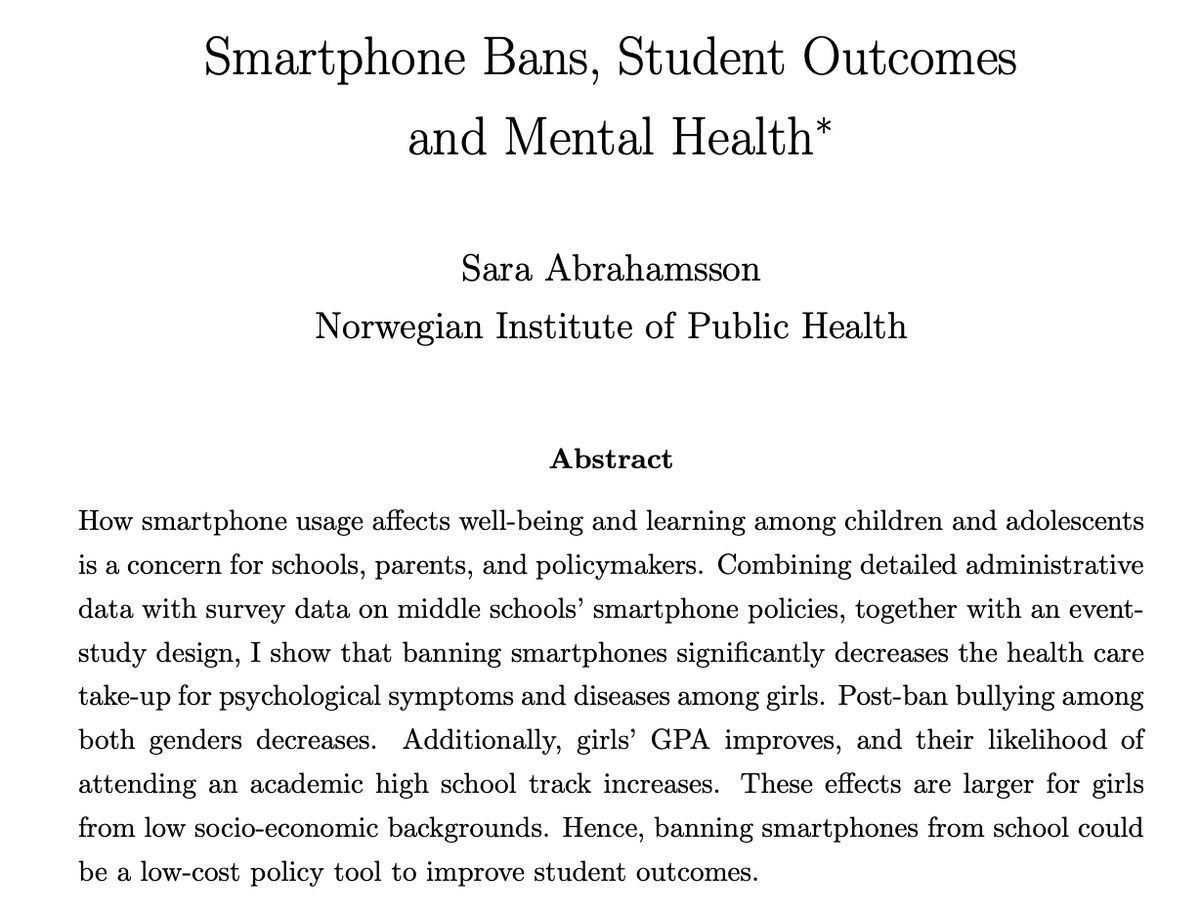
New paper from Norway: Banning smartphones in school - significantly decreased doctors visits for psychological symptoms and diseases among girls - reduced bullying among both genders - improved girls’ GPA and attendance rates - largest effect sizes were among the poorest kids
Derek Thompson tweet media
English
213
3.9K
16.4K
3M
Johnny Soraker retweetledi
Dr. Jonathan N. Stea
Dr. Jonathan N. Stea@jonathanstea·
Today is World Homeopathy Day. In its honor, let’s remember that time The Amazing James Randi overdosed on homeopathy and lived to tell about it.
English
155
1.4K
5.5K
648.1K