Markus Gnirck

2.2K posts

Markus Gnirck banner
Markus Gnirck

Markus Gnirck

@mgnirck

Building the leading nutrition brand in Asia | Trail runner | Angel investor | Founder @leckanutrition @trybgroup

Katılım Şubat 2012
189 Takip Edilen3.5K Takipçiler
Markus Gnirck retweetledi
Joe Weisenthal
Joe Weisenthal@TheStalwart·
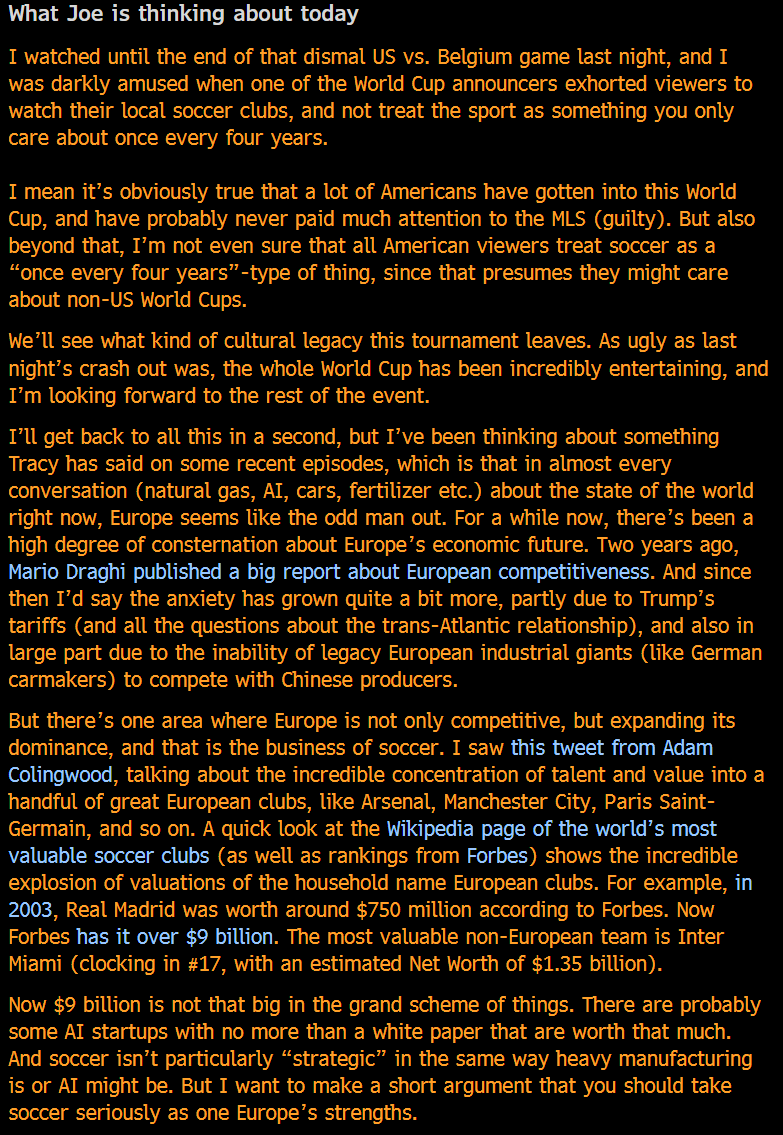
THE REAL BULL CASE FOR EUROPE: I wrote about soccer club valuations, and how if you take seriously the question of "what will be scarce in the age of AGI?", then one answer is "anything with a sense history" and there is a lot of that to be found in Europe.
Joe Weisenthal tweet mediaJoe Weisenthal tweet media
English
39
68
998
129.6K
Markus Gnirck retweetledi
david friedberg
david friedberg@friedberg·
never thought i’d say this… i wholeheartedly agree with elizabeth warren. also, term limits. being an elected representative should not be a career. there should be no path for wealth creation or perpetual income from representing the interests of the people, in service of the people. private citizens should enter public service, leave, and return to private life, as the founders intended. “politician” has become a lucrative career option for those skilled at public oration and persuasion. while they may represent their constituents’ interests, the reelection mandate incentivizes short-term decision-making and voting, often counter to the long-term interests of the people. and having unfettered private market access while holding the privileged position of influence over, and non-public knowledge of, those markets will inevitably incentivize bad behavior, to the politician’s benefit, and the public’s detriment. these ideals may be too far-fetched for our modern political machinery to consider - they would be self-defeating of the machines themselves - but the citizens can still be deafeningly loud in demanding them. thx senator warren for getting this half-right.. also, term limits.
Elizabeth Warren@ewarren

It's time for us to ban stock trading for all members of Congress, for the vice president, and for the president. Period.

English
252
240
4.2K
269.6K
Markus Gnirck
Markus Gnirck@mgnirck·
Building a race nutrition planner for all the athletes out there, trying to figure out how to plan their race nutrition better. Check it out on plan.getlecka.com It sits on top of a lot of nutrition knowledge that we have been accumulating over the years at Lecka Nutrition.
Markus Gnirck tweet media
English
0
0
0
25
Markus Gnirck retweetledi
Balaji
Balaji@balajis·
The purpose of crypto is to build a code-based order, because the rules-based order is unfortunately collapsing. That code-based order covers some of what international law once protected. It guarantees property rights, smart contracts, rule-of-code, privacy, secure voting, and user accounts across borders. Even in the face of debanking and denaturalization, the code-based order means you retain your onchain currency and onchain identity. It is true that the crypto networks that buttress the code-based order are supported in significant part by finance and lotteries. But all 50 states of the US are also supported by finance and lotteries. The question is whether the world gets something better, on balance, for that cost. As nationalism and socialism rise, the code-based order ensures that international capitalism continues. Anyone from anywhere has equality of opportunity on the Internet. You can sign a smart contract across borders with someone without knowing (or needing to know) their race, religion, accent, ancestry, or other likely irrelevant attributes. Similarly, as more companies leave failing states like Delaware and California…the code-based order will protect these corporate refugees. The entities themselves and all their contracts can now be put onchain. They can dock in country X and move to country Y at the press of a button. Redomiciliation becomes as common as incorporation. Moreover, as the politically disfavored emigrate from communist states, the code-based order also protects their property and identity via cryptography. And, if all goes well, it also adds a layer of unbreakable privacy. In short: the West is entering a period of failing states just as the East sees the rise of the all-powerful state. The balance to both of these is the code-based order that Satoshi laid the foundations for. That’s what cryptocurrency was built for. If and when your state fails, or turns against you, the Internet will be there for you.
Coop 💿@Cooopahtroopa

I think crypto is in the weirdest spot its been since I joined the space in 2017 Beyond speculating and gambling its hard to see how it adds meaningful value to people's lives and enough time has passed that you start to wonder if/when that won't be the case anymore

English
241
381
2.4K
329.8K
Christian Miele
Christian Miele@christianmiele·
Deutschland wäre eigentlich das perfekte Land um eine Flattax einzuführen: Nimmt sofort Komplexität raus. Zwei Fliegen mit einer Klappe.
Deutsch
125
30
837
53.7K
Markus Gnirck retweetledi
vitalik.eth
vitalik.eth@VitalikButerin·
This is what I worry Europe will get negatively polarized into: an ideology taking pride in a neat, sanitized online environment free of evil corporate and fascist pathogens. I hope European govs do not go this way, and instead take a Pirate Party approach of user empowerment. First, what's wrong with the tweet I'm quoting: The idea that there should be "no space" for something you dislike is fundamentally a totalitarian and anti-pluralistic impulse. It's incompatible with being in an environment that you do not fully control. This is especially true for categories that are subjective and controversial, because you end up trying to fully remove things you think are pathogens, when other people have good faith disagreements, and because you give yourself the maximalist goal of not even giving them breathing room, you create conflict and end up building the machinery of technocratic authoritarianism to impose your victory in the conflict. So sorry, if you want to be a free society, you have to bite the bullet that some people, somewhere, will be selling things that you consider dangerous and saying things you consider disinformation and vicious lies. What is the goal to shoot for? You want to create an environment where those things don't dominate. This is the problem with twitter today: not that it's a safe space where 1000 people talk to each other in a corner about how heritage americans are the master race and putin is good or whatever, but that that crap gets shoved in our face on a mass scale, and the algorithms actively favor it. The right metaphor is not castles and walls, but biological - think, why European forests don't have tropical lizards. Having incentives for social media platforms to have less of those things instead of more is fundamentally reasonable, @audreyt has talked about how Taiwan has done something similar. You also want to do this in a way where it's clear what the underlying principle is, so it's not a vehicle for imposing arbitrary and frequently changing expert-consensus agendas. You also want to empower users, rather than working against them. People want to see and buy good things instead of bad things. Often the problem is that competition is too difficult in the current market. I actually supported the USB-C standardization mandate; it created more interoperability and thus improved competition and convenience. I would support incentivizing social platforms to be more open, and to be more transparent (eg. my proposal to require algorithms to be continuously published with a 1-2 year delay, with zk-proofs to ensure that the algorithm being used in real time exactly equals the one that gets published later) Being able to better identify what messages are coming from what communities is also good, though I don't support the direction of banning anonymity of individual posters, rather I would want to see more macro-scale analytics, eg. seeing what communities are most strongly saying and amplifying content that semantically matches a particular idea; this can be done in privacy-preserving ways. There is a real opportunity to reaffirm freedom of speech in a unique and different way, that emphasizes pluralism and pushes against unbalanced attempts to manipulate the discourse by individual powerful actors. We want to do this, not go down the dark path of having something that claims to support fundamental rights but actually is not trusted by anyone to be anything other than the fundamental right to follow the footsteps of a few technocratic experts.
Digital EU 🇪🇺@DigitalEU

𝗡𝗢 space for cyberbullying. 𝗡𝗢 space for dangerous products. 𝗡𝗢 space for hate speech. 𝗡𝗢 space for scams. 𝗬𝗘𝗦. With the Digital Services Act, what is illegal offline remains illegal online. 🔗 link.europa.eu/gbRf9h

English
632
804
5.1K
631.7K
Markus Gnirck retweetledi
VEO
VEO@vrexec·
There’s this recurring trope that Europe is overregulated and the US is this sort of free-wheeling world where anything goes. As with everything, the reality is far more nuanced. I used to believe this trope myself… until I actually lived in Europe and experienced it. In Europe, regulation often operates at the collective level.. think healthcare, labor protections, food standards, infrastructure. These regulatory frameworks are heavy by design in that they create stability by increasing broad citizen-level confidence in them actually functioning. But at the individual level, daily life can be far looser. There are playgrounds in Europe that would be illegal in the US due to their “danger.” People rarely wear helmets.. not even toddlers.. on bicycles in many places. Kids climb trees higher and parents barely care or even notice. Farms are open.. kids can climb all over haystack mountains and nobody asks if their farmer is insured. There is a playground in the NL of *literal* piles of discarded shipping pallets and construction debris with rusty jagged nails sticking out everywhere… and little kids climb all over them with hammers connecting random pieces together. One false step and you’re slicing an artery or losing an eye. Yet there is barely any adult supervision, parents don’t care, and nobody is signing any paperwork or waiving liability. We bring American friends there and they literally cannot believe what they’re seeing. And they don’t let their kids. Activities proceed on the assumption that risk is visible, understood, and partly if not mostly your responsibility. Menanwhile… in the US we paradoxically flip this culture. Collectively, we resist broad social regulation writ large. Individually, though, life is wrapped in micro-regulation everywhere… liability waivers, warning labels, signage, insurance restrictions, endless legal disclaimers. Every activity sees to have some paperwork. Everyone is covering for something. This is a cultural thing. The US actually uses the legal system as a cover for social risk-sharing. In much of Europe, the downside of injury or bad luck is partially absorbed by healthcare systems, disability supports, and social insurance. The cost of risk is basically capped for you. The system carries some of the shock. In the US, harm can be financially catastrophic. When something goes wrong, someone has to pay, and courts become the primary mechanism for redistributing that risk after the fact… not “the government.” The you had to layer in contingency-based personal injury law and jury trials, and blaming someone else for your problems becomes economically logical. There’s little downside to suing, meaningful upside if you win, and enormous unpredictability for defendants.. hence why insurance costs have become comically absurd. So what happens…. Businesses respond long before anything reaches court by engineering out risk in daily life… more warnings, more forms, fewer “at your own risk” type playgrounds or other environments. So Europe can feel more regulated on paper… but in actual lived experience that matters to your day to day existenxe, in the US we are often navigating a far narrower acceptable window of risk. In many ways, the US is the most highly regulated place in the entire world, by far, it’s just not “the government” doing the regulating.
English
426
1.2K
6.7K
487K
Markus Gnirck retweetledi
@levelsio
@levelsio@levelsio·
🇪🇺 So good to see the world wake up to the terrors of the European Commission I hope all the attention helps European people via their country's governments force the European Union to reform and redesign its structure to one that's actually democratic No indirect appointment of corrupt cronies but actual democracy close to the people It also makes no sense to have 720 members of the European Parliament, it's simply too much and makes it too inefficient The real cancer rotting the EU from within though is the European Commission which should be disbanded and replaced with a democratic body FYI the European Commission consists of 32,000 paid civil servants and all it does it create laws that nobody agrees with Europeans, you should keep posting about the terrors of the European Commission and vote parties into power in your country that can put real pressure on the EU to change and reform
English
1.1K
2.1K
12.7K
26.6M
Markus Gnirck retweetledi
Naval
Naval@naval·
In 1971, money changed from a natural system (gold) to a socialist system (fiat). Crypto is tech to replace socialist money with a free-market system. Market systems are inherently competitive and as tech evolves, new monies will continue to emerge to challenge existing ones.
English
812
1.6K
13.4K
1.7M
Markus Gnirck retweetledi
Naval
Naval@naval·
If it starts with the word “public,” it’s probably in decay.
English
460
544
8.2K
550.3K
Markus Gnirck retweetledi
Russ Greene
Russ Greene@GreenPlusAnE·
Under @GovernorVA Glenn Youngkin, Virginia created a new permitting dashboard, and cut permit processing times by 72%. The state's attracted $125 Billion in capital investment since 2022. Conservative abundance at work.
Russ Greene tweet media
English
19
101
710
264.2K
Markus Gnirck retweetledi
Ryan Holiday
Ryan Holiday@RyanHoliday·
Not a lot of people understand this... but you actually don’t have to have an opinion about everything. You don’t have to decide if something is good or bad. Marcus Aurelius says limiting the amount of opinions we have is one of the most powerful things we can do in life.
English
172
478
3.2K
154.9K
Kote
Kote@kotecinho·
1982 Mercedes-Benz 500SL
Kote tweet mediaKote tweet mediaKote tweet mediaKote tweet media
Deutsch
4
35
334
23.7K
Markus Gnirck retweetledi
Meng Hu
Meng Hu@MengHu13·
This graph shows that the higher the economic freedom, the higher the income of the poorest 10% of the population.
Meng Hu tweet media
English
83
838
3.9K
334.8K
DarkMiner
DarkMiner@DarkMiner·
Calm before the storm Going to give them hell in tomorrow’s triathlon!
DarkMiner tweet media
English
37
0
156
11K