Monica
375 posts


Monica
@monicashiii
#1 neocloud analyst


The Special Forces of Demand: How Nvidia Manufactures Demand Through Neoclouds Let me present to you the Special Forces for Demand of Nvidia - the Neoclouds. Jensen, a veteran of the dot-com era, knew exactly what he had to take care of and control in order to maintain Nvidia’s position for as long as possible. You need to diversify your base of clients, keep your competitors from gaining any stake in the game, and above all, control the demand if you want to keep the “Beat and Raise” cycle going as long as possible. Once you control the demand, you control the numbers, who gets what, and how much they get. To achieve all of this, beyond becoming one of the top venture capitalists with investments in over 120 AI companies and startups, Nvidia made sure to create, push, and promote the “Neoclouds” in the AI industry. Since the end of 2022, Nvidia has led investment rounds, participated as an investor, and provided GPUs for cloud credits or equity stakes in today’s leading Neoclouds. Jensen made sure to promote these Neoclouds among investors as the “next hyperscaler” that you wouldn’t want to miss. By creating a sense of FOMO, Jensen ensured that the Neoclouds received all the funds they needed including Nvidia’s own, to buy more GPUs, secure demand and dominate the GPU-leasing industry. Looking to rent AMD GPUs from any of the leading neoclouds? Coincidentally, none of them offer those. Oh, I’m sorry, there’s only one that offers some AMD GPUs, Crusoe, with a deal Jensen didn’t like. These Neoclouds, along with the hyperscalers, dominate the GPU-leasing market. Nvidia, both as an investor and as a GPU supplier, made sure to control the demand. And if there is any concern about demand, don’t worry. Nvidia will make sure to cover it (e.g. CoreWeave) or rent for its own use (e.g. Lambda). And if you don’t have a client yet, Nvidia will make sure to find one for you (e.g. Microsoft for Nscale). Demand must exist. Chips must sell. The "Beat and Raise" machine must continue. If that requires providing cash, leading IPOs, buying stakes in vendors, or funding investment rounds, whether ten billion or one hundred billion dollars, it will happen. When genuine demand is not enough, it is manufactured. Barter transactions, equity-for-revenue swaps, and cloud credits for GPUs become the tools. Whatever it takes to keep the manufactured demand engine running, Nvidia will make sure it does with its Special Forces for Demand, the Neoclouds.








Agentic Restaurant Reservations. If your agent has a wallet and supports x402/@mpp via @agentcashdev, @coinbase, or @tempo, it can now book restaurant reservations through agentres.dev Built this as a fun experiment. Give it a try!


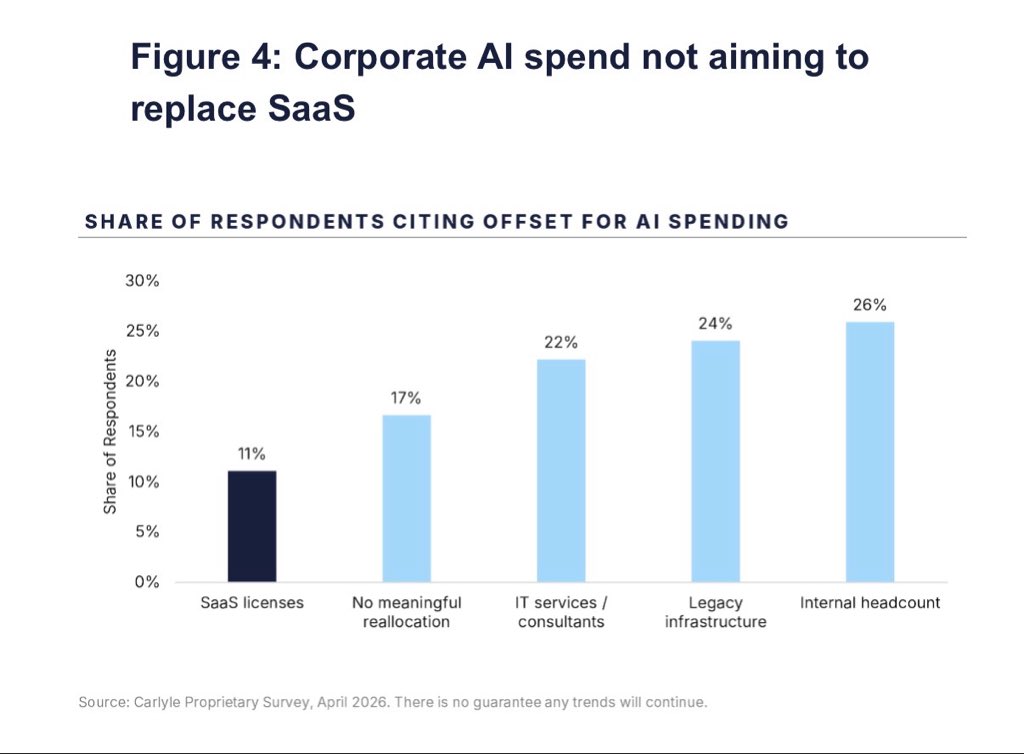



The Phone in the Limo is Busted The "buy the dip" mentality floating around software right now feels a lot like pattern matching to the wrong cycle. This is not meant to be or sound like a generic bear porn take. I am attempting to share my observation about the quality of information available to make that bet, and the reliability of the signals people are using to make it. I've written about the private markets mechanics and the credit backdrop separately (use the twit search function for more background). In this post I am going to attempt to bring it together a bit more... Let's start with the mosaic. The BTD ("buy the fcking you dip, you fcking moron - youtube.com/watch?v=0akBdQ…) crowd isn't necessarily wrong about any single piece of this. Slowing growth alone, 'seems' manageable. Multiple compression alone if history is any guide (I don't believe it is...), potentially an opportunity. AI disruption narrative alone, maybe overblown for specific names (feels that way, but I can't prove it...can you?). Rising debt alone, depends on the asset. PE overhang alone, slow moving but they are actively playing defense in lights. But when I take a step back, you have all of them simultaneously, and you're weighting them selectively to support a position you already want to have. Essentially, I see cherry picking one name that checks two or three boxes is not the whole picture. The signals people are leaning on to support that rationalization are broken. Let's start with the obvious one...management guidance. The visibility that made SaaS guidance reliable is genuinely impaired right now. AI impact on renewal rates, expansion revenue, customer behavior, nobody has clean line of sight on this. Management isn't lying. They just don't know either. The confidence required to extrapolate forward from the last four years hasn't been earned by the situation. Next let's address buybacks. FinTwit loves pushing buybacks as this panacea. Borrowing money to retire shares is not a vote of confidence in the business from my perch. We are witnessing 'earnings per share management', SBC dilution control, and in some cases financial engineering to hold a stock up that is doing real operational work as a retention and recruiting tool. Next, when the terminal value question is genuinely open, levering up against an uncertain denominator is a wild risk to take. The buyback benefits the people making the decision more directly than it benefits you the investor (good for the traders). One of the most oversold narratives in investing is insider buying. I mean, don't get me wrong, I like when insiders of the companies I am involved with buy stock. I privately encourage insiders, who have a great feel for their forward looking prospects to get ahead of it as a signal to market participants, and for their own wealth generation to buy stock before the path is obvious to others... But keep in mind, that many of these executives are already wealthy (I could give you some great stories about encouraging insiders at Nexstar to just do this before several material earnings inflections). Let's address something and just say it directly...seat risk and livelihood risk are not the same conversation. A $1M open market purchase when you have $40M in stock and options is an extremely cheap signal to send, and the market treats it like something big/game changing that costs something real. The asymmetry between what it signals and what it actually costs them personally is too wide right now to carry the weight people are putting on it. Get your mind right. I am not here to shit on the sell side. The research space is a tool, that's it! But let's discuss sell side estimates. The models were built for a world of predictable recurring revenue and stable competitive moats. The adjustments being made to those models are just educated guesses about something with no real historical precedent. I am genuinely not making a criticism of the analysts making the estimates and revisions call or changing the price targets after the stock or sector gets walloped, but its their job and they have the incentive structure to match that seat. There are also a lot of narrative violations occurring with large PE sponsor(s) commentary in the press. When Thoma and Vista are making the media rounds reassuring everyone about portfolio health, that is the only lever they have left, and I don't really see this as a datapoint with a lot of merit. So as of now, they aren't walking away from their companies, and why should they? They are not handing keys to lenders (yet/now), and why should they? But let's take a 2021 or 2022 vintage deal, bought at 10 to 14 times sales, financed at 7 times leverage when debt cost 9 percent (wrap deal structure), in a business that has slowed from 25 percent growth to 7 percent, with comps that have re-rated from 10 times to 3 or 4 times sales, with debt that now costs 13 percent. The math certainly works less efficiently now, and there is a case to be made that on paper the equity is impaired, and the IRRs presented 6-9 months ago are pretty much unlikely to be realized. The marks don't reflect it because nobody in the ecosystem has the standing or the incentive to force the issue. And let's be honest about why the media tour is happening at all. The exit market is essentially closed (other than the full pamp private deals where they are "reserving space" for retail...yikes). IPO into this? For what audience and at what price? The strategic buyer universe, your Oracles, your Salesforces, Constellations, SAP, has pulled back. The competitive bidding situations between Thoma, Vista, KKR, Blackstone and the long list of other capable strategics that made 2020 to 2022 feel like a permanent bull market for these assets, those are gone, at least for now. It's opportunistic now and sparse, and the optics of what deals you do matter as much as the economics and snap shot accretion. The special dividend recap at 2022 terms with 25 lenders fighting for allocations? Not happening. So what's left? Merging portfolio companies that you wouldn't normally put together to cut OpEx. Rolling assets into continuation vehicles to buy time and avoid a new mark. Selectively selling the winners to show LPs some DPI and prove the fund is working, while the weeds sit on the books marked at something that has no real buyer to test it against. Someone will respond to this with a one off deal example as if it really matters. Ask yourself whether that sponsor is doing it because the setup is genuinely compelling or because they need liquidity and think they better move before it gets worse. We will also almost certainly see a sponsor pay a multiple materially higher than where public comps are trading, and a lot of people will call that a re-rate signal for the sector. It ain't. Get your mind right. You bought $80 to $100 billion of deals at 8 to 14 times sales two to four years ago and now you're telling your investment committee you're hunting in a world where deals are 2 to 6 times sales. Someone is going to respond to this post and immediately jump right to but but but, software multiples are cheap versus history. This is the most seductive and probably the most dangerous signal of all. Insert its a trap gif. Multiples are only cheap relative to the growth, moat, and terminal value assumptions that justified them historically. If those assumptions have structurally changed, the historical comparison is a false anchor. The prior cycles where buying software on a drawdown worked, 2016, 2018, 2022, those were multiple compression events. Those business models were intact. Terminal value wasn't seriously in question (I am sure a few were...so come get me in the comments). The lending environment recovered. You could trust the c-suite disclosed guidance (and was likely sandbagged), trust the board increasing the buybacks, and in many, if not most cases, could trust the moat. This is a different set of conditions and the old toolkit doesn't cleanly apply. So what does real underwriting look like here and now? The framework and variety of checklists that involve unit economics that genuinely benefit from AI or true insulation from it, improving earnings revisions (rate of change), no material pricing degradation, clean balance sheet, straight forward formulaic and opportunistic honest capital allocation that is all spelled out and aligned with governance and incentive compensation structures. Almost nothing in software passes all of that simultaneously right now is the way I see it. But the more difficult issue to contend with, is that even if you find something that does, the work is just beginning and you have to keep verifying. This environment requires dynamic re-underwriting as conditions shift, which adds real stress to longer duration investing in a way that sitting back and letting it work and play out is a tough way to approach this, is my view. I look at this approach as the lazy approach with excuses like I have a mandate that allows me to be patient and I have earned the trust of my LPs. PSA: I would be very careful with this assumption... And for a lot of people it's genuine conviction that it resolves the way it always has. Maybe it does...and perhaps it will. This is what I keep coming back to...The AI disruption risk is probably somewhat overhyped. I think that (I don't necessarily have a convicted belief in the statement). I just can't really quantify it, I certainly can't qualify it with any real precision, and I have no honest way to weight that assumption in a model (do you??). I would be careful of anyone telling you they can issue spot this with conviction and are sizing up the opportunity as a long duration investment (this is not a TRADING DISCUSSION POST - yes if semi's sell off, software will prob bounce!). The phone in the limo is busted. The signals that used to tell you where you were and where you were going aren't working the same way anymore. More comin'...this much I promise you. Best, Mojo