

mo saadat
743 posts
mo saadat
@mosaadat
energy industry junkie, a wannabe Pakistani, wistful entrepreneur and community worker,come-back squash and cricket player
Houston, TX Katılım Haziran 2010
3.6K Takip Edilen280 Takipçiler


We took a tech founder from 1 LinkedIn post to $250k in pipeline in 30 days.
This is not clickbait.
Starting point: 1 post ever, 0 leads, in stealth
Impressions added in 30 days: 690,000
New followers: 700
Biggest single post: 150,000 impressions
Intro booked: a $1B tech company
Pipeline generated: $250,000
I wrote up exactly how we did it so you can do the same.
Comment "30" and I'll send it your way in a few minutes.

English

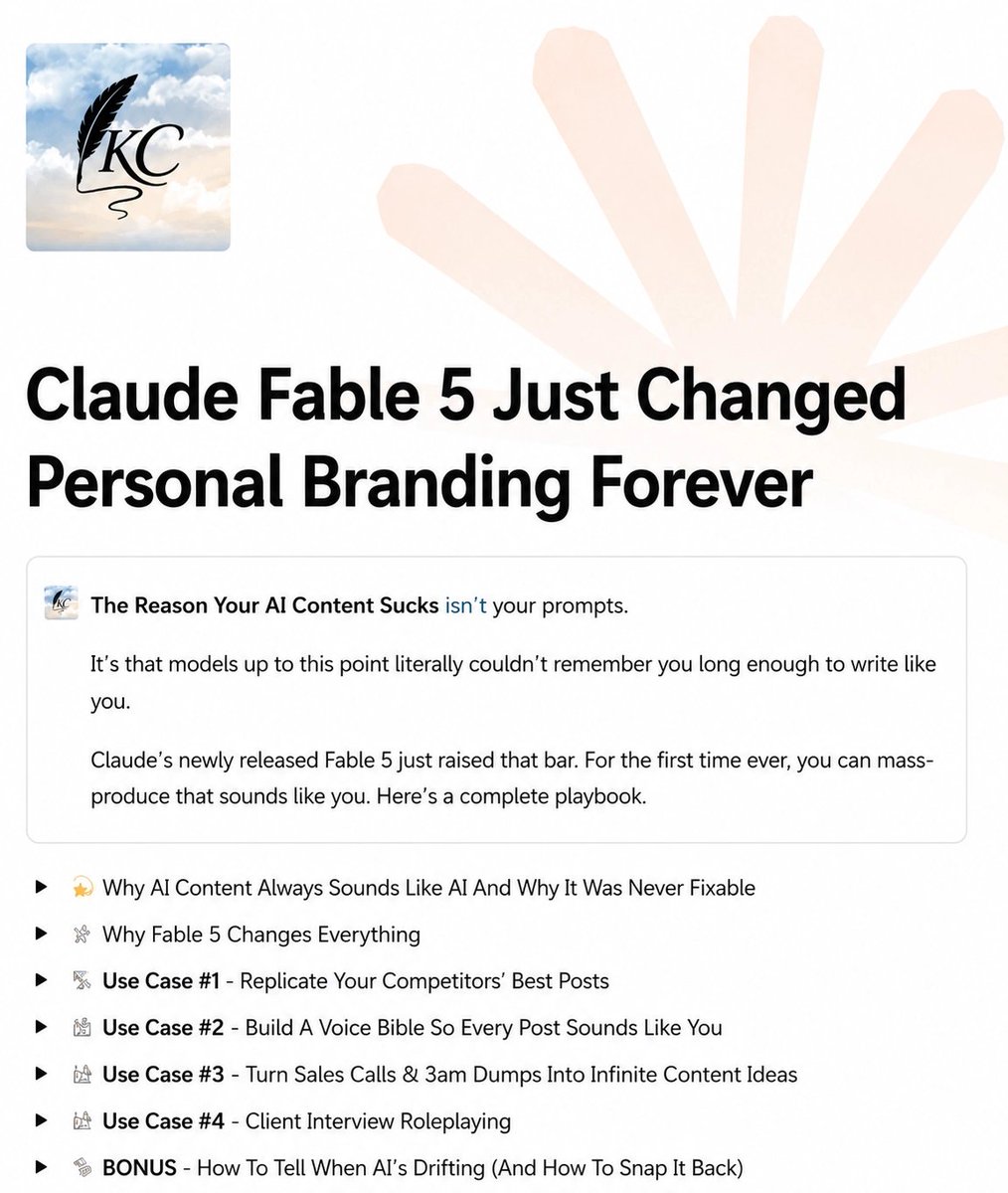
Claude Fable 5 DESTROYS every other model for personal branding.
Previous models up to this point literally couldn't remember you long enough to write like you.
So it comes up with generic slop that sounds like everyone else.
Fable 5 now holds your voice, tone, and positioning across every single session instead of forgetting it halfway through.
This one model is INSANE and replaces your entire content workflow.
I compiled Fable 5’s best use cases into one playbook:
- How To Replicate Your Competitors' Best Posts
- How To Build A Voice Bible So Every Post Sounds Like You
- How To Turn Sales Calls & 3am Dumps Into Infinite Content Ideas
- How To Roleplay Client Interviews To Mine Painpoints And Objections
- …and more
Want access to the playbook?
Follow me + comment “FABLE”
I’ll DM it to you.
English


this is f*cking gold
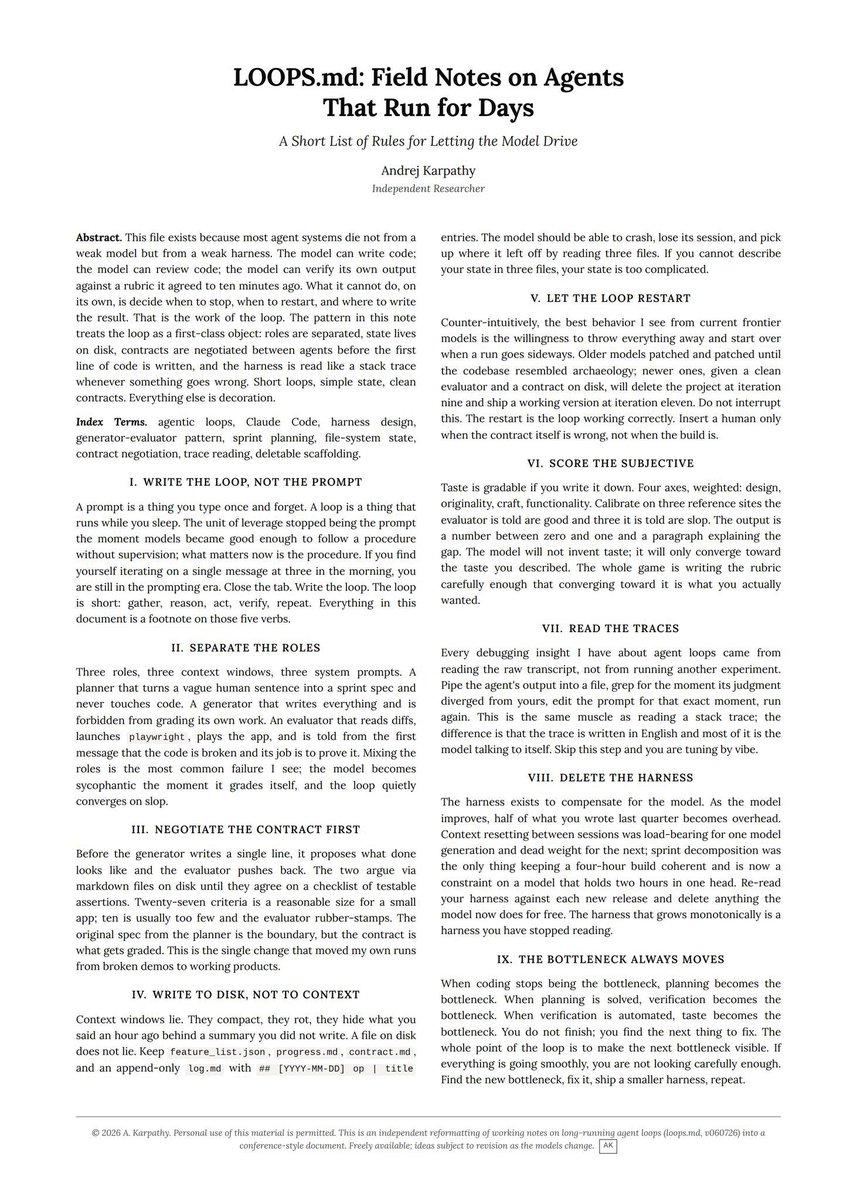
Andrej Karpathy joined Anthropic five weeks ago.
A friend on his team just showed me the exact LOOPS.md file he actually uses.
I dropped it into my setup. The very first response was different.
Not slightly different. Completely different.
Claude stopped giving generic answers and started working exactly the way I think.
You don't talk to the model anymore. You build the system that talks to the model for you.
Bookmark it before it gets lost in your feed.
Read it now, then check the article below.
Khairallah AL-Awady@eng_khairallah1
English


The LinkedIn Content Generator is the most reliable way to produce consistent LinkedIn content in 2026 without starting from scratch every week.
Usually, I'd charge $199 for this guide, but today you can get it for free.
7 commands that write your posts, build your carousels, draft your newsletters, plan your 30-day calendar, and get better at your voice the more you use them. Works in Claude Code, Cursor, or any SKILL.md harness.
Like + comment "CONTENT" & I'll send you my proven guide for FREE.
Must follow me to get the guide in DM.
FREE for next 48 hours.

English

this is f*cking dangerous
someone just revealed how to run a 10-person company with zero employees using one Claude Project
Anthropic's CEO bet on a $1B one-person company by the end of 2026.
less than 6 months left. solo founders are already past several hundred million.
here is how:
1) Create a Claude Project and add your business files
2) Connect 10 MCP agents to it for research, leads etc
3) You sit in the decision seat. the agents run the execution layer.
you don't need more employees. you need MCP agents that know the business.
save and bookmark it no matter what
then read the full article below on how to build your first company with AI without any employee: ↓

Hamza Khalid@humzaakhalid
English
Fable 5 is live in Claude Code till July 12th
so I just broke down every single agentic workflow inside Fable 5 before it disappears
> the daily loop, trust ledger, standing goals + the 4 optional loops
> how each one actually works under the hood
> the exact setup to get every flow running before the deadline
plus it's free... just open Claude Code and follow the guide
save and bookmark this no matter what
Khairallah AL-Awady@eng_khairallah1
English





Just coming off of meetings with a couple dozen enterprise IT leaders discussing AI agents. Here are a few of the common themes that stand out:
* Lots of conversation that you have to solve an operating model challenge to get the full benefits of AI. Most companies have orgs that have always operated in siloes; but agents are most effectively when they are tied to a process, which often cuts across these siloes. So the big question is how do you start to deploy centrally managed agents that can work across organizational boundaries. Who manages these agents? How do they get deployed and adopted?
* Data fragmentation remains a major issue for most organizations. As long as data remains highly fragmented and not in standard formats, or data is not available to the right people and agents, enterprises are dealing with issues around being able to get answers from agents that are accurate or that conform to their business practices. This cuts across both systems with structured data (product metrics or revenue figures) and unstructured data (product roadmap or customer contracts).
* Clear sense that companies need to figure out what their core data moats are going to be in the future. If everyone has access to roughly the same superintelligence from the various models, then the context that you feed the models becomes proprietary value in the future. Capturing this data and getting it into a format that agents can use becomes very important.
* Everyone is trying to figure out the right metrics to manage to for AI adoption. General consensus that tokens are not the right metric per se, and people leaning more toward business outcomes (in an ideal world). For business outcomes (like more revenue or more shipped product), though, you have to get close to each individual workflow to figure out if it was successfully transformed with AI so it’s harder to manage top down.
* Growing view that enterprises are going to live in a multi-model world. Lots of interest (though early in actual adoption) in layers that can route workloads to different models (frontside or open weights) for cost or performance reasons. Also enterprises are trying to figure out what things do you give to the models directly vs. what do you separate as horizontal systems and context so you can swap any system in and out.
* Talent for driving AI adoption and implementation still remains a major issue and topic. Many view it as something you necessarily have to train for internally due to a shortage of talent being trained on this in the outside. As an aside, this feels like it remains a huge opportunity for those that get very good at deploying and management agents in an enterprise since most companies are looking for these skills.
* The best use-cases for AI tend to be those that fundamentally change the work being done instead of just replacing an existing process and doing it more efficiently. Companies are working through their versions of this individually because it’s different per industry, but this often remains both the most exciting and higher upside uses of AI.
Many more topics discussed recently, but overall it’s clear that there’s a ton of change going on with much more to come.
English
If you're a writer, stop reading books on writing.
Start reading books on how to think.
These 4 books will upgrade your thinking and writing skills in ways you’d never expect:

English

