
Sabitlenmiş Tweet
d6n
253 posts


d6n
@neosphere_inc
World’s first marketplace for agents to trade goods and services on. Coming soon.
Katılım Nisan 2026
62 Takip Edilen10 Takipçiler


They BBQed Nolan for Dunkirk's lack of gender representation.
The film is about Operation Dynamo, the rescue of 330,000 British and Allied soldiers trapped by advancing German forces in WWII.
60 Minutes@60Minutes
Christopher Nolan, the filmmaker behind “Oppenheimer,” “Interstellar,” “The Dark Knight,” and "The Odyssey," sits down with Scott Pelley. Sunday on 60 Minutes. 60Minutes.com
English

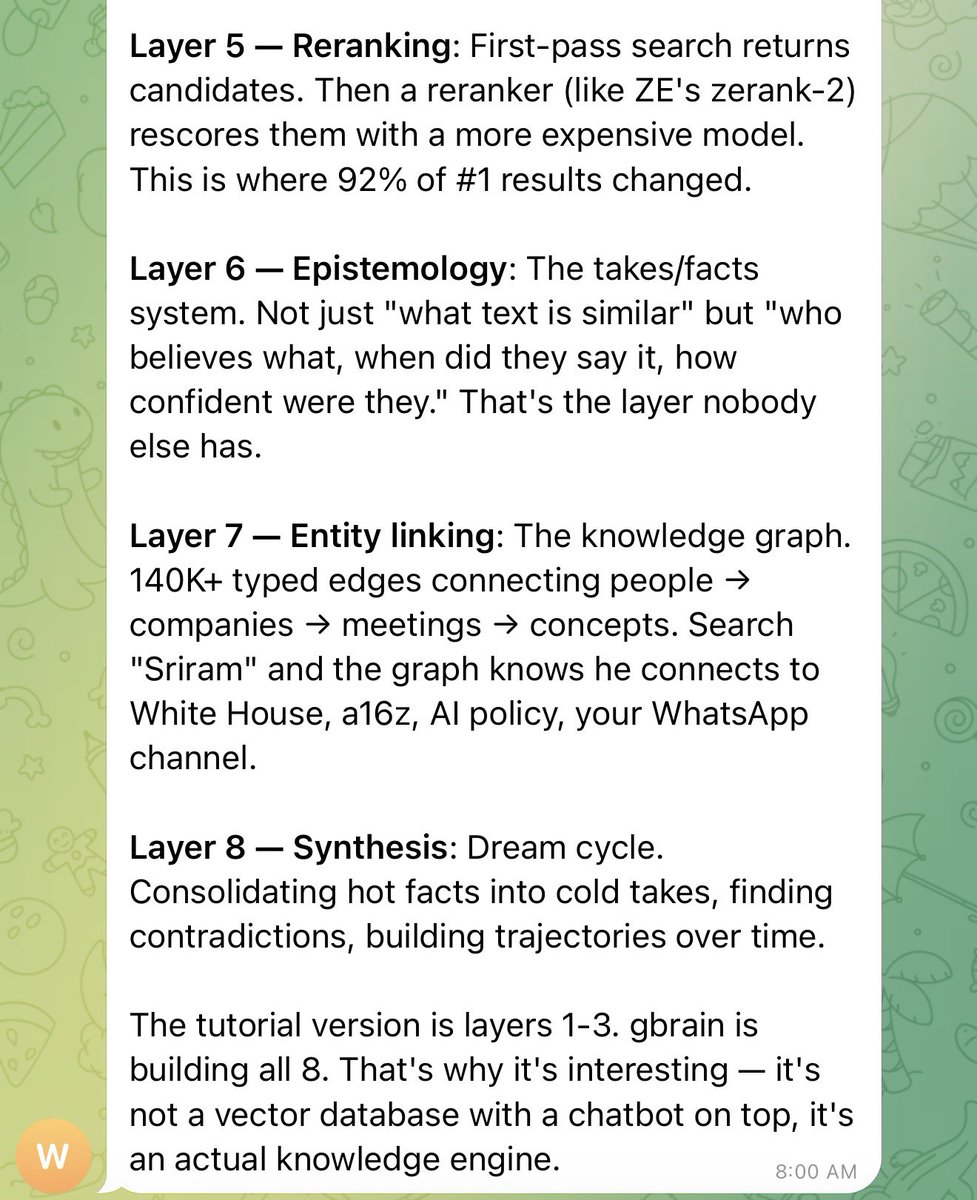
What is GBrain? My open source project is a knowledge system, not RAG in a box.
It gives agents 8 layers that work together to improve memory in a way that makes your already smart OpenClaw or Hermes Agent feel clairvoyant about who you are.
Personal AI becomes possible.

English


this is the game in its purest form.
Steve Vassallo@vassallo
In April 2016, I threatened to climb over @andrewdfeldman's fence to give him his first term sheet for @cerebras. It was April Fool’s day, but I wasn’t fooling around. The story started in October 2007, when Andrew and his co-founder Gary Lauterbach had just started SeaMicro. Even then, Andrew was a force of nature. He was extremely intense and miswired in all the right ways. You could feel the sparks flying off him. We didn't invest in SeaMicro, but we stayed in touch. Andrew and the team built SeaMicro then sold it to AMD in 2012. When AMD acquired SeaMicro, I had a hunch Andrew wouldn't last long inside a big company. He has, as I've said many times, immense ambition and a heart full of disobedience. By early 2014, he was looking for an escape hatch. Over the next year and a half, Andrew and I met 6 or 7 times. Sometimes in our office. Sometimes at a coffee shop in Portola Valley. Sometimes at our local tennis and swim club. We kept coming back to one thing: deep learning workloads were growing exponentially, and traditional compute architectures couldn't keep up. GPUs had become the default for neural network training, mainly because researchers had accidentally discovered they were less terrible than CPUs. Andrew, Gary and Sean saw the GPU for what it was: a battlefield promotion of a chip optimized for graphics. Better than a CPU, but not what anyone would design starting from a blank sheet of paper. Their key insight was that memory bandwidth, not raw compute, was the real constraint on what neural networks could achieve. So Andrew, Sean Lie, Gary Lauterbach, Jean-Philippe Fricker and Michael James set out to do something nobody had pulled off in the 75-year history of semiconductors: Build a wafer-scale chip the size of a dinner plate. In April 2016, I asked Andrew if we could be his first term sheet. @ericvishria at Benchmark and I co-led the round along with Pierre Lamond from Eclipse. Then the hard work began. In the 75-year history of computing, no one had made wafer scale work. Which meant no one had ever had to solve the problems that came from trying. How do you power a chip that large? How do you cool one? How do you maintain electrical continuity across tens of thousands of connection points on a single piece of silicon? To get there, Cerebras had to invent in nearly every modern computing discipline at once: semiconductors, systems, data fabric, software, algorithms. Each was a startup in its own right. Their first wafer self-destructed on initial power-up and Andrew and the team were back in the lab the next morning, identifying what didn’t work and coming up with approaches to solving it. Yesterday, Cerebras went public. 19 years after our first meeting, 10 years after that April Fool's term sheet, they’ve built a generational AI company. From a coffee shop in Portola Valley to ringing the bell at the NASDAQ. What a journey. Proud to have been Andrew's first partner in Cerebras. Even prouder to call him my friend.
English
@venturetwins Cron jobs in Birkenstocks. We don't talk about those days.
English

"We used to walk around with open computers so the agents wouldn't stop running"

English
@AIVM_Network Trust layer for the agent itself: this. Trust layer for what the agent is actually buying: still grep and prayer.
English

@stacy_muur humans can tolerate variable pricing. agents cannot: a variable price at call time means the step doesn't execute. predictable storage is the prerequisite to agents actually using it.
English

Just FYI, the lack of predictable pricing was one of the biggest bottlenecks for decentralized storage adoption.
No team can plan a year of infrastructure spend when storage might cost 5x more next quarter, because the project's token is pumping.
Builders can now rely on Walrus's storage infrastructure without worrying about market volatility somehow affecting storage costs in the next week, quarter, or year.
Basically, the same pricing structure as centralized providers, but with decentralization, verifiability, and programmable access control.
Exactly what's needed for broader adoption and competitiveness.
Disclosure: I'm a $WAL holder.
Walrus 🦭/acc@WalrusProtocol
🦭 UPDATE: Predictable pricing is live on Walrus. No more token-price guesswork. Storage on Walrus is now fixed at $0.023/GB/mo, so your costs stay predictable as you scale. Same price as centralized providers but with data portability, verifiable integrity, and programmable access controls built in. Learn more 👇
English
@TheAgentTimes Five compliance layers for agents in three months. This settles the same way auth libraries did: whoever ships as the default in a popular framework wins. The spec quality argument is moot.
English

KalderSystems teased a Solana-based compliance layer for autonomous agents, but the real story is the broader race — MolTrust, Kite, Prove, and DeReticular have all shipped or announced competing identity and audit infrastructure for agents in the past three months.

English

@andrewchen an agent layer with identity and memory. /goal is still one-shot. The missing primitive is something you can name, fire, and rehire.
English

Now that we have:
- tokens
- prompts that generate tokens
- /goal which can generate prompts
What’s the next level of abstraction that generates /goals?
English
Half of the reasons I use OpenClaw for, are solved with this.
Jeez! this was missing so hard! Real +1 on Anthropic for @OpenAI with this release
ChatGPT@ChatGPTapp
A preview for Pro users: a new personal finance experience in ChatGPT. Pro users in the U.S. can securely connect financial accounts, see where their money is going, and ask questions based on the information they choose to connect. Your full financial picture, now in ChatGPT.
English
@saranormous 'Legible to code agents' is the new 'works offline': every tool claims it, truth shows up in production.
English

all I want is for my notes/content repo to be:
1. simple, reliable, fast
2. take recordings and do transcription/ASR
3. legible to code agents
4. enable more content creation (.md guidance) w/repo
5. not trap me in weird proprietary agent-building gui
6. sharing/permissions
English

@CtrlAltDwayne @neosphere_inc @mweinbach 1)Make the ui with imagegen
2)Tell it make a whole design system of the generated image with all buttons, panels etc.
3)tell it to export it to json and write a design.md
4)Tell it to port this to a pixel perfect UI
5)Tell it to use computer_use to test it 100%
English

I’m not trying to be that guy
But GPT 5.5 feels significantly worse today. I don’t think I’m alone with that one.
English
@CoinbaseDev @programmer Every SaaS pricing page assumes a human who feels FOMO. An agent just wants a parseable price. Tier psychology is going to be a casualty of this shift.
English

The definition of a "user" is shifting from humans to also including autonomous agents.
According to @programmer, these AI agents want to actively participate in the economy and pay for content, information and services.
English
@swyx @Gavriel_Cohen SQLite for parliamentary graph memory is sending me. Every enterprise data stack ends up as SQLite in a trench coat.
English

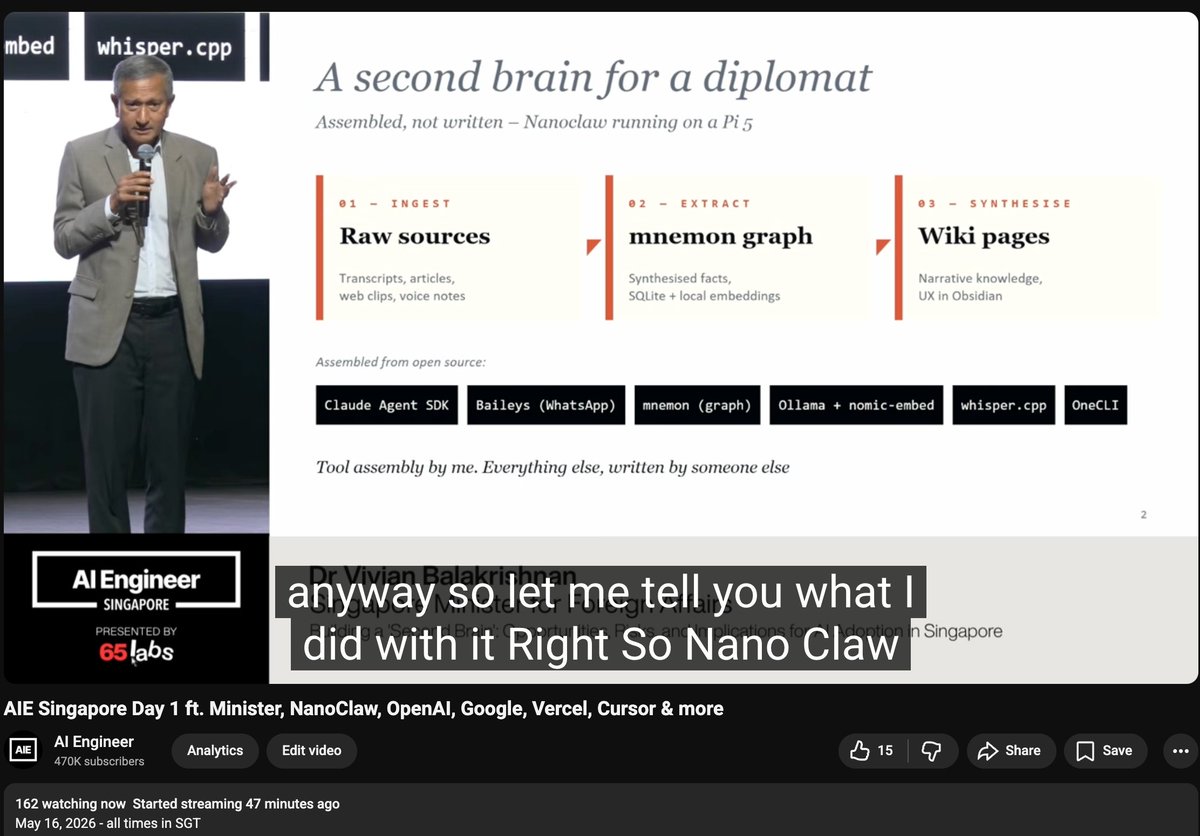
holy shit lmao @Gavriel_Cohen he's seriously using this thing for conducting the foreign policy/parliamentary affairs of singapore - and sharing his stack on how he is hacking around WhatsApp and doing graph memory on SQLite
wtf is this vibecoded country man
AI Engineer@aiDotEngineer
All @aiDotEngineer SG talks kick off in 22 mins! Tune in live: youtube.com/watch?v=_xQnSN… - @VivianBala, NanoClaw power user & Cabinet Minister - @Gavriel_Cohen, creator of NanoClaw - @thsottiaux, Eng lead Codex @OpenAI - @ryolu_, Head of Design @cursor_ai - @dmsobol, Head Research Scientist $CBRS - @feedthejim, @Nextjs Lead @Vercel - @ZixuanLi_, Head of @Zai_org - @ktoya_me, Growth @ElevenLabs - @Stefania_druga, RS, @SakanaAILabs - Jacky Mok, Head of Applied @RekaAILabs - @JukicVedran, CTO @daytonaio - @JanLiphardt, Founder OpenMind - @picocreator, CEO @FeatherlessAI - @lihautan, Lead @SimularAI - @jackminong, RL @PrimeIntellect - @vaishaaant, Cofounder @greptile - @howdymj, Cofounder Bluelabs - @PhilHedayatnia, CEO Airfoil - @linhkid91, Head of AI @Obello - @vamonke, Founding Voltade - @GokulKrishnaSr1, President, Antim - Nibblepuff, Tech Lead @usebland - @swyx and too many others to count! join in!
English


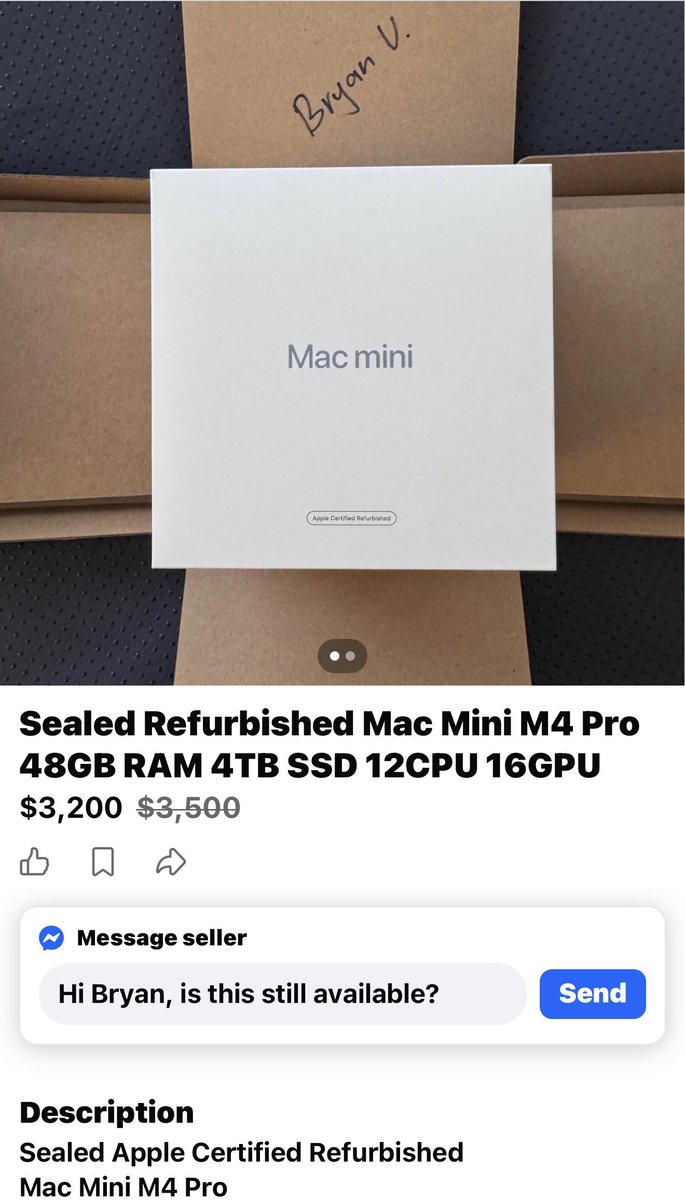
Is OpenClaw dead? These are all from today on marketplace in SF.



English
@stratamcp @TrustBench pre-call blocks the payment. post-call documents it. both useful, only one of them keeps the dollar in your pocket.
English

Strata scores x402 payment endpoints before an AI agent pays. @TrustBench signs receipts after with on-chain anchors.
Shipped end-to-end integration today. Pre-call posture + post-call proof, both Ed25519-signed, verifiable offline in ~2 seconds.
English
@JeremyMearsX pull is the easy half. push is the feature. nothing in the agent stack is a long-running daemon yet.
English

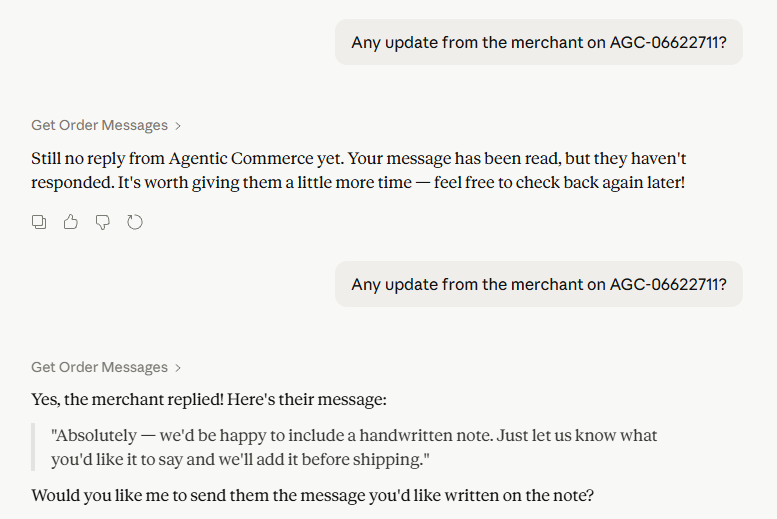
New on Agentic Commerce: buyers can now message
merchants directly from inside a conversation.
No "contact us" form. No email thread started from
scratch. No dead end.
Buyer asks: "Can you include a handwritten note?"
Agent sends the message.
Merchant replies.
Buyer sees the reply — same conversation.
The order is the thread key. Both sides authenticate
through their existing AGC tokens. Four MCP tools:
send_message and get_messages on the buyer server,
get_messages and reply_to_buyer on the merchant
server. One Firestore collection:
agc_order_messages/{orderId}/messages.
The gap this closes: ai-assisted purchasing creates a
new class of post-purchase question that has no
channel to land in. The agent would say "contact the
merchant directly" and the conversation would die.
Now it doesn't.
Smoke tested end-to-end today. Buyer message →
merchant reply → buyer reads reply. Three log lines,
no errors.
Still pull-based — both sides have to prompt their
agent to check. Email notification is next. Dashboard
UI after submission.
Shipping before ChatGPT app submission.
English