

nyorke
229 posts

nyorke
@niallyorke
@LayerZero_Core | 0xSquadwealth | FWB ⚖️ | KB5 🌱
Vancouver, British Columbia Katılım Şubat 2012
611 Takip Edilen384 Takipçiler

Shane Gillis was one of the many stars that came out to watch Steph tonight ⭐
English


"My wife was called a pedophile by Sean Strickland. ... I'll pump the f*cking mouth off Sean Strickland."
Ian Machado Garry has a score to settle with the former champ after #UFC298 😳
English
Woman screams 'NO' as Donald Trump is sworn in as the 45th President of the United States
English
This is an excellent thread summarizing the journey of web3 data from the blockchain to the application.
The often-underappreciated nature of this aspect within the stack underscores @Covalent_HQ's essential role, making it a cornerstone in developing decentralized ecosystems.
Simon Dedic@sjdedic
Bull thread on @Covalent_HQ $CQT: The "Google of Web3" kind of play. TLDR: critical data infrastructure that is absolutely essential for a multi-chain and data availability future, 7-digit revenue generating business, flywheel and real yield coming for token holders, stellar team. But let’s dive into it in detail 🧵 What is it? Most people see Covalent as a data indexing solution, similar to @graphprotocol. But after years of hard work and progress, there is much more to it by now. Why is it relevant? The Blockchain world is growing at an exponential scale: more ecosystems, more new L1s and L2s, hopefully more and more users, which means more txs, which eventually means more data. And all of this data is in silos. Obviously super cool that blockchains are decentralized, open and accessible. But the downside to that: it gets more complicated and less efficient to pull data in a reliable and convenient fashion. This problem is called the lack of read-scalability. For a multi-chain future we need a reliable and decentralized data readability layer. Democratized data access reduces information asymmetry, accelerates product innovation, enables better-informed capital allocation, and makes the market more efficient as a whole. This is where Covalent comes into play as an indexing and querying layer to enable accessible and readable data at scale. Covalent's flagship product is the Unified API. This Unified API allows consumers and dApps to scrap all on chain data in a normalized and structured fashion. So it’s most convenient for them to start integrating it into their solutions with the best ease of use and completeness, without the hustle of intensive data processing. But what makes it so special compared to other solutions? What’s interesting: usually the go to solution to process data is in an ETL (Extract-Transform-Load) fashion. This is for example also how The Graph is doing it with their subgraphs. However, Covalent flipped it around and uses an ELT solution (Extract-Load-Transform). This allows flexibility to handle changes for upstream and downstream requirements, makes it cheaper, allows to handle requirements that need the entire blockchain data as well as true chain-agnosticism. This makes Covalent's approach not only verifiable, but also composable and scalable. However, the Unified API was only the beginning. There is much more yet to come, but more on this later. What is the competitive landscape looking like for Covalent? Obviously, the data indexing space isn't new and hence, quite competitive already. But here are my thoughts why Covalent will win: There are many solutions like @Bitquery_io, @etherscan, @MoralisWeb3, @blockvisionhq etc, which are centralized & non-tokenized. But there are only 2 notable players when it comes to decentralized indexing solutions, which is what we care about...right? The Graph & Covalent $GRT is sitting at an almost 1.5 billion FDV while $CQT at a 138M FDV (just for the record, less than 1/10 of it!) While most see them as competitors, they can actually also complement each other. The Graph data seems to be way more complex and focused on way more niche data sets, while Covalent focuses more on general data sets like DEXs, marketplaces, NFTs etc. So @MessariCrypto for example is arguing that they are not necessarily competing with each other. The Graph seems to be way more progressed though with its decentralized network being live already and operators already contributing to the data set, while those are still things that are yet to come for Covalent. However, this is why Covalent would always be my go-to solution: in my opinion, data completeness and ease of use are the most important factors when it comes to the decision making process where to scrape data from. Compared with The Graph, Covalent seems like a no brainer here. While they are normalizing and structuring the data perfectly for the end-consumer, they are also way ahead when it comes to the number of blockchains they are indexing. But enough of that, let’s have a look at Covalent’s adoption, which should speak for itself: - The already have more than 1000 applications building on top of its data infrastructure with some top tier names like @Consensys, @Fidelity or E&Y using it - Their API revenue alone is already sitting at 500k ARR (The Graph is generating below 100k ARR) - Some of the biggest ecosystems out there are paying them to get indexed, adding another huge revenue stream of more than 2M ARR - Flywheel effect for the demand side: more chains → more devs → more applications → more data → more chains (shoutout to @1kxnetwork who wrote a great article on that last year) But this is only the beginning. While their revenue is growing at an exponential rate, the best things are actually yet to come, especially for $CQT token holders. Let’s have a look at them: - The Covalent network isn’t fully decentralized yet. However, the goal is to get there in the next 12 months. This means, the network and data processing is going to be handled by node operators, that will have to lock away huge amounts of CQT - They will introduce a fee switch soon, meaning that they will share a portion of the revenue with token holders - Buy backs with the revenue are coming - Class C is coming: people will be able to build their own API endpoints to earn revenue with it, which will require CQT staking = decreasing token supply side even further - They are building out flagship applications by their own (like Block explorers or Dune-like analytics platforms @IncrementHQ) in order to showcase what their data infrastructure got in store, while generating even more revenue in parallel - They are working on the Ethereum Wayback Machine, which should solve the long-term data availability issue in the EVM space, hence complementing solutions like @CelestiaOrg, @eigencloud and @Filecoin (multi-billion dollar valuations), contributing to make this space more efficient as a whole I hope you made it until here! Quite some information to digest and still I haven’t touched on everything that is interesting with Covalent by far. Maybe I’ll do some more deep dives into each of the huge catalysts that are in the pipeline, if there is interest. To sum it up, I am personally incredibly bullish on not only Covalent, but also the founder and its team to deliver on their vision and make Web3 not only a more efficient, but also a better place. What they are building is needed by almost everyone who is building something in Web3, the adoption metrics and revenue speaks for itself. On top of that, their long-term vision is even much bigger and if they can deliver on it, this should be a multi-billion dollar market cap. Let me know if you have any questions, happy to answer them!
English
nyorke retweetledi

🚨NEW Founder/Project Scam Alert🚨
Every Founder needs to read this and be aware!!
Please share this to spread awareness! This scam is very well-done, and took a little digging and safeguards to uncover.
Thread 1/8 ⏬
English

"WE SHOULD BE LOOKING AT HIM... HE'S 18 & ALREADY HAS THE PHYSICAL PROFILE TO PLAY AS A NUMBER 9 IN THE PREMIER LEAGUE!"
@bethTmufc thinks Ferguson is a brilliant prospect at 18 years old to develop into a top Premier League striker.
Should Man United try to sign him?👇
#MUFC
English
nyorke retweetledi

Welcome!! @Covalent_HQ 💙🧡
Covalent's integration will improve data availability for developers building on Arbitrum Nova. 🛠️
Covalent@Covalent_HQ
1/ 🎉Breaking News! 🎉 We're thrilled to announce our latest integration with @arbitrum Nova, the leading L2 scaling solution for Ethereum! (💙,🧡) Aribitrum Nova is also purpose-built to accelerate the development of Web3 social apps. ➡️ covalenthq.com/blog/covalent-… More ⬇️ 🧵
English
nyorke retweetledi

1/ As crypto continues to grow and gain cross-functionality, standardized data across these different chains become less accessible.
@Covalent_HQ has answered the call by creating a "Unified API". 🧵

English
@joeljohn @Covalent_HQ @MessariCrypto When we consider app chains, layer 2s, testnets and so on, it will be north of 100 🫰
English

Pleased to see @Covalent_HQ covered by @MessariCrypto today.
Only one thing I disagree with. I think the number of chains covered will be way north of 50 in 2023.
messari.io/report/covalen…
English


Kanye West admits that “Sway had the answer” 9 years later 😂😭 twitter.com/smallzstill/st…
English
nyorke retweetledi

1/ Web3’s impact on the🌎global economy is growing exponentially. Yet, there remains a *deficit* of Blockchain #DataAnalyst talent😢
& In comes our ‘Data Alchemist Boot-Camp’🧪that *PAYs* you $2,000💵to learn Web3 Analytics.
Unlock your path towards a Web3 Career🧵👇🏼
English

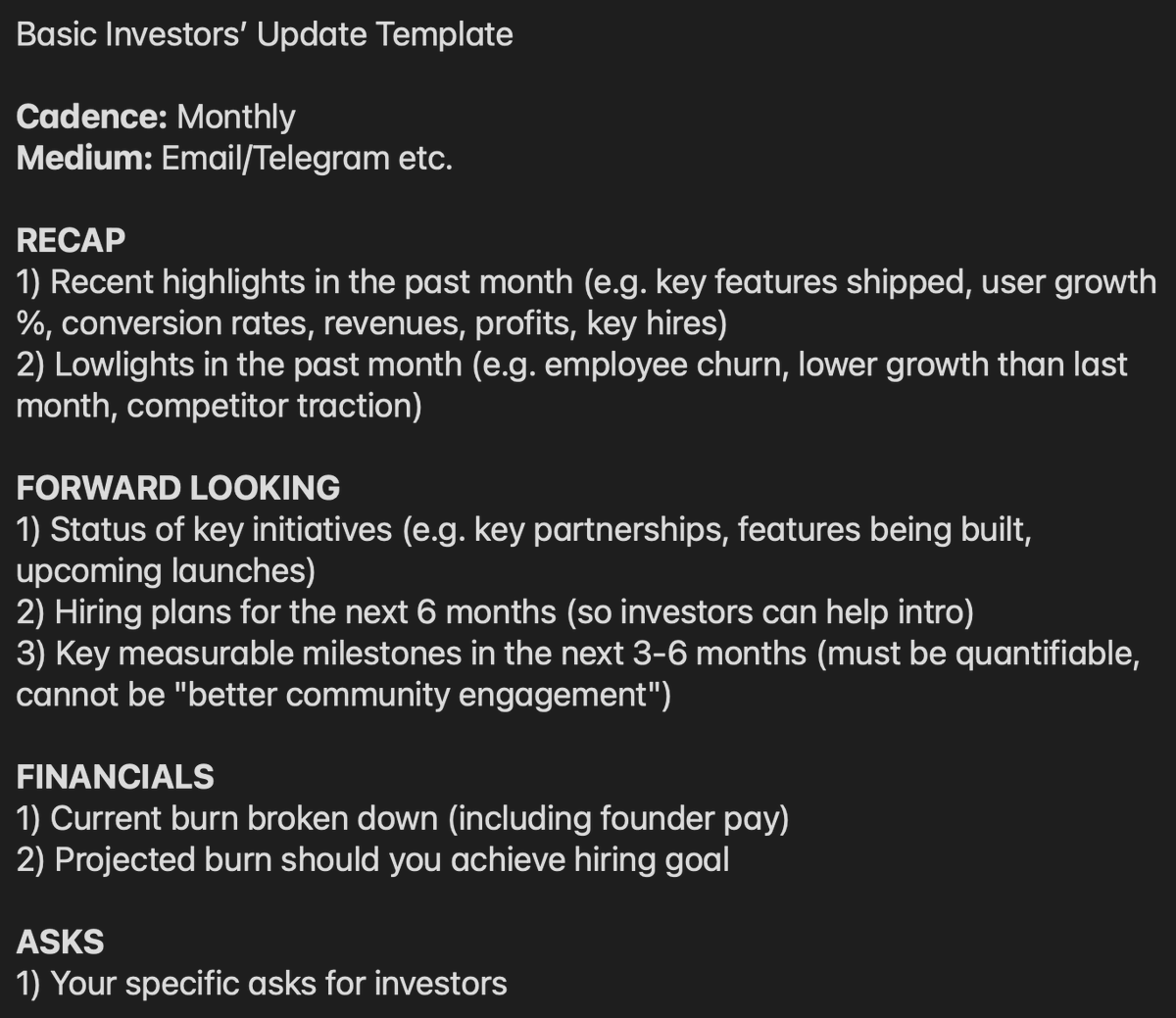
One of the handy skills effective founders use is leveraging their investors.
This comes down to writing good investor updates.
Here's a template 👇
English
nyorke retweetledi

Been great working with @AxieInfinity community & @SkyMavisHQ on governance these last few months.
"We are proud to have established a formal partnership with Metaportal DAO, an organization comprised of individuals with considerable track records in decentralized governance.."
Axie Infinity@AxieInfinity
The Axie nation builds relentlessly. Recently, we've put together a string of victories that will propel us towards our infinite destiny. We’re proud to present our July Development Update! 📜: axie.substack.com/p/julydev
English
English
On tight controls to ensure the correctness of data in the network
- We ensure data validity through the proof mechanism employed
- There is a role labelled auditor who checks these proofs to ensure they match. @Covalent_HQ plays this role currently. Operators will in the future
David Tso (dave.base.eth)@davidtsocy
This piece on @Covalent_HQ by @ConsenSys is incredibly thorough and well-written. Anyone accessing multi-chain data or building data use-cases in Web3 needs to read this! consensys.net/blog/cryptoeco…
English
nyorke retweetledi



nyorke retweetledi

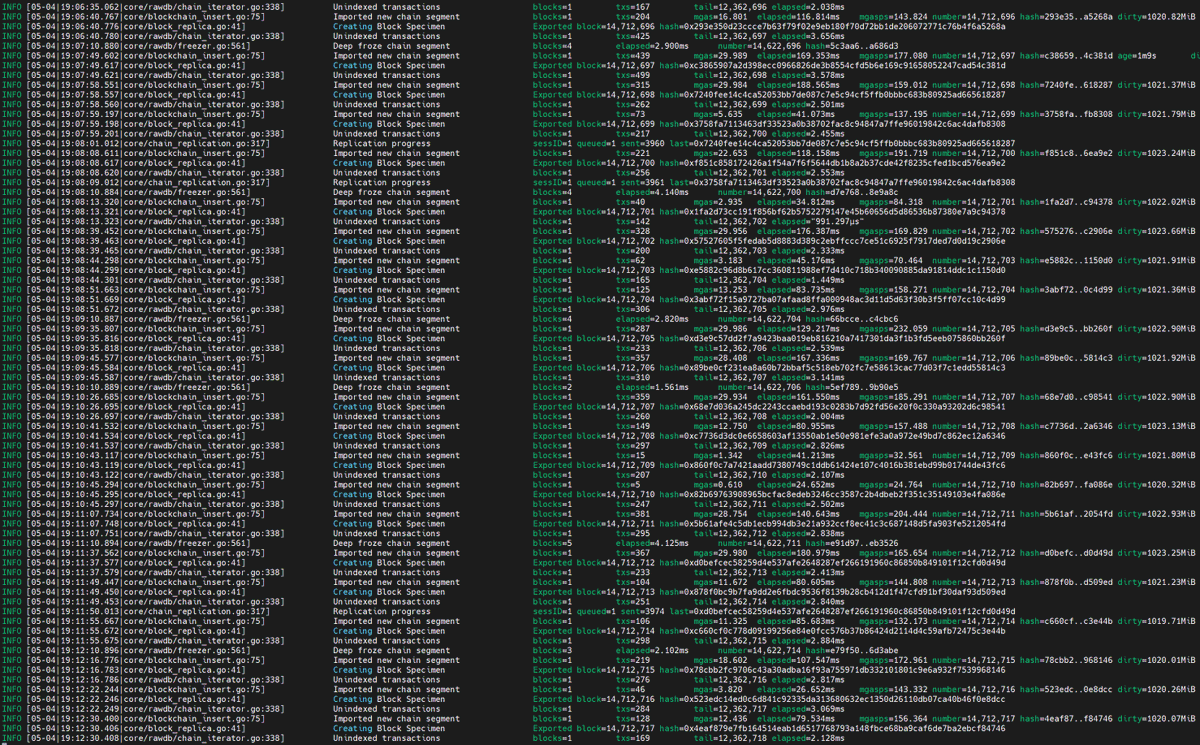
Congratulations @Covalent_HQ for the launch of the Covalent Network!!
It has been a pleasure to be working with the Covalent team and we at @Stakely_io are really proud to be part of the network as one of the first validators🚀
Here we are, creating block specimens👀
English