Primitive Architect

135 posts

Primitive Architect banner
Primitive Architect

Primitive Architect

@paris_steff

Trying to understand the primitives of the system. Everyone else debating the UI.

Paris, France Katılım Mart 2020
88 Takip Edilen29 Takipçiler
Primitive Architect
Primitive Architect@paris_steff·
@OlivierRimmel @AnthropicAI @OpenAI Tu touches juste… mais c’est encore en surface. Ce n’est pas le dev qui devient “un dieu”, c’est le coût d’accès à la capacité qui s’effondre. Quand la latence tend vers zéro, ce n’est plus le code qui compte, mais la lecture du système. On ne code plus le réel. On le reprice.
Français
0
0
0
7
Olivier Rimmel 🕊️
Olivier Rimmel 🕊️@OlivierRimmel·
Lisez bien. Sur la base de ce que je peux constater et que j'expérimente quotidiennement, j'affirme que tout développeur informatique expérimenté qui utilise @AnthropicAI #Claude Code et son modèle Opus 4.7 et également @OpenAI #Codex et son modèle GPT-5.4 peut désormais considérer qu'il est devenu « un Dieu en informatique ». Et c'est un vétéran de l'IA et du codage à l'ancienne qui vous le dit. Le niveau actuel des LLMC est absolument considérable.
Français
12
4
46
7.2K
Primitive Architect
Primitive Architect@paris_steff·
@Ross__Hendricks You’re reading cost, not leverage. Inference isn’t “burn”… it’s replacing ENTIRE org charts. Looks like misallocation only if you assume static output. When output scales faster than spend, it’s not a bubble. It’s a rebase.
English
0
0
0
12
Ross Hendricks
Ross Hendricks@Ross__Hendricks·
Imagine how much the AI slop will cost when the labs go public and have to start actually earning money When the dust settles, the AI mania will go down as one of the greatest episodes of capital misallocation in history
Hedgie@HedgieMarkets

🦔Goldman Sachs reports that companies are blowing past their AI inference budgets by orders of magnitude, with inference costs in engineering now approaching 10% of total headcount costs and potentially reaching parity with salaries within several quarters. KPMG surveyed 2,100 senior leaders and found US companies plan to spend an average of $178 million on AI over the next 12 months, with Asia-Pacific firms budgeting $245 million and EMEA $157 million. The two reports together show companies are spending more than planned and intend to spend even more. My Take Inference costs approaching headcount parity is an extraordinary number that most finance teams did not model when they approved their AI strategies twelve months ago. The compute crunch, electrical component shortages, and GPU spot prices up 48% in two months are all flowing into corporate operating costs faster than anyone budgeted for, and Goldman's trajectory suggests it accelerates from here. What I find hard to reconcile is that $178 million average sitting alongside enterprise data showing eight in ten workers are either avoiding AI tools or not using them at all. Companies are committing to nine-figure inference budgets while their own employees aren't using what's already been deployed. I've watched this dynamic build all year and my honest read is that a significant portion of this spending is driven by competitive fear rather than demonstrated returns. Nobody wants to be the company that didn't invest in AI when everyone else did. That's how bubbles get funded, and at some point boards are going to demand a number that justifies it. Hedgie🤗

English
37
70
635
35.7K
Primitive Architect
Primitive Architect@paris_steff·
@chamath Moats don’t just erode, they become irrelevant. If AI compresses cost and latency to near zero, cash flows lose structural meaning. This isn’t about paying less for the future. It’s that the unit you’re discounting stops being the right object entirely.
English
0
0
0
8
Primitive Architect
Primitive Architect@paris_steff·
@_The_Prophet__ You’re assuming uncertainty compresses multiples. It doesn’t just compress, it breaks the pricing model itself. When capabilities reprice faster than markets can update, discounting fails. This isn’t a dispersion cycle. It’s a regime where valuation lags reality structurally.
English
0
0
0
8
SightBringer
SightBringer@_The_Prophet__·
⚡️The deeper thing nobody in finance media wants to discuss is that AI might break the entire traditional valuation framework. The assumption that you can discount future cash flows at a reasonable rate assumes cash flows that are somewhat predictable. In an environment where a new capability can eliminate a business category in eighteen months, future cash flows are not predictable enough to price confidently. So the market defaults to pricing current earnings with progressively less weight on the future. That compresses multiples across the board until the visibility improves. When does visibility improve? When AI’s economic impact becomes legible. Which requires at least one full cycle of companies being destroyed by AI and new companies being built on AI, with clear evidence of the magnitudes involved. That’s probably a three to five year process. Which means multiples stay compressed for three to five years unless something breaks the uncertainty faster. Chamath is right that multiples don’t come back unless AI turns out to be less impactful than advertised. He’s wrong that this means multiples don’t come back. They come back for the winners. They stay down for the losers. The average stays compressed because there are more losers than winners and the sorting takes time. The people making real money through this period are not the ones playing the index. They’re the ones picking the winners individually, or they’re the ones invested in the private companies where the AI value is being captured before it hits public markets, or they’re the ones operating in the spaces AI hasn’t reached yet and won’t reach soon. Specific positioning on specific companies and specific themes. Not macro index bets. The real signal is that the sorting phase is underway, the dispersion is widening, and the people who understand which companies are on which side of the AI transition are going to make the most money of any generation in market history. The people who don’t are going to watch their index fund underperform while both the winners and losers diverge from the blended average.
Chamath Palihapitiya@chamath

If AI lives up to the hype, it will erode the traditional long term moats of technology companies. As a result, no one with a brain wants to pay for cashflows far in the future. These multiples cannot come back unless AI turns out to be a toy.

English
17
11
160
35.5K
Primitive Architect
Primitive Architect@paris_steff·
@blackroomsec You’re measuring replacement. The shift is reduction. Jobs don’t vanish overnight, they stop being needed. Fewer hires, less junior demand, slower growth. AI doesn’t need to be perfect to break the system. It just needs to make humans economically optional.
English
0
0
0
34
BlackRoomSec
BlackRoomSec@blackroomsec·
It's almost as if there are people alive who can refute all of this nonsense. I work with over 300 paralegals. My former law firm's paralegals all have jobs and all of our sister firms which we did work for all have the same paralegals, hundreds of them working for them, and no one has been laid off. This is in New York. The capital of the fucking world. 🙄 AI has not replaced any of them, because it can't. It doesn't know that you need a car to go through a car wash. I sincerely doubt it can draft a memorandum of understanding that will hold up in court. The last lawyer who tried to use AI in court just got spanked three weeks ago, because aside from it not being able to do anything new in the last two years it also continues to hallucinate. We Tech experts keep telling you people this but for some reason you don't believe us. You believe the people who are saying they're building something that's going to replace you. Talk about a reliable narrator! 🙄 And all of these "new releases" are just the same features you had a week ago rebranded as new. That doesn't actually make it new. I used to have a neighbor that had a trailer for a house and one day he got tired of looking at it so he went out and he got somebody to put siding all around it so that it looked like an actual house with a foundation. But at no point in time after he did this did his trailer which was underneath this siding shell, so to speak, magically become a house. It was still a trailer. That's what these new releases are.
SightBringer@_The_Prophet__

⚡️Anthropic is quietly strip mining the knowledge work economy and smiling while they do it. Every product launch from every frontier lab follows the same pattern now. Announce a new capability. Frame it as helpful. Bundle it into existing subscriptions. Watch another professional category collapse over the following 18 months. Claude for Word eliminated junior paralegals. Claude Code eliminated junior developers. Now Claude Design eliminates junior designers. The pattern is identical each time. A beta announcement. A demo video. Thousands of people posting “this is incredible.” A small group of people in the affected industry posting “this is fine actually, the complex work still needs humans.” And then six months later headcount reductions start showing up in earnings calls. The entire design industry from Figma down to individual freelancers just watched their market get compressed in real time. The freelancers on Fiverr offering “I will design your slide deck for $50” have a business model with a finite runway now. They just don’t know how finite yet. The ones that paid attention to Adobe’s trajectory over the last year have some idea. The ones that didn’t will find out when the gigs stop coming in. The truth is that every major lab is racing and the race is structurally unwinnable to slow down. Anthropic cannot unilaterally pause capability research because OpenAI won’t. OpenAI cannot pause because Google won’t. Google cannot pause because Meta and xAI and Chinese labs won’t. The game theory forces every player to move as fast as possible while maintaining enough safety theater to prevent regulatory intervention. That’s what’s actually happening. The safety discourse is real at the research level and functionally cosmetic at the deployment level. Because the deployment level is where the revenue comes from, and revenue is what funds the next capability jump. Every white collar worker currently sitting in a cubicle producing routine deliverables on a predictable schedule is in the target zone. They don’t know it yet because their job still exists today and their paycheck still clears. But the product that eats their job is being built. Possibly shipped. Possibly already in beta. They just haven’t encountered it yet because their manager hasn’t figured out it exists or their company hasn’t worked out the implementation or the IT department is dragging its feet on procurement. Each of those delays is temporary. Each of them resolves in the direction of replacement.

English
10
24
156
11.9K
Primitive Architect
Primitive Architect@paris_steff·
@_The_Prophet__ This isn’t job replacement. It’s task collapse. AI doesn’t just replace juniors, it erodes the economic unit of work itself. As latency drops and cost → 0, roles don’t shift cleanly. They dissolve. Value moves upstream, away from execution entirely.
English
0
0
0
23
SightBringer
SightBringer@_The_Prophet__·
⚡️Anthropic is quietly strip mining the knowledge work economy and smiling while they do it. Every product launch from every frontier lab follows the same pattern now. Announce a new capability. Frame it as helpful. Bundle it into existing subscriptions. Watch another professional category collapse over the following 18 months. Claude for Word eliminated junior paralegals. Claude Code eliminated junior developers. Now Claude Design eliminates junior designers. The pattern is identical each time. A beta announcement. A demo video. Thousands of people posting “this is incredible.” A small group of people in the affected industry posting “this is fine actually, the complex work still needs humans.” And then six months later headcount reductions start showing up in earnings calls. The entire design industry from Figma down to individual freelancers just watched their market get compressed in real time. The freelancers on Fiverr offering “I will design your slide deck for $50” have a business model with a finite runway now. They just don’t know how finite yet. The ones that paid attention to Adobe’s trajectory over the last year have some idea. The ones that didn’t will find out when the gigs stop coming in. The truth is that every major lab is racing and the race is structurally unwinnable to slow down. Anthropic cannot unilaterally pause capability research because OpenAI won’t. OpenAI cannot pause because Google won’t. Google cannot pause because Meta and xAI and Chinese labs won’t. The game theory forces every player to move as fast as possible while maintaining enough safety theater to prevent regulatory intervention. That’s what’s actually happening. The safety discourse is real at the research level and functionally cosmetic at the deployment level. Because the deployment level is where the revenue comes from, and revenue is what funds the next capability jump. Every white collar worker currently sitting in a cubicle producing routine deliverables on a predictable schedule is in the target zone. They don’t know it yet because their job still exists today and their paycheck still clears. But the product that eats their job is being built. Possibly shipped. Possibly already in beta. They just haven’t encountered it yet because their manager hasn’t figured out it exists or their company hasn’t worked out the implementation or the IT department is dragging its feet on procurement. Each of those delays is temporary. Each of them resolves in the direction of replacement.
Claude@claudeai

Introducing Claude Design by Anthropic Labs: make prototypes, slides, and one-pagers by talking to Claude. Powered by Claude Opus 4.7, our most capable vision model. Available in research preview on the Pro, Max, Team, and Enterprise plans, rolling out throughout the day.

English
50
70
455
105.5K
Primitive Architect
Primitive Architect@paris_steff·
@EMostaque Strong take. But wrappers aren’t moats, they’re learning pipes. The more enterprises integrate, the faster models commoditize the layer. When latency collapses and quality converges, value won’t sit in APIs. It shifts upstream, to control, coordination, and access.
English
0
0
0
5
Emad
Emad@EMostaque·
What folk don’t get is that the play of Anthropic et al is to get enterprises to use their models via their own wrapper hooked into systems of record This is why they are moving from per seat pricing to “API” pricing Best models will only be available via their wrappers..
Claude@claudeai

Introducing Claude Design by Anthropic Labs: make prototypes, slides, and one-pagers by talking to Claude. Powered by Claude Opus 4.7, our most capable vision model. Available in research preview on the Pro, Max, Team, and Enterprise plans, rolling out throughout the day.

English
21
7
96
21.4K
Primitive Architect
Primitive Architect@paris_steff·
@beffjezos Right, but incomplete. Efficiency doesn’t just increase demand, it erodes the meaning of “work” itself. When latency collapses and output approaches zero cost, value doesn’t scale with labor anymore. It migrates upstream: governance, coordination, memory, finality… in ACCESS.
English
0
0
0
6
Primitive Architect
Primitive Architect@paris_steff·
@0xKasper_ Hors sujet total… Boucles d’auto-optimisation. Co-évolution HW/SW. Routage global. Effondrement de la latence. Méta-optimisation. Tu vois des limites. Ce système les transforme en leviers. C’est comme si un moteur redesignait lui-même son carburant ET ses cylindres en tps réel.
Français
0
0
0
76
Kasper
Kasper@0xKasper_·
L’IA aura tôt ou tard un problème d’infrastructure énergétique et c’est précisément à ce moment-là que la narrative va se calmer. La cadence n’est pas tenable car on produit des modèles de plus en plus performants de manière exponentielle et non linéaire. ( Les benchmark repoussent les limites chaque mois désormais ) La question de l’énergie qui est pour le moment mise sous le tapis finira par se poser.
Kasper tweet media
Français
19
6
55
8.4K
Primitive Architect
Primitive Architect@paris_steff·
@brivael On ne peut plus résonner encore comme si construire protégeait. C’est fini! La lantence s’effondre : 3 ans de travail se copient et se digèrent en quelques jours. Le meilleur produit devient remplaçable. La valeur ne vient plus de « faire » mais de là où on est dans le système.
Français
0
0
0
9
Brivael Le Pogam
Brivael Le Pogam@brivael·
Tu connais ce resto. Tu passes devant, tu regardes la carte. Il y a des sushis. Des pizzas. Du homard thermidor. Des pâtes à la truffe. Des huîtres. Un tajine. Un pad thaï. Trois desserts signature dont un soufflé. Tu sais déjà, avant même d'être rentré, que tu vas manger moyennement. Pas mal. Moyennement. Tout sera tiède, tout sera correct, rien ne sera bon. Le chef ne peut pas être obsédé par vingt plats en même temps. C'est mathématique. Un grand resto, c'est l'inverse. C'est un mec qui a passé quinze ans à faire la même sauce. Qui a goûté dix mille fois sa réduction. Qui a viré trois seconds parce qu'ils ne comprenaient pas la cuisson. Qui engueule son fournisseur de beurre à 6h du matin. Tout le resto, la salle, le service, la carte des vins, la déco, tout est construit autour de cette obsession monomaniaque pour UN truc bien fait. Les big labs sont en train de devenir le premier resto. Design. Slides. One-pagers. Excel. Chrome. Code. Agents. Search. Un nouveau vertical par mois. Et à chaque fois la même promesse: notre modèle est tellement bon qu'on va casser ce marché. C'est un contresens total sur ce qu'est un bon produit vertical. Figma c'est pas une UI au-dessus d'un moteur de rendu. C'est dix ans de founders qui ont parlé à des designers tous les jours, qui ont itéré sur des détails invisibles au non-initié, qui ont construit un GTM, un sales motion, une communauté, une culture interne entièrement connectés à cette obsession. Notion pareil. Linear pareil. Stripe pareil. Toutes les boîtes que tu admires, pareil. Avoir accès au meilleur modèle de coding ne remplace pas ça. Ça ne remplace même pas 5% de ça. La partie modèle c'est le four du resto. C'est nécessaire. C'est pas ce qui fait le plat. Un bon produit c'est 2-3 ans minimum de founders obsédés, qui dorment avec la problématique, qui vendent eux-mêmes les dix premiers deals, qui perdent le sommeil sur un edge case, qui recrutent en fonction de cette obsession, qui refusent 80% des features demandées parce qu'elles sont pas dans la thèse. Tu peux pas commander ça à une équipe produit interne qui a reçu un OKR trimestriel. Donc quand je vois les big labs sortir un vertical par mois, je vois pas de la force. Je vois de la panique. Je vois des boîtes qui ont compris que vendre des tokens à la marge zéro ne justifiera jamais une valo à 200 milliards, et qui cherchent désespérément des rentes. Exactement le même move qu'OpenAI avec son app store, son navigateur, sa tentative de réseau social, son hardware. Chercher un business model là où il n'y en a pas. On va bientôt devoir appeler Philippe Etchebest pour aller inspecter la cuisine d'Anthropic. À mon avis il va trouver du sale.
Claude@claudeai

Introducing Claude Design by Anthropic Labs: make prototypes, slides, and one-pagers by talking to Claude. Powered by Claude Opus 4.7, our most capable vision model. Available in research preview on the Pro, Max, Team, and Enterprise plans, rolling out throughout the day.

Français
42
37
452
158.7K
Primitive Architect
Primitive Architect@paris_steff·
@Andercot Physical won’t be the moat either. AI collapses LATENCY… So global production, software and physical, becomes infrastructure. Value shifts above it: allocation, coordination, access. Owning output won’t matter if you don’t control who gets routed to it. #OwnTheRouting 😏
English
0
0
0
166
Andrew Côté
Andrew Côté@Andercot·
The simplest reason why 'services' is not the next defensible investment category is this: Using AI for something trains it to do that task. This means every possible niche where you can use AI to do something better eventually becomes a niche occupied by AI. There is no 'next' generation of $1T software companies. The last generation is already here and its obvious. Software investing is over. Software was never more than 2% of the economy anyway. The hard business of technology lies ahead, which is remaking the physical world. The other 98% of the economy. Chemicals, Metal, Energy, Transportation, Healthcare. Each market is 10x the total size of all software. These are not $1T company valuations, they are $10T gross annual revenue markets. These have been unsexy to investors for two reasons: - Lower annual growth rates - Lower leverage on value production AI + Robotics will fundamentally change this in all areas of the physical economy. You will see software like margins and growth rates in physical industries where the TAM for a single industrial process is $400 billion, where demand is extremely price sensitive and the addressable market is massively under-estimated. We are lightyears from satisfying the demand for material things in the world. Almost all economic growth is in the future.
Guillermo Flor@guilleflorvs

Sequoia's thesis that the next $1T company will sell work, not software, is the most important reframe in AI right now. The argument: if you sell a copilot, you're competing with every new model release. But if you sell the outcome — books closed, contracts reviewed, claims handled — every AI improvement makes your margins better, not your product obsolete. The key insight most people miss: for every $1 spent on software, ~$6 is spent on services. The entire SaaS playbook was about capturing the software dollar. The AI playbook is about capturing the services dollar — at software margins. Not "AI for accountants." The AI accounting firm. Not "AI for lawyers." The AI law firm. The companies that figure this out won't look like SaaS companies. They'll look like services firms rebuilt on software infrastructure. That's a fundamentally different company to build, fund, and scale. And most founders are still building copilots.

English
38
63
677
198.6K
Primitive Architect
Primitive Architect@paris_steff·
@cb_doge @elonmusk True for the last century. AI compresses margins toward zero, so “goods & services” stop being the bottleneck. Value shifts above production, into allocation, coordination, and access. The economy isn’t just what’s made anymore. It’s who gets routed to it.
English
0
0
0
5
DogeDesigner
DogeDesigner@cb_doge·
"People get confused sometimes they think an economy is money. Money is a database for exchange of goods & services. Money doesn't have power in & of itself. The actual economy is goods & services" 一 Elon Musk
English
926
2.8K
12.1K
1M
Primitive Architect
Primitive Architect@paris_steff·
@powerbottomdad1 You’re aiming wrong. He’s not taking jobs. He’s describing a system where value shifts faster than people can adapt. Anger feels justified. Misdiagnosis is costly. This isn’t about him getting rich but about what still has value when work doesn’t. Claude gets priced to zero too💀
English
0
0
0
502
Primitive Architect
Primitive Architect@paris_steff·
@missmayn Cheryl is phase one. Same output, fewer people, more pressure. Phase two is when Cheryl disappears too. This isn’t redistribution of work. It’s compression of it. And when output ≠ leverage, both jobs get repriced.
English
0
0
0
183
ally
ally@missmayn·
Ai is not taking people’s jobs. companies are doing mass layoffs and then making other employees take on extra tasks. your job wasn’t automated, it was given to cheryl without giving her a raise.
English
33
764
4.7K
60K
Primitive Architect
Primitive Architect@paris_steff·
@pmarca Productivity surges don’t free time, they trigger extraction. Everyone grabs a slice until margins compress to zero. It’s a gold rush dynamic: most dig faster, few own the ground. AI scales labor but the real value accrues to what controls access, not output.
English
0
0
0
30
Primitive Architect
Primitive Architect@paris_steff·
@gfodor We’re still modeling a price economy. That breaks first when AI compresses margins everywhere. When goods → ~0, the constraint shifts to coordination, trust, and eligibility. It’s not “no buyers.”It’s that most people won’t be selected. The solution isn’t money. It’s ACCESS.
English
0
0
1
35
gfodor.id
gfodor.id@gfodor·
Imagine the prices of all goods and services were slashed by 1000x, but if you tried to find a job, raise money for a startup, or sell anything yourself you’d find no counterparty whatsoever. Now imagine that’s true for most people. What’s the logical solution to this?
English
128
5
367
32.7K
Primitive Architect
Primitive Architect@paris_steff·
@rationalaussie Exactly! Add that AI is about to collapsed LATENCY. Then the Value get now reprices against real utility, not reported output. Most equity still assumes those are the same. They’re not. When that gap closes, it won’t be gradual. So what happens to anything priced on the illusion?
English
0
0
0
3.6K
Rational Aussie
Rational Aussie@rationalaussie·
It's funny how AI has made white collar work 10x faster already but there's been basically no economic impact from it. The reason is quite simple: 1. Most white collar work is bullshit, so speeding it up by 10x still equals a pile of bullshit at the end 2. Most white collar employees are using AI to do all their work for the week in 4 hours instead of 40, whilst telling their manager the deadline is still 40 hours away We have been living in a fake economy for the better part of two decades. It is all a fugazi. People who do real jobs in the real world get paid comparatively crap, and people who do fake jobs in the fiat Ponzi world get paid just enough fiat currency to pretend they are important. None of it amounts to anything productive nor valuable for the world though. An entire generation doing fake email jobs, slide decks and excel sheets for corporations who ultimately produce nothing.
English
513
920
9.7K
507.7K
Primitive Architect
Primitive Architect@paris_steff·
@FinanceLancelot We’re still at phase 1 : cost cutting, offshoring, narrative cover. AI’s real impact isn’t layoffs. It’s latency collapse. When tasks get done instantly, roles don’t get “cut”but stop being needed. You won’t see a wave of losses. You’ll see entire categories quietly vanish.
English
1
0
0
25
Financelot
Financelot@FinanceLancelot·
I haven't seen any AI job losses. All I'm seeing are job losses blamed on AI.
English
121
130
1.7K
62K
Primitive Architect
Primitive Architect@paris_steff·
@ilyamiskov You’re watching value collapse… AI compresses latency to near-zero—so markets clear instantly. What used to survive on effort or polish now gets priced in real time. The flood of copies isn’t the problem. It’s the proof that most work had no structural value to begin with.
English
1
0
0
62
Ilya · イリア
Ilya · イリア@ilyamiskov·
I'm overdosed by AI. I'm tired of keeping up with every new tool that comes out on a seemingly daily basis. The information overload is crazy, the legitimacy of the content you see daily is already questionable, the entry bar is lowest it's ever been and it's only going to get worse. Most things I see these days are the copies of a copy of another copy. Lifeless, sloppy, low quality work that does not spark interest or emotion. It's just dull. I acknowledge the insane value and potential that AI brings to the table. I myself use AI in my work and outside of my work as well, as an accompanying tool. It's another means to make work more efficient. Just like we went from analogue to digital, from Photoshop to Sketch, Sketch to Figma, etc. AI is just another new step we are taking. But like with any tool, it must not define the craftsman. I want to see more people use their head genuinely, innovatively, creatively and bring what they've got to show to the table instead of relying on machines to do everything for them.
English
117
149
1K
45.8K
Primitive Architect
Primitive Architect@paris_steff·
@CernBasher And this also breaks the ownership lens 🙃 In an access-driven system, value isn’t just in owning “the best”, it’s in how the system routes through them. The edge shifts from holding equity… to securing position, priority, and access within those blockchain protocols layers.
English
0
0
0
22
Cern Basher
Cern Basher@CernBasher·
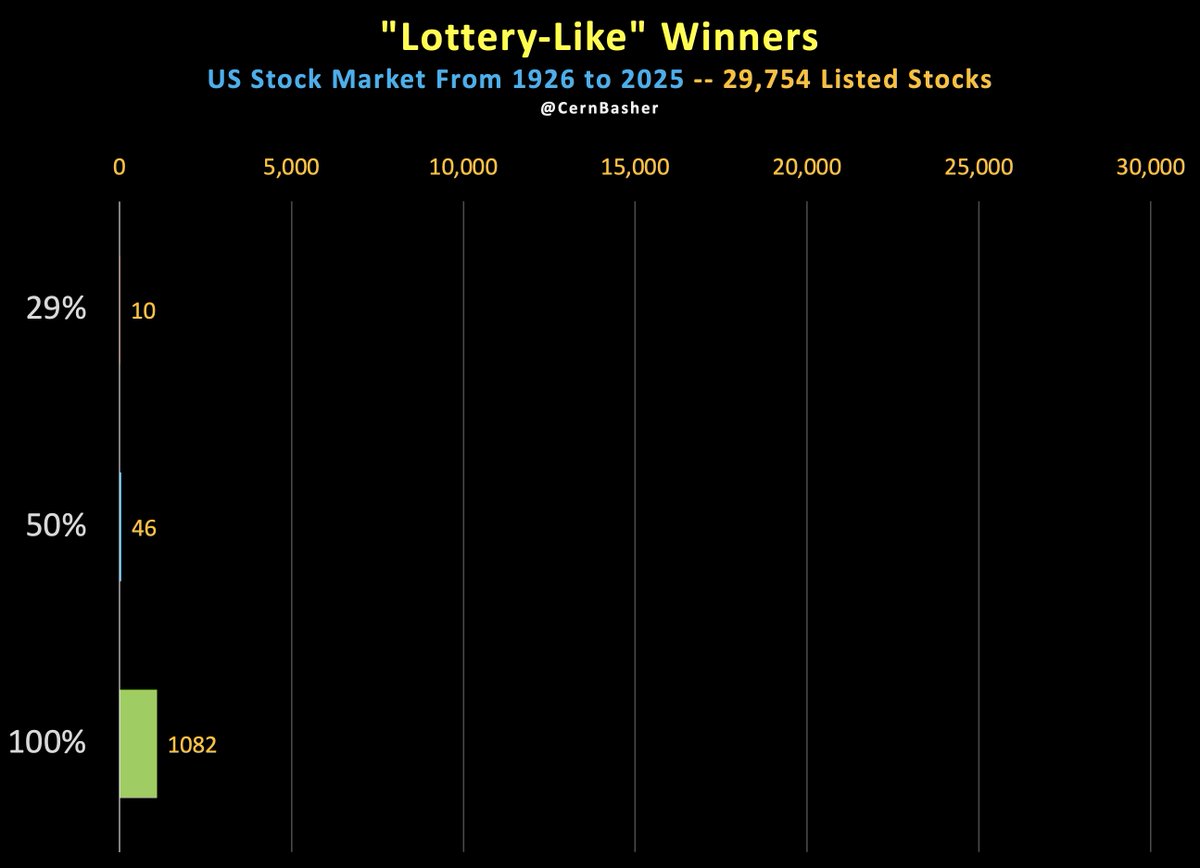
Operating Systems of Civilization This is so important for investors to understand... Over the last 100 years just 46 companies accounted for 50% of all the wealth created in the US stock market. In the first 90 years, 89 companies (or 0.351% of the total) created 50% of all the wealth. Over the last decade, just 13 companies (or 0.166%) were needed. Wealth creation is concentrating. I believe that AI and robotics will further concentrate wealth creation. This has important implications for investors (see the post below and the link within it to the "Who are the Future Wealth Creators?" article). Hint: the companies that become the operating systems for civilization will be the big wealth creators.
Cern Basher tweet media
Cern Basher@CernBasher

x.com/i/article/2043…

English
18
36
309
28.5K