Semir Jahic

2.8K posts

Semir Jahic banner
Semir Jahic

Semir Jahic

@realSemir

CEO & Co-Founder @ https://t.co/zjLG85PTje 👨🏻‍💻 Building an AI sales agents + other projects 💰 bootstrapped, profitable 🌍🇨🇭🇬🇧 Ex-Clari, Ex-Salesforce


London, England Katılım Ekim 2010
1.1K Takip Edilen297 Takipçiler
Simon Høiberg
Simon Høiberg@SimonHoiberg·
Lifemaxxing in a Swiss Mountain Village 🇨🇭🥰 This is my backyard.
English
38
1
218
18.1K
Semir Jahic retweetledi
Andrew Curran
Andrew Curran@AndrewCurran_·
Three weeks ago there were rumors that one of the labs had completed its largest ever successful training run, and that the model that emerged from it performed far above both internal expectations and what people assumed the scaling laws would predict. At the time these were only rumors, and no lab was attached to them. But in light of what we now know about Mythos, they look more credible, and the lab was probably Anthropic. Around the same time there were also rumors that one of the frontier labs had made an architectural breakthrough. If you are in enough group chats, you hear claims like this constantly, and most turn out to be nothing. But if Anthropic found that training above a certain scale, or in a certain way at that scale, produces capabilities that sit far above the prior trendline, then that is an architectural breakthrough. I think the leaked blog post was real, but still a draft. Mythos and Capybara were both candidate names for the new tier, though Mythos may now have enough mindshare that they end up keeping it. The specific rumor in early March was that the run produced a model roughly twice as performant as expected. That remains unconfirmed. What is confirmed is that Anthropic told Fortune the new model is a 'step change,' a sudden 2x would certainly fit the definition. We will find out in April how much of this is true. My own view is that the broad shape of this is correct even if some of the numbers are wrong. And if it is substantially accurate, then it also casts OpenAI's recent restructuring in a new light. If very large training runs are about to become essential to staying in the game, then a lot of their recent decisions, like dropping Sora, make even more sense strategically. For the public, this would mean the best models in the world are about to become much more expensive to serve, and therefore much more expensive to use. That will put pressure on rate limits, pricing, and subscription plans that are already subsidized to some unknown degree. Instead of becoming too cheap to meter, frontier intelligence may be about to become too expensive for most of humanity to afford. Second-order effects; compute, memory, and energy are about to become much more important than they already are. In the blog they describe the new model as not just an improvement, but having 'dramatically higher scores' than Opus 4.6 in coding and reasoning, and as being 'far ahead' of any other current models. If this is the new reality, then scale is about to become king in a whole new way. It would also mean, as usual, that Jensen wins again.
English
184
323
4.1K
956.9K
Bojan Tunguz
Bojan Tunguz@tunguz·
European mind cannot comprehend this.
English
57
7
156
49.5K
Semir Jahic
Semir Jahic@realSemir·
@wickedguro That’s awesome. What was the accelerator that helped grow so fast suddenly? Was it that post of 5m views or something else?
English
0
0
0
34
Nevo David
Nevo David@wickedguro·
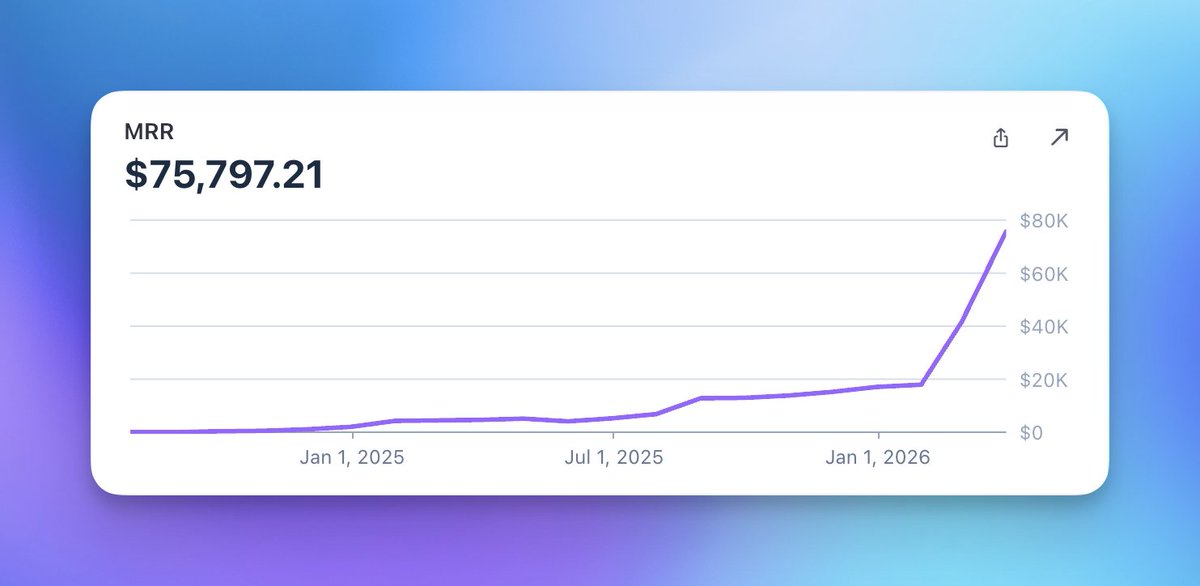
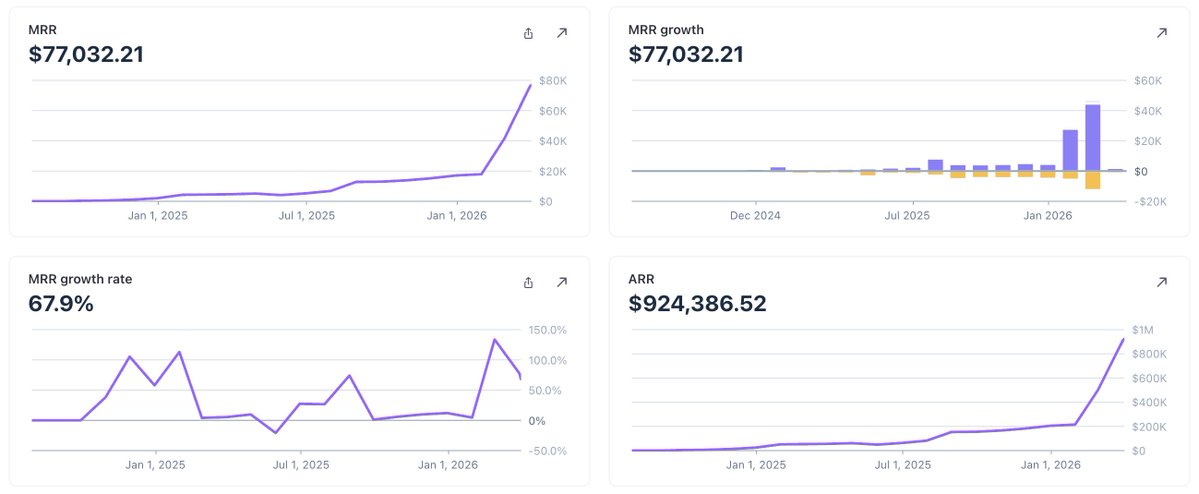
Opening this morning with $76,460 MRR. I am still shocked about all this growth; it was my milestone for a few years in the future. Interesting stuff is happening: ➡ Hired a DevRel — it's the first employee of the company, bye bye indie hacking haha. ➡ Doing some Paperclip SEO — I am making a page alternative to every competitor using WordPress skill (wp-json) and agent-browser, if HTTP requests don't give information. ➡ Hopefully get ads on Postiz running — having a problem with the Meta Ads Manager. ➡ Scaling marketing — have a few partnerships brewing. ➡ Perfecting Customer Support — My DevRel already told me a few tools she needs from the Discord bot. ➡ Mobile freelancer finished Postiz — only templating because I hate UI, going to check it and start working on the logic. ➡ Solving Bugs in Postiz
Nevo David tweet media
Nevo David@wickedguro

x.com/i/article/2037…

English
7
0
33
5K
le.hl
le.hl@0xleegenz·
People who moved abroad alone in their 20s, handled all docs, bank account, visa, tax, jobs, accomadation, and culture difference These people fear nothing anymore
English
970
6.9K
60K
4.1M
Semir Jahic
Semir Jahic@realSemir·
@wickedguro Fantastic. A lot of this is what I am doing manually with skills and MD files. Will check out paper clip!
English
1
0
0
307
Nevo David
Nevo David@wickedguro·
I made $76,665 in March 2026 🌷 🦞 Postiz — $75,678 🦀 Agent-Media — $987 + I have never made such a monstrous amount of money. Never thought it possible. + A month ago, Postiz was on $20,000.
Nevo David tweet media
Nevo David@wickedguro

x.com/i/article/2037…

English
36
2
218
48.8K
Semir Jahic
Semir Jahic@realSemir·
@tomercn Gotcha, my Google result put that random app up on top. Now, I check what you're actually doing. Cool stuff!
Semir Jahic tweet media
English
0
0
0
132
Semir Jahic
Semir Jahic@realSemir·
@PaulGTM @edsim Also totally recommend his newsletter on Substack. I read it every week.
English
0
0
0
19
Paul Irving
Paul Irving@PaulGTM·
@edsim is someone we’ve spent a lot of time learning from. He’s been investing at the earliest stages for three decades, backing companies like Protect AI, Kustomer, Clay, Superhuman, and Snyk. More importantly, he’s done it across multiple platform shifts, each one forcing a reset in how companies get built. What makes Ed’s perspective different is how consistent his lens is, even as the environment changes. He still starts in the same place. The founder, and the problem they’re obsessed with. A lot stuck with me from this conversation. The thing I keep coming back to is how he thinks about durability when the pace of change keeps accelerating. There are two parts to it: 1. The advantage is shifting from what you build to how you adapt. In previous cycles, you could build a wedge, prove demand, and spend time turning it into a scalable go-to-market motion. That timeline is compressing quickly. Ed’s point around the “jet stream” is real. Products can be recreated or absorbed much faster now, which means the edge comes from how quickly a founder can learn, reposition, and stay ahead of where the market is moving. 2. The companies that win are being built differently from the inside. One of the most practical shifts he called out is how teams are using agents. Engineering is no longer the clear bottleneck. In many cases, teams are shipping faster than the rest of the company can absorb. That creates pressure across go-to-market, hiring, and leadership. The founders who are leaning into this are redesigning how their companies operate around that speed. The Clay example is a good reminder of how this actually plays out. They spent years iterating without a clear breakout. Stayed disciplined on burn. Stayed close to user behavior. When the wedge showed up, they were ready to move on it. ~$600K → $4.6M → $30M → $100M+. That path is messier than most people expect, but also more common than you realize. Full conversation on YouTube or wherever you get your podcasts. Big thank you to our series partner, @AngelList, who have been instrumental in helping GTMfund scale since the early days.
English
3
3
8
840
Semir Jahic retweetledi
Josh Wood
Josh Wood@J_K_Wood·
“Children don’t make you happy” - The Daily Mail I'm no researcher, but I downloaded the dataset and looked for myself. The study's numbers say the EXACT OPPOSITE of the headline 👇🏻
Josh Wood tweet media
English
753
2.8K
18.8K
1M
Marc Seitz — oss/acc
2.5 years to look like an “overnight success.” $0 → $1M ARR: 18 months $1M → $2M ARR: 6 months The early days test your patience. The later days reward your consistency. Build anyway.
Marc Seitz — oss/acc tweet media
English
30
1
95
5.7K
Semir Jahic retweetledi
orph
orph@orphcorp·
this is excellent >GitLab founder diagnosed with rare cancer (osteosarcoma) >standard care works but cancer comes back later >medical team says there's not much else to do >"It became my own job to keep myself alive. Nobody else was going to do it for me at this point" >starts researching, assembles his own medical team, uses AI for deep research >“I’ll talk to anyone, I’ll go anywhere, and I can be there anytime" to collect information >does as many diagnostic tests as he can find as often as he can (maximal diagnostics) >develops his own therapeutic ladder with repurposed drugs, personalized medicine, etc >Sid’s cancer currently in remission
orph tweet media
Sebastian Caliri@SebastianCaliri

The full deck on Sid’s cancer approach is here: sytse.com/cancer/ Worth a read. Raw data for download is also available and linked in the deck


English
118
1.2K
11.7K
1.7M
Louis Meyer
Louis Meyer@Louis__Meyer·
That's it. Today again @claudeai down, like almost every morning. And a new "update" for Claude Desktop, more bugs, even slower, it's a CPU/Memory hog. Not paying for that anymore. Cancelled.
English
3
0
3
491
Semir Jahic retweetledi
clem 🤗
clem 🤗@ClementDelangue·
After @Pinterest @Airbnb @NotionHQ @cursor_ai, today it’s @eoghan @intercom publicly sharing that they’re finding it better, cheaper, faster to use and train open models themselves rather than use APIs for many tasks. And hundreds of other companies are doing the same without sharing. Ultimately, I believe the majority of AI workflows will be in-house based on open-source (vs API). It took much more time than we anticipated but it’s happening now!
clem 🤗 tweet media
English
81
185
1.7K
397.8K
Semir Jahic retweetledi
Andreas Klinger 🦾
Andreas Klinger 🦾@andreasklinger·
A student in Zurich sleeps in a camper van outside a hangar every night. Just to have more hours to build a humanoid robot. He’s obsessive. He's not alone. 2,500 students across Europe are getting into robotics right now. And now they united and just launched: ESRA, the European Student Robotics Association. 🇪🇺🦾 They are bringing together highly talented young people, give them space, give them resources and let them build. By now already 13 robotics clubs. 8 countries. 2,500+ students. I visited several of them over the last weeks to get to know them and let them tell their stories. We've also been helping behind the scenes where we can, because this is exactly what Europe needs. Several multiple billion dollar companies will come out of the ESRA network. Right here in Europe. If the Bay Area had a student robotics network like this, they would never shut up about it. Time we do the same. 😤🔥🇪🇺 It only needs a few crazy ones to fix a continent. Turns out they're already building. 🇪🇺
English
54
164
1.2K
115.4K
Semir Jahic retweetledi
Tuki
Tuki@TukiFromKL·
🚨 Andrej Karpathy just explained the scariest thing happening in software right now.. someone poisoned a Python package that gets 97 million downloads a month.. and a simple pip install was enough to steal everything on your machine.. SSH keys.. AWS credentials.. crypto wallets.. database passwords.. git credentials.. shell history.. SSL private keys.. everything.. and here's the part that should terrify every developer alive.. the attack was only discovered because the attacker wrote sloppy code.. the malware used so much RAM that it crashed someone's computer.. if the attacker had been better at coding.. nobody would have noticed for weeks.. one developer.. using Cursor with an MCP plugin.. had litellm pulled in as a dependency they didn't even know about.. their machine crashed.. and that crash saved thousands of companies from getting their entire infrastructure stolen.. Karpathy's take is the real wake up call.. every time you install any package you're trusting every single dependency in its tree.. and any one of them could be poisoned.. vibe coding saved us this time.. the attacker vibe coded the attack and it was too sloppy to work quietly.. next time they won't make that mistake.
Andrej Karpathy@karpathy

Software horror: litellm PyPI supply chain attack. Simple `pip install litellm` was enough to exfiltrate SSH keys, AWS/GCP/Azure creds, Kubernetes configs, git credentials, env vars (all your API keys), shell history, crypto wallets, SSL private keys, CI/CD secrets, database passwords. LiteLLM itself has 97 million downloads per month which is already terrible, but much worse, the contagion spreads to any project that depends on litellm. For example, if you did `pip install dspy` (which depended on litellm>=1.64.0), you'd also be pwnd. Same for any other large project that depended on litellm. Afaict the poisoned version was up for only less than ~1 hour. The attack had a bug which led to its discovery - Callum McMahon was using an MCP plugin inside Cursor that pulled in litellm as a transitive dependency. When litellm 1.82.8 installed, their machine ran out of RAM and crashed. So if the attacker didn't vibe code this attack it could have been undetected for many days or weeks. Supply chain attacks like this are basically the scariest thing imaginable in modern software. Every time you install any depedency you could be pulling in a poisoned package anywhere deep inside its entire depedency tree. This is especially risky with large projects that might have lots and lots of dependencies. The credentials that do get stolen in each attack can then be used to take over more accounts and compromise more packages. Classical software engineering would have you believe that dependencies are good (we're building pyramids from bricks), but imo this has to be re-evaluated, and it's why I've been so growingly averse to them, preferring to use LLMs to "yoink" functionality when it's simple enough and possible.

English
285
2.3K
14K
3.2M
Tibo
Tibo@tibo_maker·
building a new SEO audit tool drop your site below 👇 I'll reply with a single prompt you run it your SEO is fixed ✨
Tibo tweet media
English
232
20
313
33K