
Reshma Shetty

2K posts

Reshma Shetty banner
Reshma Shetty

Reshma Shetty

@reshmapshetty

Co-founder at Ginkgo Bioworks (@Ginkgo, $DNA)

Katılım Kasım 2011
532 Takip Edilen8.4K Takipçiler
Reshma Shetty retweetledi
Benchling
Benchling@benchling·
We’re launching direct ordering with @TwistBioscience, @adaptyvbio, and @Ginkgo! 🙌 Now scientists can design candidates, place orders for synthesis and services, and receive structured results back without ever leaving Benchling. This closes the gap between in silico design and wet lab execution, with full experimental context. In partnership with: ✔️ @TwistBioscience for gene fragments, clonal genes, antibody production, and characterization ✔️ @adaptyvbio for protein engineering services ✔️ @Ginkgo for antibody developability See how it works: benchling.com/blog/one-click…
English

2
15
87
8K
Reshma Shetty retweetledi
Jason Kelly
Jason Kelly@jrkelly·
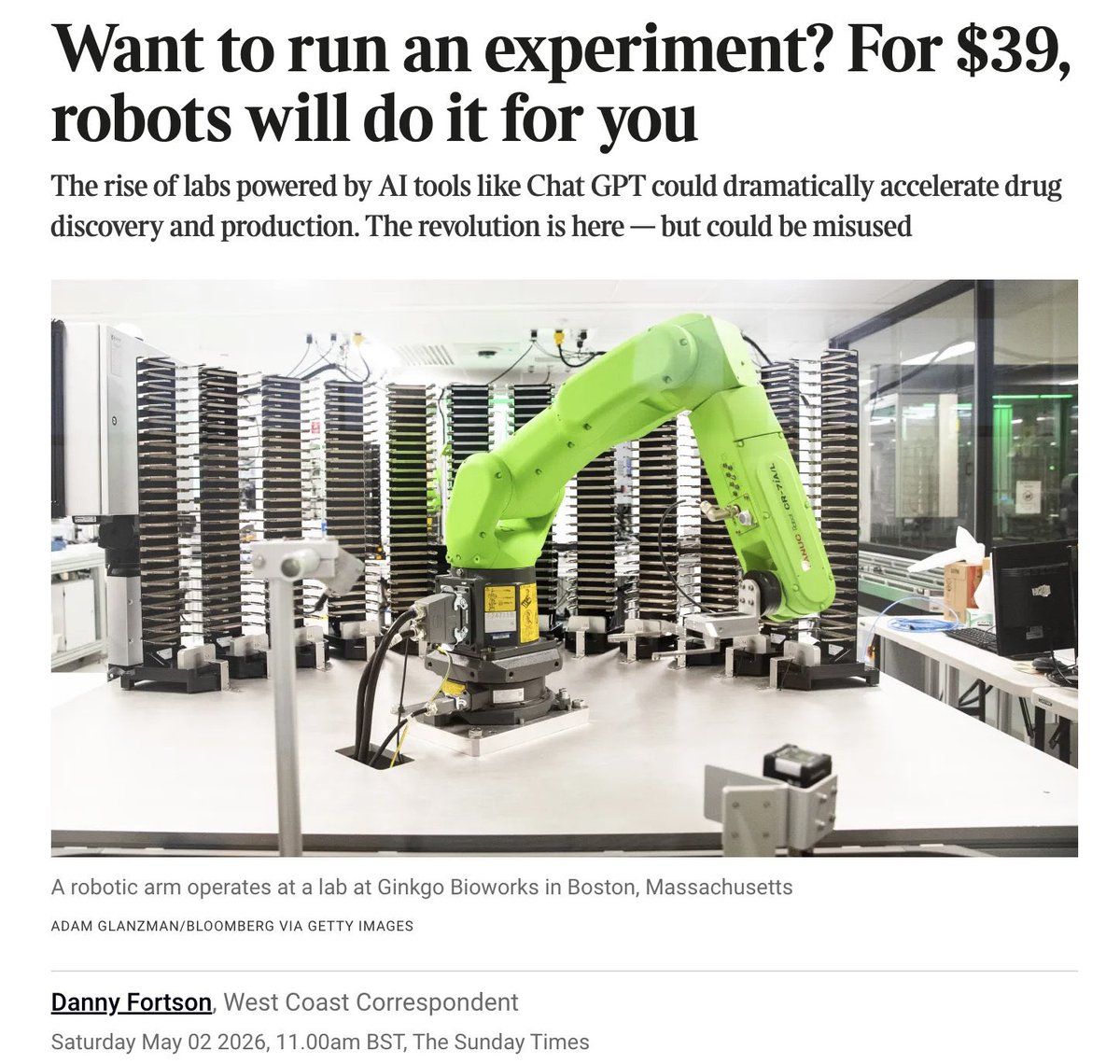
Fun piece in @thetimes today on @Ginkgo Cloud Lab! You (or openclaw :) can order lab experiments for $39! Links 👇
Jason Kelly tweet media
English
8
38
244
15.4K
Reshma Shetty retweetledi
Adriana Sophia Taylor
Adriana Sophia Taylor@TheToxDonna·
Super cool to see Jason and Ginkgo innovating so fast. I’ve been to the Ginkgo Bioworks facility in the seaport. State of the art. They offer tours of their autonomous labs too!! Check it out :)
Jason Kelly@jrkelly

Was fortunate to ribbon-cut the first Autonomous Lab as part of the Genesis Mission with @SecretaryWright. Scientists should direct autonomous labs to do their lab work 24/7 in our national labs! This is how the US keeps our lead in science - amazing leadership from @ENERGY, @mkratsios47, @ScienceUnderSec, and @sriramk 🇺🇸 Excited to see how the autonomous labs program expands!

English
1
5
21
3.5K
Reshma Shetty retweetledi
Jason Kelly
Jason Kelly@jrkelly·
It's 1AM -- is your autonomous lab running experiments for you?
Jason Kelly tweet media
English
13
19
171
20.6K
Reshma Shetty retweetledi
Jason Kelly
Jason Kelly@jrkelly·
Was fortunate to ribbon-cut the first Autonomous Lab as part of the Genesis Mission with @SecretaryWright. Scientists should direct autonomous labs to do their lab work 24/7 in our national labs! This is how the US keeps our lead in science - amazing leadership from @ENERGY, @mkratsios47, @ScienceUnderSec, and @sriramk 🇺🇸 Excited to see how the autonomous labs program expands!
Darío Gil@ScienceUnderSec

What if we could automate experiments to speed the discovery of new medicines and advanced materials? The Genesis Mission is making this a reality by building AI-driven labs to help scientists accelerate breakthroughs.

English
5
34
191
22.1K
Reshma Shetty retweetledi
Jason Kelly
Jason Kelly@jrkelly·
See a video tour of the first Autonomous Lab built for the Genesis Mission by @Ginkgo at @PNNLab !🇺🇸🤖 US keeping lead in science needs scientists driving AI+robots instead of toiling at the lab bench!
Darío Gil@ScienceUnderSec

What if we could automate experiments to speed the discovery of new medicines and advanced materials? The Genesis Mission is making this a reality by building AI-driven labs to help scientists accelerate breakthroughs.

English
12
68
347
39.6K
Reshma Shetty retweetledi
Keith Robison
Keith Robison@OmicsOmicsBlog·
@MacrinePhD @razoralign @MIT You design; we test One design or thousands - no order too small or too large Ginkgo Cloud Labs rolls out a new affordable protocol every week Last week it was $159/design for thermal stability measure Don’t see what you want - let me know! cloud.ginkgo.bio
English
0
3
7
903
Reshma Shetty retweetledi
Ginkgo Bioworks
Ginkgo Bioworks@Ginkgo·
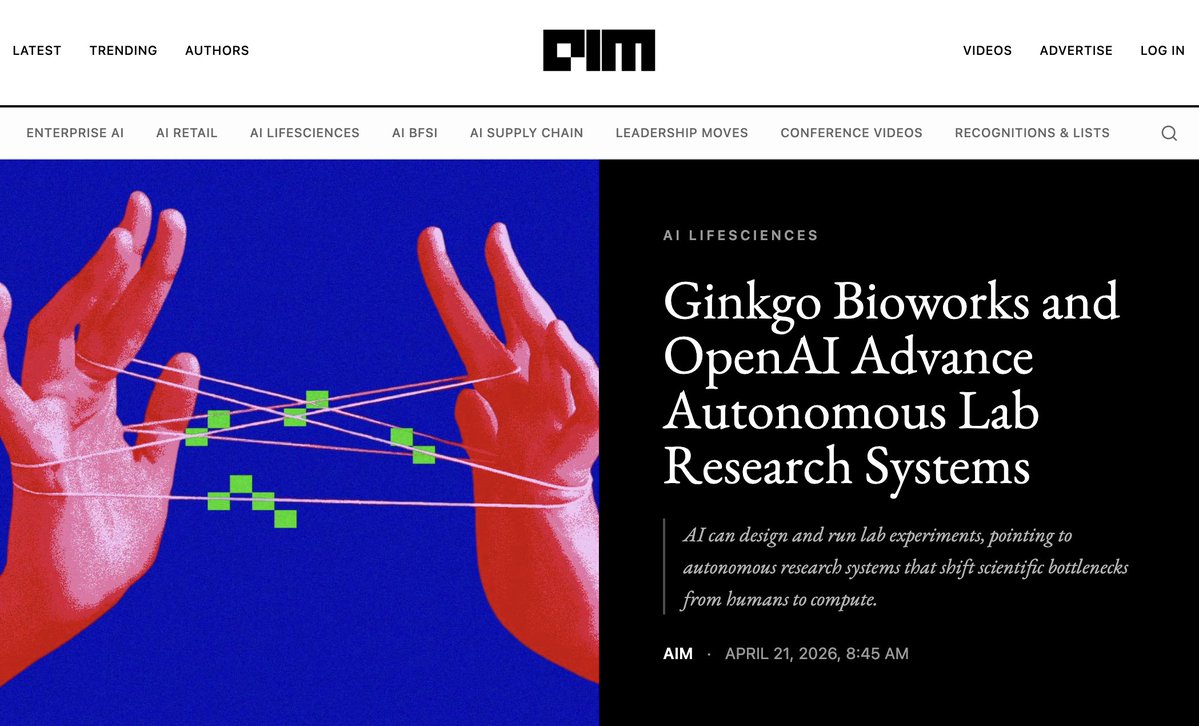
We worked with @OpenAI to connect AI to our autonomous lab. Read all about it in a new article from @AIMmediahouse: 🟢 How AI models designed experiments, generated protocols, and analyzed results from lab runs on Nebula, our autonomous lab 🟢 Results that improved cell-free protein synthesis #CFPS costs by 40% over the state-of-the-art 🟢 Shoutouts from @joyjiao12 and Yunyun Wang on the OpenAI Podcast hubs.la/Q04dn0QR0
Ginkgo Bioworks tweet media
English
0
14
55
7.7K
Reshma Shetty
Reshma Shetty@reshmapshetty·
Jake nails it.
Jake Wintermute 🧬/acc@SynBio1

In the coming years we’re going to see a lot of claims about “autonomous labs” accompanied by videos of cool-looking robots. I’m extremely bullish about this space and I’m rooting for all these companies to succeed. But right now it’s hard to know who is succeeding because the word “autonomous” has no fixed meaning. It’s lowkenuinely a problem that robots look so cool. It's easy to see a video of robots in motion and be convinced that the future has arrived. If you haven’t worked on an automated lab floor, frontier tech looks about as cool as useless arm-flailing. So here are some quick heuristics you can use to get a sense for how “autonomous” the lab you see in a video really is. - Compact form factors. Physical space is at a premium in the lab. Mature automation systems use it efficiently. If a robot has lots of open space around it, that’s a sign that it requires a lot of human support. - Cold storage. Almost all biological protocols need some kind of refrigeration. Automating sample retrieval from freezers is particularly annoying, because frost interferes with mechanical gripping, barcode reading, etc. If you don’t see a freezer near the robot, it means humans are doing the sample management off-camera. - Sample transfer. Real lab protocols require the operations of many different devices (PCR machines, incubators, liquid handlers, centrifuges etc) - too many to fit in a single workstation. An autonomous lab needs a way to shuttle samples around. If you don’t see plates moving around the room, humans are doing that. - Inventory and waste. Biotech eats a lot of reagents and makes a lot of plastic waste. Managing inventory is labor intensive but unglamorous - the last thing most buzzy startups want to care about. A true autonomous lab demo will include robots doing boring and unsexy things. With these tips, you too can become a cynical jerk who looks at a startup’s tech demo and says “that’s not REALLY an autonomous lab!” But don’t do that. Instead, root for success and watch as more automation teams check off more items from this list over time. I’m expecting fully autonomous labs, even by my high standards, before 2030.

English
0
3
24
2.8K
Reshma Shetty retweetledi
Jake Wintermute 🧬/acc
Jake Wintermute 🧬/acc@SynBio1·
In the coming years we’re going to see a lot of claims about “autonomous labs” accompanied by videos of cool-looking robots. I’m extremely bullish about this space and I’m rooting for all these companies to succeed. But right now it’s hard to know who is succeeding because the word “autonomous” has no fixed meaning. It’s lowkenuinely a problem that robots look so cool. It's easy to see a video of robots in motion and be convinced that the future has arrived. If you haven’t worked on an automated lab floor, frontier tech looks about as cool as useless arm-flailing. So here are some quick heuristics you can use to get a sense for how “autonomous” the lab you see in a video really is. - Compact form factors. Physical space is at a premium in the lab. Mature automation systems use it efficiently. If a robot has lots of open space around it, that’s a sign that it requires a lot of human support. - Cold storage. Almost all biological protocols need some kind of refrigeration. Automating sample retrieval from freezers is particularly annoying, because frost interferes with mechanical gripping, barcode reading, etc. If you don’t see a freezer near the robot, it means humans are doing the sample management off-camera. - Sample transfer. Real lab protocols require the operations of many different devices (PCR machines, incubators, liquid handlers, centrifuges etc) - too many to fit in a single workstation. An autonomous lab needs a way to shuttle samples around. If you don’t see plates moving around the room, humans are doing that. - Inventory and waste. Biotech eats a lot of reagents and makes a lot of plastic waste. Managing inventory is labor intensive but unglamorous - the last thing most buzzy startups want to care about. A true autonomous lab demo will include robots doing boring and unsexy things. With these tips, you too can become a cynical jerk who looks at a startup’s tech demo and says “that’s not REALLY an autonomous lab!” But don’t do that. Instead, root for success and watch as more automation teams check off more items from this list over time. I’m expecting fully autonomous labs, even by my high standards, before 2030.
English
24
28
240
25.8K
Reshma Shetty retweetledi
Sajith Wickramasekara
Sajith Wickramasekara@sajithw·
In the AI era, the traditional biopharma industry is the underdog. Big tech and AI labs are building wet labs. China has overtaken Europe in molecules produced. But the tools available to the industry discuss science, not do it. The hard problem in AI for science is at the interface between the physical and digital worlds. We built an AI Scientist at that seam. It wires together the digital and physical worlds of R&D. Predictive models, data infrastructure, wet lab execution feed into a single loop that reasons, acts, and improves with every experiment. Our ambition: get molecules to the clinic twice as fast. Last fall I wrote about why biotech needs to be rebuilt for the AI era. Today I'm sharing the next chapter: what the AI Scientist is, a blueprint for how it works, and why even Richard Feynman couldn't hack it in a wet lab.
English
7
32
150
29.9K
Reshma Shetty retweetledi
Ginkgo Bioworks
Ginkgo Bioworks@Ginkgo·
Tomorrow, our own @reshmapshetty will take the stage at @Unlock2026AI in San Francisco for a discussion on breakthrough AI in science: separating hype from reality. Attending #UNLOCK2026? Don’t miss this session on where AI is genuinely advancing biological research and where challenges remain.
Ginkgo Bioworks tweet mediaGinkgo Bioworks tweet media
English
0
6
27
1.8K
Reshma Shetty retweetledi
Ginkgo Bioworks
Ginkgo Bioworks@Ginkgo·
Imagine a future where every scientist can essentially run their own lab by directing AI agents to perform the experiments for them. For @Forbes, @jrkelly spoke with @TheAlexKnapp about the ways Ginkgo has integrated AI into our autonomous lab, including with @OpenAI 👇 In our work with OpenAI, its AI model designs, executes, and iterates scientific experiments via our physical laboratory. Through the Ginkgo Cloud Lab, our EstiMate agent allows any researcher to submit and run their desired protocol on our fleet of more than 70 robots. Read more in Forbes: hubs.la/Q04cKCKX0 Check out our Cloud Lab here: hubs.la/Q04cKs2V0
Ginkgo Bioworks tweet mediaGinkgo Bioworks tweet media
English
1
16
57
3.1K
Reshma Shetty retweetledi
Ginkgo Bioworks
Ginkgo Bioworks@Ginkgo·
Autonomous research institutes that are constantly running and curing human disease, making new materials, making new drugs and personalized medicine. On the @OpenAI podcast, @joyjiao12 talked about the potential of hooking up autonomous labs like Ginkgo's Nebula to AI models like the new GPT-Rosalind.
English
1
13
52
4.8K
Reshma Shetty retweetledi
Ginkgo Bioworks
Ginkgo Bioworks@Ginkgo·
On the @OpenAI podcast, @joyjiao12 discussed OpenAI's work this year with Ginkgo's autonomous cloud lab on Cell-Free Protein Synthesis. When they started, they weren't even sure if GPT-5 could do biology. By the end, it had beaten the human state-of-the-art.
English
1
12
48
4.2K
Reshma Shetty retweetledi
Jason Kelly
Jason Kelly@jrkelly·
You can access @Ginkgo's Cloud Lab services via the new @amazon Bio Discovery announced today! The future is researchers designing lab experiments guided by AI and executing them on Cloud Autonomous Labs. Give it a try!! aws.amazon.com/biodiscovery/
English
15
36
203
23.4K