Roberta Raileanu

1.7K posts

Roberta Raileanu

Roberta Raileanu

@robertarail

Open-Endedness Team Lead and Senior Staff Research Scientist @GoogleDeepMind. Honorary Associate Professor @bold_lab_ai. ex @Meta | @NYU | @Princeton.

London, UK Katılım Nisan 2013
1.7K Takip Edilen11.1K Takipçiler
Sabitlenmiş Tweet
Roberta Raileanu
Roberta Raileanu@robertarail·
I’m building a new team at @GoogleDeepMind to work on Open-Ended Discovery! We’re looking for strong Research Scientists and Research Engineers to help us push the frontier of autonomously discovering novel artifacts such as new knowledge, capabilities, or algorithms, in an open-ended self-improving loop. We aim to work on ambitious research projects in a fast-paced manner. If this sounds appealing to you, apply using the link below by Friday, August 1st EOD: job-boards.greenhouse.io/deepmind/jobs/…
English
89
254
2.5K
347.1K
Sam Earle
Sam Earle@Smearle_RH·
Proud to have received a Best Paper Award for our AI Picbreeder work at GECCO 2026 @GeccoConf in the Complex Systems track. Blog post here: pub.sakana.ai/picbreeder-vlm/. (Along with an Outstanding Reviewer award in the Evolutionary Machine Learning track!🧎🏻‍♂️🙏🏻)
Sam Earle tweet media
Sam Earle@Smearle_RH

Our new work, The AI Picbreeder Experiment, explores the use of frontier models as drivers of synthetic open-endedness. If we're serious about putting these things in the driver's seat of a new and automatic science, then we need to know what they're really made of in terms of the ability to create and discover through intuition. Giving shape to the formless, making decisions based on vibes, having "taste"—whatever you want to call it—Can they do it? Do they have the sauce? Picbreeder, a website where human users collaborated to spontaneously evolve images, is just the sauce-bearing test we need. Here, images were represented as neural networks that could be bred and mutated, with humans playing the role of natural selectors. By design, this interface prohibits the creative baggage of premeditation, of having goals in advance, and demands the artist patiently follow the flow of the work and seize upon serendipitous opportunities when they arise. It's more like catching fish from a stream than drawing a picture. And yet, distributing their work across many sessions, and branching and remixing each other's creations, humans were ultimately able to bend these neural networks into all manner of interesting, evocative, and striking images. So, can large vision language models do the same? On the blog, we've built an interactive archive viewer that allows visitors to walk through galleries of Picbreeder images created by both humans and AI, and judge for themselves. Call us old fashioned, but we're pretty sure the human output has something special that the AI can't quite yet replicate. We design a number of evaluation metrics to get at this quality. We ask: "How visually different are the images in the archive? How much do they look like real things? How different are the things they look like?" The numbers show the humans coming out on top. And looking at the AI-generated archives and lineages, we find traces of an anxious attachment to plans and objectives. Often, even when the AI makes an apparent creative leap—e.g. transforming an image of a hood ornament into a side view of a car—it really stays stuck in place in some broader semantic/thematic space. And that's to say nothing of the handful of archives littered almost entirely with top-down views of soda can pull tabs, or high frequency circular patterns that appear chaotic and uninteresting to us, but apparently scratch some perceptual itch in the agents. And yet we're optimistic. Though the AI's output is less refined, its movement through the stream of images less graceful and vivacious than our own, what we have here is a plausible model organism of open-endedness. The agents indeed (re)discover distributions of novel and interesting images when left to their own devices. They display a keen eye (even sometimes discovering optical illusions that might slip by a casual glance from a human), and explore persistently under considerable creative constraints. This allows us to model factors that are consequential to such open-ended exploration; i.e. injecting noise into the agents' decision making process, playing with their memory, and seeding them with subtly distinct personalities—all of which can be beneficial in the right doses. And there's something to be said for searching without objectives. Prior work shows that if we optimize Picbreeder's pattern-producing neural networks to resemble a particular image (say, a skull), these representations will be fractured (meddling with their internal weights will immediately explode the skull beyond recognition), while the same neural image found by humans via open-ended exploration is robust to such perturbations, and even shows meaningful variations across them (e.g. the jaw opening and closing). Our VLM agents also stumbled upon images of skulls. Their representations are not as neatly semantically factorized as those discovered by humans, but neither are they nearly as fractured as those discovered by optimization. This suggests that if we want to have AI build the next generation of AI, then it will be crucial to let them attack this problem through aimless wandering. Without this freedom, future models will be brittle and myopic; with it, they will have developed a more thorough model of the world, and an improved capacity for the kind of creative insight that is so quietly fundamental to the most meaningful of human endeavors.

English
5
6
50
4.9K
Roberta Raileanu retweetledi
Sam Earle
Sam Earle@Smearle_RH·
Our new work, The AI Picbreeder Experiment, explores the use of frontier models as drivers of synthetic open-endedness. If we're serious about putting these things in the driver's seat of a new and automatic science, then we need to know what they're really made of in terms of the ability to create and discover through intuition. Giving shape to the formless, making decisions based on vibes, having "taste"—whatever you want to call it—Can they do it? Do they have the sauce? Picbreeder, a website where human users collaborated to spontaneously evolve images, is just the sauce-bearing test we need. Here, images were represented as neural networks that could be bred and mutated, with humans playing the role of natural selectors. By design, this interface prohibits the creative baggage of premeditation, of having goals in advance, and demands the artist patiently follow the flow of the work and seize upon serendipitous opportunities when they arise. It's more like catching fish from a stream than drawing a picture. And yet, distributing their work across many sessions, and branching and remixing each other's creations, humans were ultimately able to bend these neural networks into all manner of interesting, evocative, and striking images. So, can large vision language models do the same? On the blog, we've built an interactive archive viewer that allows visitors to walk through galleries of Picbreeder images created by both humans and AI, and judge for themselves. Call us old fashioned, but we're pretty sure the human output has something special that the AI can't quite yet replicate. We design a number of evaluation metrics to get at this quality. We ask: "How visually different are the images in the archive? How much do they look like real things? How different are the things they look like?" The numbers show the humans coming out on top. And looking at the AI-generated archives and lineages, we find traces of an anxious attachment to plans and objectives. Often, even when the AI makes an apparent creative leap—e.g. transforming an image of a hood ornament into a side view of a car—it really stays stuck in place in some broader semantic/thematic space. And that's to say nothing of the handful of archives littered almost entirely with top-down views of soda can pull tabs, or high frequency circular patterns that appear chaotic and uninteresting to us, but apparently scratch some perceptual itch in the agents. And yet we're optimistic. Though the AI's output is less refined, its movement through the stream of images less graceful and vivacious than our own, what we have here is a plausible model organism of open-endedness. The agents indeed (re)discover distributions of novel and interesting images when left to their own devices. They display a keen eye (even sometimes discovering optical illusions that might slip by a casual glance from a human), and explore persistently under considerable creative constraints. This allows us to model factors that are consequential to such open-ended exploration; i.e. injecting noise into the agents' decision making process, playing with their memory, and seeding them with subtly distinct personalities—all of which can be beneficial in the right doses. And there's something to be said for searching without objectives. Prior work shows that if we optimize Picbreeder's pattern-producing neural networks to resemble a particular image (say, a skull), these representations will be fractured (meddling with their internal weights will immediately explode the skull beyond recognition), while the same neural image found by humans via open-ended exploration is robust to such perturbations, and even shows meaningful variations across them (e.g. the jaw opening and closing). Our VLM agents also stumbled upon images of skulls. Their representations are not as neatly semantically factorized as those discovered by humans, but neither are they nearly as fractured as those discovered by optimization. This suggests that if we want to have AI build the next generation of AI, then it will be crucial to let them attack this problem through aimless wandering. Without this freedom, future models will be brittle and myopic; with it, they will have developed a more thorough model of the world, and an improved capacity for the kind of creative insight that is so quietly fundamental to the most meaningful of human endeavors.
Sakana AI@SakanaAILabs

The AI Picbreeder Experiment: Can AI agents be creative when nobody tells them what to create? Blog: pub.sakana.ai/picbreeder-vlm In our new #GECCO2026 paper, "In Search of the Ingredients of Open-Endedness: Replicating Picbreeder with Large Vision-Language Models", in collaboration with MIT and NYU, we revisit Picbreeder, a lost website where people collaboratively evolved images without any predefined objective. Users simply selected images they found interesting, allowing unexpected forms such as faces, animals, vehicles, and skulls to emerge gradually across many generations and many different people. We recreated this process using vision-language model agents. The agents explore a shared archive, choose images to branch from, evolve new candidates, publish their favorites, and evaluate the creations of other agents. There is no target image and no explicit definition of what counts as progress. The results reveal both the promise and current limitations of AI-driven open-ended discovery. Compared with humans, VLM agents tend to keep circling back to the same kinds of images and concepts. They repeatedly select similar parents, make smaller conceptual leaps, and often refine an existing idea rather than abandoning it in search of something genuinely unexpected. However, introducing a diverse population of agent personalities substantially improves exploration. In some runs, diverse agent populations approached or matched the human archive on measures of semantic diversity and produced more balanced evolutionary trees. We also find intriguing evidence that open-ended evolution can produce more robust representations. A skull evolved by the agents changes smoothly when its underlying neural representation is perturbed, less fractured than a skull directly optimized with gradient descent, although still less cleanly disentangled than one evolved collectively by humans. But perhaps the most interesting result is the gap that remains. Humans appear better at turning fortunate accidents into sustained creative discoveries: recognizing when something unexpected is worth pursuing, refining it, and then making a larger conceptual leap. The AI agents often notice interesting patterns too, but are more likely to become trapped in them. We still do not fully understand what enables humans to navigate open-ended search in this way, or what ingredient(s) current AI systems are missing. For now, the results suggest that there remains something important about human creativity that AI agents have not yet learned to reproduce. This paper will be presented at #GECCO2026 and is nominated for a best paper award! Please check out the interactive blog and technical paper for more details! Read our full paper: arxiv.org/abs/2605.23908 🐟

English
1
10
63
8.9K
Roberta Raileanu retweetledi
RAAIS
RAAIS@raais·
Frontier AI, trained on vast human knowledge, could unlock novel discoveries by connecting disparate fields. Humans struggle to master more than one. AI + Human synergy promises accelerated, superhuman breakthroughs. Watch @robertarail of @googledeepmind at @raais 2026
English
1
2
10
960
Roberta Raileanu
Roberta Raileanu@robertarail·
Excited to give a talk at the @icmlconf RLxF Workshop today at 3:30pm. I’ll be talking about the role of open-ended esss in achieving superhuman scientific discovery. Thank you @shaohua0116 @shaneguML et al. for organizing this!
Shao-Hua Sun @ ICML 🇰🇷@shaohua0116

We're excited to welcome an outstanding lineup of speakers at the RLxF Workshop: Benjamin Eysenbach @ben_eysenbach, Chelsea Finn @chelseabfinn, Jesse Zhang @Jesse_Y_Zhang, Roberta Raileanu @robertarail, Jerry Tworek @MillionInt, and Brian Zhan @brianzhan.

English
0
7
62
5.6K
Roberta Raileanu retweetledi
Feryal
Feryal@FeryalMP·
I’m hiring! Come join our team at Google DeepMind in London or Mountain View to work on Gemini agent post-training. We are looking for Research Scientists and Research Engineers interested in advancing the capabilities of AI agents. Please apply here: google.com/about/careers/…
English
31
82
1.1K
181K
Roberta Raileanu
Roberta Raileanu@robertarail·
Come chat with some BOLD people at @icmlconf 🦋
British Open-ended Learning and Discovery Lab@bold_lab_ai

We hope you’ve enjoyed a sneak peek of work from BOLD and our collaborators at #ICML2026! See below for a full summary of where you can find us this week: ▶️ (Poster) Procedural Generation of Algorithm Discovery Tasks in Machine Learning, Hall A #1803, Tuesday 10:30 - 12:15, led by @AlexDGoldie ▶️ (Poster) h1: Bootstrapping LLMs to Reason over Longer Horizons via Reinforcement Learning, Hall A #2704, led by Alesia Ivanova @sumeetrm ▶️ (Poster) Goal-Conditioned Agents that Learn Everything All at Once, Hall A #310, Tuesday 14:00 - 15:45, led by @mitrma ▶️ (Poster) Rubric Curriculum RL: Exploiting the Generation-Verification Gap in Creative Writing, Hall A #2605, Wednesday 14:30 - 14:15, led by Tejas Krishnan @sumeetrm ▶️ (Poster) Evolution Strategies at the Hyperscale, Hall A #3712, Thursday 10:30 - 12:15, led by @bidiptas13 @JuanDuquevan Mattie Fellows ▶️ (Poster) Dreaming in Code for Curriculum Learning in Open-Ended Worlds, Hall A #213, Wednesday 17:00 - 18:45, led by @k_mitsides ▶️ (Poster) Evolution Strategies at the Hyperscale, Hall A #3712, Thursday 10:30 - 12:15, led by @bidiptas13 @JuanDuquevan Mattie Fellows ▶️ (Poster) The Decrypto Benchmark for Multi-Agent Reasoning and Theory of Mind, Hall A #3504, Thursday 14:30 - 16:15, led by @_andreilupu ▶️ (Poster) LongCoT: Benchmarking Long-Horizon Chain-of-Thought Reasoning, Hall A #1705, Thursday 14:30 - 16:15, led by @sumeetrm @DanielNichols10 @CharlieLondon02 Peggy Li Fabio Pizzati ▶️ (Talk) Superhuman Scientific Discovery, RLxF Worskhop, Friday 15:30 - 16:00, by @robertarail ▶️ (Panel) RLxF Worskhop, Friday 16:00 - 17:00, by @robertarail ▶️ (Workshop) Amortising Bayesian Experimental Design for Sequential Information Gathering in LLMs, FoGen Workshop, Friday, led by @jakobhartmann99 James Harvey Jhonathan Navott ▶️ (Workshop) Elicitation Format Drives Divergent LLM Geopolitical Forecasts, AI Forecasting Workshop, Saturday, led by @hariharansuhas @michalbravansky ▶️ (Workshop) EGGROLL-IPO: Pluralistic Alignment via Decentralised Post-Training with Population Preferences, Pluralistic Alignment Workshop, Saturday, led by @alfie_lamerton ▶️ (Workshop Spotlight) Abstraction for Offline Goal-Conditioned Reinforcement Learning, DEMO Workshop, Saturday, led by @ClarisseWibault

English
1
3
50
6.5K
Roberta Raileanu retweetledi
Andrei A. Rusu
Andrei A. Rusu@andreialexrusu·
I'm hiring for my team at GDM! If you’re passionate about engineering scalable agentic learning systems and doing impactful research, please apply here: goo.gle/4wsFoTU
English
9
25
396
43.6K
Roberta Raileanu retweetledi
British Open-ended Learning and Discovery Lab
We hope you’ve enjoyed a sneak peek of work from BOLD and our collaborators at #ICML2026! See below for a full summary of where you can find us this week: ▶️ (Poster) Procedural Generation of Algorithm Discovery Tasks in Machine Learning, Hall A #1803, Tuesday 10:30 - 12:15, led by @AlexDGoldie ▶️ (Poster) h1: Bootstrapping LLMs to Reason over Longer Horizons via Reinforcement Learning, Hall A #2704, led by Alesia Ivanova @sumeetrm ▶️ (Poster) Goal-Conditioned Agents that Learn Everything All at Once, Hall A #310, Tuesday 14:00 - 15:45, led by @mitrma ▶️ (Poster) Rubric Curriculum RL: Exploiting the Generation-Verification Gap in Creative Writing, Hall A #2605, Wednesday 14:30 - 14:15, led by Tejas Krishnan @sumeetrm ▶️ (Poster) Evolution Strategies at the Hyperscale, Hall A #3712, Thursday 10:30 - 12:15, led by @bidiptas13 @JuanDuquevan Mattie Fellows ▶️ (Poster) Dreaming in Code for Curriculum Learning in Open-Ended Worlds, Hall A #213, Wednesday 17:00 - 18:45, led by @k_mitsides ▶️ (Poster) Evolution Strategies at the Hyperscale, Hall A #3712, Thursday 10:30 - 12:15, led by @bidiptas13 @JuanDuquevan Mattie Fellows ▶️ (Poster) The Decrypto Benchmark for Multi-Agent Reasoning and Theory of Mind, Hall A #3504, Thursday 14:30 - 16:15, led by @_andreilupu ▶️ (Poster) LongCoT: Benchmarking Long-Horizon Chain-of-Thought Reasoning, Hall A #1705, Thursday 14:30 - 16:15, led by @sumeetrm @DanielNichols10 @CharlieLondon02 Peggy Li Fabio Pizzati ▶️ (Talk) Superhuman Scientific Discovery, RLxF Worskhop, Friday 15:30 - 16:00, by @robertarail ▶️ (Panel) RLxF Worskhop, Friday 16:00 - 17:00, by @robertarail ▶️ (Workshop) Amortising Bayesian Experimental Design for Sequential Information Gathering in LLMs, FoGen Workshop, Friday, led by @jakobhartmann99 James Harvey Jhonathan Navott ▶️ (Workshop) Elicitation Format Drives Divergent LLM Geopolitical Forecasts, AI Forecasting Workshop, Saturday, led by @hariharansuhas @michalbravansky ▶️ (Workshop) EGGROLL-IPO: Pluralistic Alignment via Decentralised Post-Training with Population Preferences, Pluralistic Alignment Workshop, Saturday, led by @alfie_lamerton ▶️ (Workshop Spotlight) Abstraction for Offline Goal-Conditioned Reinforcement Learning, DEMO Workshop, Saturday, led by @ClarisseWibault
English
2
24
50
16.3K
Roberta Raileanu retweetledi
Tim Rocktäschel
Tim Rocktäschel@_rockt·
It has been an absolute privilege and pleasure to build up @UCL_DARK with @egrefen, @robertarail and @jparkerholder over the past eight years. Yesterday, the UK government announced not just one but two national academic fundamental AI research labs. I am extremely excited to announce that @UCL_DARK will be sunsetted and merge with @FLAIR_Ox, @whi_rl, @UCL_LASP and AIRL, to form the British Open-ended Learning and Discovery (BOLD) Lab — @BOLD_Lab_AI. This is a huge moment for academic AI research in the UK. Backed with £30m by @UKRI_News and @EPSRC, it provides a unique opportunity to attract leading international academic talent to the UK, and equip them with the computational resources to do groundbreaking exploratory AI research (more on the computational resources soon). It also creates a mentorship network of academics, industry leaders and entrepreneurs to educate young talent on how to translate fundamental AI research into real world impact. I want to thank all the students who made @UCL_DARK successful, in particular our PhD alumni @MinqiJiang, @_samvelyan, @zhengyaojiang, @_robertkirk, @akbirkhan, @LauraRuis, @YingchenX, @PaglieriDavide, and the work of our honorary faculty @egrefen, @robertarail and @jparkerholder who were generously contributing to mentorship and research in their free time.
British Open-ended Learning and Discovery Lab@bold_lab_ai

Hello world :) We are BOLD — the British Open-ended Learning and Discovery Lab! BOLD is a new academic research lab fully focussed on paradigm breaking discoveries in fundamental AI. We work towards more efficient & open AI that is built around human needs and capabilities. To pursue these breakthroughs, we pioneer new modes of collaboration in academia that are more focussed, resourced, agile, and collaborative. Rather than fragmenting resources, today we are sunsetting 5 of the UKs leading AI labs to join forces under our joined scientific vision. Our vision is centered around three pillars: ⚡ Beyond backpropagation – questioning the foundations of the field. 🤝 Human-centric learning & discovery – treating humans as core to our algorithms 🤖 Embodied learning – fast learning and adapting methods that deal with the messy real world BOLD is backed by @UKRI_News and @EPSRC with £30M – and this is just the beginning. We are urgently looking for partners and sponsors to 10x this. 👉 ox.ac.uk/news/2026-06-2… 👉 bold-lab.ai @j_foerst, @CULLYAntoine, @tonizza82, @shimon8282, @tonizza82, Ani Calinescu & @_rockt

English
18
25
210
20.4K
Roberta Raileanu retweetledi
Jakob Foerster
Jakob Foerster@j_foerst·
Very excited to launch BOLD 🚀 BOLD is a national shot at ambitious bluesky fundamental AI research in an academic setting, fully committed to open-source and open-science. BOLD's mission are research bets that would reshuffle the deck in AI if true. It will also be a launchpad for fast-tracking the British and European tech scene. Oh - and @FLAIR_Ox is no more.
British Open-ended Learning and Discovery Lab@bold_lab_ai

Hello world :) We are BOLD — the British Open-ended Learning and Discovery Lab! BOLD is a new academic research lab fully focussed on paradigm breaking discoveries in fundamental AI. We work towards more efficient & open AI that is built around human needs and capabilities. To pursue these breakthroughs, we pioneer new modes of collaboration in academia that are more focussed, resourced, agile, and collaborative. Rather than fragmenting resources, today we are sunsetting 5 of the UKs leading AI labs to join forces under our joined scientific vision. Our vision is centered around three pillars: ⚡ Beyond backpropagation – questioning the foundations of the field. 🤝 Human-centric learning & discovery – treating humans as core to our algorithms 🤖 Embodied learning – fast learning and adapting methods that deal with the messy real world BOLD is backed by @UKRI_News with £30M – and this is just the beginning. We are urgently looking for partners and sponsors to 10x this. 👉 ox.ac.uk/news/2026-06-2… 👉 bold-lab.ai @j_foerst, @CULLYAntoine, @tonizza82, @shimon8282, @tonizza82, Ani Calinescu & @_rockt

English
9
17
151
22K
Roberta Raileanu retweetledi
Antoine Cully
Antoine Cully@CULLYAntoine·
Incredibly proud to be a co-director of @bold_lab_ai 🚀 Five outstanding labs, from three world-leading institutions, one shared mission — with the resources to deliver on it. Let's build something in the UK that the entire world can benefit from. 👉 bold-lab.ai
British Open-ended Learning and Discovery Lab@bold_lab_ai

Hello world :) We are BOLD — the British Open-ended Learning and Discovery Lab! BOLD is a new academic research lab fully focussed on paradigm breaking discoveries in fundamental AI. We work towards more efficient & open AI that is built around human needs and capabilities. To pursue these breakthroughs, we pioneer new modes of collaboration in academia that are more focussed, resourced, agile, and collaborative. Rather than fragmenting resources, today we are sunsetting 5 of the UKs leading AI labs to join forces under our joined scientific vision. Our vision is centered around three pillars: ⚡ Beyond backpropagation – questioning the foundations of the field. 🤝 Human-centric learning & discovery – treating humans as core to our algorithms 🤖 Embodied learning – fast learning and adapting methods that deal with the messy real world BOLD is backed by @UKRI_News and @EPSRC with £30M – and this is just the beginning. We are urgently looking for partners and sponsors to 10x this. 👉 ox.ac.uk/news/2026-06-2… 👉 bold-lab.ai @j_foerst, @CULLYAntoine, @tonizza82, @shimon8282, @tonizza82, Ani Calinescu & @_rockt

English
1
13
73
11.6K
Roberta Raileanu
Roberta Raileanu@robertarail·
Thank you for organizing another wonderful @raais edition! Had a great time speaking about a potential path towards Superhuman Scientific Discovery and chatting with everyone!
Nathan Benaich@nathanbenaich

london's biggest week for tech starts in a few days! excited to be hosting the city's best and brightest in ai at @raais for a deep dive into world models, voice, scaling, defense, rl, fintech, and robotics with @RaiaHadsell @jeffrey_hawke @angelos_peri @ted_moskovitz @robertarail @vivnat nikolay and hadrien

English
3
2
15
3.4K
Louis Kirsch
Louis Kirsch@LouisKirschAI·
After automating AI research with @SchmidhuberAI and building AI Scientists at DeepMind, now comes the real experiment: the institution itself. Excited to co-found @inherent_labs: the recursively self-improving lab for scientific AI. inherentlabs.ai
Inherent@inherent_labs

We’re excited to introduce Inherent, a lab designed from scratch to build AI agents that discover new knowledge. The coming era of machine-driven scientific inquiry demands a new kind of research institution and a new kind of AI. To achieve our mission, we live within the experiment, recursively self-improving the entire research organisation. We investigate questions including: - What does ‘AI taste’ look like in the sciences, and how can we build an institution that embraces this new aesthetic of discovery? - What new kinds of human-machine teaming will make the most of AI that can truly innovate? - How can we build recursive self-improvement at the collective level that continually increases human agency over outcomes? We have just closed a $50m seed round led by @IndexVentures and @radicalvcfund, with participation from other outstanding investors including NVentures (@nvidia's venture capital arm), @buildexante, Metaplanet, Macroscopic, @MythosVentures, Charlie Songhurst, @chalfs, @jluan, @dwarkesh_sp, @Thom_Wolf, @j_foerst and @maxjaderberg. We are advised by @matthewclifford. Inherent is a Public Benefit Corporation headquartered in London.

English
24
39
525
72.4K
Edward Hughes
Edward Hughes@edwardfhughes·
Proud to announce the launch of @inherent_labs. We’re reinventing the scientific research factory for the age of AI agents. I’m joined by co-founders @kallyaleksiev, @LouisKirschAI and @TantumSCollins; all are deeply technical operators. Time to live within the experiment.
Inherent@inherent_labs

We’re excited to introduce Inherent, a lab designed from scratch to build AI agents that discover new knowledge. The coming era of machine-driven scientific inquiry demands a new kind of research institution and a new kind of AI. To achieve our mission, we live within the experiment, recursively self-improving the entire research organisation. We investigate questions including: - What does ‘AI taste’ look like in the sciences, and how can we build an institution that embraces this new aesthetic of discovery? - What new kinds of human-machine teaming will make the most of AI that can truly innovate? - How can we build recursive self-improvement at the collective level that continually increases human agency over outcomes? We have just closed a $50m seed round led by @IndexVentures and @radicalvcfund, with participation from other outstanding investors including NVentures (@nvidia's venture capital arm), @buildexante, Metaplanet, Macroscopic, @MythosVentures, Charlie Songhurst, @chalfs, @jluan, @dwarkesh_sp, @Thom_Wolf, @j_foerst and @maxjaderberg. We are advised by @matthewclifford. Inherent is a Public Benefit Corporation headquartered in London.

English
8
17
164
20K
Deepak Nathani
Deepak Nathani@deepaknathani11·
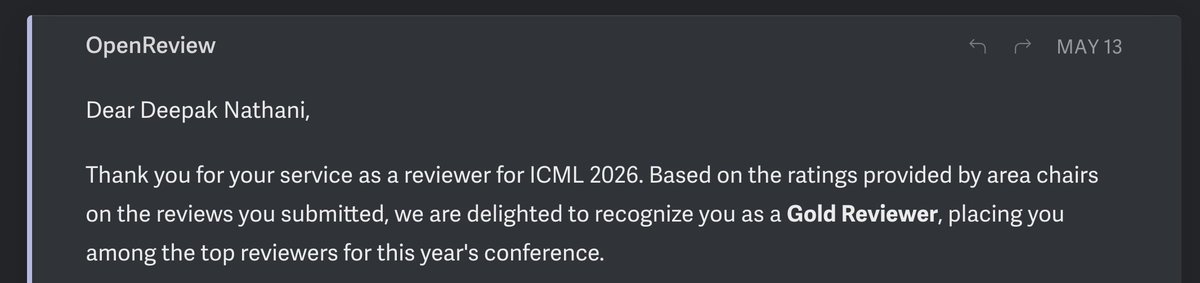
Happy to be selected as a gold reviewer for ICML 2026, thanks to area chairs and @icmlconf Now I just need to get some money for flights 🇰🇷
Deepak Nathani tweet media
English
2
0
39
2.1K