Simon Wu

1.5K posts

Simon Wu banner
Simon Wu

Simon Wu

@sim0nwu

Partner @Cathayinnov, $2.5B global venture capital firm, focused on Series A/B across consumer and enterprise

San Francisco, CA Katılım Şubat 2009
1.5K Takip Edilen810 Takipçiler
Sabitlenmiş Tweet
Simon Wu
Simon Wu@sim0nwu·
It was just 2016 when I joined with Mingpo, @denisbarrier, and the rest of @Cathayinnov to help start our next gen VC. Today, 6yrs into the journey, we partnered w/ 120+ early stage cos, w/ ~1 in 6 now a unicorn. With now $2B+ AUM, we start the next chapter, €1B Fund III 🚀
Cathay Innovation@Cathayinnov

Celebrating a huge milestone today with the launch of Fund III — a €1B global #VentureCapital fund for the #transformation of industries & society. Cathay’s @denisbarrier digs in to the vision, evolution & what we see as the next-gen VC playbook here: medium.com/cathay-innovat…

English
2
2
19
0
Hadley Harris
Hadley Harris@Hadley·
The VC fund of the future: a small number of highly experienced, high-agency people with deep trust, who are exceptional at evaluating founders and building real relationships with them. Surrounded by tons of agents.
English
78
39
523
108.7K
Jason ✨👾SaaStr.Ai✨ Lemkin
I think it could be great for sure. I love what it is trying to do Claiming an article I wrote in part from a live presentation I personally gave is 100% AI is disservice to anyone that puts in the work Even worse, the title I clearly wrote myself. That should be easy to detect as non-AI, so that’s an F.
English
1
0
6
646
Jason ✨👾SaaStr.Ai✨ Lemkin
My take on California’s “One-Time” Billionaire Tax. It’s much worse than it looks. 📉 Will it pass? Yes, likely. It only needs 50%+1 voter approval. SEIU + CTA have done this before—Prop 55 won 63% in 2016. ⚖️ Will it get tied up in litigation? Almost certainly. Retroactive wealth tax on a tax type CA has never had = due process challenges. Billionaires have the legal budgets for years of fights. 👋 But it’s clearly … only the start. The goal is an annual tax, not one-time. And the target is $25m-50m net worth folks, including illiquid foldings (early stage founders raising a Series B). The “one-time” framing is strategic, not terminal. The same coalition (CTA, CFT, SEIU) already has AB 259 written—an >annual< 1% wealth tax at a >$50M threshold<, with plans to go to $25M. It’s been introduced 3 years running. The one-time tax removes the constitutional barrier. Once that’s gone, the annual version becomes a much easier ballot measure. 🔃 CA Policy Center said: “If SEIU hopes to keep Medi-Cal spending growing, it may need to place repeated wealth taxes on the ballot—potentially lowering the threshold as billionaires flee.” The real risk for founders: At $1B, you’re taxing ~200 people. At $50M, you’re taxing 23,000 households—including most successful founders on paper before any liquidity event. The rational move isn’t to leave when you hit the threshold. It’s to leave—or never incorporate in CA—before you get anywhere close. ✈️ Net net: it will make sense to leave before the Series B. Vinod Khosla nailed it: “Even people who don’t expect this initiative to pass are still planning to leave because there will be another one.” The one-time tax is the constitutional Trojan horse. The annual tax — at a much lower threshold — is already waiting inside.
English
178
312
2.6K
801.2K
Simon Wu
Simon Wu@sim0nwu·
@pitdesi Mindshare for sure -> wonder if CB is used by more millennials and RH for Gen Z?
English
0
0
0
8
Sheel Mohnot
Sheel Mohnot@pitdesi·
Robinhood and Coinbase are direct competitors but it feels like RH has a huge advantage - you think about them for all of your financial needs, which include crypto. Hard to think of Coinbase for anything but crypto at the moment. theinformation.com/articles/robin…
Sheel Mohnot tweet media
English
34
7
280
42.5K
Simon Wu retweetledi
Alpha Partners
Alpha Partners@alphaptrs·
Hot take: by next year, no one will call themselves an “AI company.” In this clip, @sim0nwu of @Cathayinnov breaks down why the term "AI company" is already becoming meaningless; and what that means for valuations, traction, and the looming Series B crunch. 📌Listen to the full episode here: alphapartners.com/podcast/cathay… A special shoutout to our sponsor, @affinity__crm!
English
1
2
2
191
Simon Wu retweetledi
Alpha Partners
Alpha Partners@alphaptrs·
The latest Driving Alpha drop: @sim0nwu from @Cathayinnov shares what truly builds trust between founders and VCs: it’s not just the pitch deck or the metrics, it’s early engagement and shared storytelling. If you’re a founder with early traction, this is a playbook for landing strategic capital and your next customer. 📌 Full episode here:alphapartners.com/podcast/cathay… A special shoutout to our sponsor, @affinity__crm #startups #venturecapital #founders #scaling #DrivingAlpha
English
1
1
1
81
Simon Wu
Simon Wu@sim0nwu·
@atShruti Their best songs were at the end 😮‍💨
English
0
0
0
98
Simon Wu retweetledi
Alpha Partners
Alpha Partners@alphaptrs·
What if your VC could land you enterprise customers before your Series B? Most venture firms bring capital. @Cathayinnov brings contracts with global Fortune 500s. In this episode of Driving Alpha, @sim0nwu reveals how his firm helps startups scale faster by plugging them directly into a global network of corporate LPs. Simon breaks down what they look for in founders, why AI startups face a harder Series B than ever, and how to turn early traction into unstoppable scale. 🎧Watch or listen now to learn how Cathay Innovation turns corporate power into startup growth: alphapartners.com/podcast/cathay… A special shoutout to our sponsor, @affinity__crm and our host, @speedyvc!
English
1
2
2
137
Logical Intelligence
Logical Intelligence@logic_int·
We just tested Aleph prover on this version of Erdos #124 problem and were able to prove it in less that 2.5 hours and under $200 in cost: gist.github.com/winger/a2c27e4… x.com/vladtenev/stat…
Vlad Tenev@vladtenev

We are on the cusp of a profound change in the field of mathematics. Vibe proving is here. Aristotle from @HarmonicMath just proved Erdos Problem #124 in @leanprover, all by itself. This problem has been open for nearly 30 years since conjectured in the paper “Complete sequences of sets of integer powers” in the journal Acta Arithmetica. Boris Alexeev ran this problem using a beta version of Aristotle, recently updated to have stronger reasoning ability and a natural language interface. Mathematical superintelligence is getting closer by the minute, and I’m confident it will change and dramatically accelerate progress in mathematics and all dependent fields.

English
7
31
108
42K
Simon Wu
Simon Wu@sim0nwu·
@FredaDuan Could also loop in the rise of voice AI for smb services business that are charged based on call/lead.
English
0
0
0
301
Freda Duan
Freda Duan@FredaDuan·
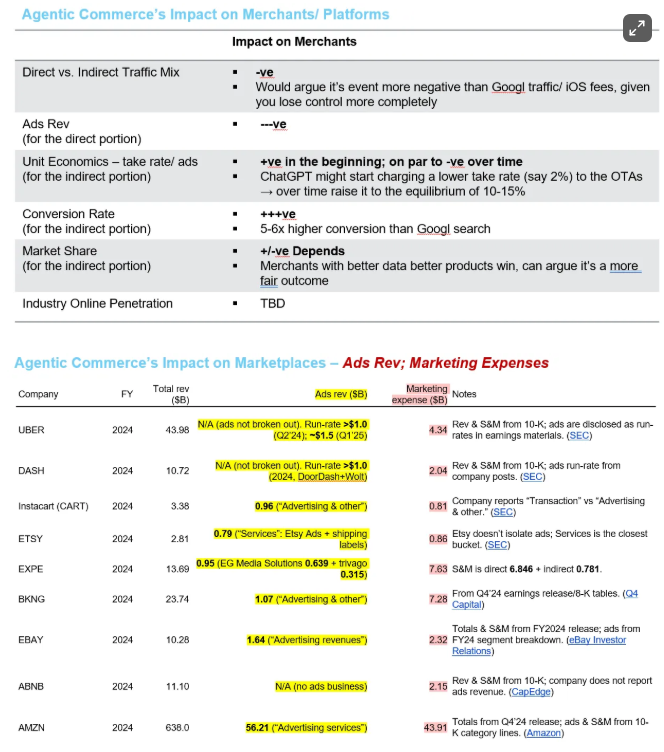
Agentic commerce's impact on merchants / platforms / Googl / payment ecosystem. The new digital tax: Convergence of ads expense (ads) & take rate (e-commerce). 1⃣ The new digital tax: Convergence of ads expense (ads) & take rate (e-commerce): This is a really interesting (and important) mental framework in consumer internet: ads expense and take rate are interchangeable forms of digital tax. Every networked economy can be viewed as charging a “take rate.” - YouTube’s "tax" is 45% on creators. - $META captures ("tax") ~99% of creator economics via ads. - $AAPL App Store: "tax" 15–30%. In the OTA example (in the quoted tweet), the effective take rate on indirect traffic is 0–5%, even though the headline rate is 15% for both direct and indirect. That means if ChatGPT were to charge $BKNG $EXPE a 10–15% take rate, they’d essentially breakeven compared with getting traffic from $GOOGL. This convergence of ads (ads expense) & e-commerce (take rate) business models has already happened in China. $PDD, $BABA, among other platforms, have all blurred the lines between ads vs. take rate when they charge merchants. It is indeed just a digital tax! How this could play out in Agentic Commerce: ChatGPT starts at a low take rate (say 2%?), then gradually raises toward equilibrium (10–15%). Whether it’s called “take rate” or “ad spend” is semantics — top-of-funnel networks always get their digital tax! 2⃣ Agentic commerce's impact on merchants & platforms: The impact on merchants comes from several different angles: - Direct vs. indirect traffic mix - For the direct traffic portion, ads rev - For the indirect traffic portion, unit economics — the “effective take rate” concept discussed above - For the indirect traffic portion, conversion rate - For the indirect traffic portion, market share - Industry online penetration — I’ve seen a lot of sell-side calling for higher online penetration driven by agentic commerce adoption. I don’t quite get that logic, but let’s see. Like Dr Strange seeing 14 million futures - most paths don’t look great for merchants / platforms - because this is further squeezing the direct channel mix %. The squeeze could be harsher than $AAPL's 30% or $Googl's CPC toll. But if agentic commerce happens, the shift is likely inevitable. In the above table: - Marketing expenses: a "swap"?. Goes to “top of the funnel”, whether that’s in the form of ads spend or take rate - Ads rev (this is only from direct traffic): a "value destruction"?. What would this number become (if agentic commerce further shifts traffic away from direct)?? 3⃣ Agentic commerce's impact on $Googl / Ads I get the bull case on $GOOGL — it has a perfect “T-shaped” value proposition: Vertically integrated across the full stack, from applications to cloud to chips; and Horizontally well-positioned across a wide range of products — productivity (Google Suite), entertainment (YouTube), and utilities (Google Home, etc.). In the end, the best model tends to win. I also understand that, so far, $GOOGL 's search ads revenue hasn’t been meaningfully affected by GPT. $GOOGL could theoretically lose 95% of its search volume and still grow revenue — as long as it retains the valuable queries, which are largely commerce-related. But whether $GOOGL 's ads model survives the agentic era intact — still TBD?. 4⃣ Agentic commerce's impact on the payment ecosystem. As agentic checkout spreads, Stripe’s role as the neutral connective tissue likely strengthens. See a separate Stripe Deep Dive. ---- Full article: Agentic Commerce | Deep Dive (II): open.substack.com/pub/robonomics…
Freda Duan tweet media
Freda Duan@FredaDuan

$Googl vs. the OTAs/marketplaces - Unit Economics of “Top of the Funnel” & the Concept of "Effective Take Rate" Roughly half of OTA's bookings and traffic are direct, and the other half indirect (mostly through $Googl). For the indirect portion, the companies basically just break even, given the high CPCs they pay $Google. Unit economics-wise: assume a $300/night hotel, a 15% take rate, CPC of $1–3, and a click-to-book conversion rate of 3–4%. That implies ~$50 in marketing expense per completed booking — essentially breakeven on indirect traffic. Direct traffic, by contrast, is gold. It’s profitable and monetizable via paid placements (ads account for ~10% of $EXPE revenue, ~5% for $BKNG; about 25% of EBITDA). $ETSY (and most marketplaces) is similar. Marketing runs ~30% of revenue - best guess is the indirect portion is barely profitable. 🔴The lesson: indirect traffic is an expensive squeeze. $GOOGL extracted more total profit from travel than all the OTAs combined - let that sink in. 🔴An important concept, "Effective Take rate": In the OTA example above, the effective take rate on indirect traffic is 0–5%, even though the headline rate is 15% for both direct and indirect. That means if ChatGPT (or if any other top of the funnel) were to charge $BKNG $EXPE a take rate (as opposed to ads rev), a 10–15% take rate = breakeven vs. getting traffic from $GOOGL. Ads expense and take rate are interchangeable forms of digital tax. We can’t really discuss agentic commerce’s impact without first understanding how $GOOGL — the OG “top of the funnel” — reshaped OTAs and other consumer internet platforms. --- Agentic Commerce | Deep Dive (II): open.substack.com/pub/robonomics…

English
6
22
129
61.1K
Raghu Raghuram
Raghu Raghuram@RaghuRaghuram·
Personal Update: Excited to join a16z. I will be working with the infrastructure investing team and growth investing team to help amazing founders build the next generation of great companies.
a16z@a16z

We are excited to welcome @RaghuRaghuram as a16z's newest General Partner.

English
76
43
1.6K
358K
Andrew Reed
Andrew Reed@andrew__reed·
POV: you’re at Workday Rising
Andrew Reed tweet mediaAndrew Reed tweet mediaAndrew Reed tweet mediaAndrew Reed tweet media
English
27
1
165
43.1K
immad
immad@immad·
@davidu Would take meeting. I need this. I do feel like there are some people already building this but no winners yet.
English
10
0
56
27.1K
immad
immad@immad·
Respond to this tweet with a startup idea. I will tell you whether I would take a investor meeting or not and why for that idea, assuming it came in from a strong warm intro. I can tell in 280 chars whether an idea is interesting to me and why. Maybe it will be useful feedback.
English
1.5K
179
4.3K
1.2M
Simon Wu
Simon Wu@sim0nwu·
@pitdesi @tjader @davidgobaud i can see it adding up for certain individuals with how you max the categories 🤣 but yeah as a category prob not worth going after.
English
0
0
2
64
Simon Wu
Simon Wu@sim0nwu·
@pitdesi @Jason Contramar 💯 I’ve gone there every time I’ve been back to cdmx.
English
0
0
0
34
Sheel Mohnot
Sheel Mohnot@pitdesi·
@Jason Polanco has a lot of fancy hotels but is boring, Roma / Condesa has better food and energy. You could stay at the Brick or Casona in Roma. Contramar: seafood El Moro: churros Rosetta: Pastries Expendio x.com/pitdesi/status…
Sheel Mohnot@pitdesi

Went to my favorite restaurant “Expendio De Maiz Sin nombre” for my bday. No menu, they just ask your dietary restrictions, go back and start cooking stuff on a fire and bring you food until you tell them to stop. Everything is corn-based, very fresh, unique and delicious.

English
8
0
28
9.8K
@jason
@jason@Jason·
1. best hotels in Mexico city 2. best food
English
160
3
245
114K
Simon Wu
Simon Wu@sim0nwu·
@saranormous the exbanker bg is just so helpful in moving things forward at these stages
English
0
0
0
804
sarah guo
sarah guo@saranormous·
tech people despise ibankers until the day they realize they really need someone smart, commercial, capable with people + numbers, who can take a lot of pain to get the job done, and then they desperately try to hire them (or ones that have been techwashed by a year in “bizops”)
English
24
23
888
122.9K